Đề thi cuối kì 2 Tiếng Anh 12 năm 2025 2026 trường THPT Xuyên Mộc – TP HCM là bộ tài liệu học thuật chuyên sâu dành cho học sinh lớp 12, được Sở GD&ĐT Thành phố Hồ Chí Minh biên soạn cho năm học 2026. Đây là mẫu đề CHK2 lớp 12 môn Tiếng Anh chất lượng nhằm mục đích khảo sát năng lực toàn diện, đồng thời hỗ trợ các em học sinh làm quen với cấu trúc bài thi thực tế. Nội dung đề thi tập trung vào các chuyên đề trọng tâm như Giáo dục nghề nghiệp, Bảo vệ môi trường, Vai trò của vườn thú và ứng dụng Công nghệ trong du lịch, giúp người học mở rộng kiến thức xã hội và kỹ năng ngôn ngữ. Thông qua việc luyện tập với đề trắc nghiệm anh văn 12 này, học sinh có cơ hội rèn luyện khả năng đọc hiểu dữ kiện, kỹ thuật chọn đáp án nhanh và củng cố tư duy phản biện để sẵn sàng cho kỳ thi chính thức.
Việc thực hành các đề ôn thi 12 và tốt nghiệp trên hệ thống dethitracnghiem.vn mang lại trải nghiệm học tập tối ưu cho học sinh lớp 12 trong giai đoạn tăng tốc năm 2026. Website cung cấp giao diện thân thiện, cho phép người dùng làm bài nhiều lần, xem đáp án chi tiết ngay sau khi nộp và dễ dàng theo dõi mức độ tiến bộ của bản thân. Điểm nổi bật của môn Tiếng Anh trên nền tảng này là các câu hỏi được phân chia khoa học từ lý thuyết cơ bản đến bài tập tình huống thực tiễn, giúp học sinh nắm vững cách ra đề và nâng cao khả năng vận dụng linh hoạt kiến thức. Nhờ đó, quá trình ôn luyện trở nên bài bản, tiết kiệm thời gian và tạo nền tảng vững chắc để các em tự tin chinh phục những mục tiêu cao hơn trong tương lai.
ĐỀ THI
LINK PDF ĐỀ THI [gồm ĐỀ THI, ĐÁP ÁN, LỜI GIẢI]:
Nội dung đề thi
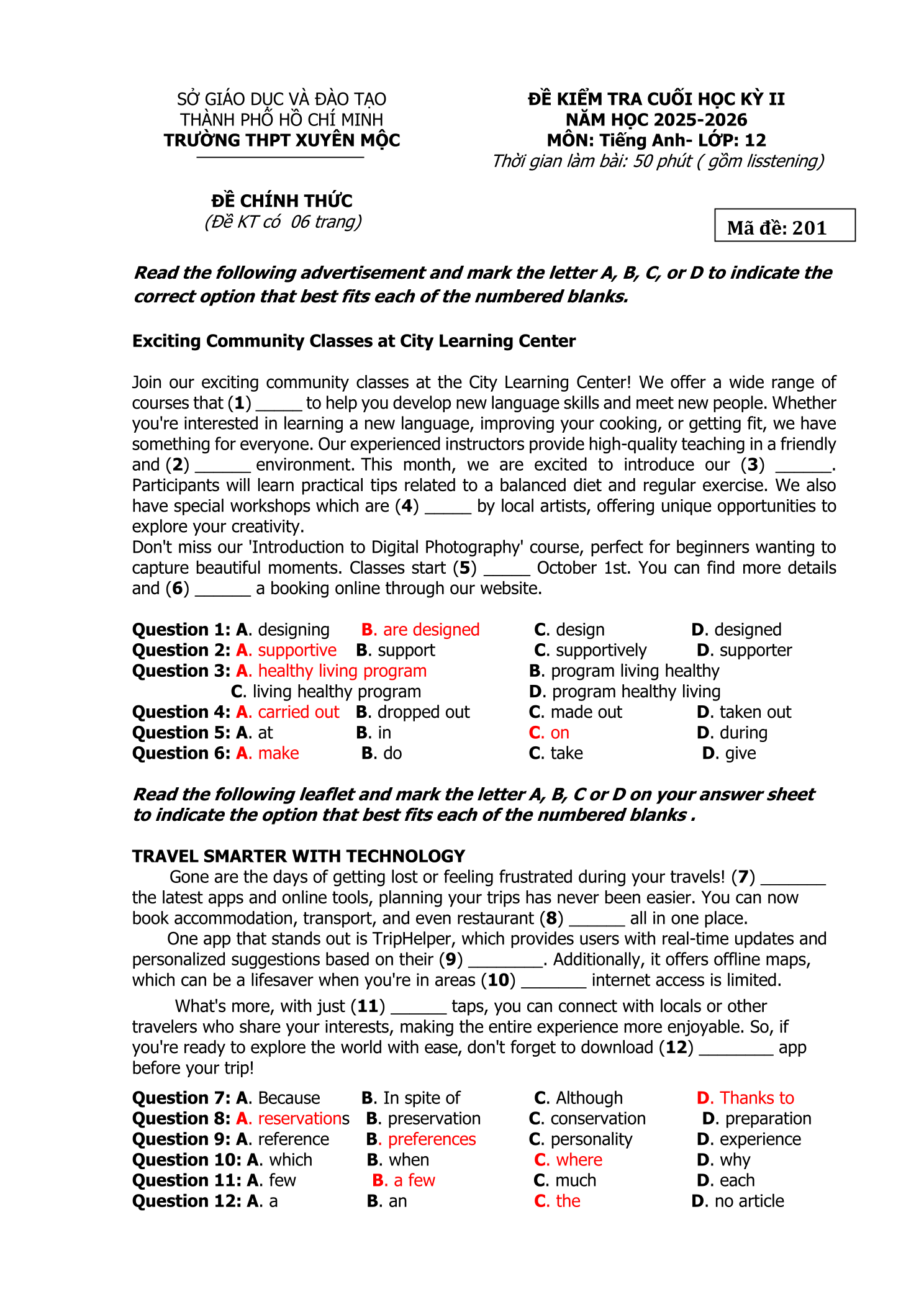
Exciting Community Classes at City Learning Center
Join our exciting community classes at the City Learning Center! We offer a wide range of courses that (1) ______ to help you develop new language skills and meet new people. Whether you’re interested in learning a new language, improving your cooking, or getting fit, we have something for everyone. Our experienced instructors provide high-quality teaching in a friendly and (2) ______ environment. This month, we are excited to introduce our (3) ______ . Participants will learn practical tips related to a balanced diet and regular exercise. We also have special workshops which are (4) ______ by local artists, offering unique opportunities to explore your creativity.
Don’t miss our ‘Introduction to Digital Photography’ course, perfect for beginners wanting to capture beautiful moments. Classes start (5) ______ October 1st. You can find more details and (6) ______ a booking online through our website.
Question 1.
A. designing
B. are designed
C. design
D. designed
Đáp án: B
Question 2.
A. supportive
B. support
C. supportively
D. supporter
Đáp án: A
Question 3.
A. healthy living program
B. program living healthy
C. living healthy program
D. program healthy living
Đáp án: A
Question 4.
A. carried out
B. dropped out
C. made out
D. taken out
Đáp án: A
Question 5.
A. at
B. in
C. on
D. during
Đáp án: C
Question 6.
A. make
B. do
C. take
D. give
Đáp án: A
Read the following leaflet and mark the letter A, B, C or D on your answer sheet to indicate the option that best fits each of the numbered blanks .
TRAVEL SMARTER WITH TECHNOLOGY
Gone are the days of getting lost or feeling frustrated during your travels! (7) ______ the latest apps and online tools, planning your trips has never been easier. You can now book accommodation, transport, and even restaurant (8) ______ all in one place.
One app that stands out is TripHelper, which provides users with real-time updates and personalized suggestions based on their (9) ______. Additionally, it offers offline maps, which can be a lifesaver when you’re in areas (10) ______ internet access is limited.
What’s more, with just (11) ______ taps, you can connect with locals or other travelers who share your interests, making the entire experience more enjoyable. So, if you’re ready to explore the world with ease, don’t forget to download (12) ______ app before your trip!
Question 7.
A. Because
B. In spite of
C. Although
D. Thanks to
Đáp án: D
Question 8.
A. reservations
B. preservation
C. conservation
D. preparation
Đáp án: A
Question 9.
A. reference
B. preferences
C. personality
D. experience
Đáp án: B
Question 10.
A. which
B. when
C. where
D. why
Đáp án: C
Question 11.
A. few
B. a few
C. much
D. each
Đáp án: B
Question 12.
A. a
B. an
C. the
D. no article
Đáp án: C
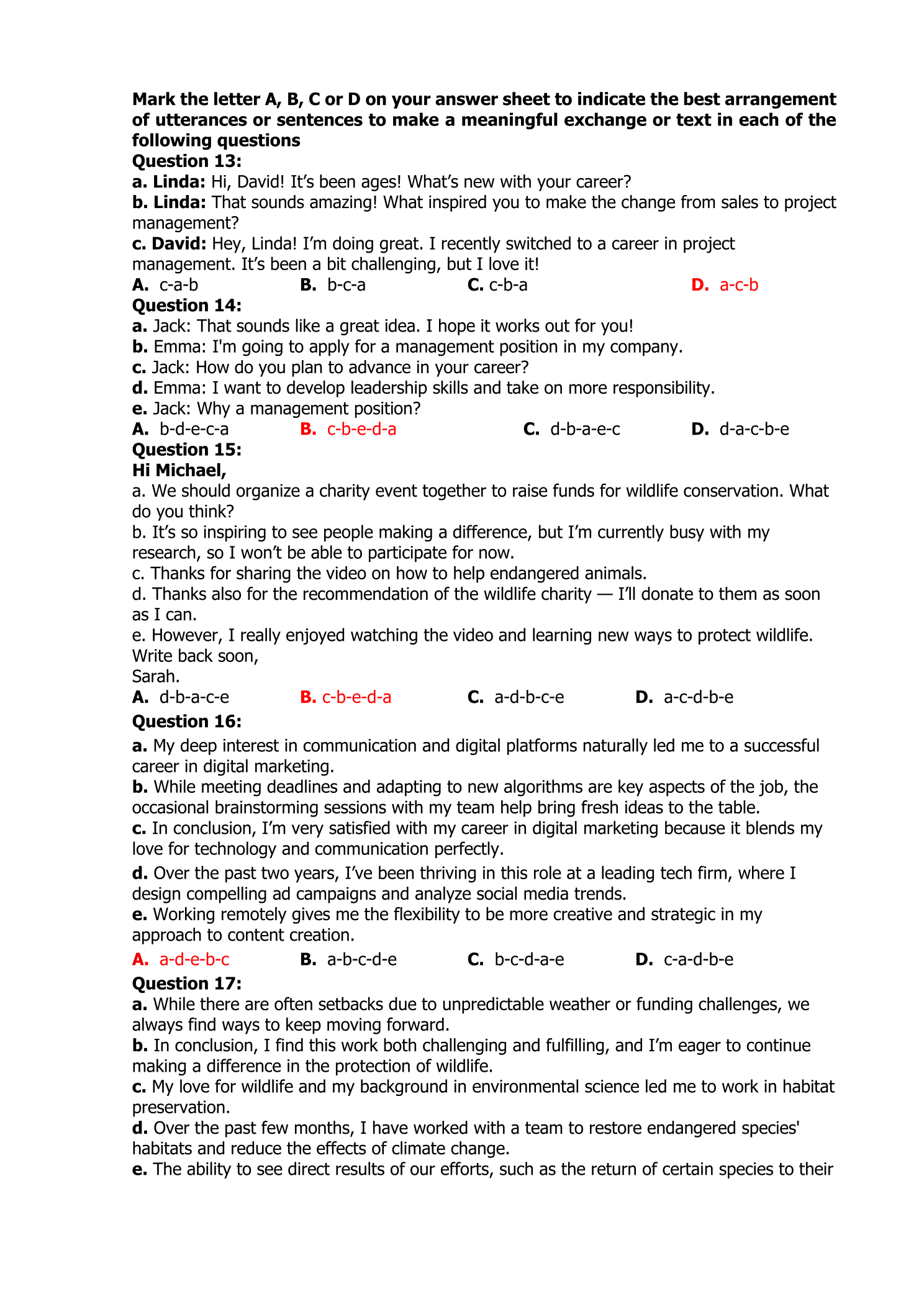
Mark the letter A, B, C or D on your answer sheet to indicate the best arrangement of utterances or sentences to make a meaningful exchange or text in each of the following questions
Question 13.
a. Linda: Hi, David! It’s been ages! What’s new with your career?
b. Linda: That sounds amazing! What inspired you to make the change from sales to project management?
c. David: Hey, Linda! I’m doing great. I recently switched to a career in project management. It’s been a bit challenging, but I love it!
A. c-a-b
B. b-c-a
C. c-b-a
D. a-c-b
Đáp án: D
Question 14.
a. Jack: That sounds like a great idea. I hope it works out for you!
b. Emma: I’m going to apply for a management position in my company.
c. Jack: How do you plan to advance in your career?
d. Emma: I want to develop leadership skills and take on more responsibility.
e. Jack: Why a management position?
A. b-d-e-c-a
B. c-b-e-d-a
C. d-b-a-e-c
D. d-a-c-b-e
Đáp án: B
Question 15.
Hi Michael,
a. We should organize a charity event together to raise funds for wildlife conservation. What do you think?
b. It’s so inspiring to see people making a difference, but I’m currently busy with my research, so I won’t be able to participate for now.
c. Thanks for sharing the video on how to help endangered animals.
d. Thanks also for the recommendation of the wildlife charity — I’ll donate to them as soon as I can.
e. However, I really enjoyed watching the video and learning new ways to protect wildlife.
Write back soon,
Sarah.
A. d-b-a-c-e
B. c-b-e-d-a
C. a-d-b-c-e
D. a-c-d-b-e
Đáp án: B
Question 16.
a. My deep interest in communication and digital platforms naturally led me to a successful career in digital marketing.
b. While meeting deadlines and adapting to new algorithms are key aspects of the job, the occasional brainstorming sessions with my team help bring fresh ideas to the table.
c. In conclusion, I’m very satisfied with my career in digital marketing because it blends my love for technology and communication perfectly.
d. Over the past two years, I’ve been thriving in this role at a leading tech firm, where I design compelling ad campaigns and analyze social media trends.
e. Working remotely gives me the flexibility to be more creative and strategic in my approach to content creation.
A. a-d-e-b-c
B. a-b-c-d-e
C. b-c-d-a-e
D. c-a-d-b-e
Đáp án: A
Question 17.
a. While there are often setbacks due to unpredictable weather or funding challenges, we always find ways to keep moving forward.
b. In conclusion, I find this work both challenging and fulfilling, and I’m eager to continue making a difference in the protection of wildlife.
c. My love for wildlife and my background in environmental science led me to work in habitat preservation.
d. Over the past few months, I have worked with a team to restore endangered species’ habitats and reduce the effects of climate change.
e. The ability to see direct results of our efforts, such as the return of certain species to their natural homes, is incredibly rewarding.
A. c-d-e-a-b
B. a-b-c-d-e
C. b-c-d-a-e
D. c-d-a-e-b
Đáp án: A
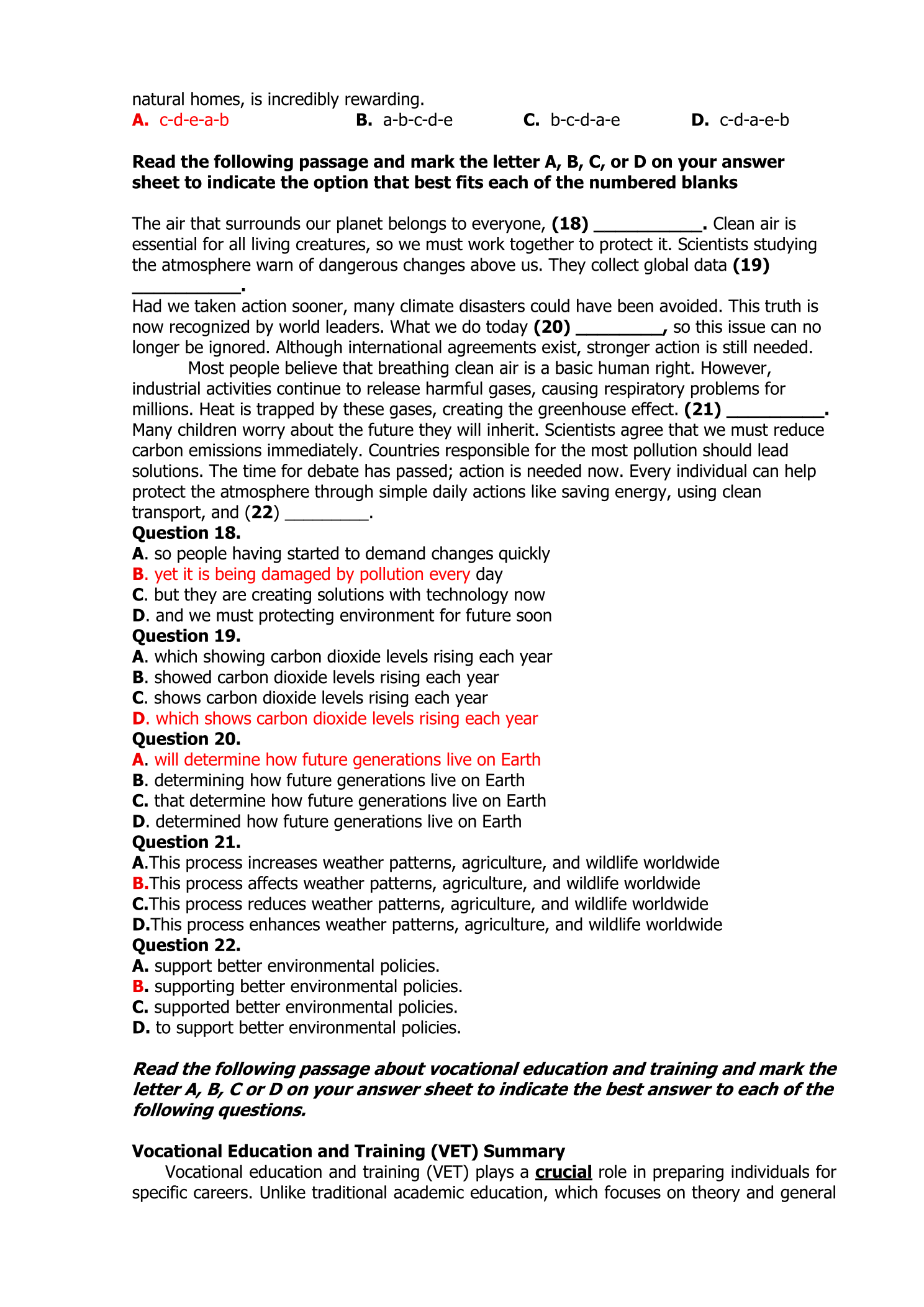
Read the following passage and mark the letter A, B, C, or D on your answer sheet to indicate the option that best fits each of the numbered blanks
The air that surrounds our planet belongs to everyone, (18) ______. Clean air is essential for all living creatures, so we must work together to protect it. Scientists studying the atmosphere warn of dangerous changes above us. They collect global data (19) ______.
Had we taken action sooner, many climate disasters could have been avoided. This truth is now recognized by world leaders. What we do today (20) ______, so this issue can no longer be ignored. Although international agreements exist, stronger action is still needed.
Most people believe that breathing clean air is a basic human right. However, industrial activities continue to release harmful gases, causing respiratory problems for millions. Heat is trapped by these gases, creating the greenhouse effect. (21) ______.
Many children worry about the future they will inherit. Scientists agree that we must reduce carbon emissions immediately. Countries responsible for the most pollution should lead solutions. The time for debate has passed; action is needed now. Every individual can help protect the atmosphere through simple daily actions like saving energy, using clean transport, and (22) ______.
Question 18.
A. so people having started to demand changes quickly
B. yet it is being damaged by pollution every day
C. but they are creating solutions with technology now
D. and we must protecting environment for future soon
Đáp án: B
Question 19.
A. which showing carbon dioxide levels rising each year
B. showed carbon dioxide levels rising each year
C. shows carbon dioxide levels rising each year
D. which shows carbon dioxide levels rising each year
Đáp án: D
Question 20.
A. will determine how future generations live on Earth
B. determining how future generations live on Earth
C. that determine how future generations live on Earth
D. determined how future generations live on Earth
Đáp án: A
Question 21.
A. This process increases weather patterns, agriculture, and wildlife worldwide
B. This process affects weather patterns, agriculture, and wildlife worldwide
C. This process reduces weather patterns, agriculture, and wildlife worldwide
D. This process enhances weather patterns, agriculture, and wildlife worldwide
Đáp án: B
Question 22.
A. support better environmental policies.
B. supporting better environmental policies.
C. supported better environmental policies.
D. to support better environmental policies.
Đáp án: B
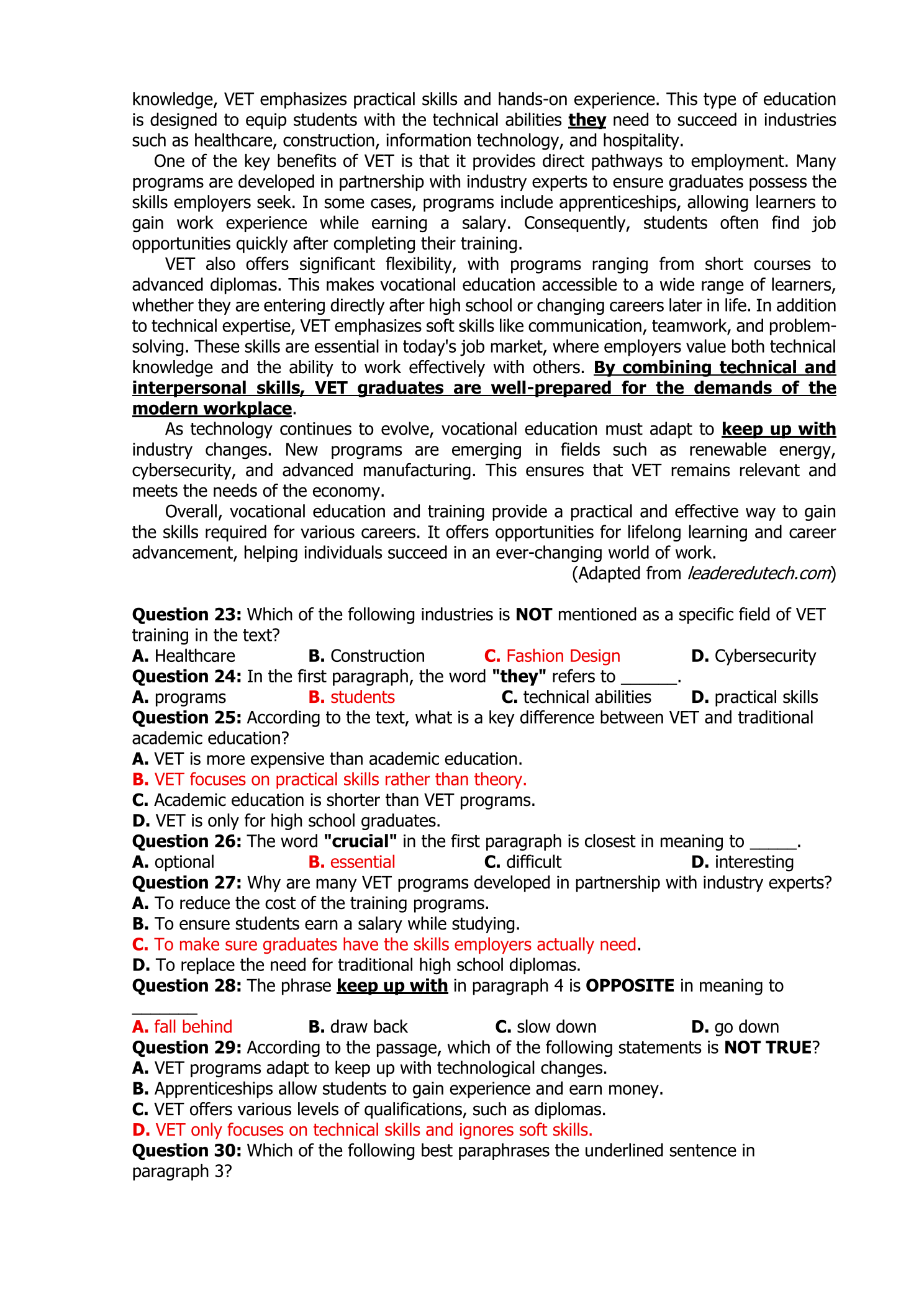
Read the following passage about vocational education and training and mark the letter A, B, C or D on your answer sheet to indicate the best answer to each of the following questions.
Vocational Education and Training (VET) Summary
Vocational education and training (VET) plays a crucial role in preparing individuals for specific careers. Unlike traditional academic education, which focuses on theory and general knowledge, VET emphasizes practical skills and hands-on experience. This type of education is designed to equip students with the technical abilities they need to succeed in industries such as healthcare, construction, information technology, and hospitality.
One of the key benefits of VET is that it provides direct pathways to employment. Many programs are developed in partnership with industry experts to ensure graduates possess the skills employers seek. In some cases, programs include apprenticeships, allowing learners to gain work experience while earning a salary. Consequently, students often find job opportunities quickly after completing their training.
VET also offers significant flexibility, with programs ranging from short courses to advanced diplomas. This makes vocational education accessible to a wide range of learners, whether they are entering directly after high school or changing careers later in life. In addition to technical expertise, VET emphasizes soft skills like communication, teamwork, and problem-solving. These skills are essential in today’s job market, where employers value both technical knowledge and the ability to work effectively with others. By combining technical and interpersonal skills, VET graduates are well-prepared for the demands of the modern workplace.
As technology continues to evolve, vocational education must adapt to keep up with industry changes. New programs are emerging in fields such as renewable energy, cybersecurity, and advanced manufacturing. This ensures that VET remains relevant and meets the needs of the economy.
Overall, vocational education and training provide a practical and effective way to gain the skills required for various careers. It offers opportunities for lifelong learning and career advancement, helping individuals succeed in an ever-changing world of work.
(Adapted from leaderedutech.com)
Question 23: Which of the following industries is NOT mentioned as a specific field of VET training in the text?
A. Healthcare
B. Construction
C. Fashion Design
D. Cybersecurity
Đáp án: C
Question 24: In the first paragraph, the word “they” refers to ______.
A. programs
B. students
C. technical abilities
D. practical skills
Đáp án: B
Question 25: According to the text, what is a key difference between VET and traditional academic education?
A. VET is more expensive than academic education.
B. VET focuses on practical skills rather than theory.
C. Academic education is shorter than VET programs.
D. VET is only for high school graduates.
Đáp án: B
Question 26: The word “crucial” in the first paragraph is closest in meaning to ______.
A. optional
B. essential
C. difficult
D. interesting
Đáp án: B
Question 27: Why are many VET programs developed in partnership with industry experts?
A. To reduce the cost of the training programs.
B. To ensure students earn a salary while studying.
C. To make sure graduates have the skills employers actually need.
D. To replace the need for traditional high school diplomas.
Đáp án: C
Question 28: The phrase keep up with in paragraph 4 is OPPOSITE in meaning to
A. fall behind
B. draw back
C. slow down
D. go down
Đáp án: A
Question 29: According to the passage, which of the following statements is NOT TRUE?
A. VET programs adapt to keep up with technological changes.
B. Apprenticeships allow students to gain experience and earn money.
C. VET offers various levels of qualifications, such as diplomas.
D. VET only focuses on technical skills and ignores soft skills.
Đáp án: D
Question 30: Which of the following best paraphrases the underlined sentence in paragraph 3?
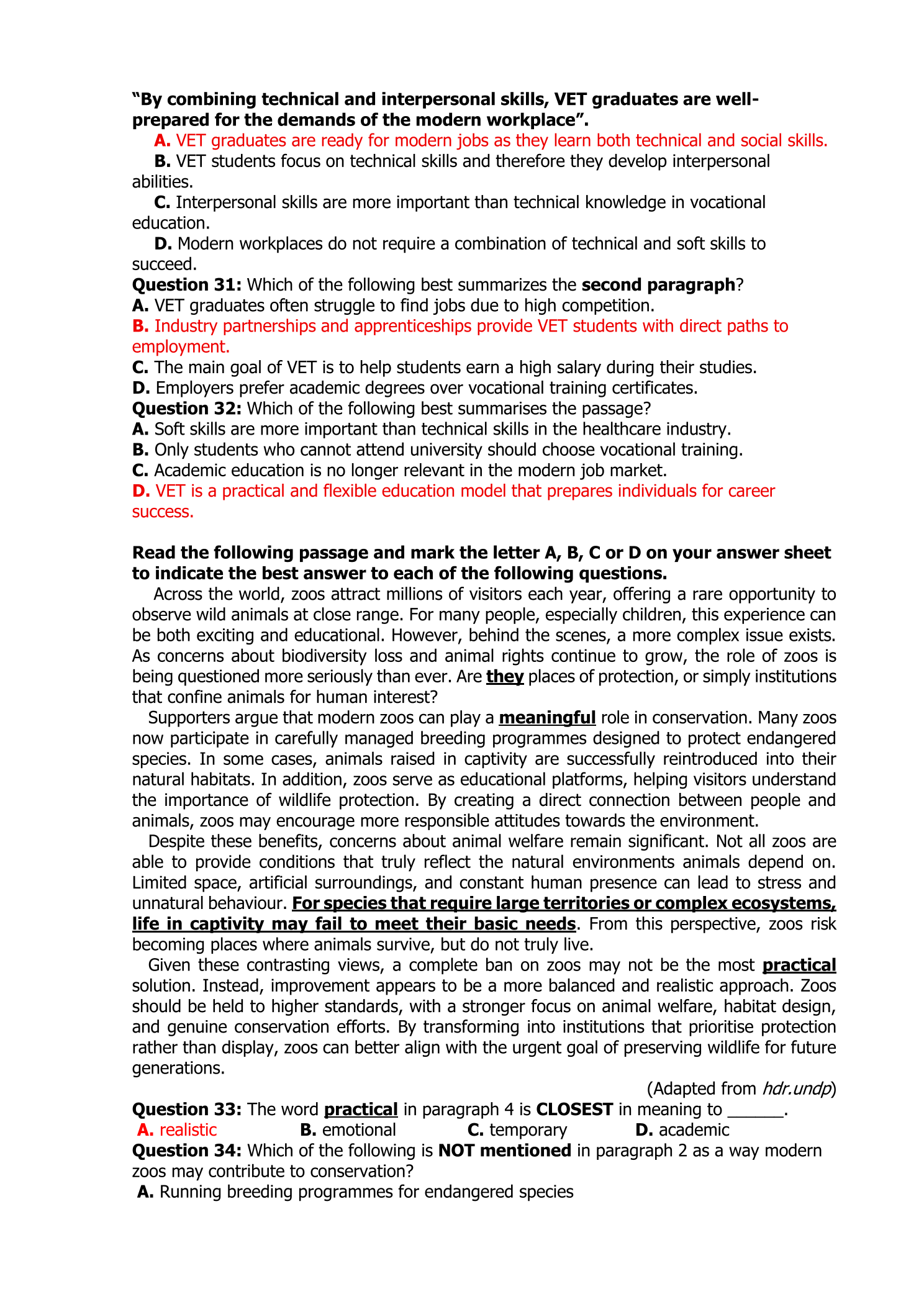
“By combining technical and interpersonal skills, VET graduates are well-prepared for the demands of the modern workplace“.
A. VET graduates are ready for modern jobs as they learn both technical and social skills.
B. VET students focus on technical skills and therefore they develop interpersonal abilities.
C. Interpersonal skills are more important than technical knowledge in vocational education.
D. Modern workplaces do not require a combination of technical and soft skills to succeed.
Đáp án: A
Question 31: Which of the following best summarizes the second paragraph?
A. VET graduates often struggle to find jobs due to high competition.
B. Industry partnerships and apprenticeships provide VET students with direct paths to employment.
C. The main goal of VET is to help students earn a high salary during their studies.
D. Employers prefer academic degrees over vocational training certificates.
Đáp án: B
Question 32: Which of the following best summarises the passage?
A. Soft skills are more important than technical skills in the healthcare industry.
B. Only students who cannot attend university should choose vocational training.
C. Academic education is no longer relevant in the modern job market.
D. VET is a practical and flexible education model that prepares individuals for career success.
Đáp án: D
Read the following passage and mark the letter A, B, C or D on your answer sheet to indicate the best answer to each of the following questions.
Across the world, zoos attract millions of visitors each year, offering a rare opportunity to observe wild animals at close range. For many people, especially children, this experience can be both exciting and educational. However, behind the scenes, a more complex issue exists. As concerns about biodiversity loss and animal rights continue to grow, the role of zoos is being questioned more seriously than ever. Are they places of protection, or simply institutions that confine animals for human interest?
Supporters argue that modern zoos can play a meaningful role in conservation. Many zoos now participate in carefully managed breeding programmes designed to protect endangered species. In some cases, animals raised in captivity are successfully reintroduced into their natural habitats. In addition, zoos serve as educational platforms, helping visitors understand the importance of wildlife protection. By creating a direct connection between people and animals, zoos may encourage more responsible attitudes towards the environment.
Despite these benefits, concerns about animal welfare remain significant. Not all zoos are able to provide conditions that truly reflect the natural environments animals depend on. Limited space, artificial surroundings, and constant human presence can lead to stress and unnatural behaviour. For species that require large territories or complex ecosystems, life in captivity may fail to meet their basic needs. From this perspective, zoos risk becoming places where animals survive, but do not truly live.
Given these contrasting views, a complete ban on zoos may not be the most practical solution. Instead, improvement appears to be a more balanced and realistic approach. Zoos should be held to higher standards, with a stronger focus on animal welfare, habitat design, and genuine conservation efforts. By transforming into institutions that prioritise protection rather than display, zoos can better align with the urgent goal of preserving wildlife for future generations.
(Adapted from hdr.undp)
Question 33: The word practical in paragraph 4 is CLOSEST in meaning to ______.
A. realistic
B. emotional
C. temporary
D. academic
Đáp án: A
Question 34: Which of the following is NOT mentioned in paragraph 2 as a way modern zoos may contribute to conservation?
A. Running breeding programmes for endangered species
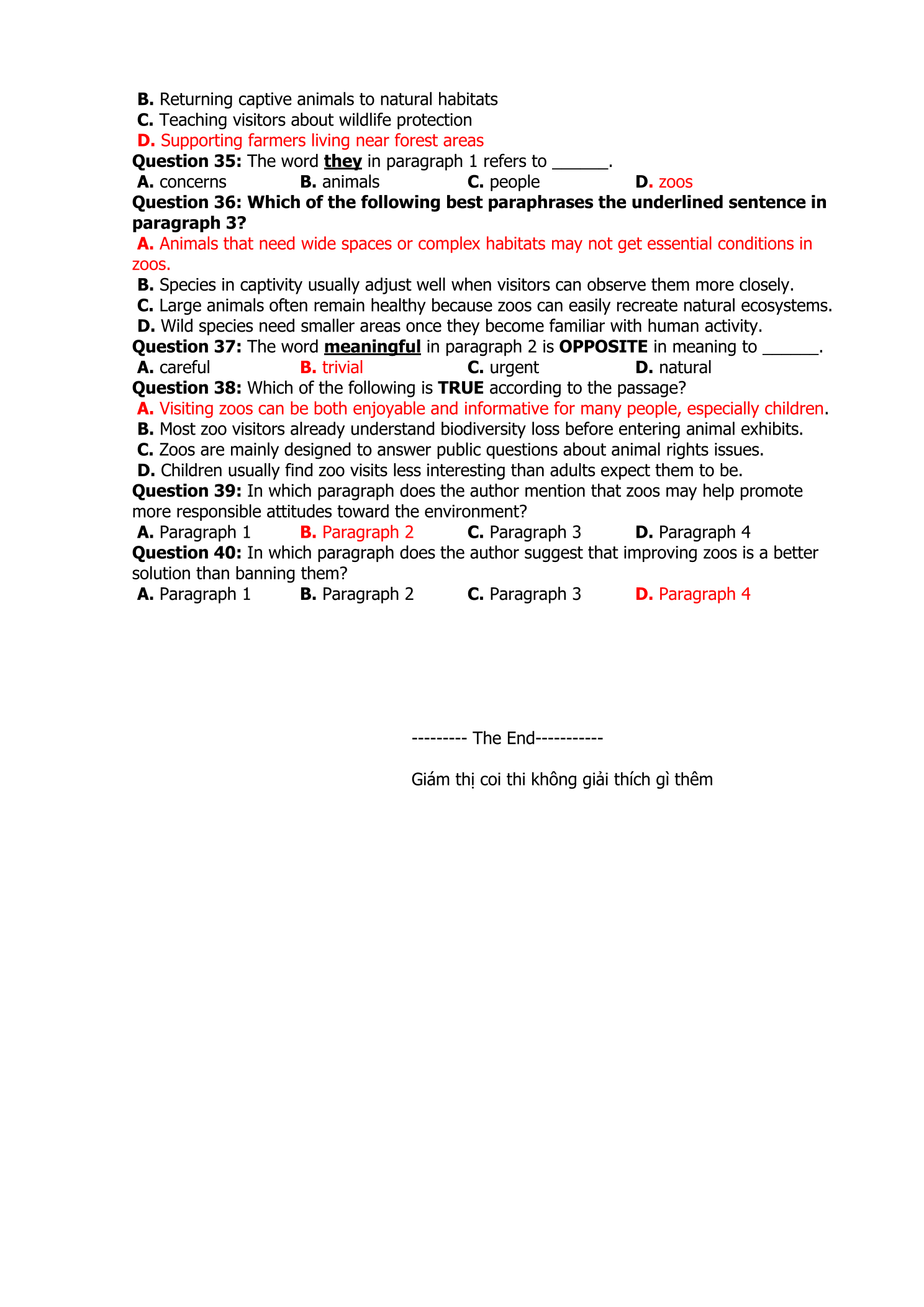
B. Returning captive animals to natural habitats
C. Teaching visitors about wildlife protection
D. Supporting farmers living near forest areas
Đáp án: D
Question 35: The word they in paragraph 1 refers to ______.
A. concerns
B. animals
C. people
D. zoos
Đáp án: D
Question 36: Which of the following best paraphrases the underlined sentence in paragraph 3?
A. Animals that need wide spaces or complex habitats may not get essential conditions in zoos.
B. Species in captivity usually adjust well when visitors can observe them more closely.
C. Large animals often remain healthy because zoos can easily recreate natural ecosystems.
D. Wild species need smaller areas once they become familiar with human activity.
Đáp án: A
Question 37: The word meaningful in paragraph 2 is OPPOSITE in meaning to ______.
A. careful
B. trivial
C. urgent
D. natural
Đáp án: B
Question 38: Which of the following is TRUE according to the passage?
A. Visiting zoos can be both enjoyable and informative for many people, especially children.
B. Most zoo visitors already understand biodiversity loss before entering animal exhibits.
C. Zoos are mainly designed to answer public questions about animal rights issues.
D. Children usually find zoo visits less interesting than adults expect them to be.
Đáp án: A
Question 39: In which paragraph does the author mention that zoos may help promote more responsible attitudes toward the environment?
A. Paragraph 1
B. Paragraph 2
C. Paragraph 3
D. Paragraph 4
Đáp án: B
Question 40: In which paragraph does the author suggest that improving zoos is a better solution than banning them?
A. Paragraph 1
B. Paragraph 2
C. Paragraph 3
D. Paragraph 4
Đáp án: D