Đề thi cuối kì 2 Tiếng Anh 12 năm 2025 2026 sở GDĐT Bắc Ninh là nguồn tư liệu học tập chính thống dành cho học sinh lớp 12, được Sở Giáo dục và Đào tạo Bắc Ninh biên soạn nhằm phục vụ công tác khảo sát chất lượng định kỳ cho năm học 2025. Đây là mẫu đề lớp 12 cuối kì 2 môn Tiếng Anh có cấu trúc chuẩn hóa, hỗ trợ các em học sinh tổng ôn kiến thức và đánh giá năng lực cá nhân trước khi bước vào kỳ thi quan trọng nhất của đời học sinh. Nội dung đề thi tập trung vào các chuyên đề trọng tâm như kỹ năng đọc hiểu thông tin qua quảng cáo và tờ rơi, kỹ thuật sắp xếp câu thành đoạn văn logic, cùng các bài đọc chuyên sâu về chủ đề sức khỏe và công nghệ hiện đại. Thông qua dạng đề trắc nghiệm tiếng anh 12 này, học sinh không chỉ được rèn luyện khả năng phân tích dữ kiện để chọn đáp án nhanh mà còn biết cách vận dụng ngôn ngữ vào thực tiễn cuộc sống.
Việc ôn luyện thông qua các bộ đề ôn thi chuyển cấp lớp 12 trên nền tảng dethitracnghiem.vn giúp học sinh lớp 12 tối ưu hóa lộ trình học tập trong giai đoạn tăng tốc năm 2025. Website sở hữu giao diện thân thiện, dễ sử dụng, cho phép người dùng làm bài nhiều lần, xem đáp án chi tiết ngay sau khi nộp và tự theo dõi mức độ tiến bộ qua từng lần thực hành. Giá trị vượt trội của các bài tập Tiếng Anh tại đây chính là hệ thống câu hỏi được phân hóa rõ ràng từ lý thuyết căn bản đến các bài tập tình huống thực tế, giúp học sinh làm quen với cách ra đề thực tế của các kỳ thi chính thức. Nhờ đó, các em có thể nâng cao khả năng vận dụng kiến thức linh hoạt, bám sát ma trận đề thi và tiết kiệm đáng kể thời gian ôn tập mà vẫn đạt hiệu quả cao nhất.
ĐỀ THI
LINK PDF ĐỀ THI [gồm ĐỀ THI, ĐÁP ÁN, LỜI GIẢI]:
Nội dung đề thi
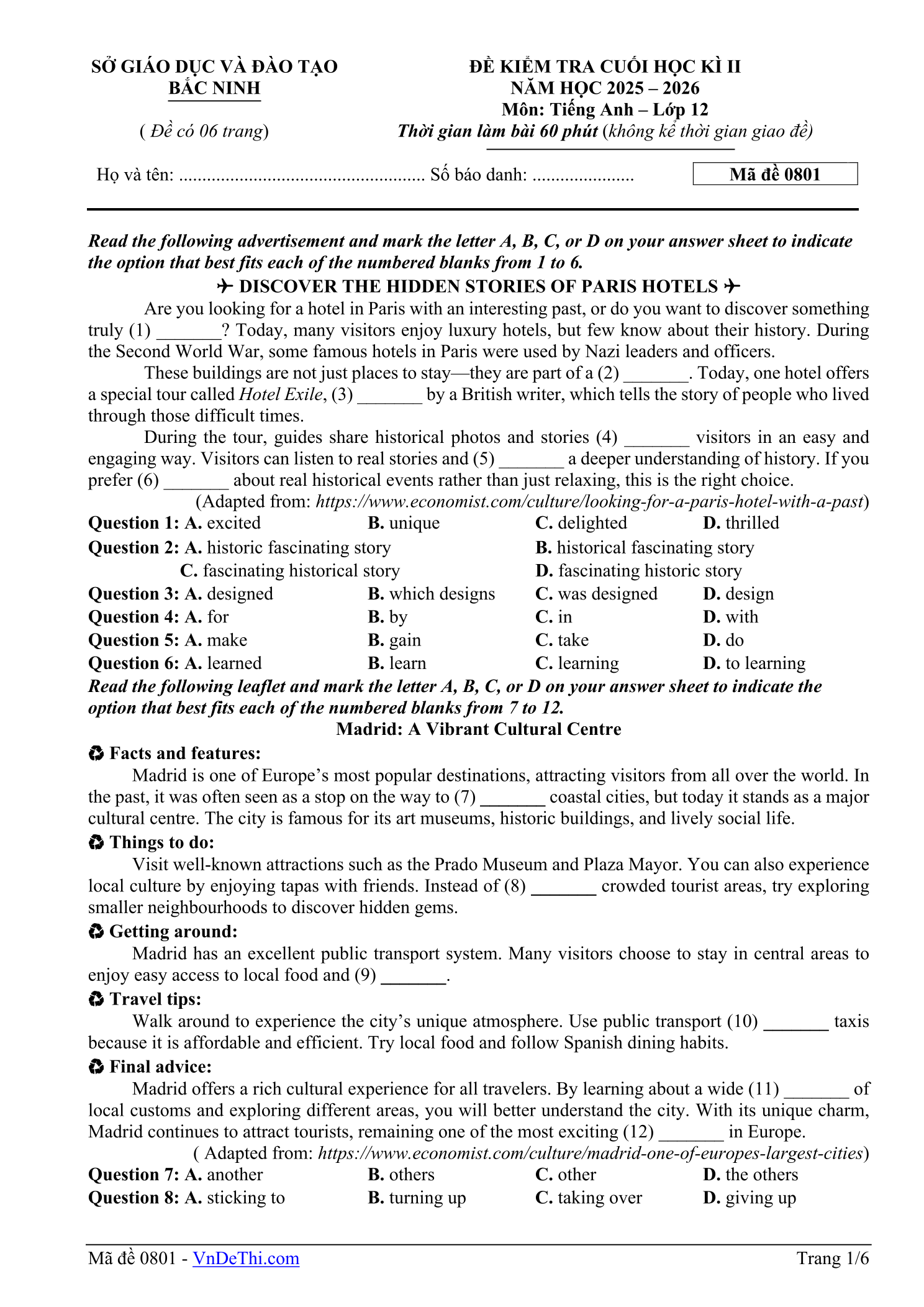
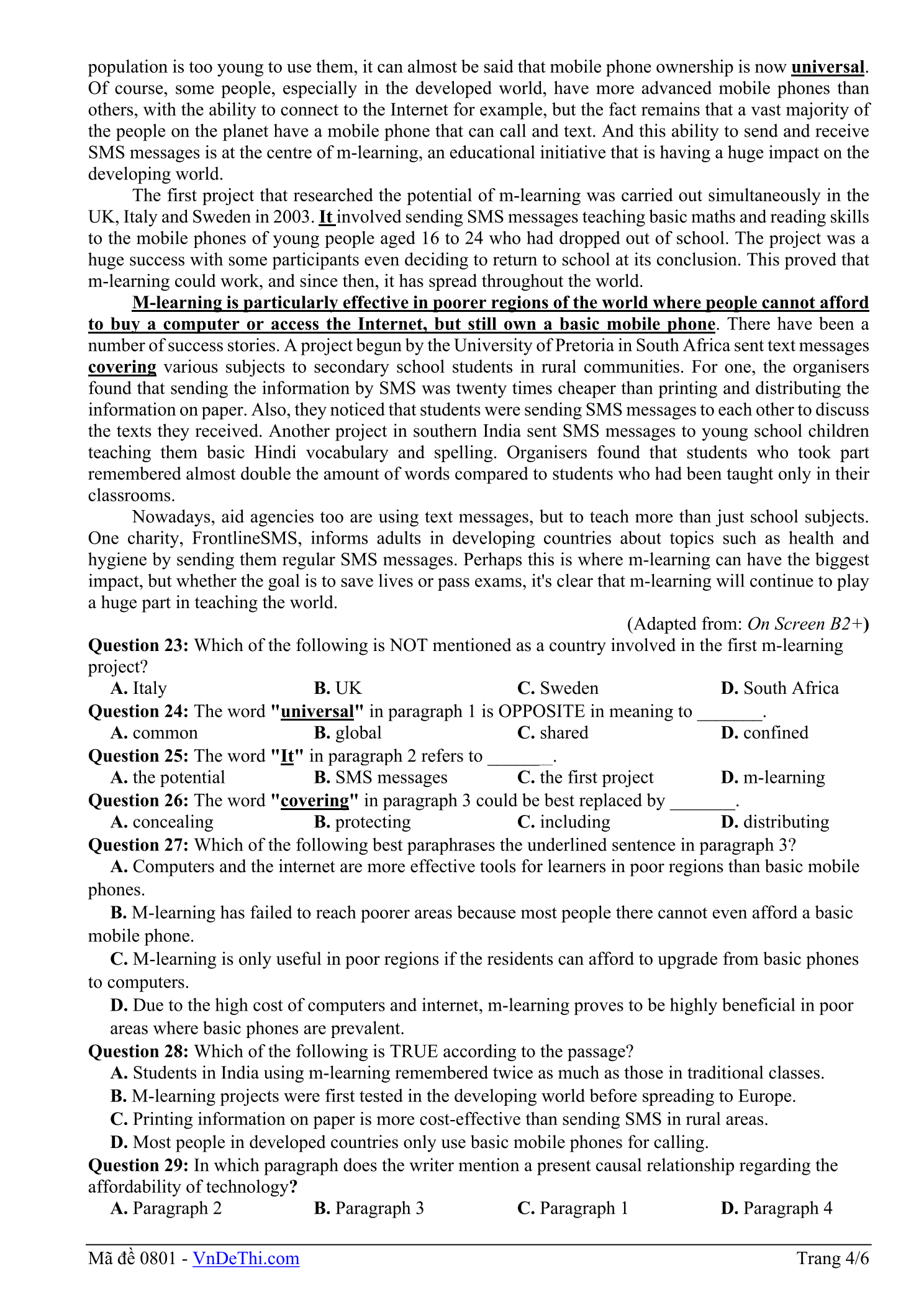
✈ DISCOVER THE HIDDEN STORIES OF PARIS HOTELS ✈
Are you looking for a hotel in Paris with an interesting past, or do you want to discover something truly (1) _______? Today, many visitors enjoy luxury hotels, but few know about their history. During the Second World War, some famous hotels in Paris were used by Nazi leaders and officers.
These buildings are not just places to stay—they are part of a (2) _______. Today, one hotel offers a special tour called Hotel Exile, (3) _______ by a British writer, which tells the story of people who lived through those difficult times.
During the tour, guides share historical photos and stories (4) _______ visitors in an easy and engaging way. Visitors can listen to real stories and (5) _______ a deeper understanding of history. If you prefer (6) _______ about real historical events rather than just relaxing, this is the right choice.
(Adapted from: https://www.economist.com/culture/looking-for-a-paris-hotel-with-a-past)
Question 1.
A. excited
B. unique
C. delighted
D. thrilled
Đáp án: B
Question 2.
A. historic fascinating story
B. historical fascinating story
C. fascinating historical story
D. fascinating historic story
Đáp án: C
Question 3.
A. designed
B. which designs
C. was designed
D. design
Đáp án: A
Question 4.
A. for
B. by
C. in
D. with
Đáp án: D
Question 5.
A. make
B. gain
C. take
D. do
Đáp án: B
Question 6.
A. learned
B. learn
C. learning
D. to learning
Đáp án: C
Read the following leaflet and mark the letter A, B, C, or D on your answer sheet to indicate the option that best fits each of the numbered blanks from 7 to 12.
Madrid: A Vibrant Cultural Centre
✪ Facts and features:
Madrid is one of Europe’s most popular destinations, attracting visitors from all over the world. In the past, it was often seen as a stop on the way to (7) _______ coastal cities, but today it stands as a major cultural centre. The city is famous for its art museums, historic buildings, and lively social life.
✪ Things to do:
Visit well-known attractions such as the Prado Museum and Plaza Mayor. You can also experience local culture by enjoying tapas with friends. Instead of (8) _______ crowded tourist areas, try exploring smaller neighbourhoods to discover hidden gems.
✪ Getting around:
Madrid has an excellent public transport system. Many visitors choose to stay in central areas to enjoy easy access to local food and (9) _______.
✪ Travel tips:
Walk around to experience the city’s unique atmosphere. Use public transport (10) _______ taxis because it is affordable and efficient. Try local food and follow Spanish dining habits.
✪ Final advice:
Madrid offers a rich cultural experience for all travelers. By learning about a wide (11) _______ of local customs and exploring different areas, you will better understand the city. With its unique charm, Madrid continues to attract tourists, remaining one of the most exciting (12) _______ in Europe.
(Adapted from: https://www.economist.com/culture/madrid-one-of-europes-largest-cities)
Question 7.
A. another
B. others
C. other
D. the others
Đáp án: C
Question 8.
A. sticking to
B. turning up
C. taking over
D. giving up
Đáp án: A
Question 9.
A. accommodation
B. infrastructure
C. security
D. delivery
Đáp án: A
Question 10.
A. instead of
B. because of
C. in spite of
D. regardless of
Đáp án: A
Question 11.
A. quantity
B. range
C. amount
D. number
Đáp án: B
Question 12.
A. establishments
B. attractions
C. venue
D. destinations
Đáp án: D
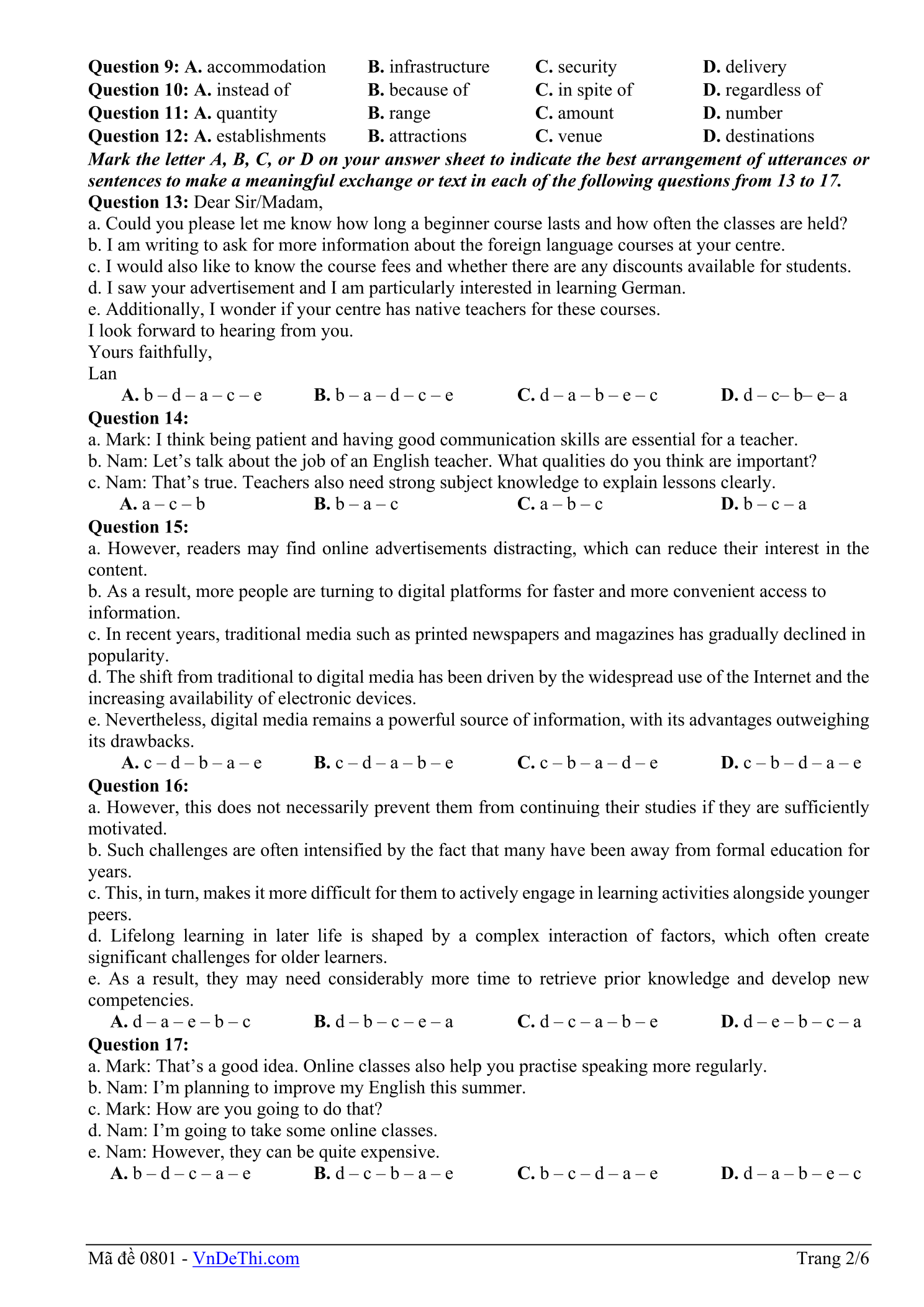
Mark the letter A, B, C, or D on your answer sheet to indicate the best arrangement of utterances or sentences to make a meaningful exchange or text in each of the following questions from 13 to 17.
Question 13.
a. Could you please let me know how long a beginner course lasts and how often the classes are held?
b. I am writing to ask for more information about the foreign language courses at your centre.
c. I would also like to know the course fees and whether there are any discounts available for students.
d. I saw your advertisement and I am particularly interested in learning German.
e. Additionally, I wonder if your centre has native teachers for these courses.
I look forward to hearing from you.
Yours faithfully,
Lan
A. b – d – a – c – e
B. b – a – d – c – e
C. d – a – b – e – c
D. d – c – b – e – a
Đáp án: A
Question 14.
a. Mark: I think being patient and having good communication skills are essential for a teacher.
b. Nam: Let’s talk about the job of an English teacher. What qualities do you think are important?
c. Nam: That’s true. Teachers also need strong subject knowledge to explain lessons clearly.
A. a – c – b
B. b – a – c
C. a – b – c
D. b – c – a
Đáp án: B
Question 15.
a. However, readers may find online advertisements distracting, which can reduce their interest in the content.
b. As a result, more people are turning to digital platforms for faster and more convenient access to information.
c. In recent years, traditional media such as printed newspapers and magazines has gradually declined in popularity.
d. The shift from traditional to digital media has been driven by the widespread use of the Internet and the increasing availability of electronic devices.
e. Nevertheless, digital media remains a powerful source of information, with its advantages outweighing its drawbacks.
A. c – d – b – a – e
B. c – d – a – b – e
C. c – b – a – d – e
D. c – b – d – a – e
Đáp án: A
Question 16.
a. However, this does not necessarily prevent them from continuing their studies if they are sufficiently motivated.
b. Such challenges are often intensified by the fact that many have been away from formal education for years.
c. This, in turn, makes it more difficult for them to actively engage in learning activities alongside younger peers.
d. Lifelong learning in later life is shaped by a complex interaction of factors, which often create significant challenges for older learners.
e. As a result, they may need considerably more time to retrieve prior knowledge and develop new competencies.
A. d – a – e – b – c
B. d – b – c – e – a
C. d – c – a – b – e
D. d – e – b – c – a
Đáp án: B
Question 17.
a. Mark: That’s a good idea. Online classes also help you practise speaking more regularly.
b. Nam: I’m planning to improve my English this summer.
c. Mark: How are you going to do that?
d. Nam: I’m going to take some online classes.
e. Nam: However, they can be quite expensive.
A. b – d – c – a – e
B. d – c – b – a – e
C. b – c – d – a – e
D. d – a – b – e – c
Đáp án: C
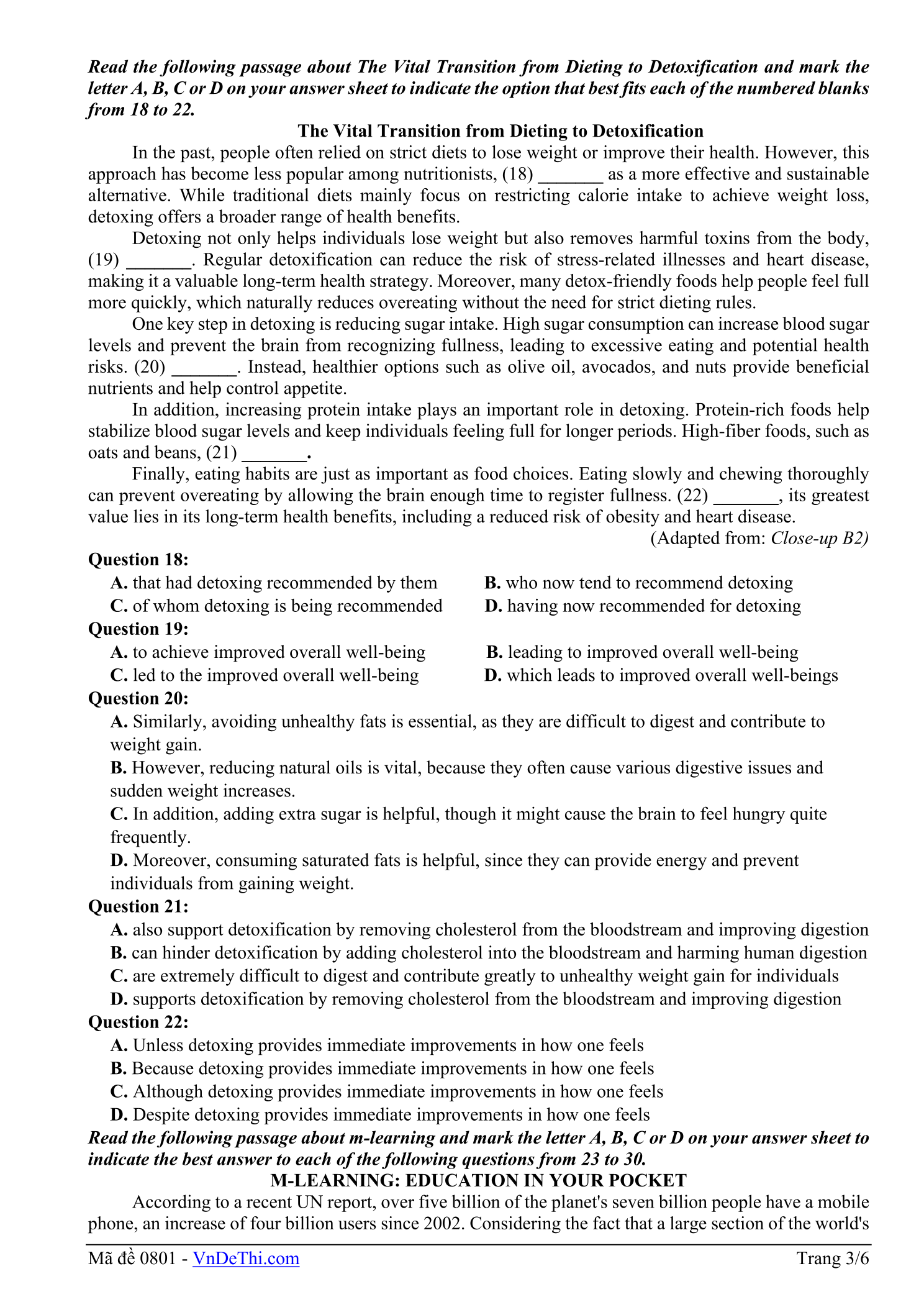
Read the following passage about The Vital Transition from Dieting to Detoxification and mark the letter A, B, C or D on your answer sheet to indicate the option that best fits each of the numbered blanks from 18 to 22.
The Vital Transition from Dieting to Detoxification
In the past, people often relied on strict diets to lose weight or improve their health. However, this approach has become less popular among nutritionists, (18) _______ as a more effective and sustainable alternative. While traditional diets mainly focus on restricting caloric intake to achieve weight loss, detoxing offers a broader range of health benefits.
Detoxing not only helps individuals lose weight but also removes harmful toxins from the body, (19) _______. Regular detoxification can reduce the risk of stress-related illnesses and heart disease, making it a valuable long-term health strategy. Moreover, many detox-friendly foods help people feel full more quickly, which naturally reduces overeating without the need for strict dieting rules.
One key step in detoxing is reducing sugar intake. High sugar consumption can increase blood sugar levels and prevent the brain from recognizing fullness, leading to excessive eating and potential health risks. (20) _______. Instead, healthier options such as olive oil, avocados, and nuts provide beneficial nutrients and help control appetite.
In addition, increasing protein intake plays an important role in detoxing. Protein-rich foods help stabilize blood sugar levels and keep individuals feeling full for longer periods. High-fiber foods, such as oats and beans, (21) _______.
Finally, eating habits are just as important as food choices. Eating slowly and chewing thoroughly can prevent overeating by allowing the brain enough time to register fullness. (22) _______, its greatest value lies in its long-term health benefits, including a reduced risk of obesity and heart disease.
(Adapted from: Close-up B2)
Question 18:
A. that had detoxing recommended by them
B. who now tend to recommend detoxing
C. of whom detoxing is being recommended
D. having now recommended for detoxing
Đáp án: B
Question 19:
A. to achieve improved overall well-being
B. leading to improved overall well-being
C. led to the improved overall well-being
D. which leads to improved overall well-beings
Đáp án: B
Question 20:
A. Similarly, avoiding unhealthy fats is essential, as they are difficult to digest and contribute to weight gain.
B. However, reducing natural oils is vital, because they often cause various digestive issues and sudden weight increases.
C. In addition, adding extra sugar is helpful, though it might cause the brain to feel hungry quite frequently.
D. Moreover, consuming saturated fats is helpful, since they can provide energy and prevent individuals from gaining weight.
Đáp án: A
Question 21:
A. also support detoxification by removing cholesterol from the bloodstream and improving digestion
B. can hinder detoxification by adding cholesterol into the bloodstream and harming human digestion
C. are extremely difficult to digest and contribute greatly to unhealthy weight gain for individuals
D. supports detoxification by removing cholesterol from the bloodstream and improving digestion
Đáp án: A
Question 22:
A. Unless detoxing provides immediate improvements in how one feels
B. Because detoxing provides immediate improvements in how one feels
C. Although detoxing provides immediate improvements in how one feels
D. Despite detoxing provides immediate improvements in how one feels
Đáp án: C
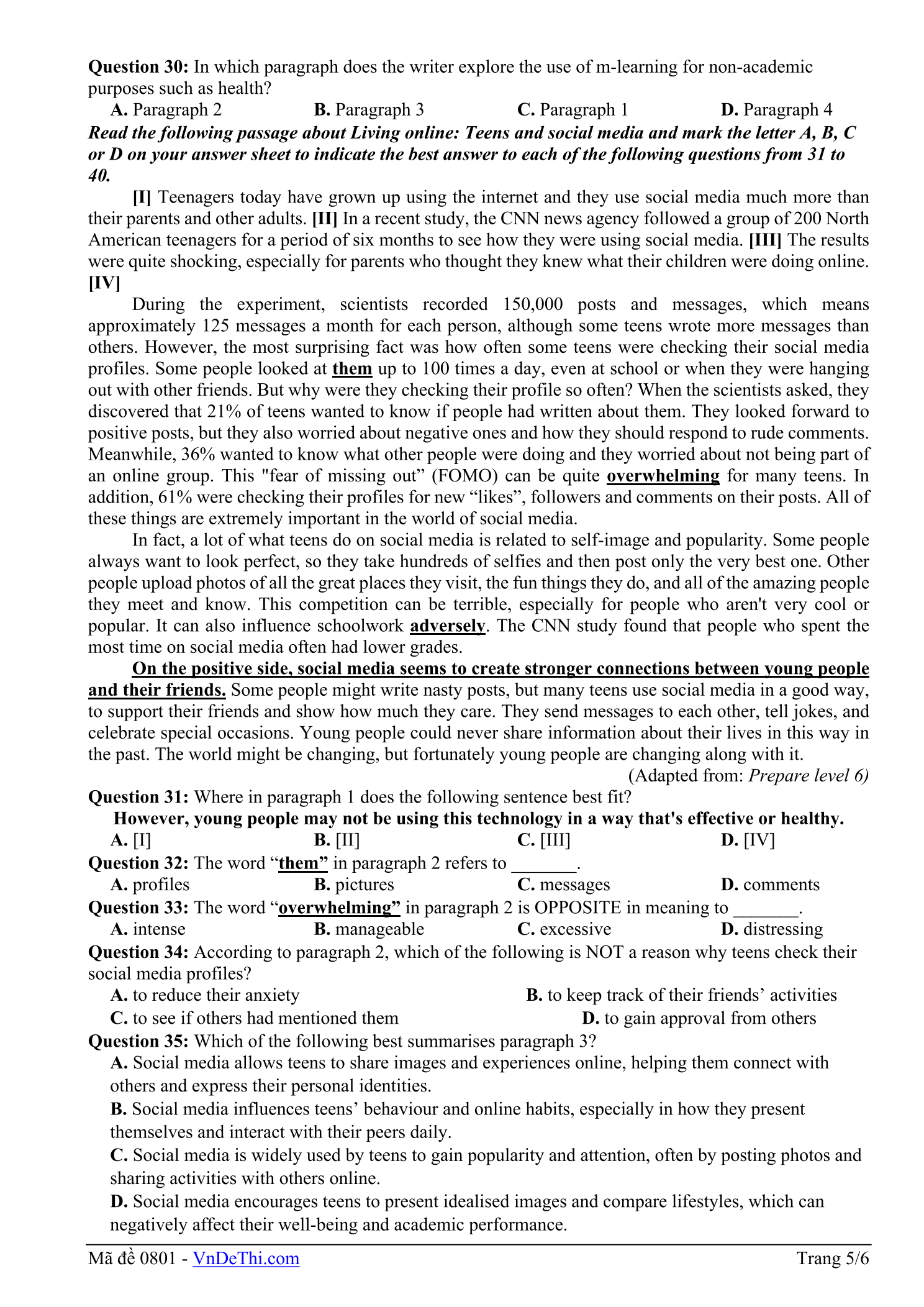
Read the following passage about m-learning and mark the letter A, B, C or D on your answer sheet to indicate the best answer to each of the following questions from 23 to 30.
M-LEARNING: EDUCATION IN YOUR POCKET
According to a recent UN report, over five billion of the planet’s seven billion people have a mobile phone, an increase of four billion users since 2002. Considering the fact that a large section of the world’s population is too young to use them, it can almost be said that mobile phone ownership is now universal. Of course, some people, especially in the developed world, have more advanced mobile phones than others, with the ability to connect to the Internet for example, but the fact remains that a vast majority of the people on the planet have a mobile phone that can call and text. And this ability to send and receive SMS messages is at the centre of m-learning, an educational initiative that is having a huge impact on the developing world.
The first project that researched the potential of m-learning was carried out simultaneously in the UK, Italy and Sweden in 2003. It involved sending SMS messages teaching basic maths and reading skills to the mobile phones of young people aged 16 to 24 who had dropped out of school. The project was a huge success with some participants even deciding to return to school at its conclusion. This proved that m-learning could work, and since then, it has spread throughout the world.
M-learning is particularly effective in poorer regions of the world where people cannot afford to buy a computer or access the Internet, but still own a basic mobile phone. There have been a number of success stories. A project begun by the University of Pretoria in South Africa sent text messages covering various subjects to secondary school students in rural communities. For one, the organisers found that sending the information by SMS was twenty times cheaper than printing and distributing the information on paper. Also, they noticed that students were sending SMS messages to each other to discuss the texts they received. Another project in southern India sent SMS messages to young school children teaching them basic Hindi vocabulary and spelling. Organisers found that students who took part remembered almost double the amount of words compared to students who had been taught only in their classrooms.
Nowadays, aid agencies too are using text messages, but to teach more than just school subjects. One charity, FrontlineSMS, informs adults in developing countries about topics such as health and hygiene by sending them regular SMS messages. Perhaps this is where m-learning can have the biggest impact, but whether the goal is to save lives or pass exams, it’s clear that m-learning will continue to play a huge part in teaching the world.
(Adapted from: On Screen B2+)
Question 23: Which of the following is NOT mentioned as a country involved in the first m-learning project?
A. Italy
B. UK
C. Sweden
D. South Africa
Đáp án: D
Question 24: The word “universal” in paragraph 1 is OPPOSITE in meaning to _______.
A. common
B. global
C. shared
D. confined
Đáp án: D
Question 25: The word “It” in paragraph 2 refers to _______.
A. the potential
B. SMS messages
C. the first project
D. m-learning
Đáp án: C
Question 26: The word “covering” in paragraph 3 could be best replaced by _______.
A. concealing
B. protecting
C. including
D. distributing
Đáp án: C
Question 27: Which of the following best paraphrases the underlined sentence in paragraph 3?
A. Computers and the internet are more effective tools for learners in poor regions than basic mobile phones.
B. M-learning has failed to reach poorer areas because most people there cannot even afford a basic mobile phone.
C. M-learning is only useful in poor regions if the residents can afford to upgrade from basic phones to computers.
D. Due to the high cost of computers and internet, m-learning proves to be highly beneficial in poor areas where basic phones are prevalent.
Đáp án: D
Question 28: Which of the following is TRUE according to the passage?
A. Students in India using m-learning remembered twice as much as those in traditional classes.
B. M-learning projects were first tested in the developing world before spreading to Europe.
C. Printing information on paper is more cost-effective than sending SMS in rural areas.
D. Most people in developed countries only use basic mobile phones for calling.
Đáp án: A
Question 29: In which paragraph does the writer mention a present causal relationship regarding the affordability of technology?
A. Paragraph 2
B. Paragraph 3
C. Paragraph 1
D. Paragraph 4
Đáp án: B
Question 30: In which paragraph does the writer explore the use of m-learning for non-academic purposes such as health?
A. Paragraph 2
B. Paragraph 3
C. Paragraph 1
D. Paragraph 4
Đáp án: D
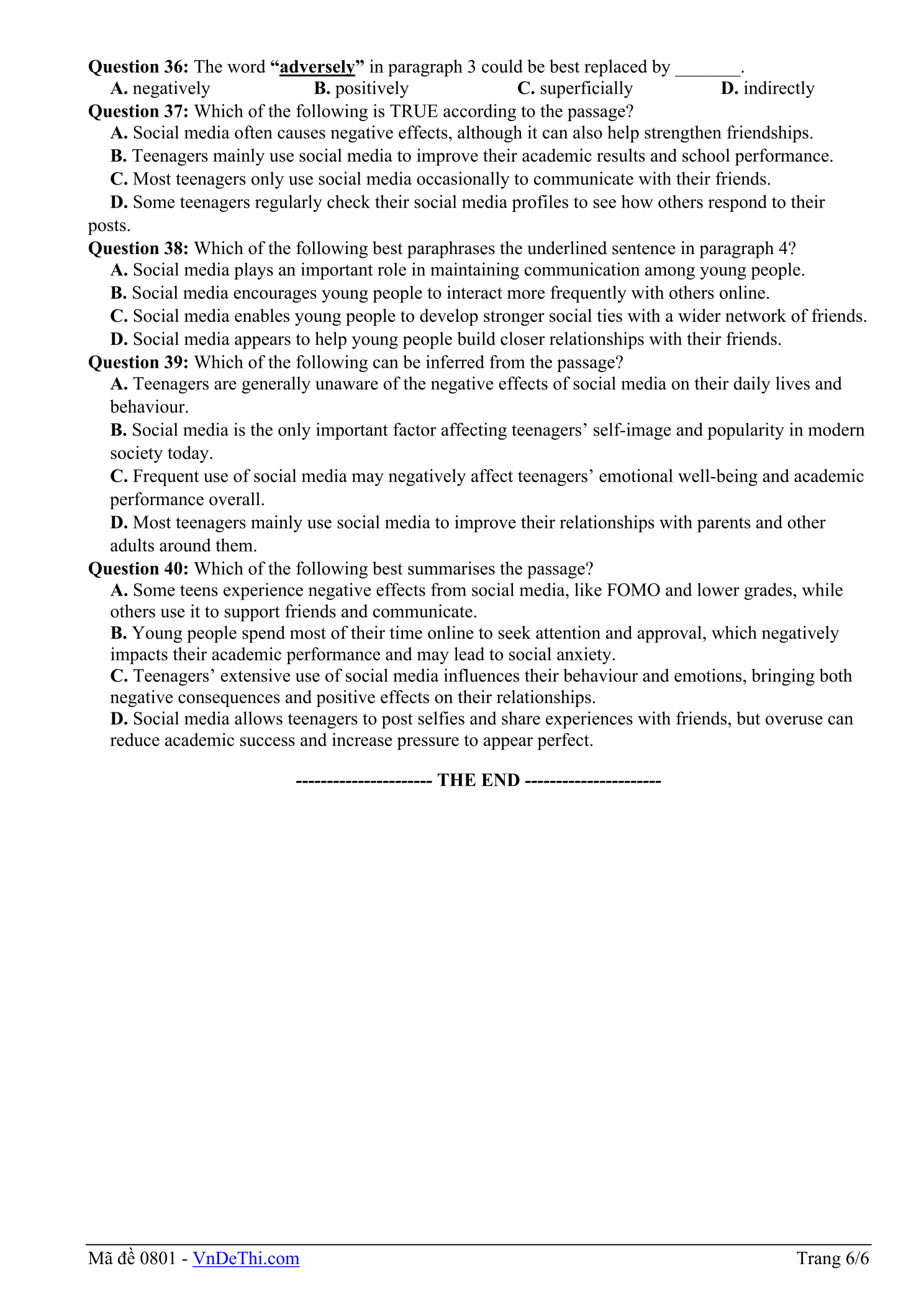
Read the following passage about Living online: Teens and social media and mark the letter A, B, C or D on your answer sheet to indicate the best answer to each of the following questions from 31 to 40.
[I] Teenagers today have grown up using the internet and they use social media much more than their parents and other adults. [II] In a recent study, the CNN news agency followed a group of 200 North American teenagers for a period of six months to see how they were using social media. [III] The results were quite shocking, especially for parents who thought they knew what their children were doing online. [IV]
During the experiment, scientists recorded 150,000 posts and messages, which means approximately 125 messages a month for each person, although some teens wrote more messages than others. However, the most surprising fact was how often some teens were checking their social media profiles. Some people looked at them up to 100 times a day, even at school or when they were hanging out with other friends. But why were they checking their profile so often? When the scientists asked, they discovered that 21% of teens wanted to know if people had written about them. They looked forward to positive posts, but they also worried about negative ones and how they should respond to rude comments. Meanwhile, 36% wanted to know what other people were doing and they worried about not being part of an online group. This “fear of missing out” (FOMO) can be quite overwhelming for many teens. In addition, 61% were checking their profiles for new “likes”, followers and comments on their posts. All of these things are extremely important in the world of social media.
In fact, a lot of what teens do on social media is related to self-image and popularity. Some people always want to look perfect, so they take hundreds of selfies and then post only the very best one. Other people upload photos of all the great places they visit, the fun things they do, and all of the amazing people they meet and know. This competition can be terrible, especially for people who aren’t very cool or popular. It can also influence schoolwork adversely. The CNN study found that people who spent the most time on social media often had lower grades.
On the positive side, social media seems to create stronger connections between young people and their friends. Some people might write nasty posts, but many teens use social media in a good way, to support their friends and show how much they care. They send messages to each other, tell jokes, and celebrate special occasions. Young people could never share information about their lives in this way in the past. The world might be changing, but fortunately young people are changing along with it.
(Adapted from: Prepare level 6)
Question 31: Where in paragraph 1 does the following sentence best fit?
However, young people may not be using this technology in a way that’s effective or healthy.
A. [I]
B. [II]
C. [III]
D. [IV]
Đáp án: B
Question 32: The word “them” in paragraph 2 refers to _______.
A. profiles
B. pictures
C. messages
D. comments
Đáp án: A
Question 33: The word “overwhelming” in paragraph 2 is OPPOSITE in meaning to _______.
A. intense
B. manageable
C. excessive
D. distressing
Đáp án: B
Question 34: According to paragraph 2, which of the following is NOT a reason why teens check their social media profiles?
A. to reduce their anxiety
B. to keep track of their friends’ activities
C. to see if others had mentioned them
D. to gain approval from others
Đáp án: A
Question 35: Which of the following best summarises paragraph 3?
A. Social media allows teens to share images and experiences online, helping them connect with others and express their personal identities.
B. Social media influences teens’ behaviour and online habits, especially in how they present themselves and interact with their peers daily.
C. Social media is widely used by teens to gain popularity and attention, often by posting photos and sharing activities with others online.
D. Social media encourages teens to present idealised images and compare lifestyles, which can negatively affect their well-being and academic performance.
Đáp án: D
Question 36: The word “adversely” in paragraph 3 could be best replaced by _______.
A. negatively
B. positively
C. superficially
D. indirectly
Đáp án: A
Question 37: Which of the following is TRUE according to the passage?
A. Social media often causes negative effects, although it can also help strengthen friendships.
B. Teenagers mainly use social media to improve their academic results and school performance.
C. Most teenagers only use social media occasionally to communicate with their friends.
D. Some teenagers regularly check their social media profiles to see how others respond to their posts.
Đáp án: D
Question 38: Which of the following best paraphrases the underlined sentence in paragraph 4?
A. Social media plays an important role in maintaining communication among young people.
B. Social media encourages young people to interact more frequently with others online.
C. Social media enables young people to develop stronger social ties with a wider network of friends.
D. Social media appears to help young people build closer relationships with their friends.
Đáp án: D
Question 39: Which of the following can be inferred from the passage?
A. Teenagers are generally unaware of the negative effects of social media on their daily lives and behaviour.
B. Social media is the only important factor affecting teenagers’ self-image and popularity in modern society today.
C. Frequent use of social media may negatively affect teenagers’ emotional well-being and academic performance overall.
D. Most teenagers mainly use social media to improve their relationships with parents and other adults around them.
Đáp án: C
Question 40: Which of the following best summarises the passage?
A. Some teens experience negative effects from social media, like FOMO and lower grades, while others use it to support friends and communicate.
B. Young people spend most of their time online to seek attention and approval, which negatively impacts their academic performance and may lead to social anxiety.
C. Teenagers’ extensive use of social media influences their behaviour and emotions, bringing both negative consequences and positive effects on their relationships.
D. Social media allows teenagers to post selfies and share experiences with friends, but overuse can reduce academic success and increase pressure to appear perfect.
Đáp án: C