Đề thi cuối kì 2 Tiếng Anh 11 năm 2025 2026 trường THPT Xuyên Mộc – TPHCM là tài liệu ôn tập chất lượng dành cho học sinh lớp 11, được trường THPT Xuyên Mộc – TPHCM biên soạn cho năm học 2025 – 2026 nhằm phục vụ công tác kiểm tra, đánh giá kết quả học tập cuối học kỳ và hỗ trợ học sinh hệ thống hóa kiến thức theo chương trình giáo dục phổ thông mới. Nội dung đề thi bám sát chương trình Tiếng Anh 11 với các chuyên đề trọng tâm của học kỳ II như từ vựng, ngữ pháp theo từng chủ đề, kỹ năng nghe hiểu, đọc hiểu, giao tiếp, viết đoạn văn và vận dụng ngôn ngữ trong các tình huống thực tế. Hệ thống câu hỏi được xây dựng từ mức độ nhận biết đến vận dụng cao, giúp học sinh rèn luyện kỹ năng đọc hiểu, phân tích ngữ cảnh, lựa chọn đáp án chính xác và nâng cao hiệu quả làm bài trong các dạng đề cuối kì 2 môn Tiếng Anh lớp 11. Đồng thời, đây cũng là nguồn tài liệu tham khảo hữu ích với nhiều dạng đề Tiếng Anh 11 giúp học sinh củng cố kiến thức, phát triển toàn diện các kỹ năng ngôn ngữ và chuẩn bị tốt cho các kỳ kiểm tra quan trọng.
Tại dethitracnghiem.vn, học sinh có thể trải nghiệm hệ thống luyện đề trực tuyến hiện đại với giao diện thân thiện, dễ sử dụng và hỗ trợ làm bài nhiều lần không giới hạn. Sau mỗi lần hoàn thành bài thi, hệ thống sẽ cung cấp đáp án chi tiết, thống kê kết quả và giúp người học theo dõi quá trình tiến bộ qua từng lần luyện tập. Kho câu hỏi được xây dựng từ kiến thức cơ bản đến các dạng bài vận dụng thực tiễn, đáp ứng nhu cầu ôn tập của học sinh lớp 11 trong năm học 2025 – 2026. Việc thường xuyên luyện tập với các dạng đề ôn thi lớp 11 sẽ giúp học sinh làm quen với cấu trúc đề thi mới, nâng cao khả năng sử dụng tiếng Anh, phát triển phản xạ ngôn ngữ và tối ưu hiệu quả ôn luyện.
ĐỀ THI
LINK PDF ĐỀ THI [gồm ĐỀ THI, ĐÁP ÁN, LỜI GIẢI]:
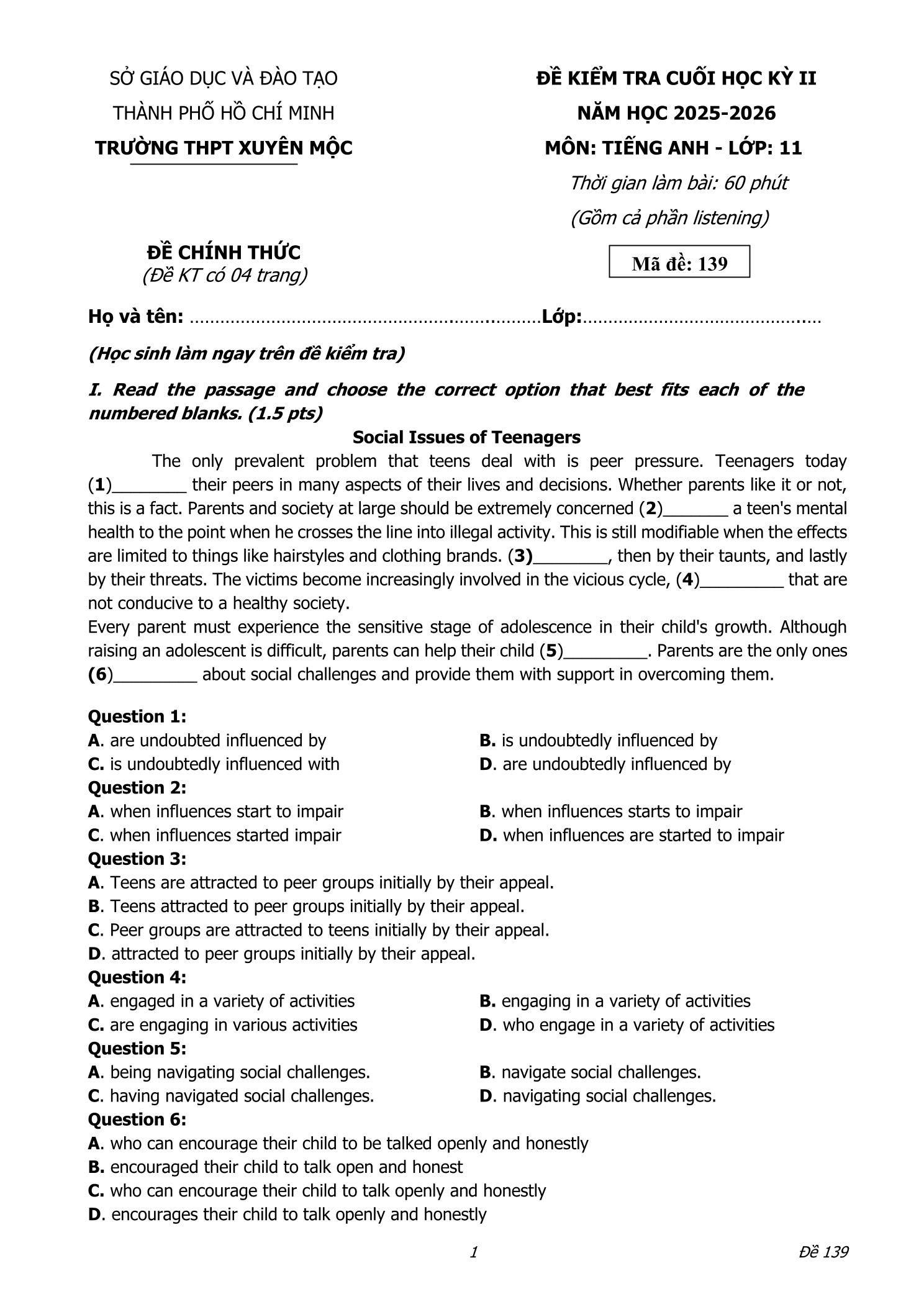
Social Issues of Teenagers
The only prevalent problem that teens deal with is peer pressure. Teenagers today (1)_______ their peers in many aspects of their lives and decisions. Whether parents like it or not, this is a fact. Parents and society at large should be extremely concerned (2)_______ a teen’s mental health to the point when he crosses the line into illegal activity. This is still modifiable when the effects are limited to things like hairstyles and clothing brands. (3)_______, then by their taunts, and lastly by their threats. The victims become increasingly involved in the vicious cycle, (4)_______ that are not conducive to a healthy society.
Every parent must experience the sensitive stage of adolescence in their child’s growth. Although raising an adolescent is difficult, parents can help their child (5)_______. Parents are the only ones (6)_______ about social challenges and provide them with support in overcoming them.
Question 1:
A. are undoubted influenced by
B. is undoubtedly influenced by
C. is undoubtedly influenced with
D. are undoubtedly influenced by
Đáp án: B
Question 2:
A. when influences start to impair
B. when influences starts to impair
C. when influences started impair
D. when influences are started to impair
Đáp án: A
Question 3:
A. Teens are attracted to peer groups initially by their appeal.
B. Teens attracted to peer groups initially by their appeal.
C. Peer groups are attracted to teens initially by their appeal.
D. attracted to peer groups initially by their appeal.
Đáp án: A
Question 4:
A. engaged in a variety of activities
B. engaging in a variety of activities
C. are engaging in various activities
D. who engage in a variety of activities
Đáp án: B
Question 5:
A. being navigating social challenges.
B. navigate social challenges.
C. having navigated social challenges.
D. navigating social challenges.
Đáp án: B
Question 6:
A. who can encourage their child to be talked openly and honestly
B. encouraged their child to talk open and honest
C. who can encourage their child to talk openly and honestly
D. encourages their child to talk openly and honestly
Đáp án: C
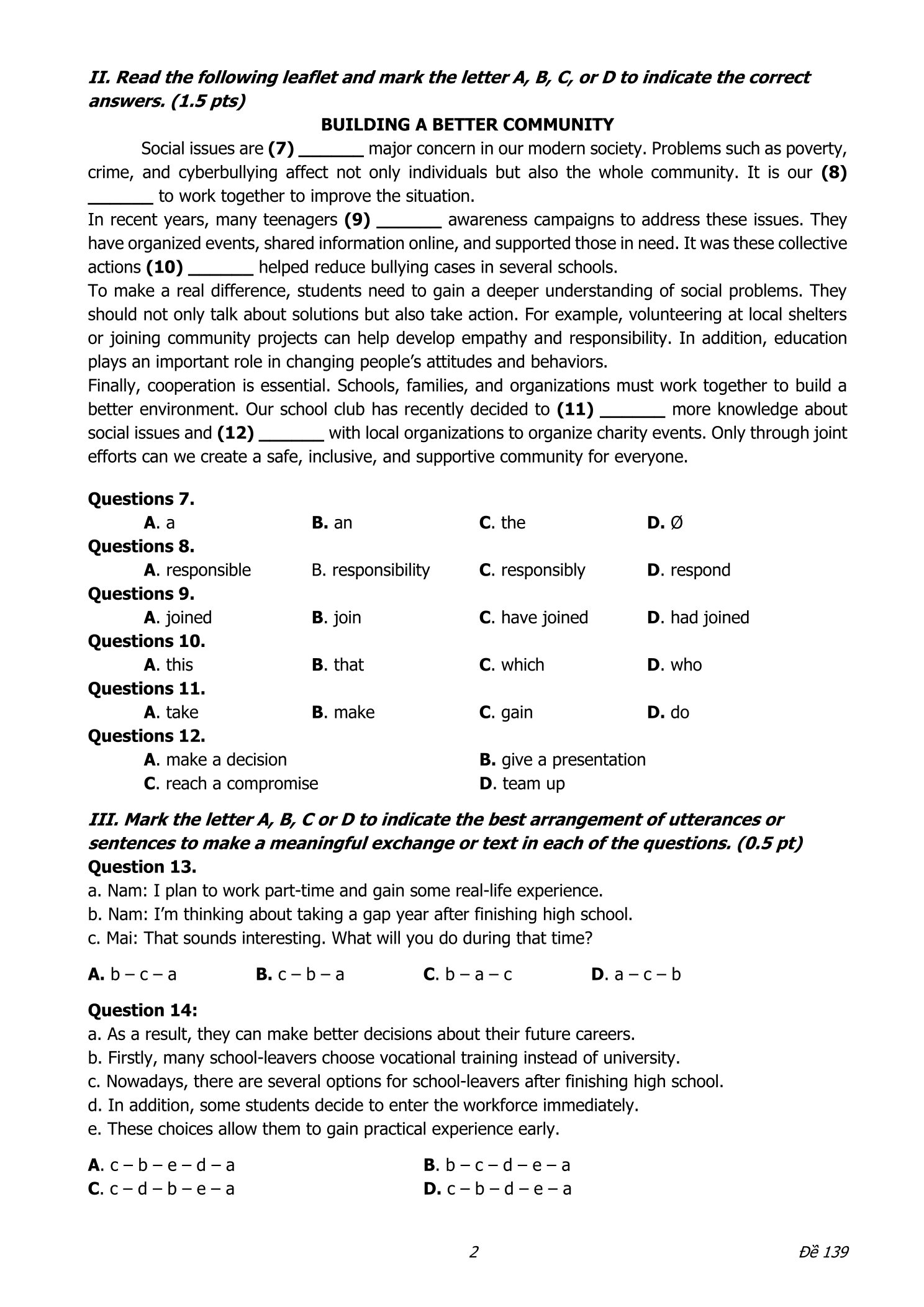
II. Read the following leaflet and mark the letter A, B, C, or D to indicate the correct answers. (1.5 pts)
BUILDING A BETTER COMMUNITY
Social issues are (7) _______ major concern in our modern society. Problems such as poverty, crime, and cyberbullying affect not only individuals but also the whole community. It is our (8) _______ to work together to improve the situation.
In recent years, many teenagers (9) _______ awareness campaigns to address these issues. They have organized events, shared information online, and supported those in need. It was these collective actions (10) _______ helped reduce bullying cases in several schools.
To make a real difference, students need to gain a deeper understanding of social problems. They should not only talk about solutions but also take action. For example, volunteering at local shelters or joining community projects can help develop empathy and responsibility. In addition, education plays an important role in changing people’s attitudes and behaviors.
Finally, cooperation is essential. Schools, families, and organizations must work together to build a better environment. Our school club has recently decided to (11) _______ more knowledge about social issues and (12) _______ with local organizations to organize charity events. Only through joint efforts can we create a safe, inclusive, and supportive community for everyone.
Questions 7.
A. a
B. an
C. the
D. Ø
Đáp án: A
Questions 8.
A. responsible
B. responsibility
C. responsibly
D. respond
Đáp án: B
Questions 9.
A. joined
B. join
C. have joined
D. had joined
Đáp án: A
Questions 10.
A. this
B. that
C. which
D. who
Đáp án: C
Questions 11.
A. take
B. make
C. gain
D. do
Đáp án: C
Questions 12.
A. make a decision
B. give a presentation
C. reach a compromise
D. team up
Đáp án: D
III. Mark the letter A, B, C or D to indicate the best arrangement of utterances or sentences to make a meaningful exchange or text in each of the questions. (0.5 pt)
Question 13.
a. Nam: I plan to work part-time and gain some real-life experience.
b. Nam: I’m thinking about taking a gap year after finishing high school.
c. Mai: That sounds interesting. What will you do during that time?
A. b – c – a
B. c – b – a
C. b – a – c
D. a – c – b
Đáp án: A
Question 14:
a. As a result, they can make better decisions about their future careers.
b. Firstly, many school-leavers choose vocational training instead of university.
c. Nowadays, there are several options for school-leavers after finishing high school.
d. In addition, some students decide to enter the workforce immediately.
e. These choices allow them to gain practical experience early.
A. c – b – e – d – a
B. b – c – d – e – a
C. c – d – b – e – a
D. c – b – d – e – a
Đáp án: D
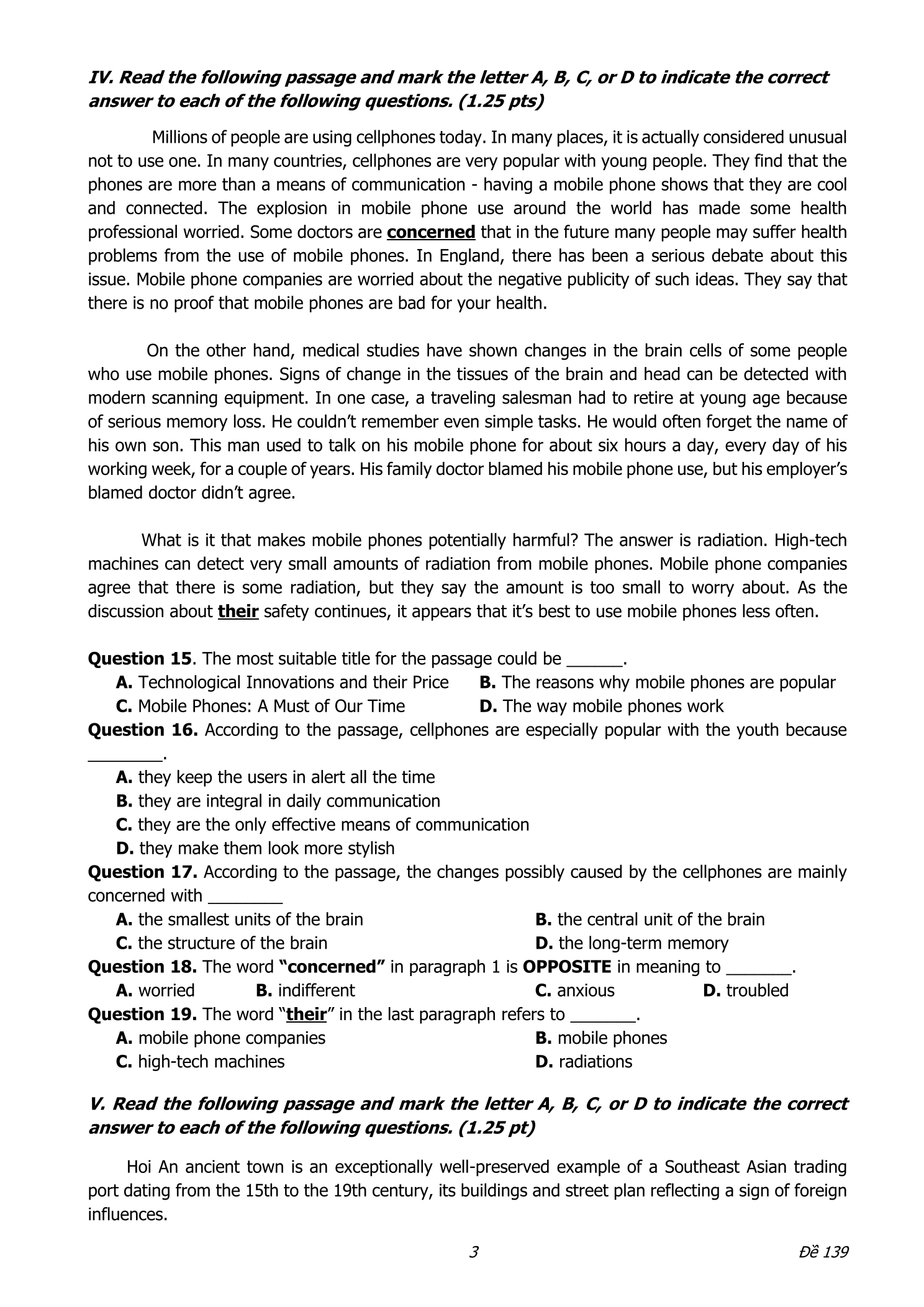
IV. Read the following passage and mark the letter A, B, C, or D to indicate the correct answer to each of the following questions. (1.25 pts)
Millions of people are using cellphones today. In many places, it is actually considered unusual not to use one. In many countries, cellphones are very popular with young people. They find that the phones are more than a means of communication – having a mobile phone shows that they are cool and connected. The explosion in mobile phone use around the world has made some health professional worried. Some doctors are concerned that in the future many people may suffer health problems from the use of mobile phones. In England, there has been a serious debate about this issue. Mobile phone companies are worried about the negative publicity of such ideas. They say that there is no proof that mobile phones are bad for your health.
On the other hand, medical studies have shown changes in the brain cells of some people who use mobile phones. Signs of change in the tissues of the brain and head can be detected with modern scanning equipment. In one case, a traveling salesman had to retire at young age because of serious memory loss. He couldn’t remember even simple tasks. He would often forget the name of his own son. This man used to talk on his mobile phone for about six hours a day, every day of his working week, for a couple of years. His family doctor blamed his mobile phone use, but his employer’s blamed doctor didn’t agree.
What is it that makes mobile phones potentially harmful? The answer is radiation. High-tech machines can detect very small amounts of radiation from mobile phones. Mobile phone companies agree that there is some radiation, but they say the amount is too small to worry about. As the discussion about their safety continues, it appears that it’s best to use mobile phones less often.
Question 15. The most suitable title for the passage could be ______.
A. Technological Innovations and their Price
B. The reasons why mobile phones are popular
C. Mobile Phones: A Must of Our Time
D. The way mobile phones work
Đáp án: C
Question 16. According to the passage, cellphones are especially popular with the youth because ______.
A. they keep the users in alert all the time
B. they are integral in daily communication
C. they are the only effective means of communication
D. they make them look more stylish
Đáp án: D
Question 17. According to the passage, the changes possibly caused by the cellphones are mainly concerned with ______
A. the smallest units of the brain
B. the central unit of the brain
C. the structure of the brain
D. the long-term memory
Đáp án: A
Question 18. The word “concerned” in paragraph 1 is OPPOSITE in meaning to ______.
A. worried
B. indifferent
C. anxious
D. troubled
Đáp án: B
Question 19. The word “their” in the last paragraph refers to ______.
A. mobile phone companies
B. mobile phones
C. high-tech machines
D. radiations
Đáp án: A
V. Read the following passage and mark the letter A, B, C, or D to indicate the correct answer to each of the following questions. (1.25 pt)
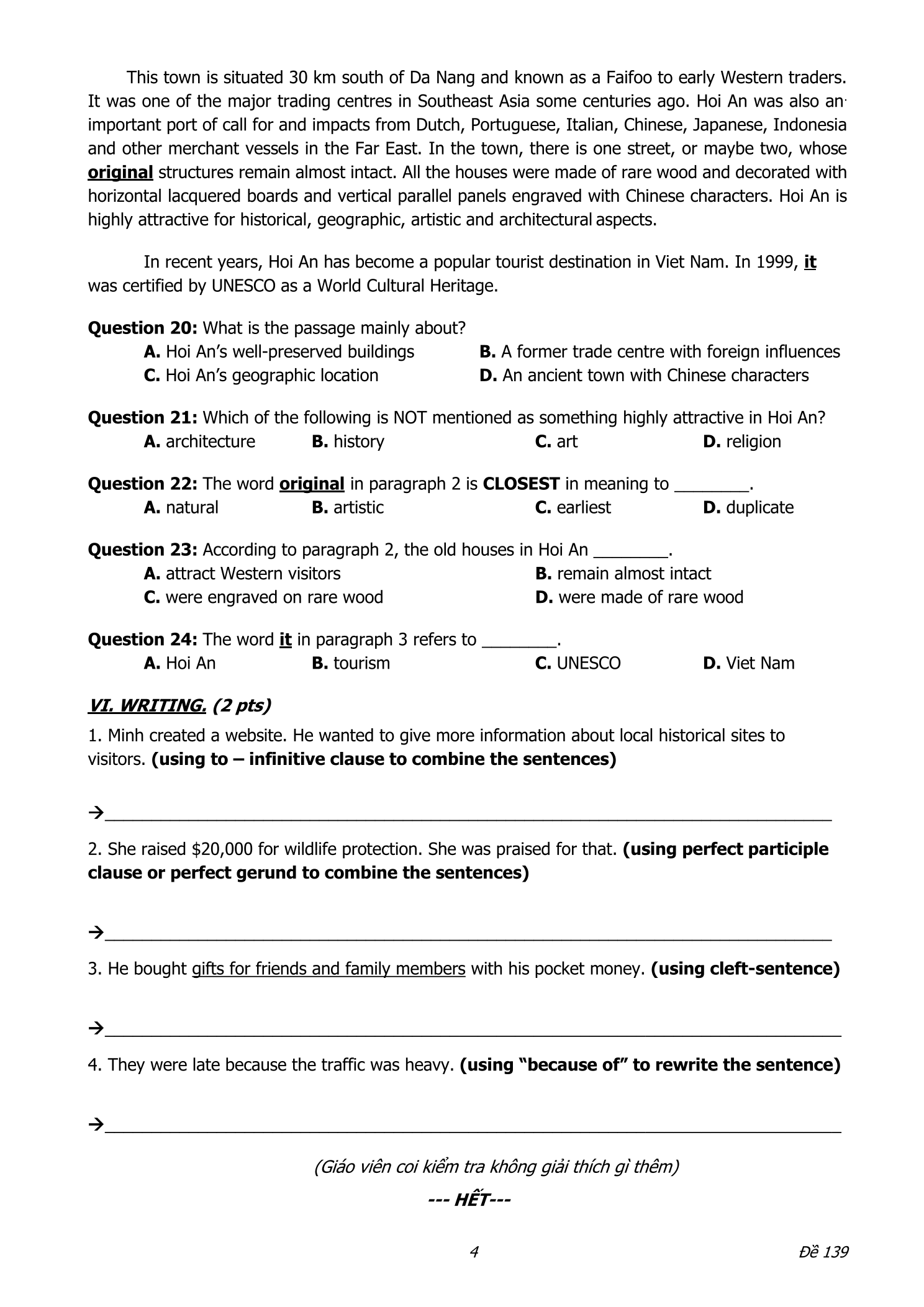
Hoi An ancient town is an exceptionally well-preserved example of a Southeast Asian trading port dating from the 15th to the 19th century, its buildings and street plan reflecting a sign of foreign influences.
This town is situated 30 km south of Da Nang and known as a Faifoo to early Western traders. It was one of the major trading centres in Southeast Asia some centuries ago. Hoi An was also an important port of call for and impacts from Dutch, Portuguese, Italian, Chinese, Japanese, Indonesia and other merchant vessels in the Far East. In the town, there is one street, or maybe two, whose original structures remain almost intact. All the houses were made of rare wood and decorated with horizontal lacquered boards and vertical parallel panels engraved with Chinese characters. Hoi An is highly attractive for historical, geographic, artistic and architectural aspects.
In recent years, Hoi An has become a popular tourist destination in Viet Nam. In 1999, it was certified by UNESCO as a World Cultural Heritage.
Question 20: What is the passage mainly about?
A. Hoi An’s well-preserved buildings
B. A former trade centre with foreign influences
C. Hoi An’s geographic location
D. An ancient town with Chinese characters
Đáp án: B
Question 21: Which of the following is NOT mentioned as something highly attractive in Hoi An?
A. architecture
B. history
C. art
D. religion
Đáp án: D
Question 22: The word original in paragraph 2 is CLOSEST in meaning to ______.
A. natural
B. artistic
C. earliest
D. duplicate
Đáp án: C
Question 23: According to paragraph 2, the old houses in Hoi An ______.
A. attract Western visitors
B. remain almost intact
C. were engraved on rare wood
D. were made of rare wood
Đáp án: B
Question 24: The word it in paragraph 3 refers to ______.
A. Hoi An
B. tourism
C. UNESCO
D. Viet Nam
Đáp án: A
VI. WRITING. (2 pts)
1. Minh created a website. He wanted to give more information about local historical sites to visitors. (using to – infinitive clause to combine the sentences)
Đáp án: Minh created a website to give more information about local historical sites to visitors.
2. She raised $20,000 for wildlife protection. She was praised for that. (using perfect participle clause or perfect gerund to combine the sentences)
Đáp án: Having raised $20,000 for wildlife protection, she was praised for that.
3. He bought gifts for friends and family members with his pocket money. (using cleft-sentence)
Đáp án: It was gifts for friends and family members that he bought with his pocket money.
4. They were late because the traffic was heavy. (using “because of” to rewrite the sentence)
Đáp án: They were late because of the heavy traffic.
I. WRITING. (2 pts)
1. My sister has opened a small shop behind the museum. She wanted to sell postcards and souvenirs to tourists. (using to – infinitive clause to combine the sentences)
Đáp án: My sister has opened a small shop behind the museum to sell postcards and souvenirs to tourists.
2. Nam won the first prize in the competition. He is very proud of this. (using perfect participle clause or perfect gerund to combine the sentences)
Đáp án: Having won the first prize in the competition, Nam is very proud of this.
3. Good life skills can help students become more independent at university. (using cleft-sentence)
Đáp án: It is at university that good life skills can help students become more independent.
4. He didn’t accept the offer because the salary was low. (using “because of” to rewrite the sentence)
Đáp án: He didn’t accept the offer because of the low salary.