
Đề thi giữa kì 1 Tiếng Anh 10 năm 2025 2026 THPT Edison – Thái Nguyên là bộ đề tham khảo dành cho học sinh lớp 10 trong năm học 2025 – 2026, được THPT Edison – Thái Nguyên biên soạn nhằm đánh giá mức độ tiếp thu kiến thức giữa học kỳ I và hỗ trợ học sinh xây dựng kế hoạch ôn tập hiệu quả. Đề thi bám sát nội dung chương trình giáo dục phổ thông mới với hệ thống câu hỏi bao gồm phát âm, trọng âm, từ vựng theo chủ điểm, các chuyên đề ngữ pháp, đọc hiểu, giao tiếp, điền từ, viết câu và viết đoạn văn. Không chỉ kiểm tra khả năng ghi nhớ kiến thức, đề còn hướng đến việc đánh giá năng lực sử dụng tiếng Anh trong nhiều ngữ cảnh thực tế, giúp học sinh nâng cao kỹ năng phân tích ngôn ngữ, suy luận và lựa chọn đáp án chính xác. Việc thường xuyên thực hành với đề giữa kì 1 môn Tiếng Anh lớp 10 sẽ giúp học sinh cải thiện khả năng đọc hiểu, mở rộng vốn từ và sử dụng ngữ pháp linh hoạt hơn trong quá trình học tập. Đồng thời, bộ đề lớp 10 môn Tiếng Anh cũng là nguồn tài liệu hữu ích để củng cố kiến thức và chuẩn bị tốt cho các kỳ kiểm tra quan trọng.
Dethitracnghiem.vn là nền tảng luyện đề trực tuyến giúp học sinh tiếp cận nhiều đề thi chất lượng với thao tác đơn giản và thuận tiện. Sau mỗi lần hoàn thành bài làm, hệ thống sẽ tự động chấm điểm, hiển thị đáp án chi tiết và lưu kết quả để người học dễ dàng theo dõi quá trình tiến bộ của mình. Kho câu hỏi được xây dựng theo lộ trình từ cơ bản đến nâng cao, phù hợp với học sinh lớp 10 trong giai đoạn tăng cường ôn luyện năm học 2025 – 2026. Luyện tập thường xuyên cùng các đề thi lớp 10 sẽ giúp học sinh nâng cao phản xạ ngoại ngữ, cải thiện kỹ năng làm bài và sử dụng thời gian ôn tập một cách hiệu quả.
ĐỀ THI
LINK PDF ĐỀ THI [gồm ĐỀ THI, ĐÁP ÁN, LỜI GIẢI]:
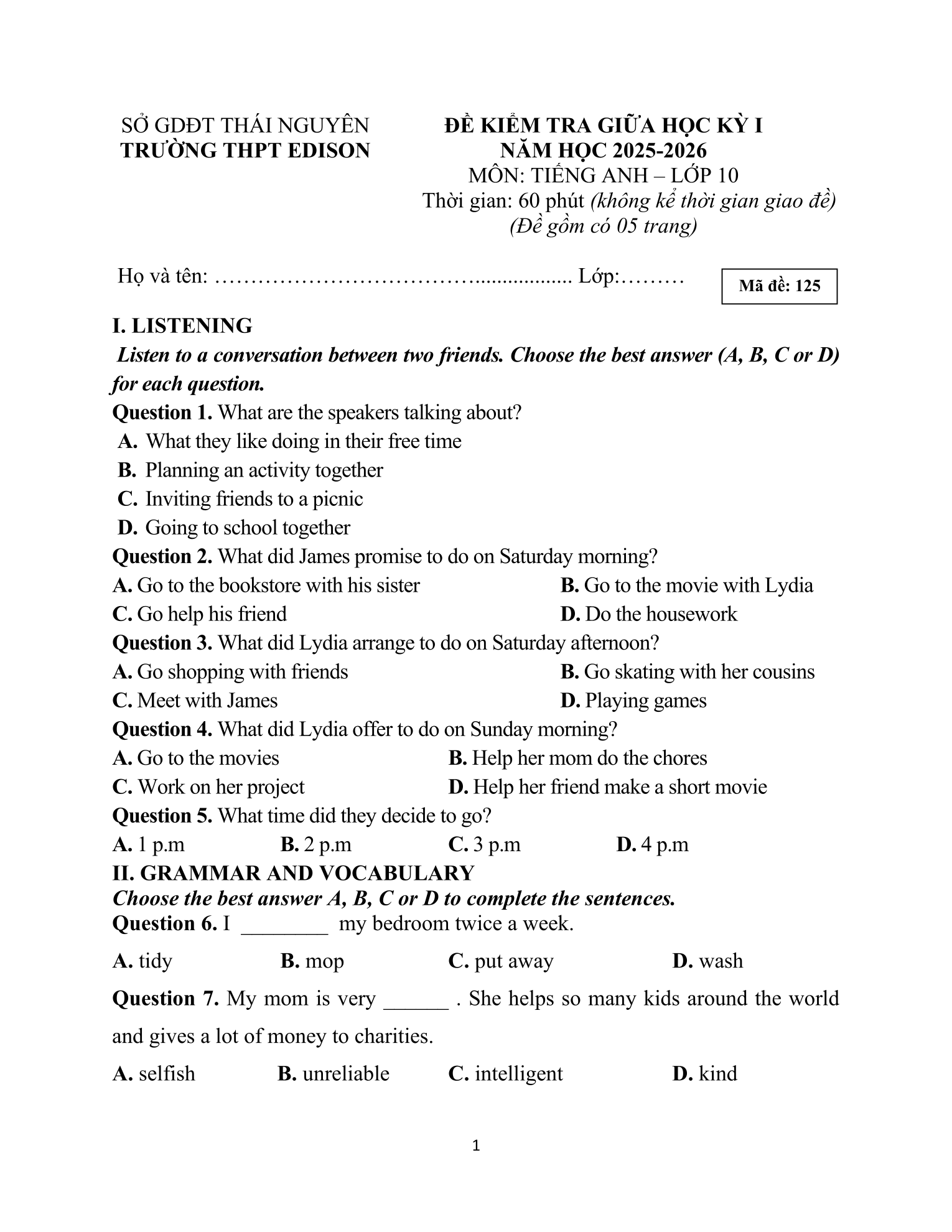
Listen to a conversation between two friends. Choose the best answer (A, B, C or D) for each question.
Question 1. What are the speakers talking about?
A. What they like doing in their free time
B. Planning an activity together
C. Inviting friends to a picnic
D. Going to school together
Đáp án: B
Question 2. What did James promise to do on Saturday morning?
A. Go to the bookstore with his sister
B. Go to the movie with Lydia
C. Go help his friend
D. Do the housework
Đáp án: C
Question 3. What did Lydia arrange to do on Saturday afternoon?
A. Go shopping with friends
B. Go skating with her cousins
C. Meet with James
D. Playing games
Đáp án: A
Question 4. What did Lydia offer to do on Sunday morning?
A. Go to the movies
B. Help her mom do the chores
C. Work on her project
D. Help her friend make a short movie
Đáp án: D
Question 5. What time did they decide to go?
A. 1 p.m
B. 2 p.m
C. 3 p.m
D. 4 p.m
Đáp án: B
II. GRAMMAR AND VOCABULARY
Choose the best answer A, B, C or D to complete the sentences.
Question 6. I ________ my bedroom twice a week.
A. tidy
B. mop
C. put away
D. wash
Đáp án: A
Question 7. My mom is very ________ . She helps so many kids around the world and gives a lot of money to charities.
A. selfish
B. unreliable
C. intelligent
D. kind
Đáp án: D
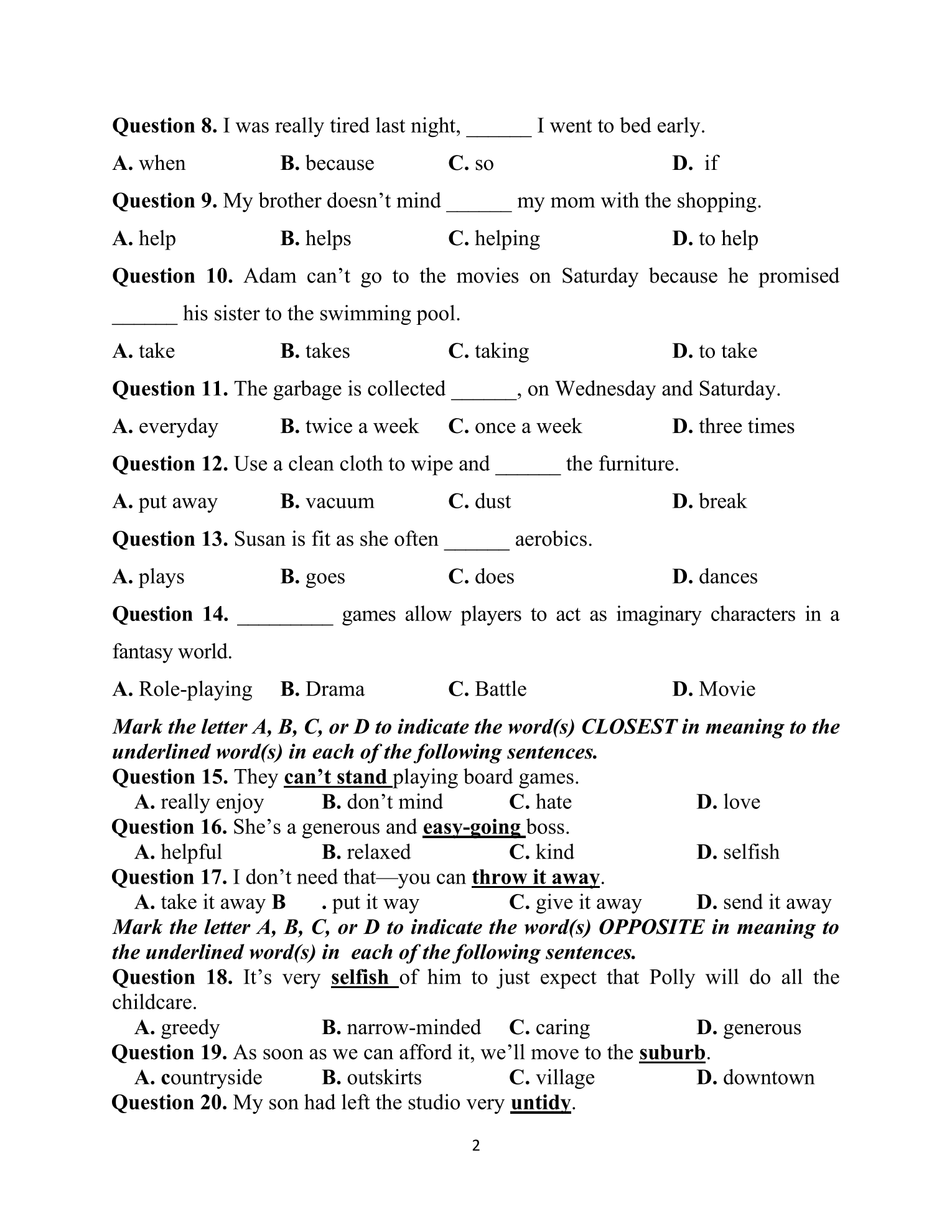
Question 8. I was really tired last night, ________ I went to bed early.
A. when
B. because
C. so
D. if
Đáp án: C
Question 9. My brother doesn’t mind ________ my mom with the shopping.
A. help
B. helps
C. helping
D. to help
Đáp án: C
Question 10. Adam can’t go to the movies on Saturday because he promised ________ his sister to the swimming pool.
A. take
B. takes
C. taking
D. to take
Đáp án: D
Question 11. The garbage is collected ________, on Wednesday and Saturday.
A. everyday
B. twice a week
C. once a week
D. three times
Đáp án: B
Question 12. Use a clean cloth to wipe and ________ the furniture.
A. put away
B. vacuum
C. dust
D. break
Đáp án: C
Question 13. Susan is fit as she often ________ aerobics.
A. plays
B. goes
C. does
D. dances
Đáp án: C
Question 14. ________ games allow players to act as imaginary characters in a fantasy world.
A. Role-playing
B. Drama
C. Battle
D. Movie
Đáp án: A
Mark the letter A, B, C, or D to indicate the word(s) CLOSEST in meaning to the underlined word(s) in each of the following sentences.
Question 15. They can’t stand playing board games.
A. really enjoy
B. don’t mind
C. hate
D. love
Đáp án: C
Question 16. She’s a generous and easy-going boss.
A. helpful
B. relaxed
C. kind
D. selfish
Đáp án: B
Question 17. I don’t need that—you can throw it away.
A. take it away
B. put it way
C. give it away
D. send it away
Đáp án: A
Mark the letter A, B, C, or D to indicate the word(s) OPPOSITE in meaning to the underlined word(s) in each of the following sentences.
Question 18. It’s very selfish of him to just expect that Polly will do all the childcare.
A. greedy
B. narrow-minded
C. caring
D. generous
Đáp án: D
Question 19. As soon as we can afford it, we’ll move to the suburb.
A. countryside
B. outskirts
C. village
D. downtown
Đáp án: D
Question 20. My son had left the studio very untidy.
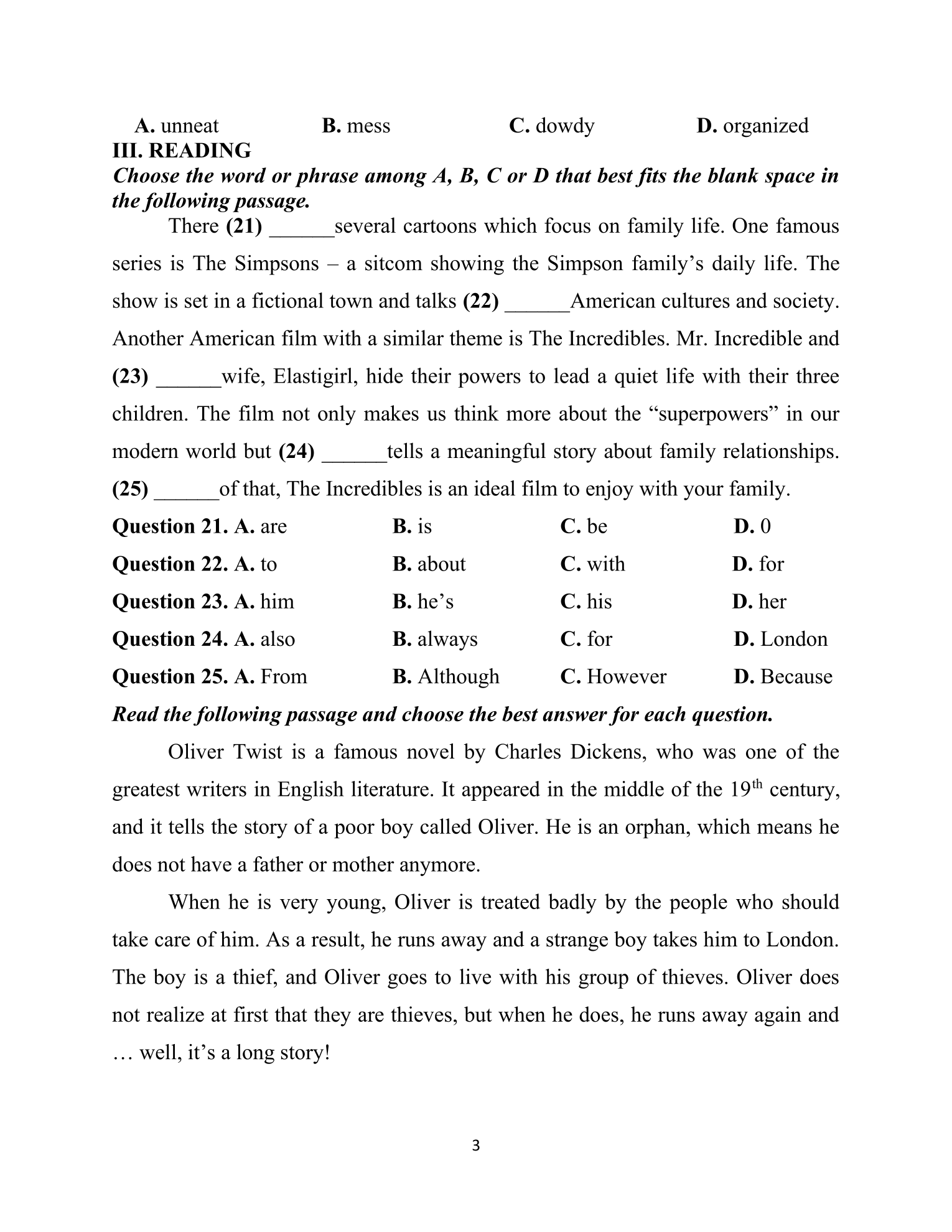
A. unneat
B. mess
C. dowdy
D. organized
Đáp án: D
III. READING
Choose the word or phrase among A, B, C or D that best fits the blank space in the following passage.
There (21) ________ several cartoons which focus on family life. One famous series is The Simpsons – a sitcom showing the Simpson family’s daily life. The show is set in a fictional town and talks (22) ________ American cultures and society. Another American film with a similar theme is The Incredibles. Mr. Incredible and (23) ________ wife, Elastigirl, hide their powers to lead a quiet life with their three children. The film not only makes us think more about the “superpowers” in our modern world but (24) ________ tells a meaningful story about family relationships. (25) ________ of that, The Incredibles is an ideal film to enjoy with your family.
Question 21.
A. are
B. is
C. be
D. 0
Đáp án: A
Question 22.
A. to
B. about
C. with
D. for
Đáp án: B
Question 23.
A. him
B. he’s
C. his
D. her
Đáp án: C
Question 24.
A. also
B. always
C. for
D. London
Đáp án: A
Question 25.
A. From
B. Although
C. However
D. Because
Đáp án: D
Read the following passage and choose the best answer for each question.
Oliver Twist is a famous novel by Charles Dickens, who was one of the greatest writers in English literature. It appeared in the middle of the 19th century, and it tells the story of a poor boy called Oliver. He is an orphan, which means he does not have a father or mother anymore.
When he is very young, Oliver is treated badly by the people who should take care of him. As a result, he runs away and a strange boy takes him to London. The boy is a thief, and Oliver goes to live with his group of thieves. Oliver does not realize at first that they are thieves, but when he does, he runs away again and … well, it’s a long story!
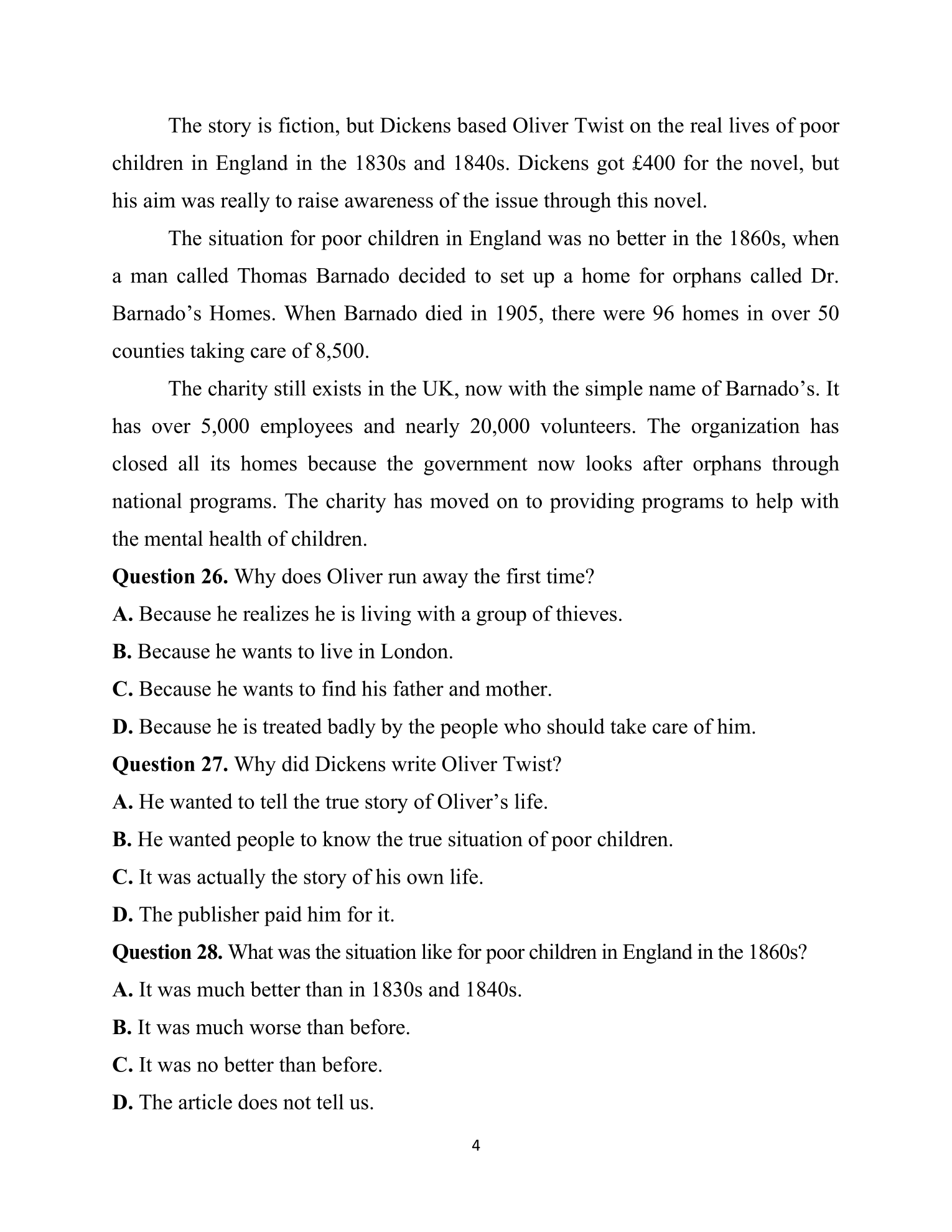
The story is fiction, but Dickens based Oliver Twist on the real lives of poor children in England in the 1830s and 1840s. Dickens got £400 for the novel, but his aim was really to raise awareness of the issue through this novel.
The situation for poor children in England was no better in the 1860s, when a man called Thomas Barnado decided to set up a home for orphans called Dr. Barnado’s Homes. When Barnado died in 1905, there were 96 homes in over 50 counties taking care of 8,500.
The charity still exists in the UK, now with the simple name of Barnado’s. It has over 5,000 employees and nearly 20,000 volunteers. The organization has closed all its homes because the government now looks after orphans through national programs. The charity has moved on to providing programs to help with the mental health of children.
Question 26. Why does Oliver run away the first time?
A. Because he realizes he is living with a group of thieves.
B. Because he wants to live in London.
C. Because he wants to find his father and mother.
D. Because he is treated badly by the people who should take care of him.
Đáp án: D
Question 27. Why did Dickens write Oliver Twist?
A. He wanted to tell the true story of Oliver’s life.
B. He wanted people to know the true situation of poor children.
C. It was actually the story of his own life.
D. The publisher paid him for it.
Đáp án: B
Question 28. What was the situation like for poor children in England in the 1860s?
A. It was much better than in 1830s and 1840s.
B. It was much worse than before.
C. It was no better than before.
D. The article does not tell us.
Đáp án: C
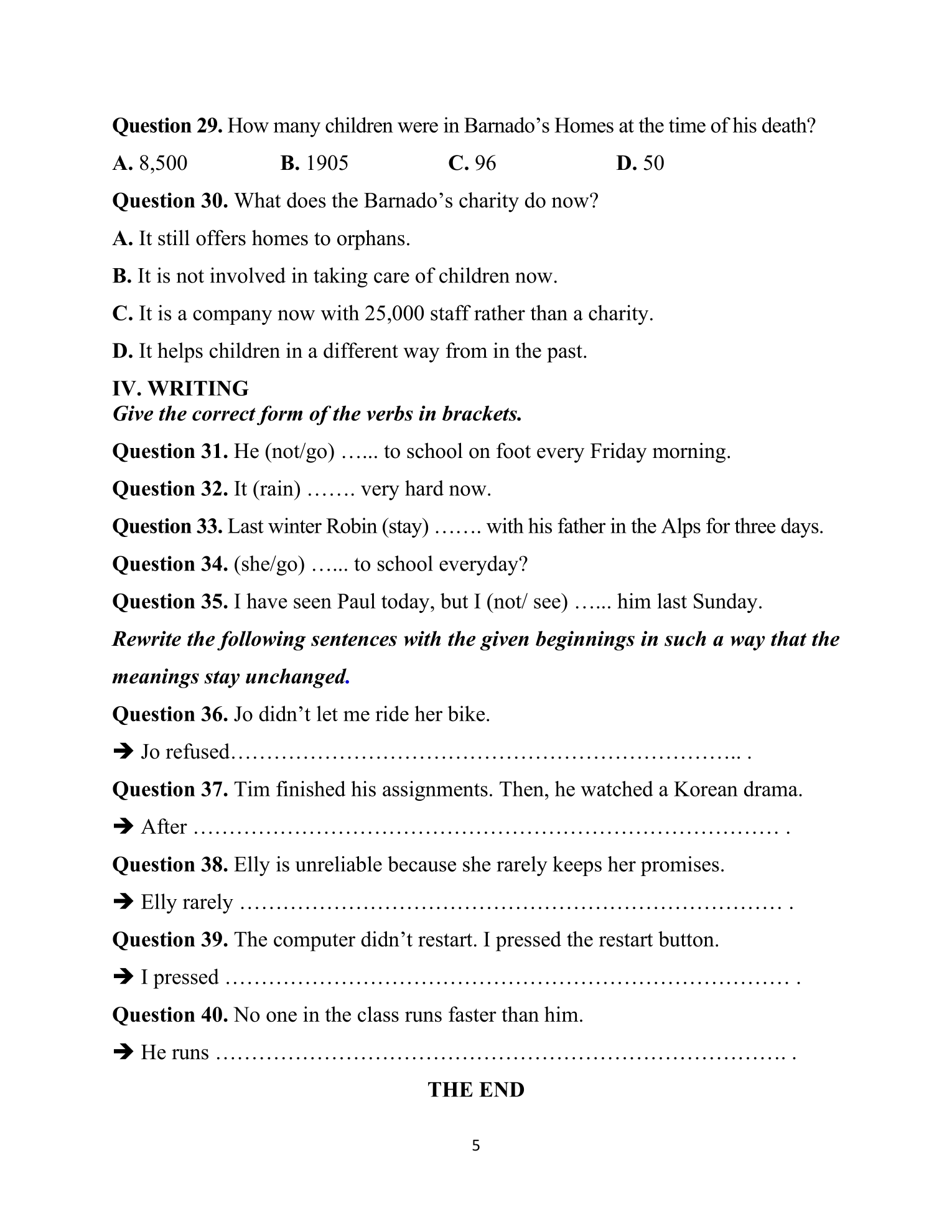
Question 29. How many children were in Barnado’s Homes at the time of his death?
A. 8,500
B. 1905
C. 96
D. 50
Đáp án: A
Question 30. What does the Barnado’s charity do now?
A. It still offers homes to orphans.
B. It is not involved in taking care of children now.
C. It is a company now with 25,000 staff rather than a charity.
D. It helps children in a different way from in the past.
Đáp án: D
IV. WRITING
Give the correct form of the verbs in brackets.
Question 31. He (not/go) …… to school on foot every Friday morning.
Đáp án: doesn’t go
Question 32. It (rain) ……. very hard now.
Đáp án: is raining
Question 33. Last winter Robin (stay) ……. with his father in the Alps for three days.
Đáp án: stayed
Question 34. (she/go) …… to school everyday?
Đáp án: Does she go
Question 35. I have seen Paul today, but I (not/ see) …… him last Sunday.
Đáp án: didn’t see
Rewrite the following sentences with the given beginnings in such a way that the meanings stay unchanged.
Question 36. Jo didn’t let me ride her bike.
➔ Jo refused……………………………………………………………………………………
Đáp án: Jo refused to let me ride her bike.
Question 37. Tim finished his assignments. Then, he watched a Korean drama.
➔ After ………………………………………………………………………………………….
Đáp án: After Tim had finished his assignments, he watched a Korean drama.
Question 38. Elly is unreliable because she rarely keeps her promises.
➔ Elly rarely …………………………………………………………………………………..
Đáp án: Elly rarely keeps her promises, so she is unreliable.
Question 39. The computer didn’t restart. I pressed the restart button.
➔ I pressed …………………………………………………………………………………….
Đáp án: I pressed the restart button, but the computer didn’t restart.
Question 40. No one in the class runs faster than him.
➔ He runs ………………………………………………………………………………………
Đáp án: He runs the fastest in the class.