
Đề thi giữa kì 1 Tiếng anh 12 năm 2026 THPT Gia Bình 1 – Bắc Ninh là tài liệu học tập quan trọng thuộc môn Tiếng Anh dành riêng cho học sinh lớp 12 đang chuẩn bị cho các kỳ thi quan trọng. Đây là mẫu đề Tiếng Anh 12 GHK1 do THPT Gia Bình 1 thành phố Bắc Ninh biên soạn cho năm học 2025-2026 nhằm mục đích khảo sát chất lượng giáo dục và định hướng ôn luyện sớm. Nội dung đề thi được thiết kế khoa học, xoay quanh các chủ đề mang tính thời đại như sức ảnh hưởng của mạng xã hội TikTok, trách nhiệm bảo vệ môi trường, các mô hình kinh doanh đa văn hóa và cuộc đời sự nghiệp của Neil Armstrong. Qua đó, học sinh không chỉ được rèn luyện kỹ năng đọc hiểu dữ kiện và kỹ thuật chọn đáp án nhanh mà còn biết cách vận dụng kiến thức vào thực tiễn đời sống. Đây chính là dạng đề tiếng anh 12 giúp các em xây dựng bản lĩnh và sự tự tin trước kỳ thi chính thức.
Trải nghiệm luyện tập các bộ đề ôn thi 12 trên dethitracnghiem.vn giúp học sinh lớp 12 tối ưu hóa lộ trình học tập trong giai đoạn tăng tốc năm 2025. Website sở hữu giao diện thân thiện, cho phép người dùng làm bài nhiều lần, nhận đáp án chi tiết ngay sau khi hoàn thành và tự theo dõi biểu đồ tiến bộ cá nhân. Đặc biệt, hệ thống câu hỏi môn Tiếng Anh tại đây được phân loại chặt chẽ từ lý thuyết nền tảng đến các bài tập tình huống thực tế bám sát cấu trúc đề thi mới nhất. Việc làm quen với cách ra đề thực tế giúp học sinh nâng cao khả năng phản xạ, tiết kiệm tối đa thời gian ôn tập và dễ dàng chinh phục mức điểm mong muốn trong các kỳ kiểm tra sắp tới.
ĐỀ THI
LINK PDF ĐỀ THI [gồm ĐỀ THI, ĐÁP ÁN, LỜI GIẢI]:
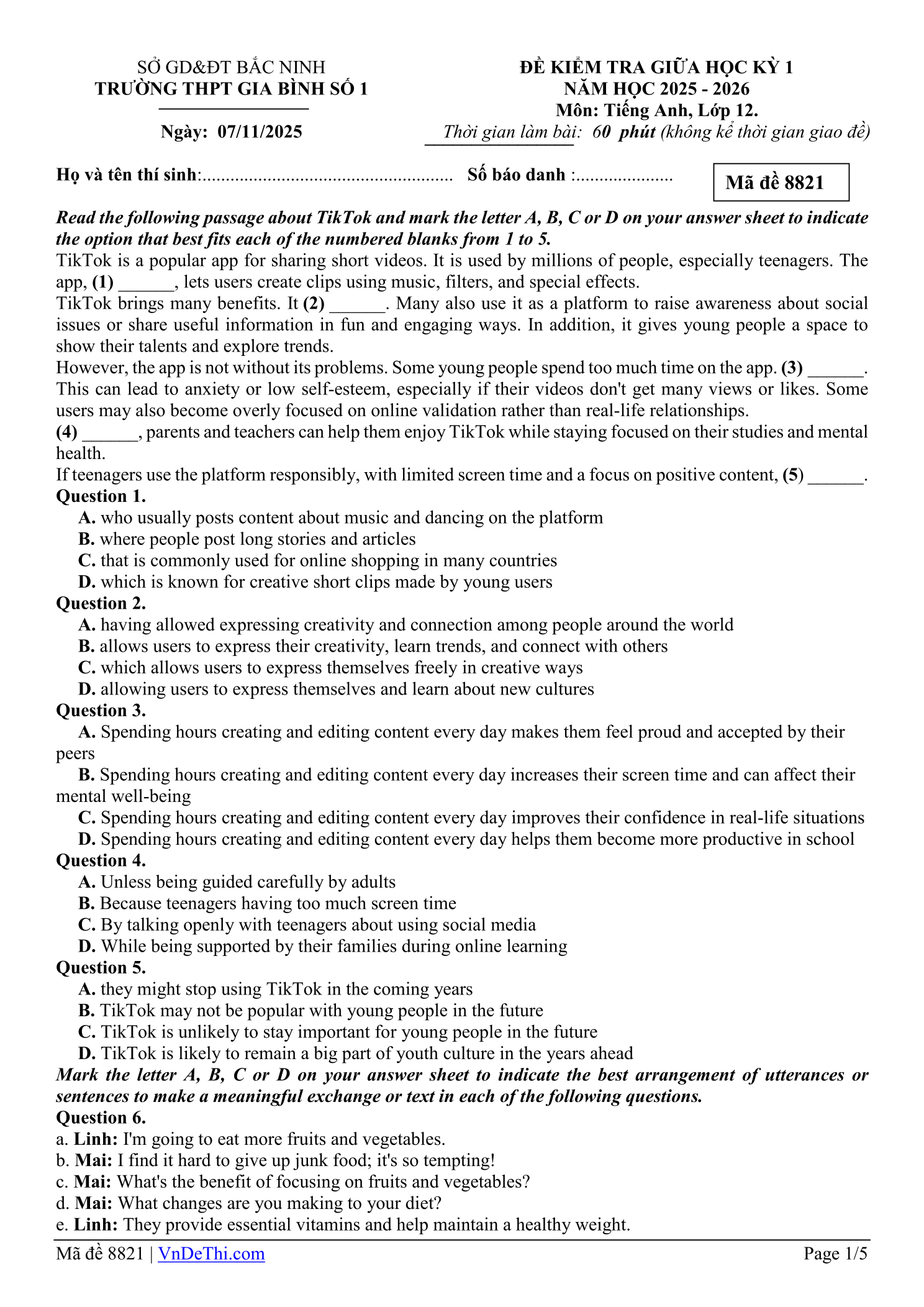
TikTok is a popular app for sharing short videos. It is used by millions of people, especially teenagers. The app, (1) _____, lets users create clips using music, filters, and special effects.
TikTok brings many benefits. It (2) _____. Many also use it as a platform to raise awareness about social issues or share useful information in fun and engaging ways. In addition, it gives young people a space to show their talents and explore trends.
However, the app is not without its problems. Some young people spend too much time on the app. (3) _____. This can lead to anxiety or low self-esteem, especially if their videos don’t get many views or likes. Some users may also become overly focused on online validation rather than real-life relationships.
(4) _____, parents and teachers can help them enjoy TikTok while staying focused on their studies and mental health.
If teenagers use the platform responsibly, with limited screen time and a focus on positive content, (5) _____.
Question 1.
A. who usually posts content about music and dancing on the platform
B. where people post long stories and articles
C. that is commonly used for online shopping in many countries
D. which is known for creative short clips made by young users
Đáp án: D
Question 2.
A. having allowed expressing creativity and connection among people around the world
B. allows users to express their creativity, learn trends, and connect with others
C. which allows users to express themselves freely in creative ways
D. allowing users to express themselves and learn about new cultures
Đáp án: B
Question 3.
A. Spending hours creating and editing content every day makes them feel proud and accepted by their peers
B. Spending hours creating and editing content every day increases their screen time and can affect their mental well-being
C. Spending hours creating and editing content every day improves their confidence in real-life situations
D. Spending hours creating and editing content every day helps them become more productive in school
Đáp án: B
Question 4.
A. Unless being guided carefully by adults
B. Because teenagers having too much screen time
C. By talking openly with teenagers about using social media
D. While being supported by their families during online learning
Đáp án: C
Question 5.
A. they might stop using TikTok in the coming years
B. TikTok may not be popular with young people in the future
C. TikTok is unlikely to stay important for young people in the future
D. TikTok is likely to remain a big part of youth culture in the years ahead
Đáp án: D
Mark the letter A, B, C or D on your answer sheet to indicate the best arrangement of utterances or sentences to make a meaningful exchange or text in each of the following questions.
Question 6.
a. Linh: I’m going to eat more fruits and vegetables.
b. Mai: I find it hard to give up junk food; it’s so tempting!
c. Mai: What’s the benefit of focusing on fruits and vegetables?
d. Mai: What changes are you making to your diet?
e. Linh: They provide essential vitamins and help maintain a healthy weight.
A. b-e-d-a-c
B. b-a-c-e-d
C. d-a-c-e-b
D. d-e-c-a-b
Đáp án: C
Question 7.
a. If we continue to put sustainability at the center of our recovery plans, we will have stronger economies that can last for a long time without damaging nature.
b. When businesses use clean energy like solar power, they can save money while they help the environment.
c. Cities that plant more trees and build bike lanes are becoming healthier places where people enjoy living and working.
d. Many countries are planning new ways to grow their economies because the old ways hurt our planet too much.
e. Although some people think green jobs are expensive, studies show that they create more work opportunities than traditional industries.
A. d-b-e-c-a
B. e-d-c-b-a
C. b-d-c-e-a
D. c-b-e-d-a
Đáp án: A
Question 8.
Dear Nam,
a. All of these efforts aim to not only improve our environment but also raise awareness about the importance of protecting our planet.
b. Additionally, every year we hold a “Clean Up Day” during which students and teachers work together to clean our school and the nearby area.
c. We also have a recycling program where students collect and sort materials like paper, plastic, and glass for recycling.
d. I hope you’re doing well. In your last letter, you asked me about the things our school does to keep the surroundings clean and green.
e. At our school, we take part in several green initiatives. For example, we plant trees and maintain a small vegetable garden to encourage sustainability.
Best regards,
Tuan
A. d-b-a-e-c
B. a-b-e-d-c
C. b-a-d-e-c
D. d-e-c-b-a
Đáp án: D
Question 9.
a. Nam: Yes, Mai and I did. The fair was great, and we got a lot of useful information.
b. Ms. Hoa: I’m glad to hear that both of you attended the fair.
c. Ms. Hoa: Good morning, class. There was an education fair last weekend. Did anyone go?
A. c-a-b
B. b-a-c
C. b-c-a
D. a-c-b
Đáp án: A
Question 10.
a. However, this scenic landscape complex may be adversely affected by mass tourism.
b. This kind of tourism can result in environmental degradation, such as pollution of rivers and caves, erosion of trails and disturbance of wildlife.
c. Tràng An (Ninh Bình province), the first site in Vietnam to be recognized by UNESCO as a mixed World Heritage Site, is famous for its outstanding karst landscape and important cultural landmarks.
d. To preserve Tràng An, it is recommended that Vietnamese people increase their awareness of the site’s significance, actively participate in responsible tourism practices and support local communities.
e. Another problem might be young people’s lack of knowledge about the cultural heritage, which causes inappropriate behaviors and insufficient support for conservation efforts.
A. c-d-a-b-e
B. c-e-a-b-d
C. c-b-d-e-a
D. c-a-b-e-d
Đáp án: D
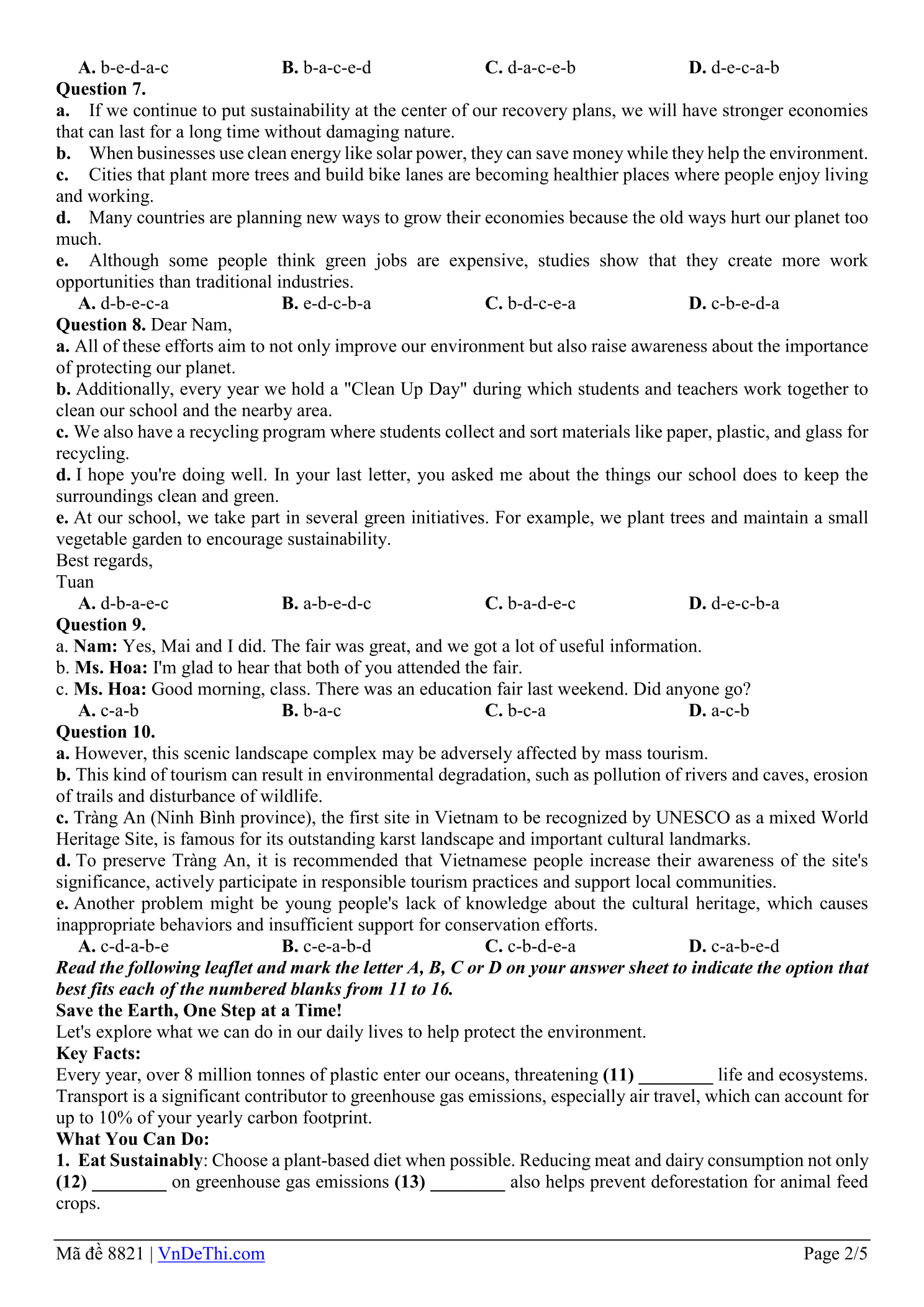
Read the following leaflet and mark the letter A, B, C or D on your answer sheet to indicate the option that best fits each of the numbered blanks from 11 to 16.
Save the Earth, One Step at a Time!
Let’s explore what we can do in our daily lives to help protect the environment.
Key Facts:
Every year, over 8 million tonnes of plastic enter our oceans, threatening (11) _____ life and ecosystems.
Transport is a significant contributor to greenhouse gas emissions, especially air travel, which can account for up to 10% of your yearly carbon footprint.
What You Can Do:
1. Eat Sustainably: Choose a plant-based diet when possible. Reducing meat and dairy consumption not only (12) _____ on greenhouse gas emissions (13) _____ also helps prevent deforestation for animal feed crops.
2. Reduce Waste: Avoid single-use plastics. Opt for reusable bags, containers, and water bottles. Every time you (14) _____, you prevent more plastic waste from ending up in landfills or oceans.
3. Travel Responsibly: Whenever possible, walk or bike short distances. If traveling longer distances, (15) _____ public transport or trains instead of flights to save (16) _____ large amount of carbon emissions.
Adapted from WWF, Global Stewards
Question 11.
A. coastal
B. wildlife
C. aquatic
D. marine
Đáp án: D
Question 12.
A. breaks up
B. cuts down
C. gets down
D. breaks down
Đáp án: B
Question 13.
A. so
B. or
C. but
D. and
Đáp án: C
Question 14.
A. recycle
B. reduce
C. refill
D. reuse
Đáp án: D
Question 15.
A. prefer
B. ignore
C. consider
D. avoid
Đáp án: C
Question 16.
A. an
B. the
C. no article
D. a
Đáp án: D
Read the following passage about Successful Business Models of 2025 and mark the letter A, B, C or D on your answer sheet to indicate the best answer to each of the following questions.
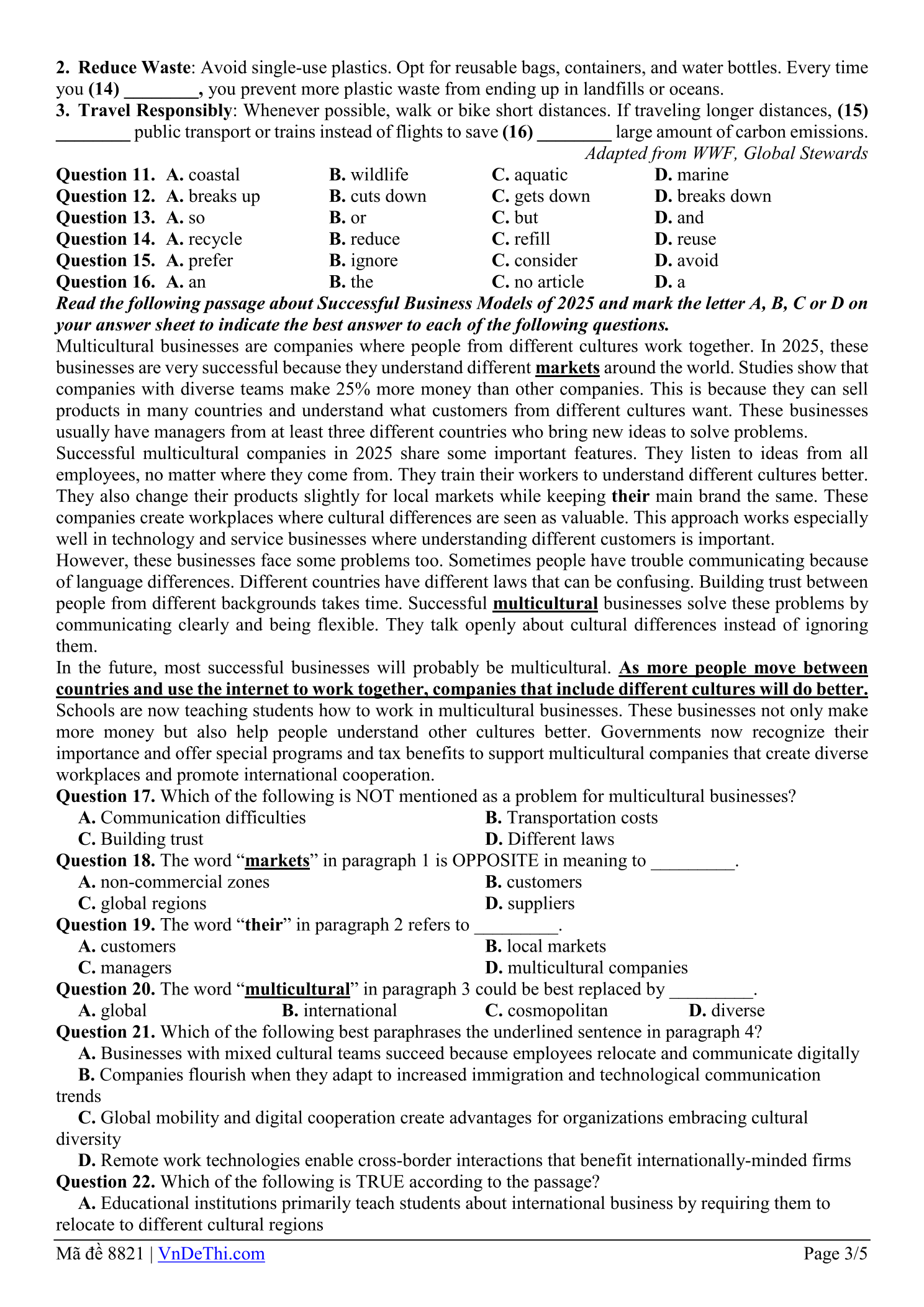
Multicultural businesses are companies where people from different cultures work together. In 2025, these businesses are very successful because they understand different markets around the world. Studies show that companies with diverse teams make 25% more money than other companies. This is because they can sell products in many countries and understand what customers from different cultures want. These businesses usually have managers from at least three different countries who bring new ideas to solve problems.
Successful multicultural companies in 2025 share some important features. They listen to ideas from all employees, no matter where they come from. They train their workers to understand different cultures better. They also change their products slightly for local markets while keeping their main brand the same. These companies create workplaces where cultural differences are seen as valuable. This approach works especially well in technology and service businesses where understanding different customers is important.
However, these businesses face some problems too. Sometimes people have trouble communicating because of language differences. Different countries have different laws that can be confusing. Building trust between people from different backgrounds takes time. Successful multicultural businesses solve these problems by communicating clearly and being flexible. They talk openly about cultural differences instead of ignoring them.
In the future, most successful businesses will probably be multicultural. As more people move between countries and use the internet to work together, companies that include different cultures will do better. Schools are now teaching students how to work in multicultural businesses. These businesses not only make more money but also help people understand other cultures better. Governments now recognize their importance and offer special programs and tax benefits to support multicultural companies that create diverse workplaces and promote international cooperation.
Question 17.
A. Communication difficulties
B. Transportation costs
C. Building trust
D. Different laws
Đáp án: B
Question 18.
A. non-commercial zones
B. customers
C. global regions
D. suppliers
Đáp án: D
Question 19.
A. customers
B. local markets
C. managers
D. multicultural companies
Đáp án: D
Question 20.
A. global
B. international
C. cosmopolitan
D. diverse
Đáp án: D
Question 21.
A. Businesses with mixed cultural teams succeed because employees relocate and communicate digitally
B. Companies flourish when they adapt to increased immigration and technological communication trends
C. Global mobility and digital cooperation create advantages for organizations embracing cultural diversity
D. Remote work technologies enable cross-border interactions that benefit internationally-minded firms
Đáp án: C
Question 22.
A. Educational institutions primarily teach students about international business by requiring them to relocate to different cultural regions
B. Successful businesses modify their products for local markets while maintaining their core brand identity across different cultural contexts
C. Companies with multicultural teams consistently solve problems by ignoring cultural differences and focusing on shared business goals
D. Government agencies worldwide have eliminated special tax incentives for companies that promote diversity in their global operations
Đáp án: B
Question 23.
A. Paragraph 4
B. Paragraph 2
C. Paragraph 1
D. Paragraph 3
Đáp án: B
Question 24.
A. Paragraph 3
B. Paragraph 4
C. Paragraph 1
D. Paragraph 2
Đáp án: B
Read the following advertisement and mark the letter A, B, C or D on your answer sheet to indicate the option that best fits each of the numbered blanks from 25 to 30.
Smart Home, Smart Earth: The Connected Eco-Revolution of 2025
Smartly and (25) _____ transform your living space today with ease!
Our (26) _____ system makes all modern homes greener than ever before.
The smart devices (27) _____ are made from recycled materials help conserve resources while beautifying your home environment. Our company delivers significant energy savings (28) _____ customers through innovative smart technology solutions.
Just (29) _____ your energy management system and turn off your worries. We strongly encourage everyone (30) _____ clean renewable energy sources in their everyday daily life.
Join the eco-revolution and make your home smart for a better Earth!
Question 25.
A. efficient
B. inefficient
C. efficiently
D. efficiency
Đáp án: C
Question 26.
A. energy management innovative
B. innovative management energy
C. innovative energy management
D. management innovative energy
Đáp án: C
Question 27.
A. when
B. which
C. who
D. what
Đáp án: B
Question 28.
A. with
B. at
C. for
D. to
Đáp án: D
Question 29.
A. turn on
B. hold on
C. give up
D. turn off
Đáp án: A
Question 30.
A. using
B. to using
C. to use
D. use
Đáp án: C
Read the following passage about Neil Armstrong and mark the letter A, B, C, or D to indicate the correct answer to each of the questions.
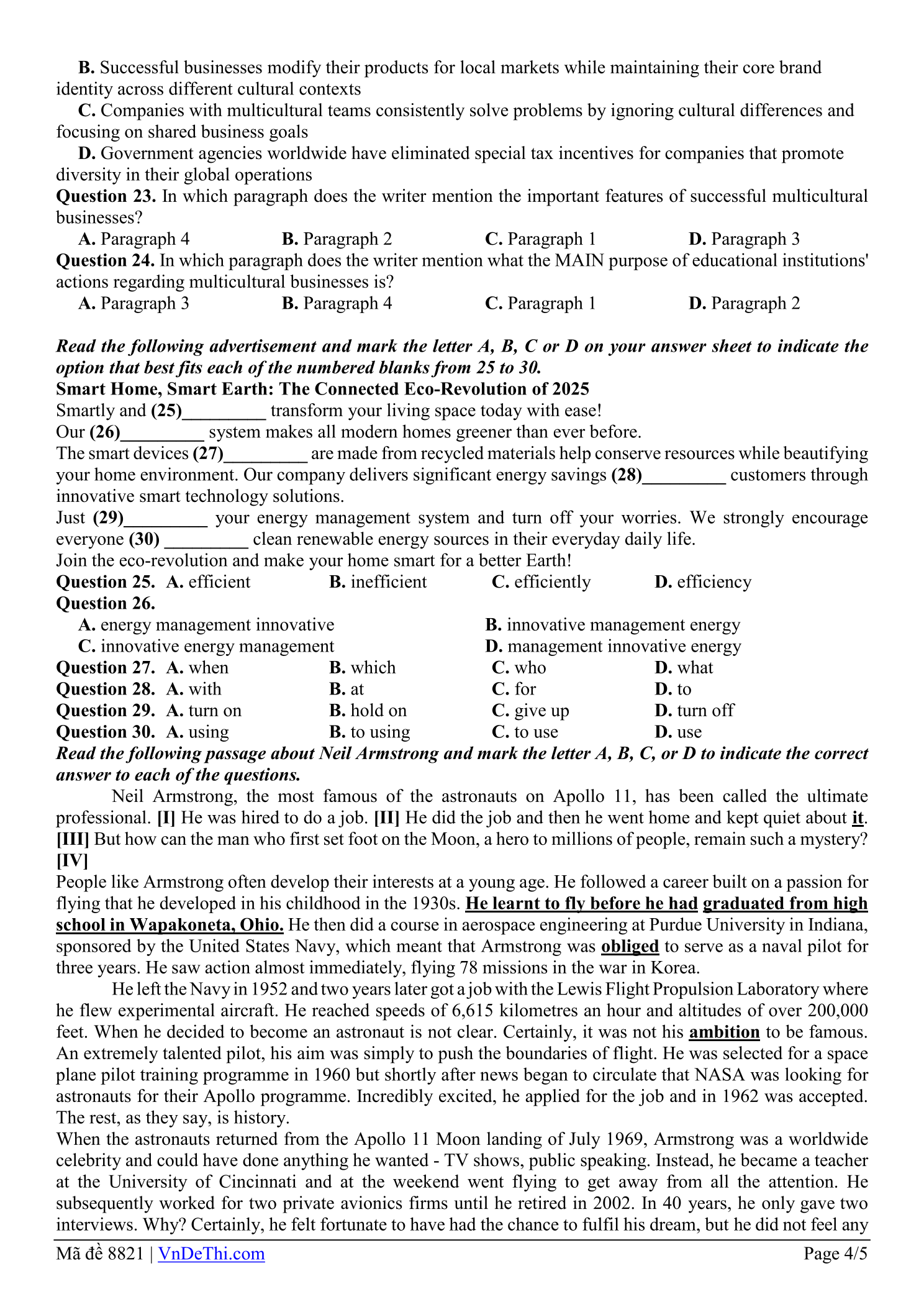
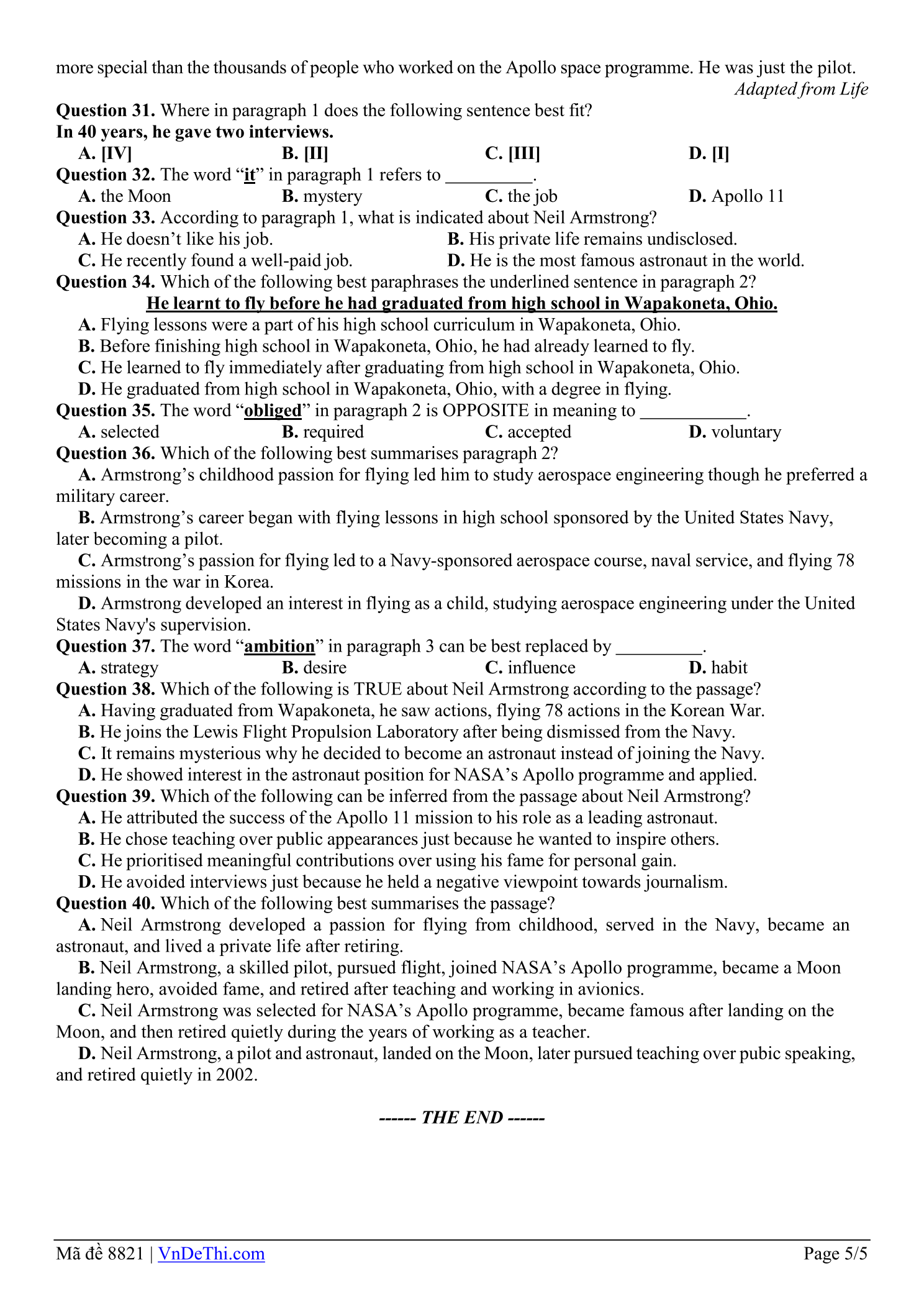
Neil Armstrong, the most famous of the astronauts on Apollo 11, has been called the ultimate professional. [I] He was hired to do a job. [II] He did the job and then he went home and kept quiet about it. [III] But how can the man who first set foot on the Moon, a hero to millions of people, remain such a mystery? [IV]
People like Armstrong often develop their interests at a young age. He followed a career built on a passion for flying that he developed in his childhood in the 1930s. He learnt to fly before he had graduated from high school in Wapakoneta, Ohio. He then did a course in aerospace engineering at Purdue University in Indiana, sponsored by the United States Navy, which meant that Armstrong was obliged to serve as a naval pilot for three years. He saw action almost immediately, flying 78 missions in the war in Korea.
He left the Navy in 1952 and two years later got a job with the Lewis Flight Propulsion Laboratory where he flew experimental aircraft. He reached speeds of 6,615 kilometres an hour and altitudes of over 200,000 feet. When he decided to become an astronaut is not clear. Certainly, it was not his ambition to be famous. An extremely talented pilot, his aim was simply to push the boundaries of flight. He was selected for a space plane pilot training programme in 1960 but shortly after news began to circulate that NASA was looking for astronauts for their Apollo programme. Incredibly excited, he applied for the job and in 1962 was accepted. The rest, as they say, is history.
When the astronauts returned from the Apollo 11 Moon landing of July 1969, Armstrong was a worldwide celebrity and could have done anything he wanted – TV shows, public speaking. Instead, he became a teacher at the University of Cincinnati and at the weekend went flying to get away from all the attention. He subsequently worked for two private avionics firms until he retired in 2002. In 40 years, he only gave two interviews. Why? Certainly, he felt fortunate to have had the chance to fulfil his dream, but he did not feel any more special than the thousands of people who worked on the Apollo space programme. He was just the pilot.
Adapted from Life
Question 31.
A. [IV]
B. [II]
C. [III]
D. [I]
Đáp án: C
Question 32.
A. the Moon
B. mystery
C. the job
D. Apollo 11
Đáp án: C
Question 33.
A. He doesn’t like his job.
B. His private life remains undisclosed.
C. He recently found a well-paid job.
D. He is the most famous astronaut in the world.
Đáp án: B
Question 34.
A. Flying lessons were a part of his high school curriculum in Wapakoneta, Ohio.
B. Before finishing high school in Wapakoneta, Ohio, he had already learned to fly.
C. He learned to fly immediately after graduating from high school in Wapakoneta, Ohio.
D. He graduated from high school in Wapakoneta, Ohio, with a degree in flying.
Đáp án: B
Question 35.
A. selected
B. required
C. accepted
D. voluntary
Đáp án: D
Question 36.
A. Armstrong’s childhood passion for flying led him to study aerospace engineering though he preferred a military career.
B. Armstrong’s career began with flying lessons in high school sponsored by the United States Navy, later becoming a pilot.
C. Armstrong’s passion for flying led to a Navy-sponsored aerospace course, naval service, and flying 78 missions in the war in Korea.
D. Armstrong developed an interest in flying as a child, studying aerospace engineering under the United States Navy’s supervision.
Đáp án: C
Question 37.
A. strategy
B. desire
C. influence
D. habit
Đáp án: B
Question 38.
A. Having graduated from Wapakoneta, he saw actions, flying 78 actions in the Korean War.
B. He joins the Lewis Flight Propulsion Laboratory after being dismissed from the Navy.
C. It remains mysterious why he decided to become an astronaut instead of joining the Navy.
D. He showed interest in the astronaut position for NASA’s Apollo programme and applied.
Đáp án: C
Question 39.
A. He attributed the success of the Apollo 11 mission to his role as a leading astronaut.
B. He chose teaching over public appearances just because he wanted to inspire others.
C. He prioritised meaningful contributions over using his fame for personal gain.
D. He avoided interviews just because he held a negative viewpoint towards journalism.
Đáp án: C
Question 40.
A. Neil Armstrong developed a passion for flying from childhood, served in the Navy, became an astronaut, and lived a private life after retiring.
B. Neil Armstrong, a skilled pilot, pursued flight, joined NASA’s Apollo programme, became a Moon landing hero, avoided fame, and retired after teaching and working in avionics.
C. Neil Armstrong was selected for NASA’s Apollo programme, became famous after landing on the Moon, and then retired quietly during the years of working as a teacher.
D. Neil Armstrong, a pilot and astronaut, landed on the Moon, later pursued teaching over pubic speaking, and retired quietly in 2002.
Đáp án: B