
Đề thi giữa kì 1 Tiếng anh 12 năm 2026 2027 THPT Trương Định (TPHCM) là tài liệu học thuật môn Tiếng Anh dành cho học sinh lớp 12, được biên soạn bởi Tổ Ngoại ngữ trường THPT Trương Định cho năm học 2026. Đây là mẫu đề kiểm tra giữa học kỳ 1 môn Tiếng Anh 12 nhằm mục đích khảo sát chất lượng định kỳ và hỗ trợ học sinh ôn thi tốt nghiệp THPT hiệu quả. Nội dung đề thi tập trung vào các chuyên đề trọng tâm như Bản sắc văn hóa, Tiểu sử nhân vật nổi tiếng, Lối sống xanh, cùng các kỹ năng đọc hiểu và ngữ pháp chuyên sâu. Thông qua việc giải đề, học sinh sẽ được rèn luyện kỹ năng xử lý dữ kiện, chọn đáp án nhanh và vận dụng kiến thức vào thực tiễn để chuẩn bị tốt nhất cho kỳ đề trắc nghiệm Tiếng Anh 12 sắp tới.
Trải nghiệm làm bộ đề ôn thi lớp 12 trên dethitracnghiem.vn mang lại sự thuận tiện tối đa cho học sinh lớp 12 trong giai đoạn tăng tốc ôn thi 2026 nhờ giao diện dễ dùng và tính năng xem đáp án ngay sau khi nộp. Website cho phép người dùng thực hiện bài thi nhiều lần để theo dõi kết quả học tập và tự đánh giá mức độ tiến bộ qua từng ngày. Giá trị ôn luyện môn Tiếng Anh trên nền tảng này nằm ở hệ thống câu hỏi được phân loại từ lý thuyết cơ bản đến các tình huống thực tiễn, giúp học sinh làm quen với cấu trúc ra đề thực tế, từ đó nâng cao khả năng vận dụng và tiết kiệm đáng kể thời gian ôn tập.
ĐỀ THI
LINK PDF ĐỀ THI [gồm ĐỀ THI, ĐÁP ÁN, LỜI GIẢI]:
Nội dung đề thi
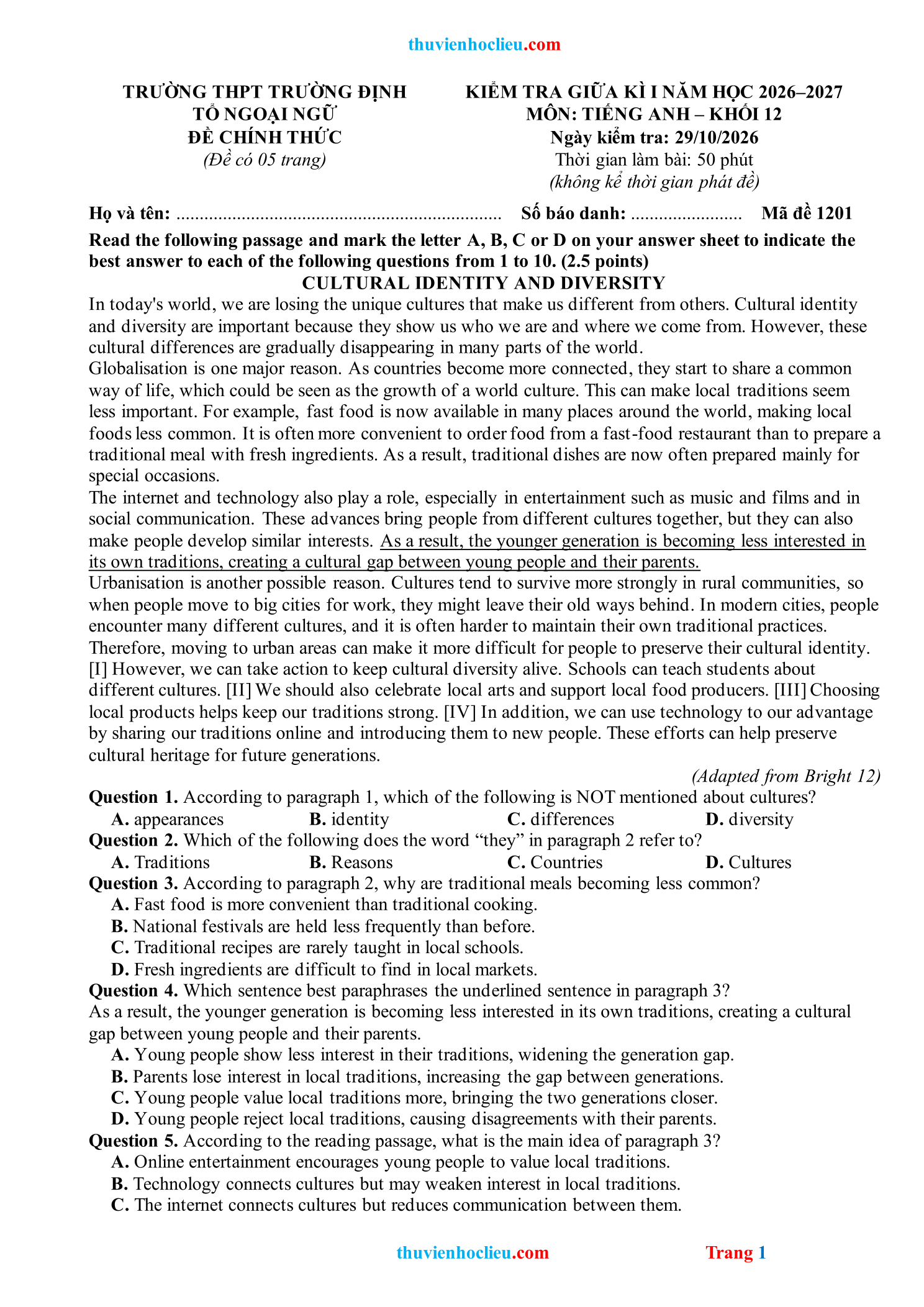
CULTURAL IDENTITY AND DIVERSITY
In today’s world, we are losing the unique cultures that make us different from others. Cultural identity and diversity are important because they show us who we are and where we come from. However, these cultural differences are gradually disappearing in many parts of the world.
Globalisation is one major reason. As countries become more connected, they start to share a common way of life, which could be seen as the growth of a world culture. This can make local traditions seem less important. For example, fast food is now available in many places around the world, making local foods less common. It is often more convenient to order food from a fast-food restaurant than to prepare a traditional meal with fresh ingredients. As a result, traditional dishes are now often prepared mainly for special occasions.
The internet and technology also play a role, especially in entertainment such as music and films and in social communication. These advances bring people from different cultures together, but they can also make people develop similar interests. As a result, the younger generation is becoming less interested in its own traditions, creating a cultural gap between young people and their parents.
Urbanisation is another possible reason. Cultures tend to survive more strongly in rural communities, so when people move to big cities for work, they might leave their old ways behind. In modern cities, people encounter many different cultures, and it is often harder to maintain their own traditional practices. Therefore, moving to urban areas can make it more difficult for people to preserve their cultural identity.
[I] However, we can take action to keep cultural diversity alive. Schools can teach students about different cultures. [II] We should also celebrate local arts and support local food producers. [III] Choosing local products helps keep our traditions strong. [IV] In addition, we can use technology to our advantage by sharing our traditions online and introducing them to new people. These efforts can help preserve cultural heritage for future generations.
(Adapted from Bright 12)Question 1. According to paragraph 1, which of the following is NOT mentioned about cultures?
A. appearances
B. identity
C. differences
D. diversity
Đáp án: A
Question 2. Which of the following does the word “they” in paragraph 2 refer to?
A. Traditions
B. Reasons
C. Countries
D. Cultures
Đáp án: C
Question 3. According to paragraph 2, why are traditional meals becoming less common?
A. Fast food is more convenient than traditional cooking.
B. National festivals are held less frequently than before.
C. Traditional recipes are rarely taught in local schools.
D. Fresh ingredients are difficult to find in local markets.
Đáp án: A
Question 4. Which sentence best paraphrases the underlined sentence in paragraph 3?
As a result, the younger generation is becoming less interested in its own traditions, creating a cultural gap between young people and their parents.
A. Young people show less interest in their traditions, widening the generation gap.
B. Parents lose interest in local traditions, increasing the gap between generations.
C. Young people value local traditions more, bringing the two generations closer.
D. Young people reject local traditions, causing disagreements with their parents.
Đáp án: A
Question 5. According to the reading passage, what is the main idea of paragraph 3?
A. Online entertainment encourages young people to value local traditions.
B. Technology connects cultures but may weaken interest in local traditions.
C. The internet connects cultures but reduces communication between them.
D. Modern technology can prevent people from developing similar interests.
Đáp án: B
Question 6. Which of the following is CLOSEST in meaning to the word “encounter” in paragraph 4?
A. discourage
B. experience
C. participate
D. specialize
Đáp án: B
Question 7. According to the reading passage, what can be inferred from paragraph 4 about the impact of urbanisation?
A. It encourages many city dwellers to adopt rural lifestyles.
B. It forces migrants to abandon traditional rural lifestyles.
C. It poses a challenge to the preservation of local customs.
D. It creates equal opportunities for all cultures to flourish.
Đáp án: C
Question 8. Which of the following is OPPOSITE in meaning to the word “support” in paragraph 5?
A. respect
B. decide
C. oppose
D. value
Đáp án: C
Question 9. Where does the following sentence best fit in paragraph 5?
This can help students learn to appreciate and respect other ways of life.
A. [I]
B. [II]
C. [III]
D. [IV]
Đáp án: B
Question 10. Which sentence best summarises the reading passage?
A. Schools and local communities can preserve cultural diversity by teaching students and supporting traditional arts and foods.
B. Globalisation, technology and urbanisation threaten cultural diversity, but education and local action can help preserve it.
C. Urbanisation threatens cultural diversity because people may leave their traditional practices behind when moving to cities.
D. Globalisation and technology make fast food and online entertainment more popular, reducing interest in traditional lifestyles.
Đáp án: B
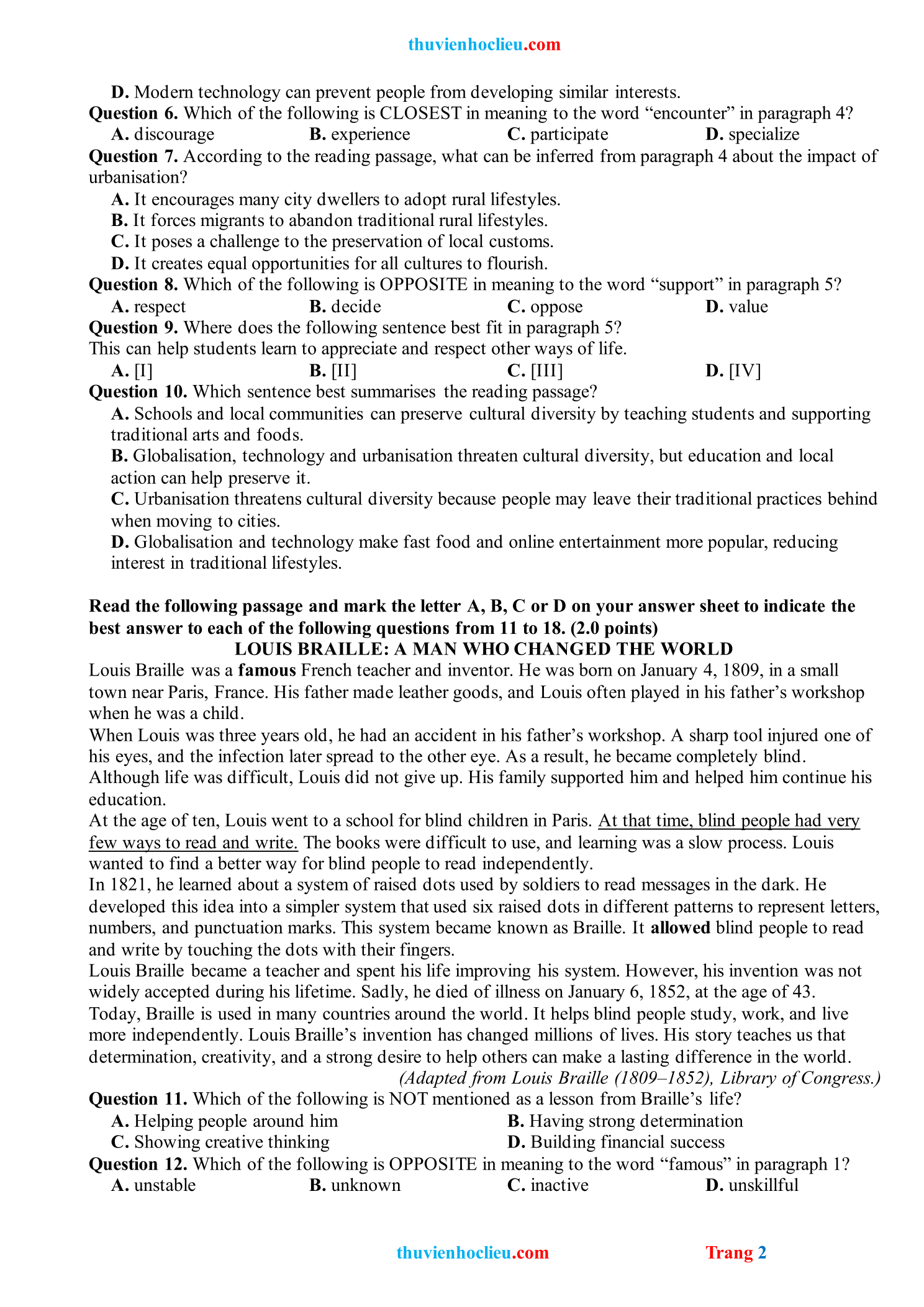
Read the following passage and mark the letter A, B, C or D on your answer sheet to indicate the best answer to each of the following questions from 11 to 18. (2.0 points)
LOUIS BRAILLE: A MAN WHO CHANGED THE WORLD
Louis Braille was a famous French teacher and inventor. He was born on January 4, 1809, in a small town near Paris, France. His father made leather goods, and Louis often played in his father’s workshop when he was a child.
When Louis was three years old, he had an accident in his father’s workshop. A sharp tool injured one of his eyes, and the infection later spread to the other eye. As a result, he became completely blind. Although life was difficult, Louis did not give up. His family supported him and helped him continue his education.
At the age of ten, Louis went to a school for blind children in Paris. At that time, blind people had very few ways to read and write. The books were difficult to use, and learning was a slow process. Louis wanted to find a better way for blind people to read independently.
In 1821, he learned about a system of raised dots used by soldiers to read messages in the dark. He developed this idea into a simpler system that used six raised dots in different patterns to represent letters, numbers, and punctuation marks. This system became known as Braille. It allowed blind people to read and write by touching the dots with their fingers.
Louis Braille became a teacher and spent his life improving his system. However, his invention was not widely accepted during his lifetime. Sadly, he died of illness on January 6, 1852, at the age of 43.
Today, Braille is used in many countries around the world. It helps blind people study, work, and live more independently. Louis Braille’s invention has changed millions of lives. His story teaches us that determination, creativity, and a strong desire to help others can make a lasting difference in the world.
(Adapted from Louis Braille (1809–1852), Library of Congress.)
Question 11. Which of the following is NOT mentioned as a lesson from Braille’s life?
A. Helping people around him
B. Having strong determination
C. Showing creative thinking
D. Building financial success
Đáp án: D
Question 12. Which of the following is OPPOSITE in meaning to the word “famous” in paragraph 1?
A. unstable
B. unknown
C. inactive
D. unskillful
Đáp án: B
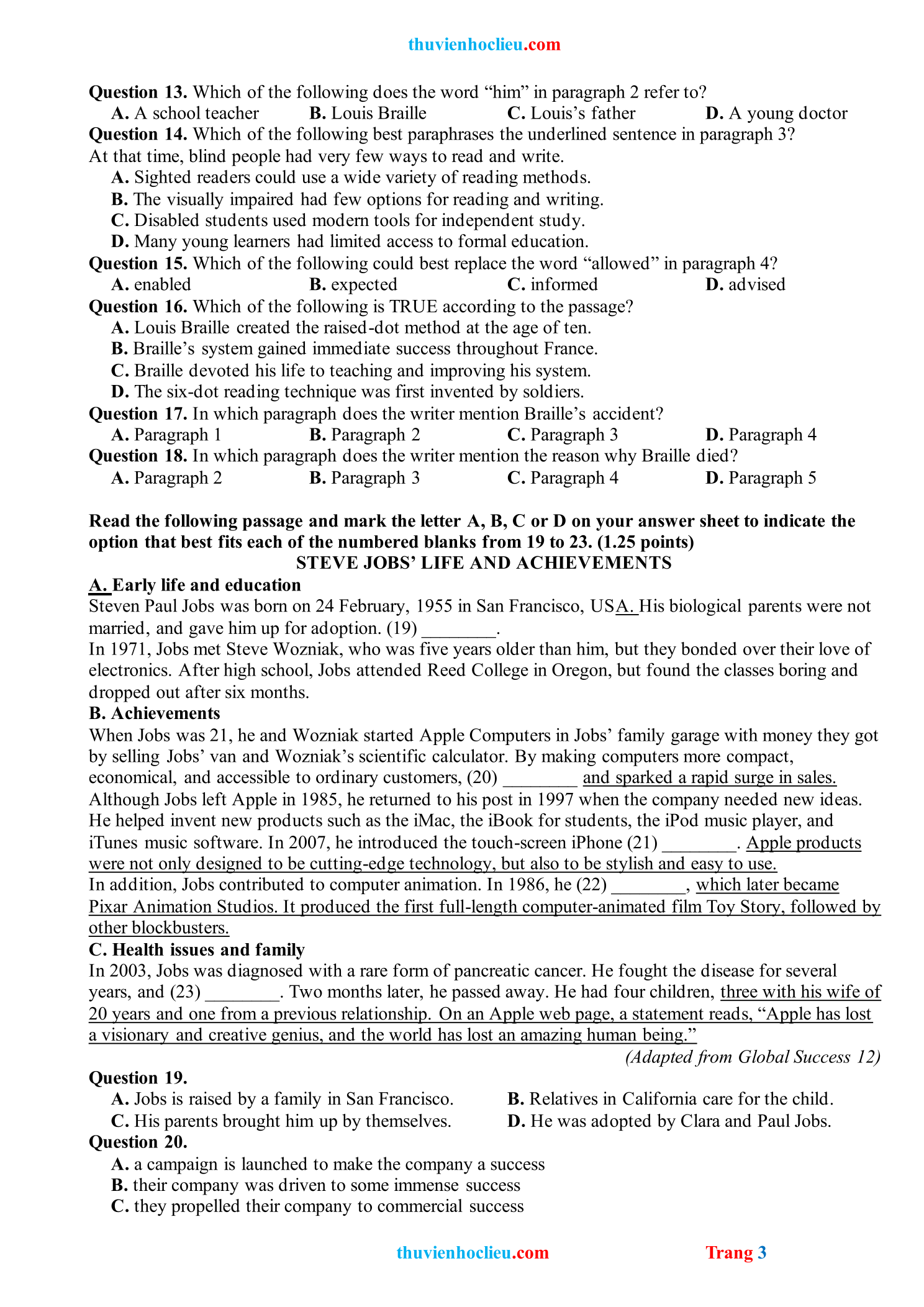
Question 13. Which of the following does the word “him” in paragraph 2 refer to?
A. A school teacher
B. Louis Braille
C. Louis’s father
D. A young doctor
Đáp án: B
Question 14. Which of the following best paraphrases the underlined sentence in paragraph 3?
At that time, blind people had very few ways to read and write.
A. Sighted readers could use a wide variety of reading methods.
B. The visually impaired had few options for reading and writing.
C. Disabled students used modern tools for independent study.
D. Many young learners had limited access to formal education.
Đáp án: B
Question 15. Which of the following could best replace the word “allowed” in paragraph 4?
A. enabled
B. expected
C. informed
D. advised
Đáp án: A
Question 16. Which of the following is TRUE according to the passage?
A. Louis Braille created the raised-dot method at the age of ten.
B. Braille’s system gained immediate success throughout France.
C. Braille devoted his life to teaching and improving his system.
D. The six-dot reading technique was first invented by soldiers.
Đáp án: C
Question 17. In which paragraph does the writer mention Braille’s accident?
A. Paragraph 1
B. Paragraph 2
C. Paragraph 3
D. Paragraph 4
Đáp án: B
Question 18. In which paragraph does the writer mention the reason why Braille died?
A. Paragraph 2
B. Paragraph 3
C. Paragraph 4
D. Paragraph 5
Đáp án: D
Read the following passage and mark the letter A, B, C or D on your answer sheet to indicate the option that best fits each of the numbered blanks from 19 to 23. (1.25 points)
STEVE JOBS’ LIFE AND ACHIEVEMENTS
A. Early life and education
Steven Paul Jobs was born on 24 February, 1955 in San Francisco, USA. His biological parents were not married, and gave him up for adoption. (19) __________.
In 1971, Jobs met Steve Wozniak, who was five years older than him, but they bonded over their love of electronics. After high school, Jobs attended Reed College in Oregon, but found the classes boring and dropped out after six months.
B. Achievements
When Jobs was 21, he and Wozniak started Apple Computers in Jobs’ family garage with money they got by selling Jobs’ van and Wozniak’s scientific calculator. By making computers more compact, economical, and accessible to ordinary customers, (20) __________ and sparked a rapid surge in sales.
Although Jobs left Apple in 1985, he returned to his post in 1997 when the company needed new ideas. He helped invent new products such as the iMac, the iBook for students, the iPod music player, and iTunes music software. In 2007, he introduced the touch-screen iPhone (21) __________. Apple products were not only designed to be cutting-edge technology, but also to be stylish and easy to use.
In addition, Jobs contributed to computer animation. In 1986, he (22) __________, which later became Pixar Animation Studios. It produced the first full-length computer-animated film Toy Story, followed by other blockbusters.
C. Health issues and family
In 2003, Jobs was diagnosed with a rare form of pancreatic cancer. He fought the disease for several years, and (23) __________. Two months later, he passed away. He had four children, three with his wife of 20 years and one from a previous relationship. On an Apple web page, a statement reads, “Apple has lost a visionary and creative genius, and the world has lost an amazing human being.”
(Adapted from Global Success 12)
Question 19.
A. Jobs is raised by a family in San Francisco.
B. Relatives in California care for the child.
C. His parents brought him up by themselves.
D. He was adopted by Clara and Paul Jobs.
Đáp án: D
Question 20.
A. a campaign is launched to make the company a success
B. their company was driven to some immense success
C. they propelled their company to commercial success
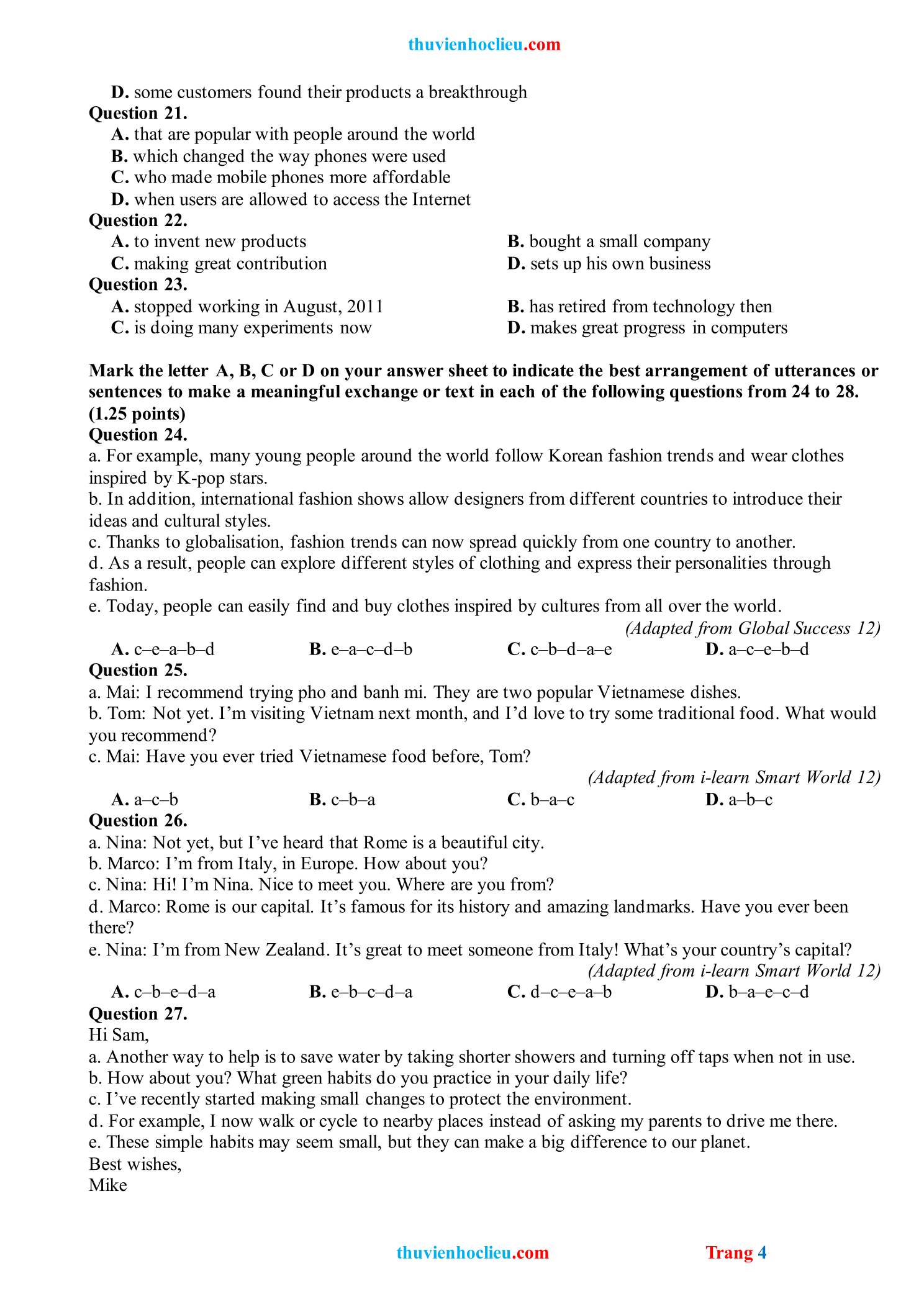
D. some customers found their products a breakthrough
Đáp án: C
Question 21.
A. that are popular with people around the world
B. which changed the way phones were used
C. who made mobile phones more affordable
D. when users are allowed to access the Internet
Đáp án: B
Question 22.
A. to invent new products
B. bought a small company
C. making great contribution
D. sets up his own business
Đáp án: B
Question 23.
A. stopped working in August, 2011
B. has retired from technology then
C. is doing many experiments now
D. makes great progress in computers
Đáp án: A
Mark the letter A, B, C or D on your answer sheet to indicate the best arrangement of utterances or sentences to make a meaningful exchange or text in each of the following questions from 24 to 28. (1.25 points)
Question 24.
a. For example, many young people around the world follow Korean fashion trends and wear clothes inspired by K-pop stars.
b. In addition, international fashion shows allow designers from different countries to introduce their ideas and cultural styles.
c. Thanks to globalisation, fashion trends can now spread quickly from one country to another.
d. As a result, people can explore different styles of clothing and express their personalities through fashion.
e. Today, people can easily find and buy clothes inspired by cultures from all over the world.
(Adapted from Global Success 12)
A. c-e-a-b-d
B. e-a-c-d-b
C. c-b-d-a-e
D. a-c-e-b-d
Đáp án: A
Question 25.
a. Mai: I recommend trying pho and banh mi. They are two popular Vietnamese dishes.
b. Tom: Not yet. I’m visiting Vietnam next month, and I’d love to try some traditional food. What would you recommend?
c. Mai: Have you ever tried Vietnamese food before, Tom?
(Adapted from i-learn Smart World 12)
A. a-c-b
B. c-b-a
C. b-a-c
D. a-b-c
Đáp án: B
Question 26.
a. Nina: Not yet, but I’ve heard that Rome is a beautiful city.
b. Marco: I’m from Italy, in Europe. How about you?
c. Nina: Hi! I’m Nina. Nice to meet you. Where are you from?
d. Marco: Rome is our capital. It’s famous for its history and amazing landmarks. Have you ever been there?
e. Nina: I’m from New Zealand. It’s great to meet someone from Italy! What’s your country’s capital?
(Adapted from i-learn Smart World 12)
A. c-b-e-d-a
B. e-b-c-d-a
C. d-c-e-a-b
D. b-a-e-c-d
Đáp án: A
Question 27.
Hi Sam,
a. Another way to help is to save water by taking shorter showers and turning off taps when not in use.
b. How about you? What green habits do you practice in your daily life?
c. I’ve recently started making small changes to protect the environment.
d. For example, I now walk or cycle to nearby places instead of asking my parents to drive me there.
e. These simple habits may seem small, but they can make a big difference to our planet.
Best wishes,
Mike
(Adapted from chatgpt.com)
A. c-d-a-e-b
B. e-d-c-b-a
C. d-a-e-c-b
D. a-c-d-b-e
Đáp án: A
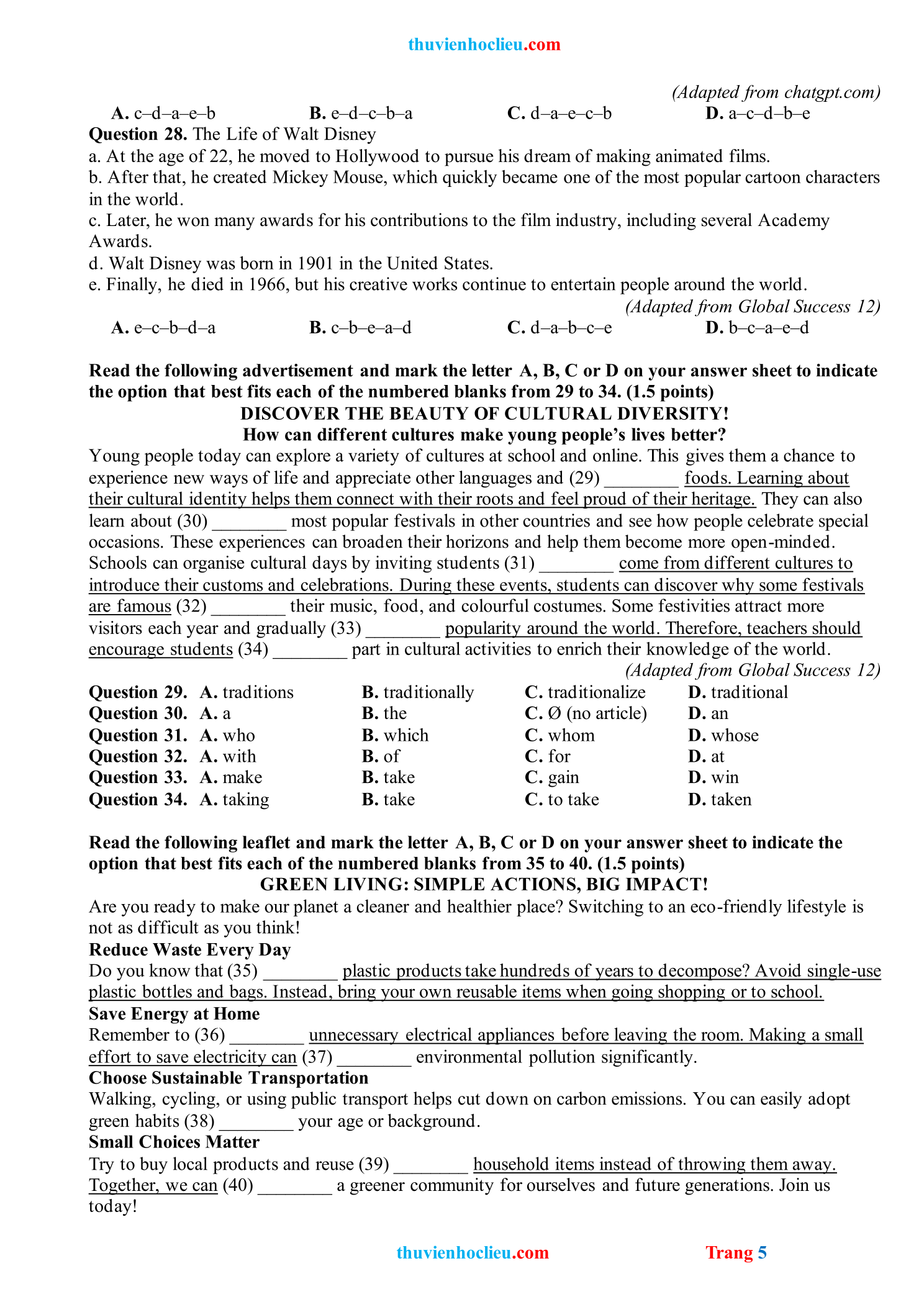
Question 28. The Life of Walt Disney
a. At the age of 22, he moved to Hollywood to pursue his dream of making animated films.
b. After that, he created Mickey Mouse, which quickly became one of the most popular cartoon characters in the world.
c. Later, he won many awards for his contributions to the film industry, including several Academy Awards.
d. Walt Disney was born in 1901 in the United States.
e. Finally, he died in 1966, but his creative works continue to entertain people around the world.
(Adapted from Global Success 12)
A. e-c-b-d-a
B. c-b-e-a-d
C. d-a-b-c-e
D. b-c-a-e-d
Đáp án: C
Read the following advertisement and mark the letter A, B, C or D on your answer sheet to indicate the option that best fits each of the numbered blanks from 29 to 34. (1.5 points)
DISCOVER THE BEAUTY OF CULTURAL DIVERSITY!
How can different cultures make young people’s lives better?
Young people today can explore a variety of cultures at school and online. This gives them a chance to experience new ways of life and appreciate other languages and (29) __________ foods. Learning about their cultural identity helps them connect with their roots and feel proud of their heritage. They can also learn about (30) __________ most popular festivals in other countries and see how people celebrate special occasions. These experiences can broaden their horizons and help them become more open-minded.
Schools can organise cultural days by inviting students (31) __________ come from different cultures to introduce their customs and celebrations. During these events, students can discover why some festivals are famous (32) __________ their music, food, and colourful costumes. Some festivities attract more visitors each year and gradually (33) __________ popularity around the world. Therefore, teachers should encourage students (34) __________ part in cultural activities to enrich their knowledge of the world.
(Adapted from Global Success 12)
Question 29.
A. traditions
B. traditionally
C. traditionalize
D. traditional
Đáp án: D
Question 30.
A. a
B. the
C. Ø (no article)
D. an
Đáp án: B
Question 31.
A. who
B. which
C. whom
D. whose
Đáp án: A
Question 32.
A. with
B. of
C. for
D. at
Đáp án: C
Question 33.
A. make
B. take
C. gain
D. win
Đáp án: C
Question 34.
A. taking
B. take
C. to take
D. taken
Đáp án: C
Read the following leaflet and mark the letter A, B, C or D on your answer sheet to indicate the option that best fits each of the numbered blanks from 35 to 40. (1.5 points)
GREEN LIVING: SIMPLE ACTIONS, BIG IMPACT!
Are you ready to make our planet a cleaner and healthier place? Switching to an eco-friendly lifestyle is not as difficult as you think!
Reduce Waste Every Day
Do you know that (35) __________ plastic products take hundreds of years to decompose? Avoid single-use plastic bottles and bags. Instead, bring your own reusable items when going shopping or to school.
Save Energy at Home
Remember to (36) __________ unnecessary electrical appliances before leaving the room. Making a small effort to save electricity can (37) __________ environmental pollution significantly.
Choose Sustainable Transportation
Walking, cycling, or using public transport helps cut down on carbon emissions. You can easily adopt green habits (38) __________ your age or background.
Small Choices Matter
Try to buy local products and reuse (39) __________ household items instead of throwing them away. Together, we can (40) __________ a greener community for ourselves and future generations. Join us today!
Question 35.
A. a lot
B. much
C. little
D. many
Đáp án: D
Question 36.
A. give up
B. take over
C. switch on
D. turn off
Đáp án: D
Question 37.
A. present
B. reduce
C. increase
D. conserve
Đáp án: B
Question 38.
A. in spite of
B. in addition to
C. instead of
D. regardless of
Đáp án: D
Question 39.
A. others
B. other
C. the others
D. another
Đáp án: B
Question 40.
A. build
B. take
C. cause
D. buy
Đáp án: A