
Đề ôn tập Giữa kì 1 Tiếng anh 12 2026 2027 – Đề 6 là bộ tài liệu học thuật môn Tiếng Anh chuyên sâu dành cho đối tượng học sinh lớp 12 do thuvienhoclieu.com biên soạn cho năm học 2026. Đây là mẫu đề kiểm tra giữa học kỳ 1 môn Tiếng Anh 12 được thiết kế nhằm mục đích khảo sát chất lượng định kỳ và xây dựng nền tảng vững chắc hỗ trợ các em ôn thi tốt nghiệp THPT. Nội dung đề thi tập trung vào các chuyên đề trọng tâm bao gồm Lifelong learning (học tập suốt đời), Cultural differences (sự khác biệt văn hóa), Naming traditions (truyền thống đặt tên) và Temple of Literature (Văn Miếu). Thông qua dạng đề thi tiếng anh 12 này, học sinh sẽ được rèn luyện kỹ năng đọc hiểu dữ kiện, kỹ thuật chọn đáp án nhanh cũng như khả năng vận dụng kiến thức ngôn ngữ vào thực tiễn đời sống và các kỳ thi quan trọng.
Việc rèn luyện với các bộ đề ôn thi lớp 12 trên dethitracnghiem.vn mang lại lợi ích to lớn cho học sinh lớp 12 trong giai đoạn tăng tốc năm 2026 nhờ giao diện thân thiện và dễ sử dụng. Người học có thể làm bài nhiều lần, xem giải thích đáp án ngay sau khi hoàn thành và hệ thống tự động theo dõi kết quả học tập để đánh giá mức độ tiến bộ theo thời gian. Các câu hỏi môn Tiếng Anh trên website được phân chia khoa học từ lý thuyết cơ bản đến bài tập tình huống thực tế, giúp học sinh làm quen với cấu trúc ra đề thực tế và nâng cao khả năng xử lý thông tin. Sử dụng nền tảng này giúp học sinh vừa nâng cao năng lực ngoại ngữ, vừa tiết kiệm thời gian ôn tập mà vẫn đạt được hiệu quả tối ưu trong quá trình chuẩn bị cho kỳ thi Đại học sắp tới.
ĐỀ THI
LINK PDF ĐỀ THI [gồm ĐỀ THI, ĐÁP ÁN, LỜI GIẢI]:
Nội dung đề thi
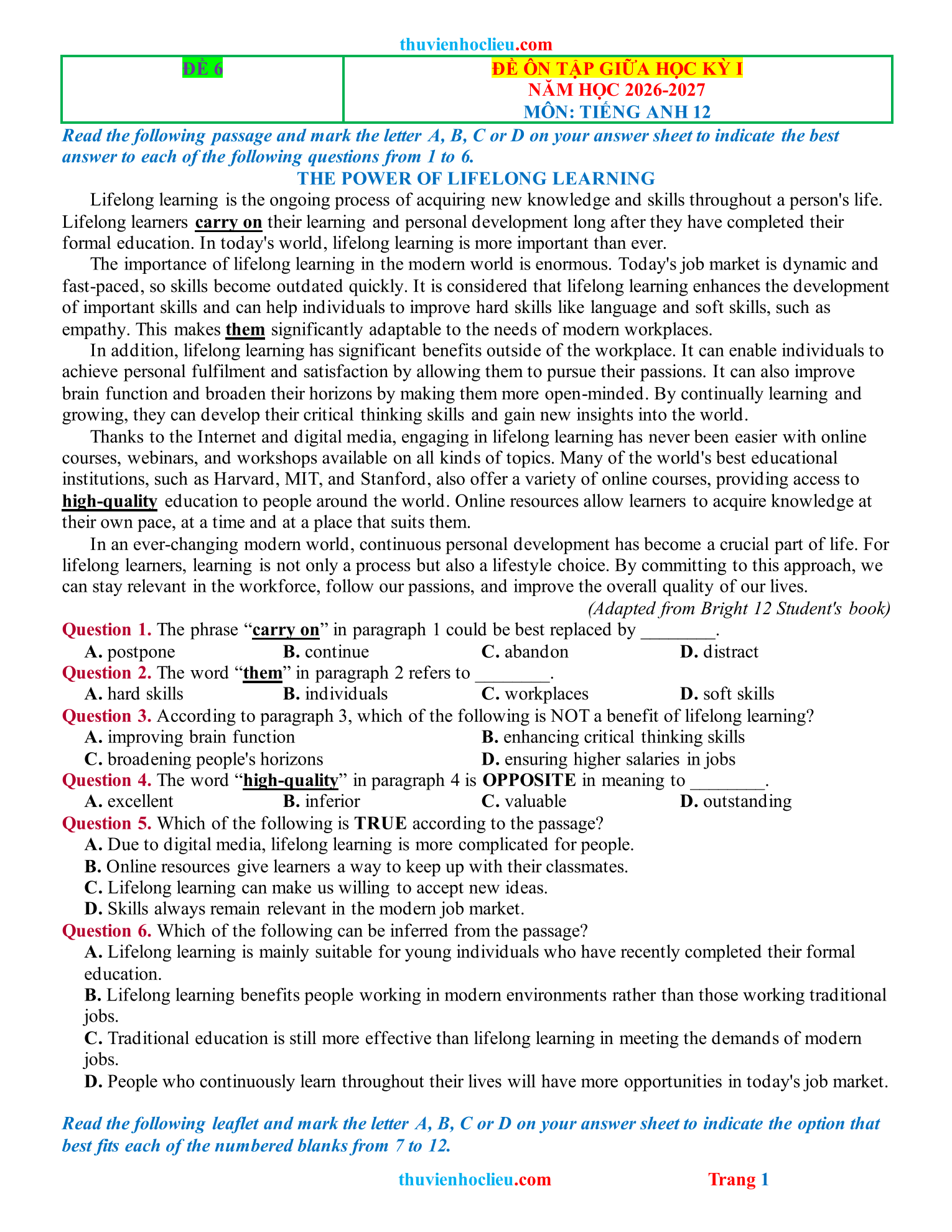
THE POWER OF LIFELONG LEARNING
Lifelong learning is the ongoing process of acquiring new knowledge and skills throughout a person’s life. Lifelong learners carry on their learning and personal development long after they have completed their formal education. In today’s world, lifelong learning is more important than ever.
The importance of lifelong learning in the modern world is enormous. Today’s job market is dynamic and fast-paced, so skills become outdated quickly. It is considered that lifelong learning enhances the development of important skills and can help individuals to improve hard skills like language and soft skills, such as empathy. This makes them significantly adaptable to the needs of modern workplaces.
In addition, lifelong learning has significant benefits outside of the workplace. It can enable individuals to achieve personal fulfilment and satisfaction by allowing them to pursue their passions. It can also improve brain function and broaden their horizons by making them more open-minded. By continually learning and growing, they can develop their critical thinking skills and gain new insights into the world.
Thanks to the Internet and digital media, engaging in lifelong learning has never been easier with online courses, webinars, and workshops available on all kinds of topics. Many of the world’s best educational institutions, such as Harvard, MIT, and Stanford, also offer a variety of online courses, providing access to high-quality education to people around the world. Online resources allow learners to acquire knowledge at their own pace, at a time and at a place that suits them.
In an ever-changing modern world, continuous personal development has become a crucial part of life. For lifelong learners, learning is not only a process but also a lifestyle choice. By committing to this approach, we can stay relevant in the workforce, follow our passions, and improve the overall quality of our lives.
(Adapted from Bright 12 Student’s book)Question 1. The phrase “carry on” in paragraph 1 could be best replaced by ______.
A. postpone
B. continue
C. abandon
D. distract
Đáp án: B
Question 2. The word “them” in paragraph 2 refers to ______.
A. hard skills
B. individuals
C. workplaces
D. soft skills
Đáp án: B
Question 3. According to paragraph 3, which of the following is NOT a benefit of lifelong learning?
A. improving brain function
B. enhancing critical thinking skills
C. broadening people’s horizons
D. ensuring higher salaries in jobs
Đáp án: D
Question 4. The word “high-quality” in paragraph 4 is OPPOSITE in meaning to ______.
A. excellent
B. inferior
C. valuable
D. outstanding
Đáp án: B
Question 5. Which of the following is TRUE according to the passage?
A. Due to digital media, lifelong learning is more complicated for people.
B. Online resources give learners a way to keep up with their classmates.
C. Lifelong learning can make us willing to accept new ideas.
D. Skills always remain relevant in the modern job market.
Đáp án: C
Question 6. Which of the following can be inferred from the passage?
A. Lifelong learning is mainly suitable for young individuals who have recently completed their formal education.
B. Lifelong learning benefits people working in modern environments rather than those working traditional jobs.
C. Traditional education is still more effective than lifelong learning in meeting the demands of modern jobs.
D. People who continuously learn throughout their lives will have more opportunities in today’s job market.
Đáp án: D
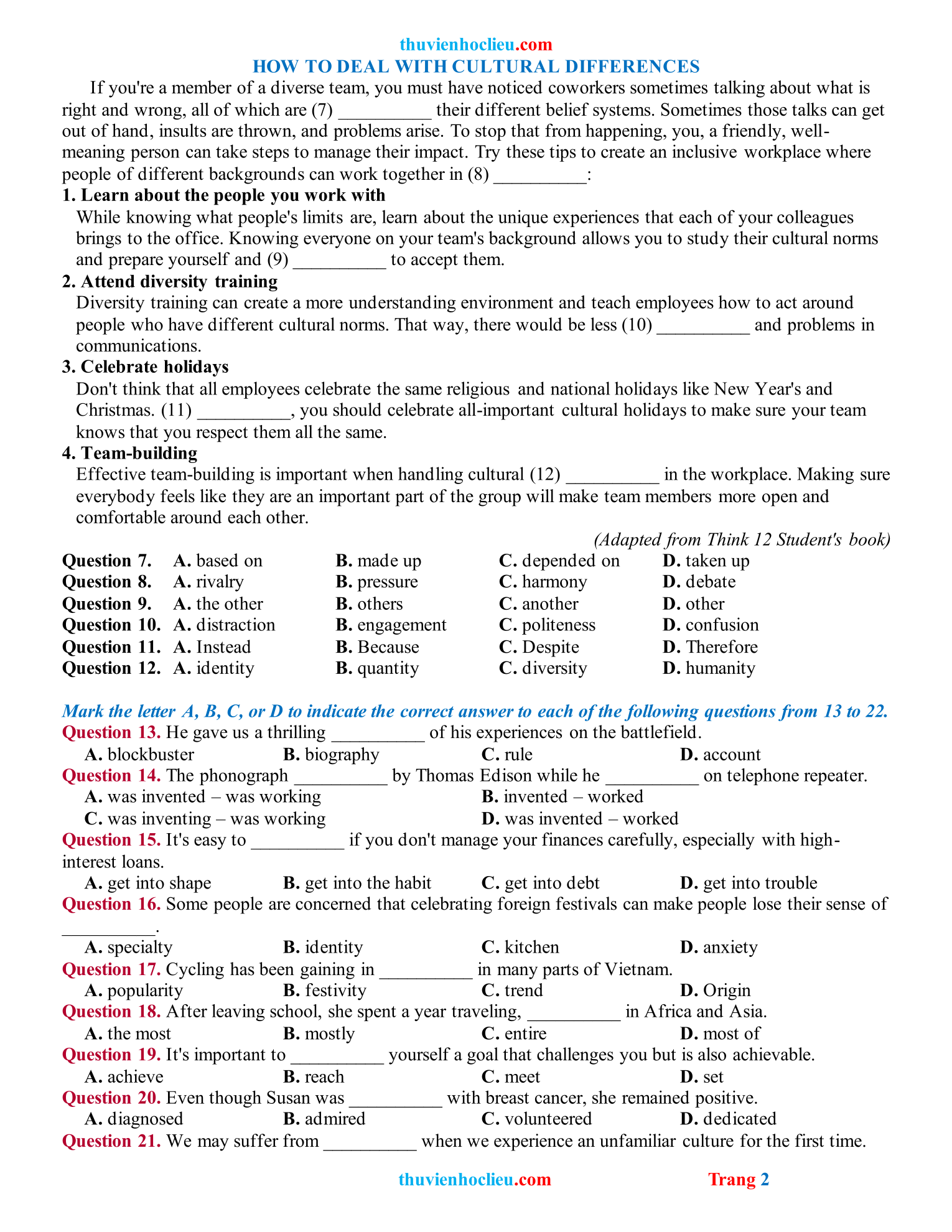
Read the following leaflet and mark the letter A, B, C or D on your answer sheet to indicate the option that best fits each of the numbered blanks from 7 to 12.
HOW TO DEAL WITH CULTURAL DIFFERENCES
If you’re a member of a diverse team, you must have noticed coworkers sometimes talking about what is right and wrong, all of which are (7) ______ their different belief systems. Sometimes those talks can get out of hand, insults are thrown, and problems arise. To stop that from happening, you, a friendly, well-meaning person can take steps to manage their impact. Try these tips to create an inclusive workplace where people of different backgrounds can work together in (8) ______:
1. Learn about the people you work with
While knowing what people’s limits are, learn about the unique experiences that each of your colleagues brings to the office. Knowing everyone on your team’s background allows you to study their cultural norms and prepare yourself and (9) ______ to accept them.
2. Attend diversity training
Diversity training can create a more understanding environment and teach employees how to act around people who have different cultural norms. That way, there would be less (10) ______ and problems in communications.
3. Celebrate holidays
Don’t think that all employees celebrate the same religious and national holidays like New Year’s and Christmas. (11) ______, you should celebrate all-important cultural holidays to make sure your team knows that you respect them all the same.
4. Team-building
Effective team-building is important when handling cultural (12) ______ in the workplace. Making sure everybody feels like they are an important part of the group will make team members more open and comfortable around each other.
(Adapted from Think 12 Student’s book)
Question 7.
A. based on
B. made up
C. depended on
D. taken up
Đáp án: A
Question 8.
A. rivalry
B. pressure
C. harmony
D. debate
Đáp án: C
Question 9.
A. the other
B. others
C. another
D. other
Đáp án: B
Question 10.
A. distraction
B. engagement
C. politeness
D. confusion
Đáp án: D
Question 11.
A. Instead
B. Because
C. Despite
D. Therefore
Đáp án: A
Question 12.
A. identity
B. quantity
C. diversity
D. humanity
Đáp án: C
Mark the letter A, B, C, or D to indicate the correct answer to each of the following questions from 13 to 22.
Question 13. He gave us a thrilling ______ of his experiences on the battlefield.
A. blockbuster
B. biography
C. rule
D. account
Đáp án: D
Question 14. The phonograph ______ by Thomas Edison while he ______ on telephone repeater.
A. was invented – was working
B. invented – worked
C. was inventing – was working
D. was invented – worked
Đáp án: A
Question 15. It’s easy to ______ if you don’t manage your finances carefully, especially with high-interest loans.
A. get into shape
B. get into the habit
C. get into debt
D. get into trouble
Đáp án: C
Question 16. Some people are concerned that celebrating foreign festivals can make people lose their sense of ______.
A. specialty
B. identity
C. kitchen
D. anxiety
Đáp án: B
Question 17. Cycling has been gaining in ______ in many parts of Vietnam.
A. popularity
B. festivity
C. trend
D. Origin
Đáp án: A
Question 18. After leaving school, she spent a year traveling, ______ in Africa and Asia.
A. the most
B. mostly
C. entire
D. most of
Đáp án: B
Question 19. It’s important to ______ yourself a goal that challenges you but is also achievable.
A. achieve
B. reach
C. meet
D. set
Đáp án: D
Question 20. Even though Susan was ______ with breast cancer, she remained positive.
A. diagnosed
B. admired
C. volunteered
D. dedicated
Đáp án: A
Question 21. We may suffer from ______ when we experience an unfamiliar culture for the first time.
A. tug of war
B. culture shock
C. lifestyle
D. bamboo dancing
Đáp án: B
Question 22. Online shopping has ______ over the past decade, especially with the rise of e-commerce.
A. gained popularity
B. gained confidence
C. gained employment
D. gained a new skill
Đáp án: A
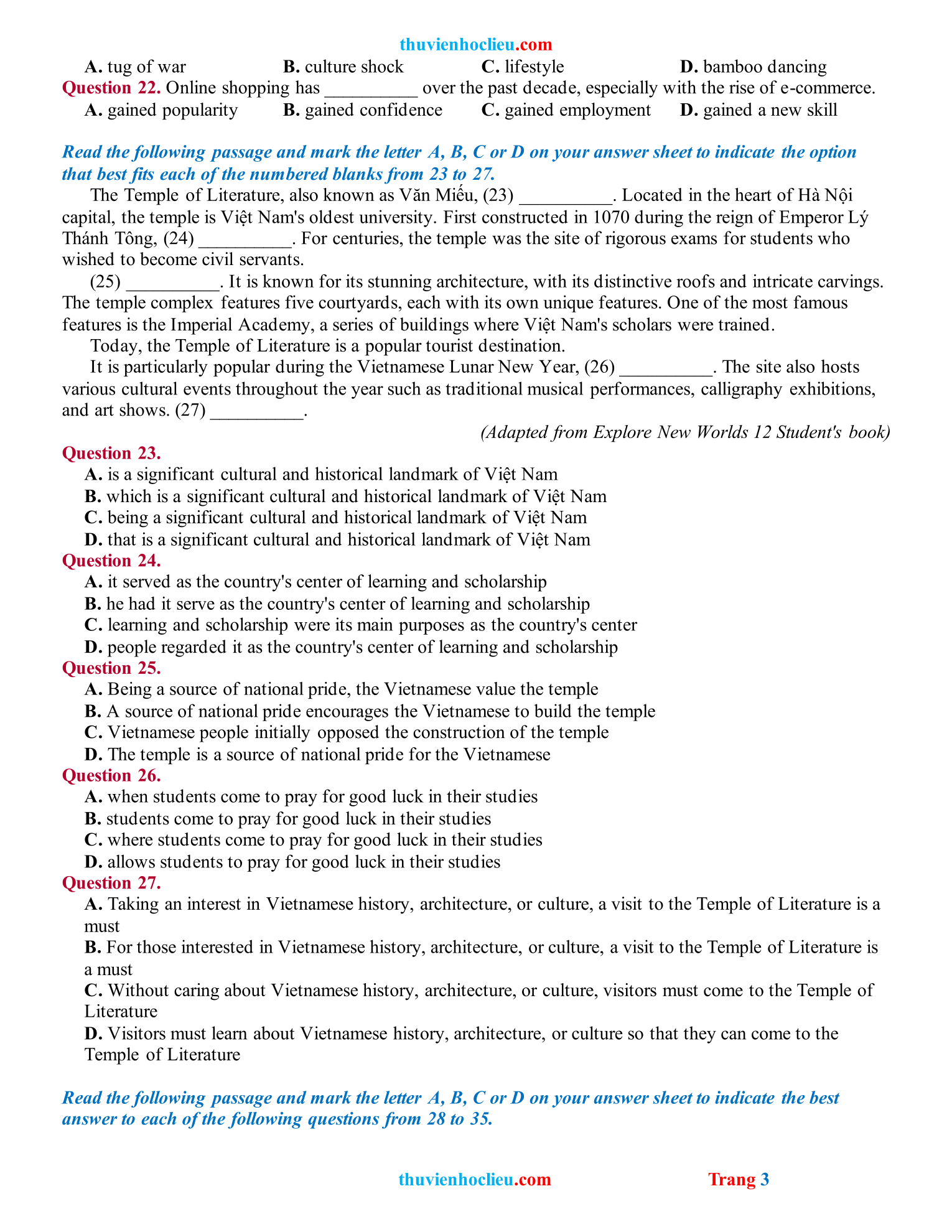
Read the following passage and mark the letter A, B, C or D on your answer sheet to indicate the option that best fits each of the numbered blanks from 23 to 27.
The Temple of Literature, also known as Văn Miếu, (23) ______. Located in the heart of Hà Nội capital, the temple is Việt Nam’s oldest university. First constructed in 1070 during the reign of Emperor Lý Thánh Tông, (24) ______. For centuries, the temple was the site of rigorous exams for students who wished to become civil servants.
(25) ______. It is known for its stunning architecture, with its distinctive roofs and intricate carvings. The temple complex features five courtyards, each with its own unique features. One of the most famous features is the Imperial Academy, a series of buildings where Việt Nam’s scholars were trained.
Today, the Temple of Literature is a popular tourist destination.
It is particularly popular during the Vietnamese Lunar New Year, (26) ______. The site also hosts various cultural events throughout the year such as traditional musical performances, calligraphy exhibitions, and art shows. (27) ______.
(Adapted from Explore New Worlds 12 Student’s book)
Question 23.
A. is a significant cultural and historical landmark of Việt Nam
B. which is a significant cultural and historical landmark of Việt Nam
C. being a significant cultural and historical landmark of Việt Nam
D. that is a significant cultural and historical landmark of Việt Nam
Đáp án: A
Question 24.
A. it served as the country’s center of learning and scholarship
B. he had it serve as the country’s center of learning and scholarship
C. learning and scholarship were its main purposes as the country’s center
D. people regarded it as the country’s center of learning and scholarship
Đáp án: A
Question 25.
A. Being a source of national pride, the Vietnamese value the temple
B. A source of national pride encourages the Vietnamese to build the temple
C. Vietnamese people initially opposed the construction of the temple
D. The temple is a source of national pride for the Vietnamese
Đáp án: D
Question 26.
A. when students come to pray for good luck in their studies
B. students come to pray for good luck in their studies
C. where students come to pray for good luck in their studies
D. allows students to pray for good luck in their studies
Đáp án: A
Question 27.
A. Taking an interest in Vietnamese history, architecture, or culture, a visit to the Temple of Literature is a must
B. For those interested in Vietnamese history, architecture, or culture, a visit to the Temple of Literature is a must
C. Without caring about Vietnamese history, architecture, or culture, visitors must come to the Temple of Literature
D. Visitors must learn about Vietnamese history, architecture, or culture so that they can come to the Temple of Literature
Đáp án: B
Read the following passage and mark the letter A, B, C or D on your answer sheet to indicate the best answer to each of the following questions from 28 to 35.
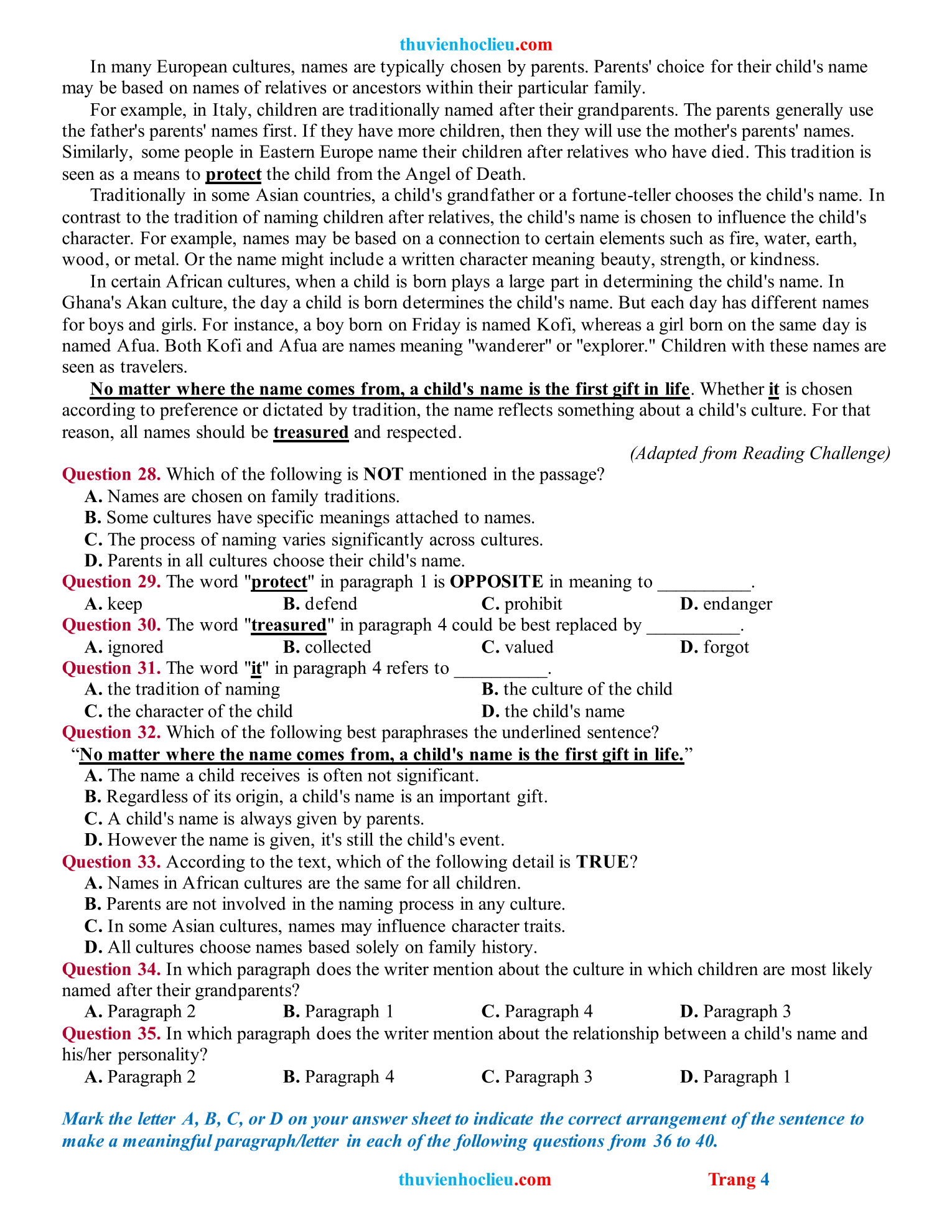
In many European cultures, names are typically chosen by parents. Parents’ choice for their child’s name may be based on names of relatives or ancestors within their particular family.
For example, in Italy, children are traditionally named after their grandparents. The parents generally use the father’s parents’ names first. If they have more children, then they will use the mother’s parents’ names. Similarly, some people in Eastern Europe name their children after relatives who have died. This tradition is seen as a means to protect the child from the Angel of Death.
Traditionally in some Asian countries, a child’s grandfather or a fortune-teller chooses the child’s name. In contrast to the tradition of naming children after relatives, the child’s name is chosen to influence the child’s character. For example, names may be based on a connection to certain elements such as fire, water, earth, wood, or metal. Or the name might include a written character meaning beauty, strength, or kindness.
In certain African cultures, when a child is born plays a large part in determining the child’s name. In Ghana’s Akan culture, the day a child is born determines the child’s name. But each day has different names for boys and girls. For instance, a boy born on Friday is named Kofi, whereas a girl born on the same day is named Afua. Both Kofi and Afua are names meaning “wanderer” or “explorer.” Children with these names are seen as travelers.
No matter where the name comes from, a child’s name is the first gift in life. Whether it is chosen according to preference or dictated by tradition, the name reflects something about a child’s culture. For that reason, all names should be treasured and respected.
(Adapted from Reading Challenge)
Question 28. Which of the following is NOT mentioned in the passage?
A. Names are chosen on family traditions.
B. Some cultures have specific meanings attached to names.
C. The process of naming varies significantly across cultures.
D. Parents in all cultures choose their child’s name.
Đáp án: D
Question 29. The word “protect” in paragraph 1 is OPPOSITE in meaning to ______.
A. keep
B. defend
C. prohibit
D. endanger
Đáp án: D
Question 30. The word “treasured” in paragraph 4 could be best replaced by ______.
A. ignored
B. collected
C. valued
D. forgot
Đáp án: C
Question 31. The word “it” in paragraph 4 refers to ______.
A. the tradition of naming
B. the culture of the child
C. the character of the child
D. the child’s name
Đáp án: D
Question 32. Which of the following best paraphrases the underlined sentence?
“No matter where the name comes from, a child’s name is the first gift in life.”
A. The name a child receives is often not significant.
B. Regardless of its origin, a child’s name is an important gift.
C. A child’s name is always given by parents.
D. However the name is given, it’s still the child’s event.
Đáp án: B
Question 33. According to the text, which of the following detail is TRUE?
A. Names in African cultures are the same for all children.
B. Parents are not involved in the naming process in any culture.
C. In some Asian cultures, names may influence character traits.
D. All cultures choose names based solely on family history.
Đáp án: C
Question 34. In which paragraph does the writer mention about the culture in which children are most likely named after their grandparents?
A. Paragraph 2
B. Paragraph 1
C. Paragraph 4
D. Paragraph 3
Đáp án: A
Question 35. In which paragraph does the writer mention about the relationship between a child’s name and his/her personality?
A. Paragraph 2
B. Paragraph 4
C. Paragraph 3
D. Paragraph 1
Đáp án: C
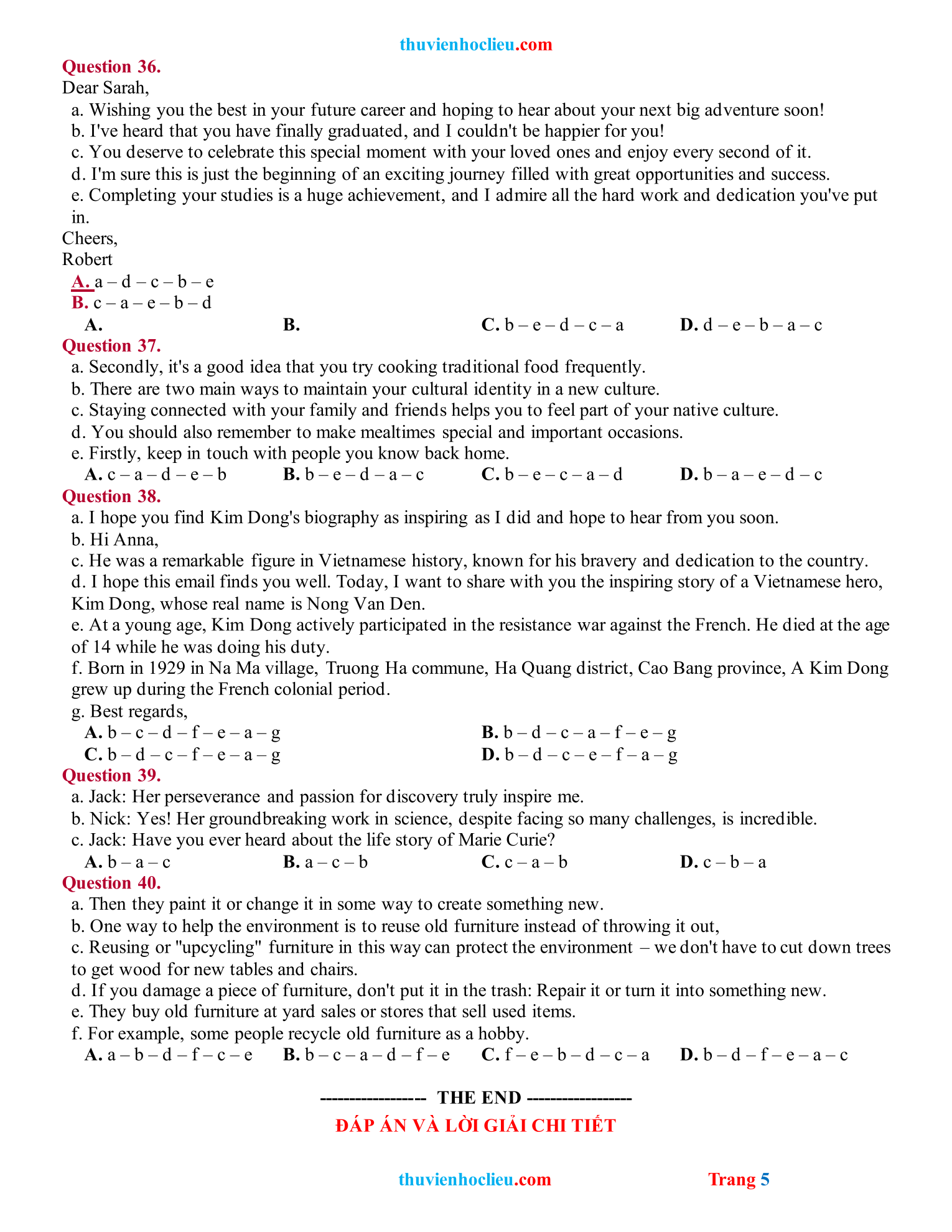
Mark the letter A, B, C, or D on your answer sheet to indicate the correct arrangement of the sentence to make a meaningful paragraph/letter in each of the following questions from 36 to 40.
Question 36.
Dear Sarah,
a. Wishing you the best in your future career and hoping to hear about your next big adventure soon!
b. I’ve heard that you have finally graduated, and I couldn’t be happier for you!
c. You deserve to celebrate this special moment with your loved ones and enjoy every second of it.
d. I’m sure this is just the beginning of an exciting journey filled with great opportunities and success.
e. Completing your studies is a huge achievement, and I admire all the hard work and dedication you’ve put in.
Cheers,
Robert
A. a – d – c – b – e
B. c – a – e – b – d
C. b – e – d – c – a
D. d – e – b – a – c
Đáp án: C
Question 37.
a. Secondly, it’s a good idea that you try cooking traditional food frequently.
b. There are two main ways to maintain your cultural identity in a new culture.
c. Staying connected with your family and friends helps you to feel part of your native culture.
d. You should also remember to make mealtimes special and important occasions.
e. Firstly, keep in touch with people you know back home.
A. c – a – d – e – b
B. b – e – d – a – c
C. b – e – c – a – d
D. b – a – e – d – c
Đáp án: C
Question 38.
a. I hope you find Kim Dong’s biography as inspiring as I did and hope to hear from you soon.
b. Hi Anna,
c. He was a remarkable figure in Vietnamese history, known for his bravery and dedication to the country.
d. I hope this email finds you well. Today, I want to share with you the inspiring story of a Vietnamese hero, Kim Dong, whose real name is Nong Van Den.
e. At a young age, Kim Dong actively participated in the resistance war against the French. He died at the age of 14 while he was doing his duty.
f. Born in 1929 in Na Ma village, Truong Ha commune, Ha Quang district, Cao Bang province, A Kim Dong grew up during the French colonial period.
g. Best regards,
A. b – c – d – f – e – a – g
B. b – d – c – a – f – e – g
C. b – d – c – f – e – a – g
D. b – d – c – e – f – a – g
Đáp án: C
Question 39.
a. Jack: Her perseverance and passion for discovery truly inspire me.
b. Nick: Yes! Her groundbreaking work in science, despite facing so many challenges, is incredible.
c. Jack: Have you ever heard about the life story of Marie Curie?
A. b – a – c
B. a – c – b
C. c – a – b
D. c – b – a
Đáp án: D
Question 40.
a. Then they paint it or change it in some way to create something new.
b. One way to help the environment is to reuse old furniture instead of throwing it out,
c. Reusing or “upcycling” furniture in this way can protect the environment – we don’t have to cut down trees to get wood for new tables and chairs.
d. If you damage a piece of furniture, don’t put it in the trash: Repair it or turn it into something new.
e. They buy old furniture at yard sales or stores that sell used items.
f. For example, some people recycle old furniture as a hobby.
A. a – b – d – f – c – e
B. b – c – a – d – f – e
C. f – e – b – d – c – a
D. b – d – f – e – a – c
Đáp án: D