Đề thi giữa kì 1 Tiếng anh 12 năm 2026 2027 THPT Chuyên Lý Tự Trọng (Cần Thơ) là tài liệu học thuật chất lượng cao thuộc bộ môn Tiếng Anh, được thiết kế chuyên biệt cho học sinh lớp 12 nhằm mục đích khảo sát năng lực định kỳ. Được biên soạn bởi đội ngũ chuyên môn của Sở GD&ĐT TP Cần Thơ cho năm học 2026, đây là mẫu đề thi tốt nghiệp THPT môn Tiếng Anh giúp các em củng cố kiến thức và chuẩn bị tâm lý vững vàng cho kỳ thi quốc gia. Nội dung đề tập trung vào các chuyên đề hiện đại như Green lifestyle, Inspiring life stories, Intercultural communication và Environmental protection, đòi hỏi học sinh phải vận dụng linh hoạt từ vựng và ngữ pháp vào các ngữ cảnh thực tiễn. Đây không chỉ là một bài kiểm tra định kỳ mà còn là dạng đề trắc nghiệm ôn thi đại học giúp rèn luyện kỹ năng đọc hiểu dữ kiện nhanh, phương pháp loại trừ đáp án và nâng cao tư duy ngôn ngữ một cách toàn diện.
Trải nghiệm luyện tập các bộ đề ôn thi chuyển cấp trên dethitracnghiem.vn mang lại lợi thế lớn cho học sinh lớp 12 trong giai đoạn tăng tốc năm 2026. Với giao diện trực quan và dễ sử dụng, website cho phép người học thực hiện bài thi nhiều lần, xem đáp án giải thích chi tiết ngay sau khi nộp bài và tự theo dõi biểu đồ tiến bộ của bản thân. Điểm nổi bật của môn Tiếng Anh trên nền tảng này là hệ thống câu hỏi được phân hóa khoa học, từ lý thuyết cơ bản đến các bài tập tình huống thực tế, giúp học sinh làm quen với cấu trúc ra đề mới nhất. Việc luyện đề thường xuyên không chỉ giúp nâng cao khả năng vận dụng kiến thức mà còn hỗ trợ tối ưu hóa thời gian làm bài, tạo tiền đề vững chắc để đạt điểm số cao trong các kỳ thi chính thức.
Đề thi giữa kì 1 Tiếng anh 12 năm 2026 2027 THPT Chuyên Lý Tự Trọng (Cần Thơ) là tài liệu học thuật chuyên sâu và có tính phân hóa vượt trội dành cho học sinh khối 12, được biên soạn nhằm mục đích khảo sát năng lực ngoại ngữ định kỳ và kiến tạo bệ phóng vững chắc cho kỳ thi cuối kì 1 2026 2027. Do tổ Tiếng Anh trường THPT Chuyên Lý Tự Trọng thuộc Sở GD&ĐT Cần Thơ trực tiếp xây dựng cho năm học 2026 – 2027, bộ đề thi giữa kì 1 tiếng anh 12 này mang đậm phong cách ra đề của trường chuyên trọng điểm vùng Đồng bằng sông Cửu Long với vốn từ vựng phong phú, bám sát các chủ đề lớn như danh nhân thế giới (Life stories), thế giới đa văn hóa (A multicultural world) và lối sống xanh (Green living), đan xen các cấu trúc ngữ pháp nâng cao về sự phối hợp thì, mạo từ cùng mệnh đề phân từ. Thử sức cùng bộ đề trắc nghiệm tiếng anh 12 đỉnh cao này sẽ giúp các em rèn luyện kỹ năng đọc hiểu văn bản học thuật và sơ đồ thông tin, tối ưu hóa kỹ thuật loại trừ để chọn nhanh trắc nghiệm, nhận diện bẫy ngữ âm tinh vi và phản xạ linh hoạt trước các tình huống giao tiếp liên hệ thực tế giàu tính hội nhập quốc tế.
Nhằm hỗ trợ học sinh cả nước tiếp cận nguồn đề thi chuyên chất lượng cao, nền tảng dethitracnghiem liên tục chọn lọc và cập nhật những đề kiểm tra mới nhất năm học 2026 – 2027 từ các trường THPT chuyên trên toàn quốc, mang đến hệ sinh thái học tập với đa dạng đề thi và môn học. Website sở hữu giao diện online trực quan, cho phép học sinh làm bài nhiều lần dưới áp lực thời gian chuẩn, đồng thời tra cứu bảng điểm, đáp án chi tiết và giải thích ngữ pháp cặn kẽ ngay sau khi nộp bài để chủ động lấp đầy các khoảng trống kiến thức kịp thời. Nhờ hệ thống câu hỏi có tính phân hóa rõ ràng từ thông hiểu đến vận dụng cao, nền tảng giúp người học tiết kiệm thời gian ôn thi một cách khoa học. Việc chủ động rèn luyện chuỗi đề thi lớp 12 chọn lọc tại đây chính là phương án tối ưu giúp các em xây dựng tâm lý tự tin, sẵn sàng bứt phá điểm số trong kỳ thi Tốt nghiệp THPT.
ĐỀ THI
LINK PDF ĐỀ THI [gồm ĐỀ THI, ĐÁP ÁN, LỜI GIẢI]:
Nội dung đề thi
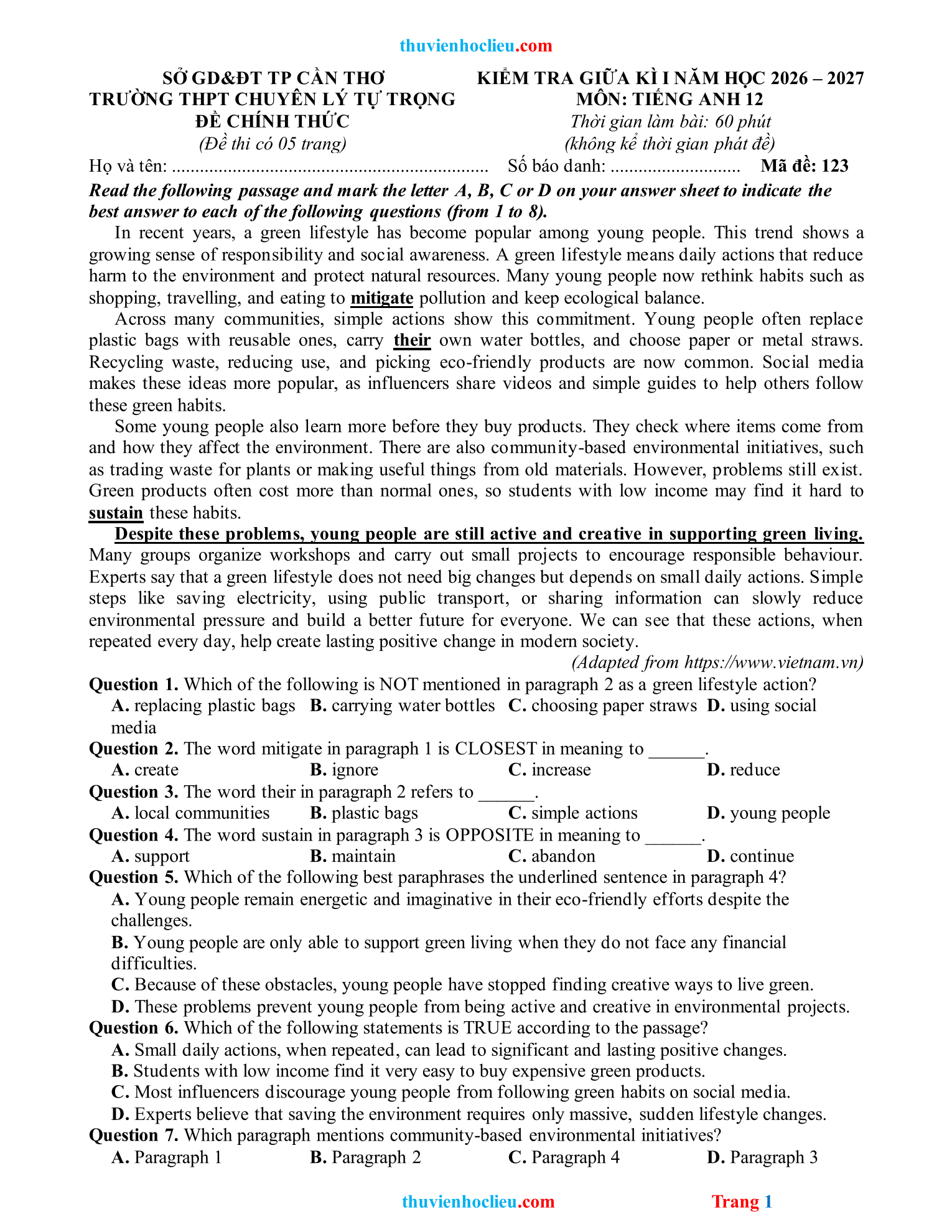
In recent years, a green lifestyle has become popular among young people. This trend shows a growing sense of responsibility and social awareness. A green lifestyle means daily actions that reduce harm to the environment and protect natural resources. Many young people now rethink habits such as shopping, travelling, and eating to mitigate pollution and keep ecological balance.
Across many communities, simple actions show this commitment. Young people often replace plastic bags with reusable ones, carry their own water bottles, and choose paper or metal straws. Recycling waste, reducing use, and picking eco-friendly products are now common. Social media makes these ideas more popular, as influencers share videos and simple guides to help others follow these green habits.
Some young people also learn more before they buy products. They check where items come from and how they affect the environment. There are also community-based environmental initiatives, such as trading waste for plants or making useful things from old materials. However, problems still exist. Green products often cost more than normal ones, so students with low income may find it hard to sustain these habits.
Despite these problems, young people are still active and creative in supporting green living. Many groups organize workshops and carry out small projects to encourage responsible behaviour. Experts say that a green lifestyle does not need big changes but depends on small daily actions. Simple steps like saving electricity, using public transport, or sharing information can slowly reduce environmental pressure and build a better future for everyone. We can see that these actions, when repeated every day, help create lasting positive change in modern society.
Question 1.
Which of the following is NOT mentioned in paragraph 2 as a green lifestyle action?
A. replacing plastic bags
B. carrying water bottles
C. choosing paper straws
D. using social media
Đáp án: D
Question 2.
The word mitigate in paragraph 1 is CLOSEST in meaning to ______.
A. create
B. ignore
C. increase
D. reduce
Đáp án: D
Question 3.
The word their in paragraph 2 refers to ______.
A. local communities
B. plastic bags
C. simple actions
D. young people
Đáp án: D
Question 4.
The word sustain in paragraph 3 is OPPOSITE in meaning to ______.
A. support
B. maintain
C. abandon
D. continue
Đáp án: C
Question 5.
Which of the following best paraphrases the underlined sentence in paragraph 4?
A. Young people remain energetic and imaginative in their eco-friendly efforts despite the challenges.
B. Young people are only able to support green living when they do not face any financial difficulties.
C. Because of these obstacles, young people have stopped finding creative ways to live green.
D. These problems prevent young people from being active and creative in environmental projects.
Đáp án: A
Question 6.
Which of the following statements is TRUE according to the passage?
A. Small daily actions, when repeated, can lead to significant and lasting positive changes.
B. Students with low income find it very easy to buy expensive green products.
C. Most influencers discourage young people from following green habits on social media.
D. Experts believe that saving the environment requires only massive, sudden lifestyle changes.
Đáp án: A
Question 7.
Which paragraph mentions community-based environmental initiatives?
A. Paragraph 1
B. Paragraph 2
C. Paragraph 4
D. Paragraph 3
Đáp án: D
Question 8.
Which paragraph mentions online communication platforms used to spread green lifestyle ideas?
A. Paragraph 2
B. Paragraph 4
C. Paragraph 1
D. Paragraph 3
Đáp án: A
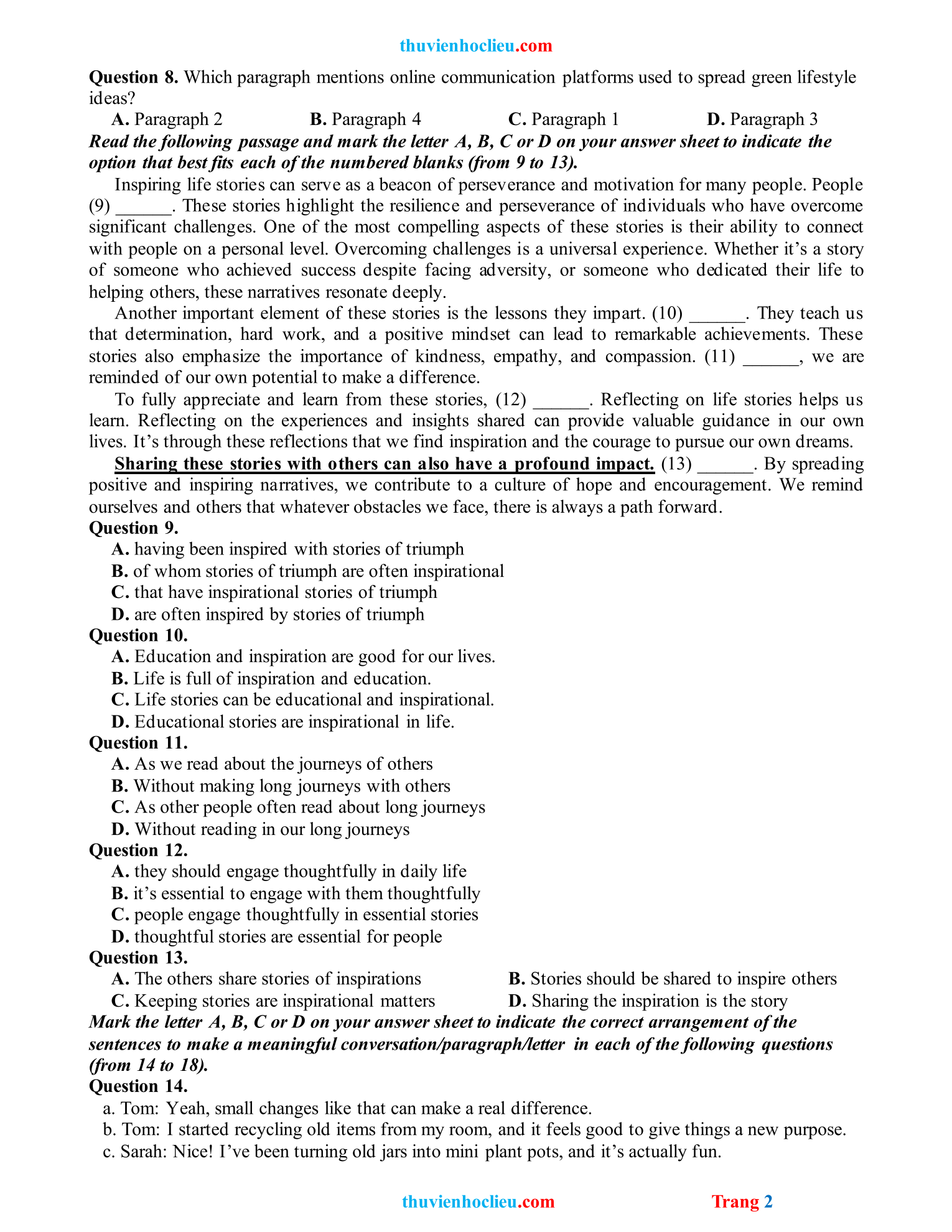
Read the following passage and mark the letter A, B, C or D on your answer sheet to indicate the option that best fits each of the numbered blanks (from 9 to 13).
Inspiring life stories can serve as a beacon of perseverance and motivation for many people. People (9) ______. These stories highlight the resilience and perseverance of individuals who have overcome significant challenges. One of the most compelling aspects of these stories is their ability to connect with people on a personal level. Overcoming challenges is a universal experience. Whether it’s a story of someone who achieved success despite facing adversity, or someone who dedicated their life to helping others, these narratives resonate deeply.
Another important element of these stories is the lessons they impart. (10) ______. They teach us that determination, hard work, and a positive mindset can lead to remarkable achievements. These stories also emphasize the importance of kindness, empathy, and compassion. (11) ______, we are reminded of our own potential to make a difference.
To fully appreciate and learn from these stories, (12) ______. Reflecting on life stories helps us learn. Reflecting on the experiences and insights shared can provide valuable guidance in our own lives. It’s through these reflections that we find inspiration and the courage to pursue our own dreams.
Sharing these stories with others can also have a profound impact. (13) ______. By spreading positive and inspiring narratives, we contribute to a culture of hope and encouragement. We remind ourselves and others that whatever obstacles we face, there is always a path forward.
Question 9.
A. having been inspired with stories of triumph
B. of whom stories of triumph are often inspirational
C. that have inspirational stories of triumph
D. are often inspired by stories of triumph
Đáp án: D
Question 10.
A. Education and inspiration are good for our lives.
B. Life is full of inspiration and education.
C. Life stories can be educational and inspirational.
D. Educational stories are inspirational in life.
Đáp án: C
Question 11.
A. As we read about the journeys of others
B. Without making long journeys with others
C. As other people often read about long journeys
D. Without reading in our long journeys
Đáp án: A
Question 12.
A. they should engage thoughtfully in daily life
B. it’s essential to engage with them thoughtfully
C. people engage thoughtfully in essential stories
D. thoughtful stories are essential for people
Đáp án: B
Question 13.
A. The others share stories of inspirations
B. Stories should be shared to inspire others
C. Keeping stories are inspirational matters
D. Sharing the inspiration is the story
Đáp án: B
Mark the letter A, B, C or D on your answer sheet to indicate the correct arrangement of the sentences to make a meaningful conversation/paragraph/letter in each of the following questions (from 14 to 18).
Question 14.
a. Tom: Yeah, small changes like that can make a real difference.
b. Tom: I started recycling old items from my room, and it feels good to give things a new purpose.
c. Sarah: Nice! I’ve been turning old jars into mini plant pots, and it’s actually fun.
A. b – c – a
B. b – a – c
C. a – c – b
D. a – b – c
Đáp án: A
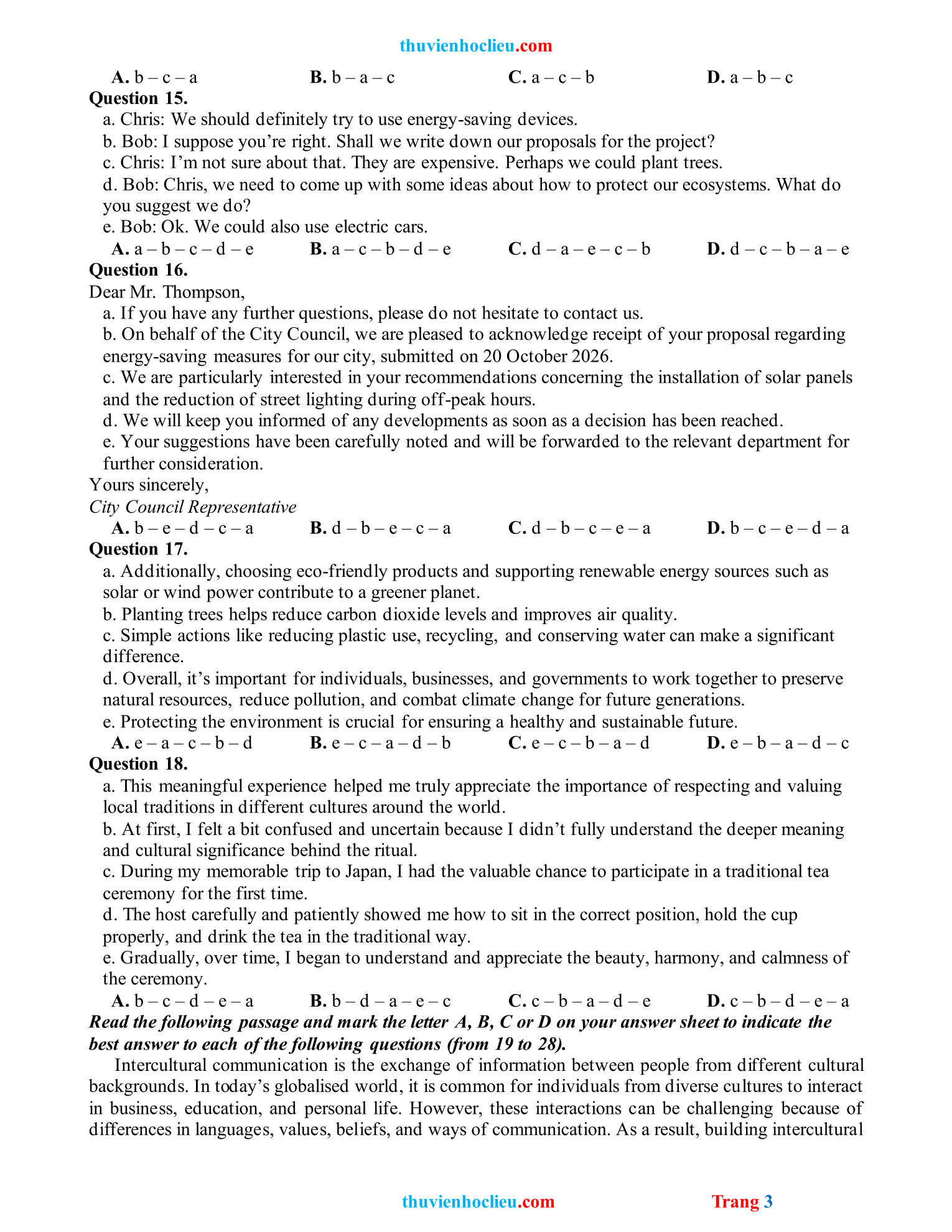
Question 15.
a. Chris: We should definitely try to use energy-saving devices.
b. Bob: I suppose you’re right. Shall we write down our proposals for the project?
c. Chris: I’m not sure about that. They are expensive. Perhaps we could plant trees.
d. Bob: Chris, we need to come up with some ideas about how to protect our ecosystems. What do you suggest we do?
e. Bob: Ok. We could also use electric cars.
A. a – b – c – d – e
B. a – c – b – d – e
C. d – a – e – c – b
D. d – c – b – a – e
Đáp án: C
Question 16.
Dear Mr. Thompson,
a. If you have any further questions, please do not hesitate to contact us.
b. On behalf of the City Council, we are pleased to acknowledge receipt of your proposal regarding energy-saving measures for our city, submitted on 20 October 2026.
c. We are particularly interested in your recommendations concerning the installation of solar panels and the reduction of street lighting during off-peak hours.
d. We will keep you informed of any developments as soon as a decision has been reached.
e. Your suggestions have been carefully noted and will be forwarded to the relevant department for further consideration.
Yours sincerely,
City Council Representative
A. b – e – d – c – a
B. d – b – e – c – a
C. d – b – c – e – a
D. b – c – e – d – a
Đáp án: D
Question 17.
a. Additionally, choosing eco-friendly products and supporting renewable energy sources such as solar or wind power contribute to a greener planet.
b. Planting trees helps reduce carbon dioxide levels and improves air quality.
c. Simple actions like reducing plastic use, recycling, and conserving water can make a significant difference.
d. Overall, it’s important for individuals, businesses, and governments to work together to preserve natural resources, reduce pollution, and combat climate change for future generations.
e. Protecting the environment is crucial for ensuring a healthy and sustainable future.
A. e – a – c – b – d
B. e – c – a – d – b
C. e – c – b – a – d
D. e – b – a – d – c
Đáp án: C
Question 18.
a. This meaningful experience helped me truly appreciate the importance of respecting and valuing local traditions in different cultures around the world.
b. At first, I felt a bit confused and uncertain because I didn’t fully understand the deeper meaning and cultural significance behind the ritual.
c. During my memorable trip to Japan, I had the valuable chance to participate in a traditional tea ceremony for the first time.
d. The host carefully and patiently showed me how to sit in the correct position, hold the cup properly, and drink the tea in the traditional way.
e. Gradually, over time, I began to understand and appreciate the beauty, harmony, and calmness of the ceremony.
A. b – c – d – e – a
B. b – d – a – e – c
C. c – b – a – d – e
D. c – b – d – e – a
Đáp án: D
Read the following passage and mark the letter A, B, C or D on your answer sheet to indicate the best answer to each of the following questions (from 19 to 28).
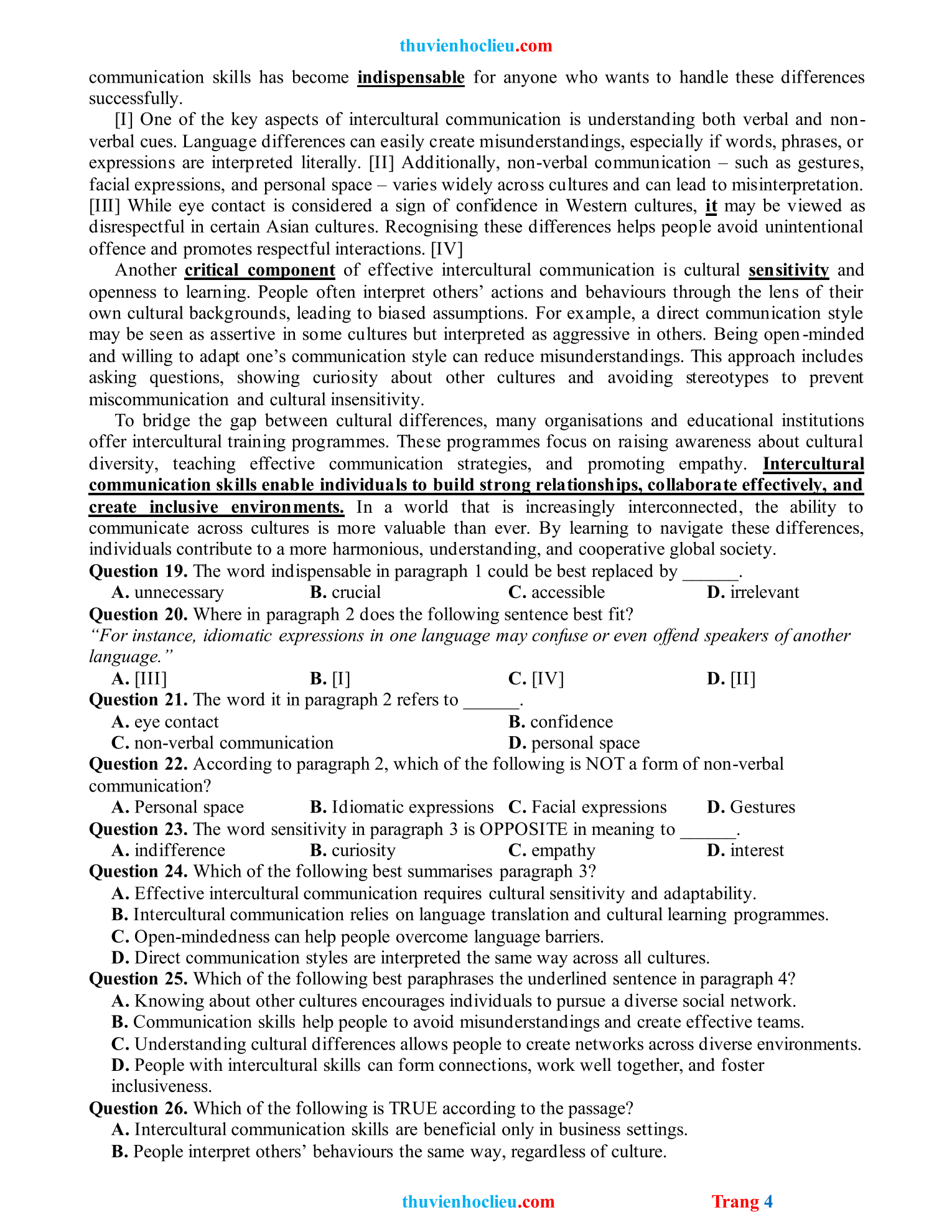
Intercultural communication is the exchange of information between people from different cultural backgrounds. In today’s globalised world, it is common for individuals from diverse cultures to interact in business, education, and personal life. However, these interactions can be challenging because of differences in languages, values, beliefs, and ways of communication. As a result, building intercultural communication skills has become indispensable for anyone who wants to handle these differences successfully.
[I] One of the key aspects of intercultural communication is understanding both verbal and non-verbal cues. Language differences can easily create misunderstandings, especially if words, phrases, or expressions are interpreted literally. [II] Additionally, non-verbal communication – such as gestures, facial expressions, and personal space – varies widely across cultures and can lead to misinterpretation. [III] While eye contact is considered a sign of confidence in Western cultures, it may be viewed as disrespectful in certain Asian cultures. Recognising these differences helps people avoid unintentional offence and promotes respectful interactions. [IV]
Another critical component of effective intercultural communication is cultural sensitivity and openness to learning. People often interpret others’ actions and behaviours through the lens of their own cultural backgrounds, leading to biased assumptions. For example, a direct communication style may be seen as assertive in some cultures but interpreted as aggressive in others. Being open-minded and willing to adapt one’s communication style can reduce misunderstandings. This approach includes asking questions, showing curiosity about other cultures and avoiding stereotypes to prevent miscommunication and cultural insensitivity.
To bridge the gap between cultural differences, many organisations and educational institutions offer intercultural training programmes. These programmes focus on raising awareness about cultural diversity, teaching effective communication strategies, and promoting empathy. Intercultural communication skills enable individuals to build strong relationships, collaborate effectively, and create inclusive environments. In a world that is increasingly interconnected, the ability to communicate across cultures is more valuable than ever. By learning to navigate these differences, individuals contribute to a more harmonious, understanding, and cooperative global society.
Question 19.
The word indispensable in paragraph 1 could be best replaced by ______.
A. unnecessary
B. crucial
C. accessible
D. irrelevant
Đáp án: B
Question 20.
Where in paragraph 2 does the following sentence best fit?
“For instance, idiomatic expressions in one language may confuse or even offend speakers of another language.”
A. [III]
B. [I]
C. [IV]
D. [II]
Đáp án: D
Question 21.
The word it in paragraph 2 refers to ______.
A. eye contact
B. confidence
C. non-verbal communication
D. personal space
Đáp án: A
Question 22.
According to paragraph 2, which of the following is NOT a form of non-verbal communication?
A. Personal space
B. Idiomatic expressions
C. Facial expressions
D. Gestures
Đáp án: B
Question 23.
The word sensitivity in paragraph 3 is OPPOSITE in meaning to ______.
A. indifference
B. curiosity
C. empathy
D. interest
Đáp án: A
Question 24.
Which of the following best summarises paragraph 3?
A. Effective intercultural communication requires cultural sensitivity and adaptability.
B. Intercultural communication relies on language translation and cultural learning programmes.
C. Open-mindedness can help people overcome language barriers.
D. Direct communication styles are interpreted the same way across all cultures.
Đáp án: A
Question 25.
Which of the following best paraphrases the underlined sentence in paragraph 4?
A. Knowing about other cultures encourages individuals to pursue a diverse social network.
B. Communication skills help people to avoid misunderstandings and create effective teams.
C. Understanding cultural differences allows people to create networks across diverse environments.
D. People with intercultural skills can form connections, work well together, and foster inclusiveness.
Đáp án: D
Question 26.
Which of the following is TRUE according to the passage?
A. Intercultural communication skills are beneficial only in business settings.
B. People interpret others’ behaviours the same way, regardless of culture.
C. Gestures and facial expressions are universally understood across cultures.
D. Intercultural training programmes promote cultural awareness and empathy.
Đáp án: D
Question 27.
Which of the following can be inferred from the passage?
A. Without intercultural skills, interactions across cultures may lead to unintended offence.
B. Effective intercultural communication eliminates cultural misunderstandings entirely.
C. Intercultural training is only essential in professional settings, not personal ones.
D. Non-verbal cues are more important than language differences when communicating across cultures.
Đáp án: A
Question 28.
Which of the following best summarises the passage?
A. Developing intercultural communication skills is essential for reducing misunderstandings and fostering respect in a globalised world.
B. Understanding non-verbal cues is the most crucial element of intercultural communication for building respectful relationships.
C. The main goal of intercultural communication is to adapt one’s own cultural norms to fit into other societies.
D. Intercultural communication primarily involves learning a new language to avoid misunderstandings across cultures.
Đáp án: A
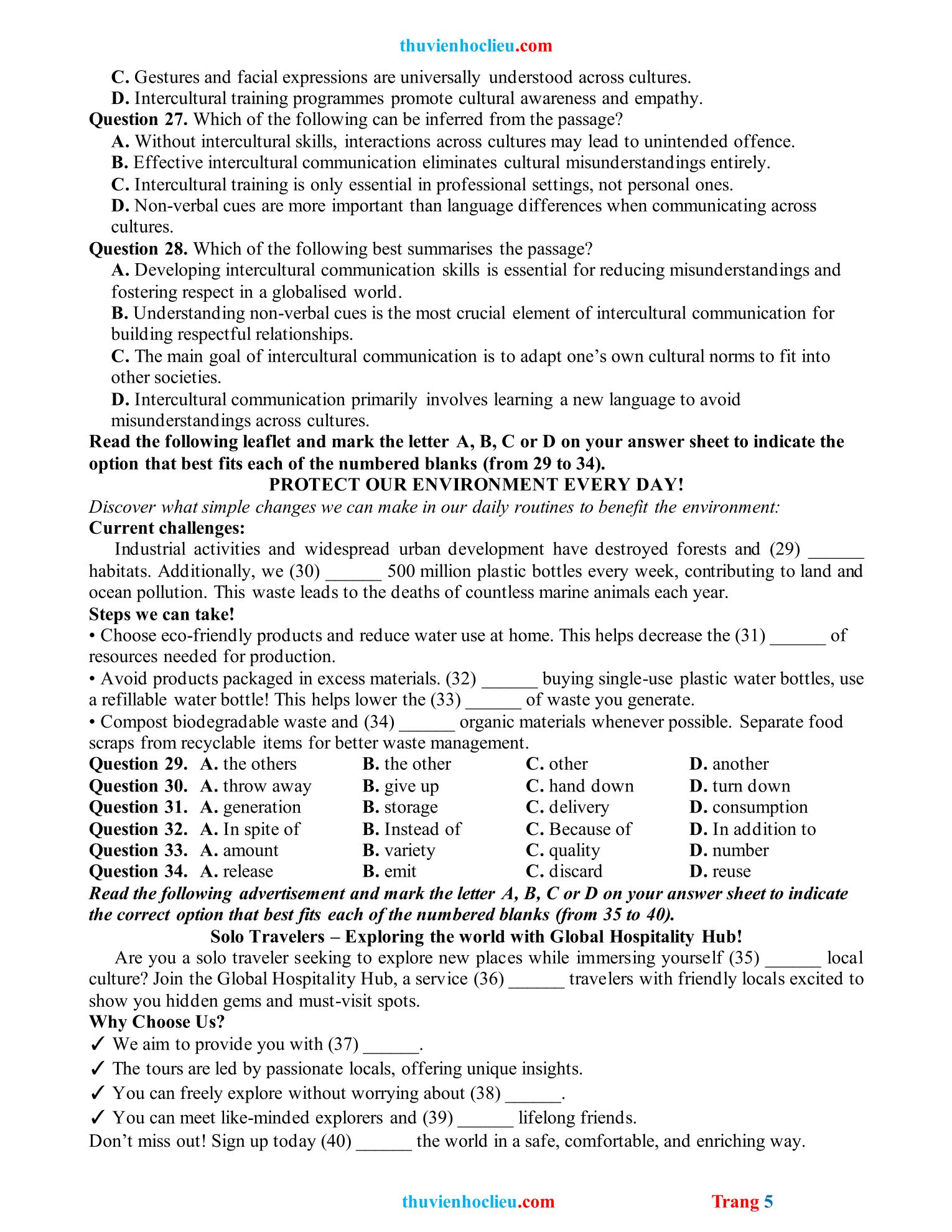
Read the following leaflet and mark the letter A, B, C or D on your answer sheet to indicate the option that best fits each of the numbered blanks (from 29 to 34).
PROTECT OUR ENVIRONMENT EVERY DAY!
Discover what simple changes we can make in our daily routines to benefit the environment:
Current challenges:
Industrial activities and widespread urban development have destroyed forests and (29) ______ habitats. Additionally, we (30) ______ 500 million plastic bottles every week, contributing to land and ocean pollution. This waste leads to the deaths of countless marine animals each year.
Steps we can take!
• Choose eco-friendly products and reduce water use at home. This helps decrease the (31) ______ of resources needed for production.
• Avoid products packaged in excess materials. (32) ______ buying single-use plastic water bottles, use a refillable water bottle! This helps lower the (33) ______ of waste you generate.
• Compost biodegradable waste and (34) ______ organic materials whenever possible. Separate food scraps from recyclable items for better waste management.
Question 29.
A. the others
B. the other
C. other
D. another
Đáp án: C
Question 30.
A. throw away
B. give up
C. hand down
D. turn down
Đáp án: A
Question 31.
A. generation
B. storage
C. delivery
D. consumption
Đáp án: D
Question 32.
A. In spite of
B. Instead of
C. Because of
D. In addition to
Đáp án: B
Question 33.
A. amount
B. variety
C. quality
D. number
Đáp án: A
Question 34.
A. release
B. emit
C. discard
D. reuse
Đáp án: D
Read the following advertisement and mark the letter A, B, C or D on your answer sheet to indicate the correct option that best fits each of the numbered blanks (from 35 to 40).
Solo Travelers – Exploring the world with Global Hospitality Hub!
Are you a solo traveler seeking to explore new places while immersing yourself (35) ______ local culture? Join the Global Hospitality Hub, a service (36) ______ travelers with friendly locals excited to show you hidden gems and must-visit spots.
Why Choose Us?
✓ We aim to provide you with (37) ______.
✓ The tours are led by passionate locals, offering unique insights.
✓ You can freely explore without worrying about (38) ______.
✓ You can meet like-minded explorers and (39) ______ lifelong friends.
Don’t miss out! Sign up today (40) ______ the world in a safe, comfortable, and enriching way.
Question 35.
A. out
B. on
C. off
D. in
Đáp án: D
Question 36.
A. is connected
B. connecting
C. which connects
D. connected
Đáp án: B
Question 37.
A. cultural experience authenticity
B. authentic cultural experiences
C. experience authentic culture
D. cultural authentic experiences
Đáp án: B
Question 38.
A. transporter
B. transportable
C. transported
D. transportation
Đáp án: D
Question 39.
A. take
B. put
C. do
D. make
Đáp án: D
Question 40.
A. experiencing
B. to experience
C. experienced
D. experience
Đáp án: B