
Đề thi giữa kì 1 Tiếng anh 12 năm 2026 2027 THPT Gò Công Đông (Đồng Tháp) là tài liệu học tập chuẩn mực và giàu giá trị thực tiễn dành cho học sinh khối 12, được thiết kế kỹ lưỡng nhằm mục đích đánh giá năng lực ngoại ngữ định kỳ và củng cố nền tảng kiến thức vững vàng cho kỳ thi cuối kì 1 2026 2027. Được biên soạn bởi tổ Ngoại ngữ trường THPT Gò Công Đông thuộc Sở GD&ĐT Đồng Tháp cho năm học 2026 – 2027, bộ đề thi giữa kì 1 tiếng anh 12 này thể hiện rõ phong cách giáo dục thực chất của miền sông nước, kết hợp hài hòa giữa vốn từ vựng chủ điểm như tiểu sử danh nhân (Life stories), thế giới đa văn hóa (A multicultural world) với các hiện tượng ngữ pháp cốt lõi về phối hợp thì quá khứ, mạo từ và liên từ chỉ kết quả. Thực hành trực tiếp với bộ đề trắc nghiệm tiếng anh 12 này sẽ giúp các em rèn luyện kỹ năng đọc hiểu văn bản thông tin và bảng biểu chỉ dẫn, làm chủ kỹ thuật loại trừ để chọn nhanh trắc nghiệm, nhận diện bẫy ngữ âm – trọng âm và phản xạ linh hoạt trước các tình huống giao tiếp liên hệ thực tế bám sát hơi thở đời sống hiện đại.
Đồng hành cùng các bạn học sinh trong mùa ôn thi, nền tảng dethitracnghiem liên tục chọn lọc và cập nhật những đề kiểm tra mới nhất năm học 2026 – 2027 từ các trường THPT trọng điểm trên cả nước, cung cấp kho học liệu phong phú với đa dạng đề thi và môn học. Website sở hữu giao diện online trực quan, cho phép học sinh làm bài nhiều lần dưới áp lực thời gian chuẩn, đồng thời tra cứu bảng điểm và xem lời giải thích chi tiết cặn kẽ ngay sau khi nộp bài để chủ động lấp đầy các lỗ hổng kiến thức kịp thời. Nhờ hệ thống câu hỏi có tính phân hóa rõ ràng từ nhận biết đến vận dụng cao, nền tảng giúp người học tiết kiệm thời gian ôn thi một cách tối đa. Việc chủ động rèn luyện chuỗi đề thi lớp 12 chất lượng tại đây chính là giải pháp tối ưu giúp các em xây dựng tâm lý tự tin, sẵn sàng bứt phá điểm số trong kỳ thi Tốt nghiệp THPT.
ĐỀ THI
LINK PDF ĐỀ THI [gồm ĐỀ THI, ĐÁP ÁN, LỜI GIẢI]:
Nội dung đề thi
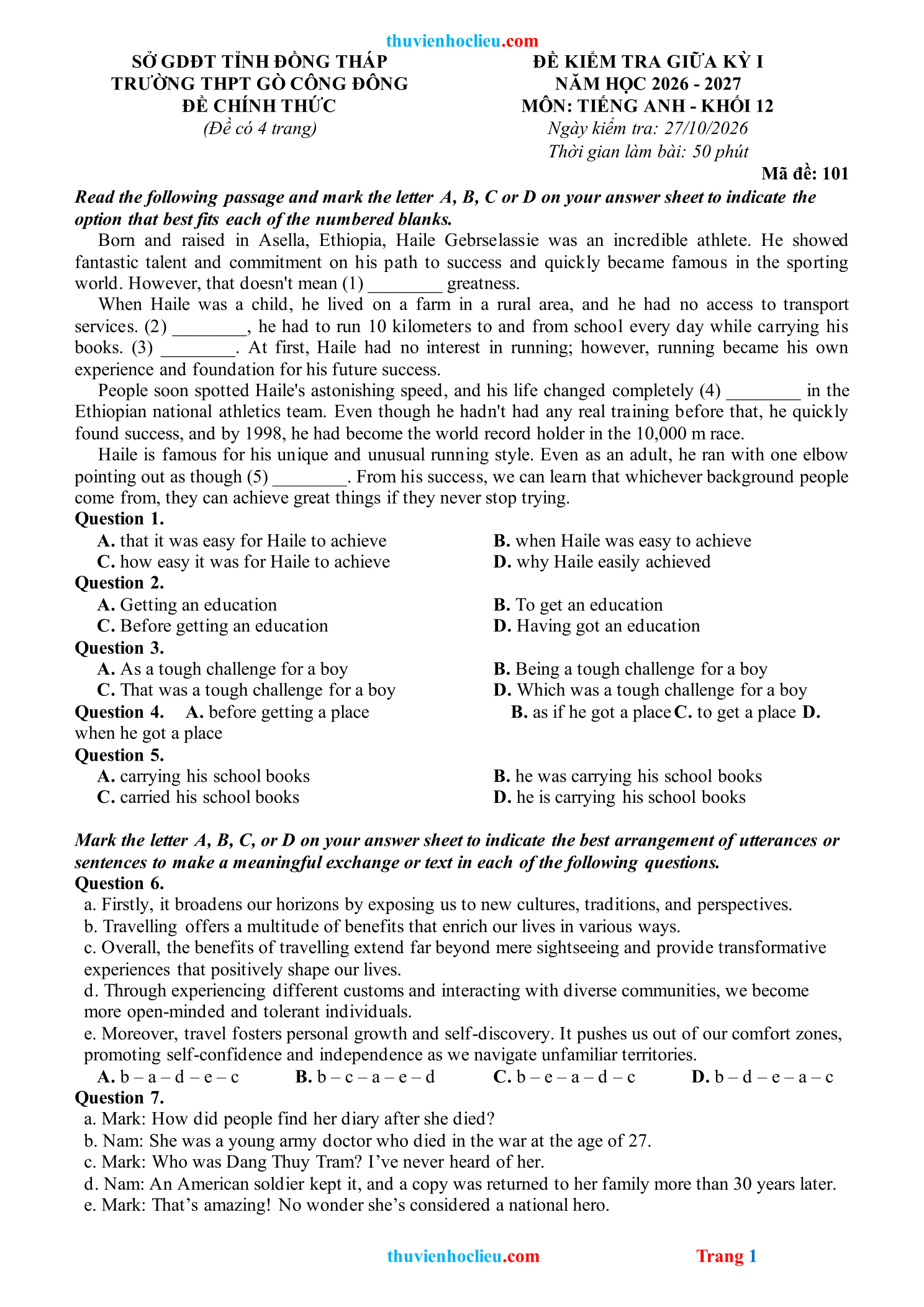
Born and raised in Asella, Ethiopia, Haile Gebrselassie was an incredible athlete. He showed fantastic talent and commitment on his path to success and quickly became famous in the sporting world. However, that doesn’t mean (1) ______ greatness.
When Haile was a child, he lived on a farm in a rural area, and he had no access to transport services. (2) ______, he had to run 10 kilometers to and from school every day while carrying his books. (3) ______. At first, Haile had no interest in running; however, running became his own experience and foundation for his future success.
People soon spotted Haile’s astonishing speed, and his life changed completely (4) ______ in the Ethiopian national athletics team. Even though he hadn’t had any real training before that, he quickly found success, and by 1998, he had become the world record holder in the 10,000 m race.
Haile is famous for his unique and unusual running style. Even as an adult, he ran with one elbow pointing out as though (5) ______. From his success, we can learn that whichever background people come from, they can achieve great things if they never stop trying.
Question 1.
A. that it was easy for Haile to achieve
B. when Haile was easy to achieve
C. how easy it was for Haile to achieve
D. why Haile easily achieved
Đáp án: A
Question 2.
A. Getting an education
B. To get an education
C. Before getting an education
D. Having got an education
Đáp án: B
Question 3.
A. As a tough challenge for a boy
B. Being a tough challenge for a boy
C. That was a tough challenge for a boy
D. Which was a tough challenge for a boy
Đáp án: C
Question 4.
A. before getting a place
B. as if he got a place
C. to get a place
D. when he got a place
Đáp án: D
Question 5.
A. carrying his school books
B. he was carrying his school books
C. carried his school books
D. he is carrying his school books
Đáp án: A
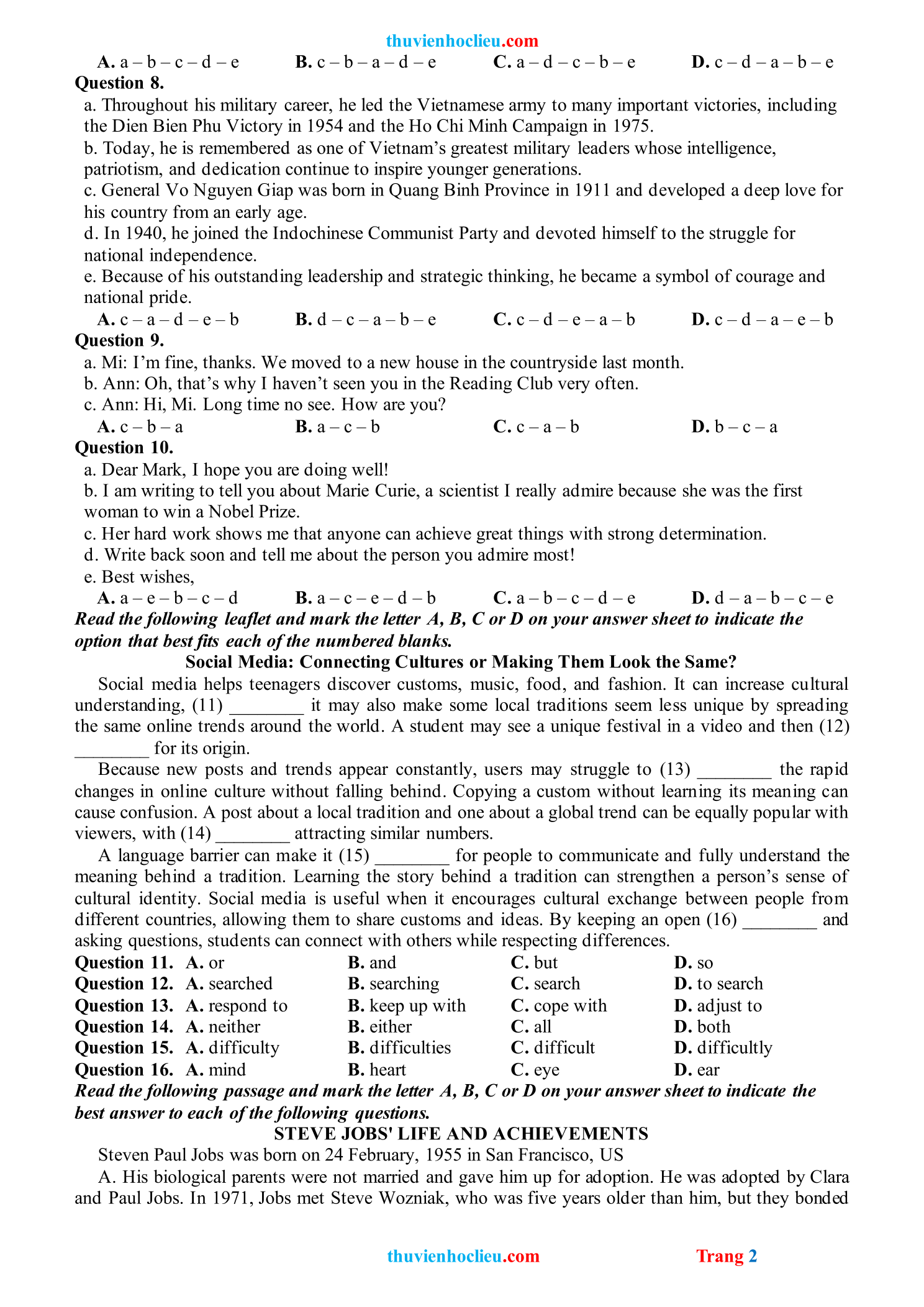
Mark the letter A, B, C, or D on your answer sheet to indicate the best arrangement of utterances or sentences to make a meaningful exchange or text in each of the following questions.
Question 6.
a. Firstly, it broadens our horizons by exposing us to new cultures, traditions, and perspectives.
b. Travelling offers a multitude of benefits that enrich our lives in various ways.
c. Overall, the benefits of travelling extend far beyond mere sightseeing and provide transformative experiences that positively shape our lives.
d. Through experiencing different customs and interacting with diverse communities, we become more open-minded and tolerant individuals.
e. Moreover, travel fosters personal growth and self-discovery. It pushes us out of our comfort zones, promoting self-confidence and independence as we navigate unfamiliar territories.
A. b – a – d – e – c
B. b – c – a – e – d
C. b – e – a – d – c
D. b – d – e – a – c
Đáp án: A
Question 7.
a. Mark: How did people find her diary after she died?
b. Nam: She was a young army doctor who died in the war at the age of 27.
c. Mark: Who was Dang Thuy Tram? I’ve never heard of her.
d. Nam: An American soldier kept it, and a copy was returned to her family more than 30 years later.
e. Mark: That’s amazing! No wonder she’s considered a national hero.
A. a – b – c – d – e
B. c – b – a – d – e
C. a – d – c – b – e
D. c – d – a – b – e
Đáp án: B
Question 8.
a. Throughout his military career, he led the Vietnamese army to many important victories, including the Dien Bien Phu Victory in 1954 and the Ho Chi Minh Campaign in 1975.
b. Today, he is remembered as one of Vietnam’s greatest military leaders whose intelligence, patriotism, and dedication continue to inspire younger generations.
c. General Vo Nguyen Giap was born in Quang Binh Province in 1911 and developed a deep love for his country from an early age.
d. In 1940, he joined the Indochinese Communist Party and devoted himself to the struggle for national independence.
e. Because of his outstanding leadership and strategic thinking, he became a symbol of courage and national pride.
A. c – a – d – e – b
B. d – c – a – b – e
C. c – d – e – a – b
D. c – d – a – e – b
Đáp án: D
Question 9.
a. Mi: I’m fine, thanks. We moved to a new house in the countryside last month.
b. Ann: Oh, that’s why I haven’t seen you in the Reading Club very often.
c. Ann: Hi, Mi. Long time no see. How are you?
A. c – b – a
B. a – c – b
C. c – a – b
D. b – c – a
Đáp án: C
Question 10.
a. Dear Mark, I hope you are doing well!
b. I am writing to tell you about Marie Curie, a scientist I really admire because she was the first woman to win a Nobel Prize.
c. Her hard work shows me that anyone can achieve great things with strong determination.
d. Write back soon and tell me about the person you admire most!
e. Best wishes,
A. a – e – b – c – d
B. a – c – e – d – b
C. a – b – c – d – e
D. d – a – b – c – e
Đáp án: C
Read the following leaflet and mark the letter A, B, C or D on your answer sheet to indicate the option that best fits each of the numbered blanks.
Social Media: Connecting Cultures or Making Them Look the Same?
Social media helps teenagers discover customs, music, food, and fashion. It can increase cultural understanding, (11) ______ it may also make some local traditions seem less unique by spreading the same online trends around the world. A student may see a unique festival in a video and then (12) ______ for its origin.
Because new posts and trends appear constantly, users may struggle to (13) ______ the rapid changes in online culture without falling behind. Copying a custom without learning its meaning can cause confusion. A post about a local tradition and one about a global trend can be equally popular with viewers, with (14) ______ attracting similar numbers.
A language barrier can make it (15) ______ for people to communicate and fully understand the meaning behind a tradition. Learning the story behind a tradition can strengthen a person’s sense of cultural identity. Social media is useful when it encourages cultural exchange between people from different countries, allowing them to share customs and ideas. By keeping an open (16) ______ and asking questions, students can connect with others while respecting differences.
Question 11.
A. or
B. and
C. but
D. so
Đáp án: C
Question 12.
A. searched
B. searching
C. search
D. to search
Đáp án: C
Question 13.
A. respond to
B. keep up with
C. cope with
D. adjust to
Đáp án: B
Question 14.
A. neither
B. either
C. all
D. both
Đáp án: D
Question 15.
A. difficulty
B. difficulties
C. difficult
D. difficultly
Đáp án: C
Question 16.
A. mind
B. heart
C. eye
D. ear
Đáp án: A
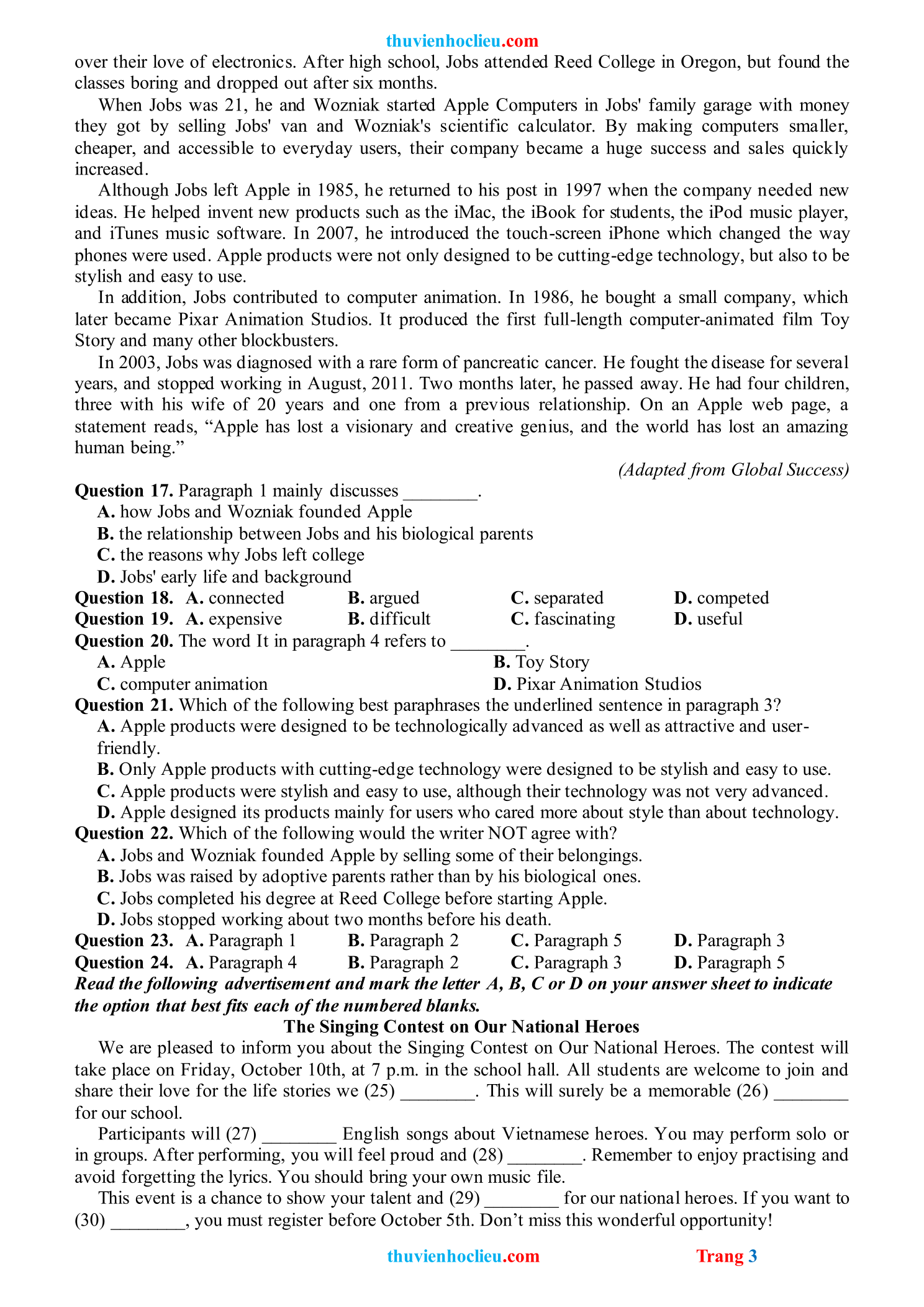
Read the following passage and mark the letter A, B, C or D on your answer sheet to indicate the best answer to each of the following questions.
STEVE JOBS’ LIFE AND ACHIEVEMENTS
Steven Paul Jobs was born on 24 February, 1955 in San Francisco, US
A. His biological parents were not married and gave him up for adoption. He was adopted by Clara and Paul Jobs. In 1971, Jobs met Steve Wozniak, who was five years older than him, but they bonded over their love of electronics. After high school, Jobs attended Reed College in Oregon, but found the classes boring and dropped out after six months.
When Jobs was 21, he and Wozniak started Apple Computers in Jobs’ family garage with money they got by selling Jobs’ van and Wozniak’s scientific calculator. By making computers smaller, cheaper, and accessible to everyday users, their company became a huge success and sales quickly increased.
Although Jobs left Apple in 1985, he returned to his post in 1997 when the company needed new ideas. He helped invent new products such as the iMac, the iBook for students, the iPod music player, and iTunes music software. In 2007, he introduced the touch-screen iPhone which changed the way phones were used. Apple products were not only designed to be cutting-edge technology, but also to be stylish and easy to use.
In addition, Jobs contributed to computer animation. In 1986, he bought a small company, which later became Pixar Animation Studios. It produced the first full-length computer-animated film Toy Story and many other blockbusters.
In 2003, Jobs was diagnosed with a rare form of pancreatic cancer. He fought the disease for several years, and stopped working in August, 2011. Two months later, he passed away. He had four children, three with his wife of 20 years and one from a previous relationship. On an Apple web page, a statement reads, “Apple has lost a visionary and creative genius, and the world has lost an amazing human being.”
(Adapted from Global Success)
Question 17. Paragraph 1 mainly discusses ______.
A. how Jobs and Wozniak founded Apple
B. the relationship between Jobs and his biological parents
C. the reasons why Jobs left college
D. Jobs’ early life and background
Đáp án: D
Question 18.
A. connected
B. argued
C. separated
D. competed
Đáp án: A
Question 19.
A. expensive
B. difficult
C. fascinating
D. useful
Đáp án: D
Question 20. The word It in paragraph 4 refers to ______.
A. Apple
B. Toy Story
C. computer animation
D. Pixar Animation Studios
Đáp án: D
Question 21. Which of the following best paraphrases the underlined sentence in paragraph 3?
A. Apple products were designed to be technologically advanced as well as attractive and user-friendly.
B. Only Apple products with cutting-edge technology were designed to be stylish and easy to use.
C. Apple products were stylish and easy to use, although their technology was not very advanced.
D. Apple designed its products mainly for users who cared more about style than about technology.
Đáp án: A
Question 22. Which of the following would the writer NOT agree with?
A. Jobs and Wozniak founded Apple by selling some of their belongings.
B. Jobs was raised by adoptive parents rather than by his biological ones.
C. Jobs completed his degree at Reed College before starting Apple.
D. Jobs stopped working about two months before his death.
Đáp án: C
Question 23.
A. Paragraph 1
B. Paragraph 2
C. Paragraph 5
D. Paragraph 3
Đáp án: B
Question 24.
A. Paragraph 4
B. Paragraph 2
C. Paragraph 3
D. Paragraph 5
Đáp án: A
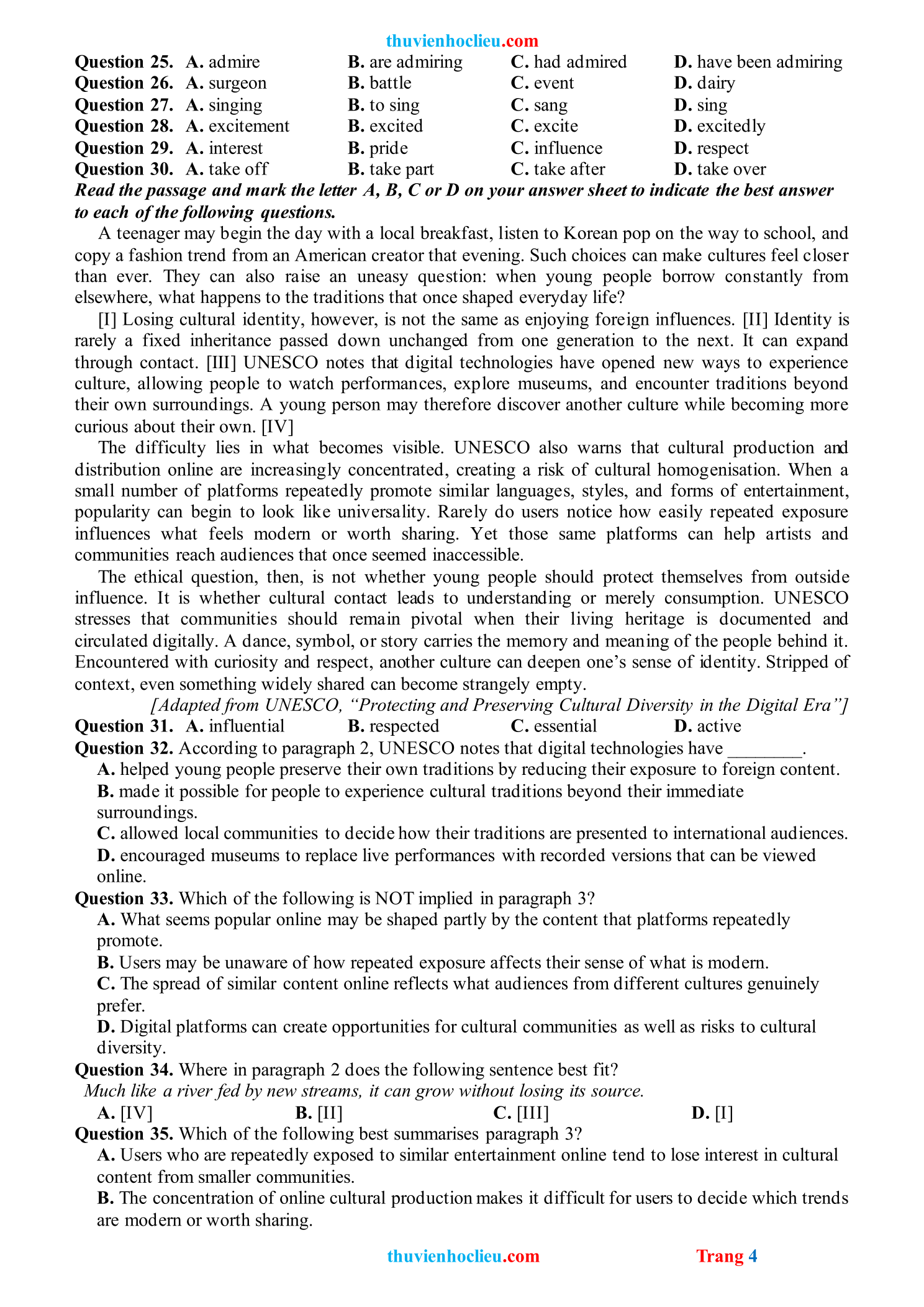
Read the following advertisement and mark the letter A, B, C or D on your answer sheet to indicate the option that best fits each of the numbered blanks.
The Singing Contest on Our National Heroes
We are pleased to inform you about the Singing Contest on Our National Heroes. The contest will take place on Friday, October 10th, at 7 p.m. in the school hall. All students are welcome to join and share their love for the life stories we (25) ______. This will surely be a memorable (26) ______ for our school.
Participants will (27) ______ English songs about Vietnamese heroes. You may perform solo or in groups. After performing, you will feel proud and (28) ______. Remember to enjoy practising and avoid forgetting the lyrics. You should bring your own music file.
This event is a chance to show your talent and (29) ______ for our national heroes. If you want to (30) ______, you must register before October 5th. Don’t miss this wonderful opportunity!
Question 25.
A. admire
B. are admiring
C. had admired
D. have been admiring
Đáp án: A
Question 26.
A. surgeon
B. battle
C. event
D. dairy
Đáp án: C
Question 27.
A. singing
B. to sing
C. sang
D. sing
Đáp án: D
Question 28.
A. excitement
B. excited
C. excite
D. excitedly
Đáp án: B
Question 29.
A. interest
B. pride
C. influence
D. respect
Đáp án: D
Question 30.
A. take off
B. take part
C. take after
D. take over
Đáp án: B
Read the passage and mark the letter A, B, C or D on your answer sheet to indicate the best answer to each of the following questions.
A teenager may begin the day with a local breakfast, listen to Korean pop on the way to school, and copy a fashion trend from an American creator that evening. Such choices can make cultures feel closer than ever. They can also raise an uneasy question: when young people borrow constantly from elsewhere, what happens to the traditions that once shaped everyday life?
[I] Losing cultural identity, however, is not the same as enjoying foreign influences. [II] Identity is rarely a fixed inheritance passed down unchanged from one generation to the next. It can expand through contact. [III] UNESCO notes that digital technologies have opened new ways to experience culture, allowing people to watch performances, explore museums, and encounter traditions beyond their own surroundings. A young person may therefore discover another culture while becoming more curious about their own. [IV]
The difficulty lies in what becomes visible. UNESCO also warns that cultural production and distribution online are increasingly concentrated, creating a risk of cultural homogenisation. When a small number of platforms repeatedly promote similar languages, styles, and forms of entertainment, popularity can begin to look like universality. Rarely do users notice how easily repeated exposure influences what feels modern or worth sharing. Yet those same platforms can help artists and communities reach audiences that once seemed inaccessible.
The ethical question, then, is not whether young people should protect themselves from outside influence. It is whether cultural contact leads to understanding or merely consumption. UNESCO stresses that communities should remain pivotal when their living heritage is documented and circulated digitally. A dance, symbol, or story carries the memory and meaning of the people behind it. Encountered with curiosity and respect, another culture can deepen one’s sense of identity. Stripped of context, even something widely shared can become strangely empty.
[Adapted from UNESCO, “Protecting and Preserving Cultural Diversity in the Digital Era”]
Question 31.
A. influential
B. respected
C. essential
D. active
Đáp án: C
Question 32. According to paragraph 2, UNESCO notes that digital technologies have ______.
A. helped young people preserve their own traditions by reducing their exposure to foreign content.
B. made it possible for people to experience cultural traditions beyond their immediate surroundings.
C. allowed local communities to decide how their traditions are presented to international audiences.
D. encouraged museums to replace live performances with recorded versions that can be viewed online.
Đáp án: B
Question 33. Which of the following is NOT implied in paragraph 3?
A. What seems popular online may be shaped partly by the content that platforms repeatedly promote.
B. Users may be unaware of how repeated exposure affects their sense of what is modern.
C. The spread of similar content online reflects what audiences from different cultures genuinely prefer.
D. Digital platforms can create opportunities for cultural communities as well as risks to cultural diversity.
Đáp án: C
Question 34. Where in paragraph 2 does the following sentence best fit?
Much like a river fed by new streams, it can grow without losing its source.
A. [IV]
B. [II]
C. [III]
D. [I]
Đáp án: C
Question 35. Which of the following best summarises paragraph 3?
A. Users who are repeatedly exposed to similar entertainment online tend to lose interest in cultural content from smaller communities.
B. The concentration of online cultural production makes it difficult for users to decide which trends are modern or worth sharing.
C. Online platforms have made popular cultural content more universal, which helps artists and communities attract audiences around the world.
D. Online platforms may reduce cultural diversity by repeatedly promoting similar content, although they can also help communities reach wider audiences.
Đáp án: D
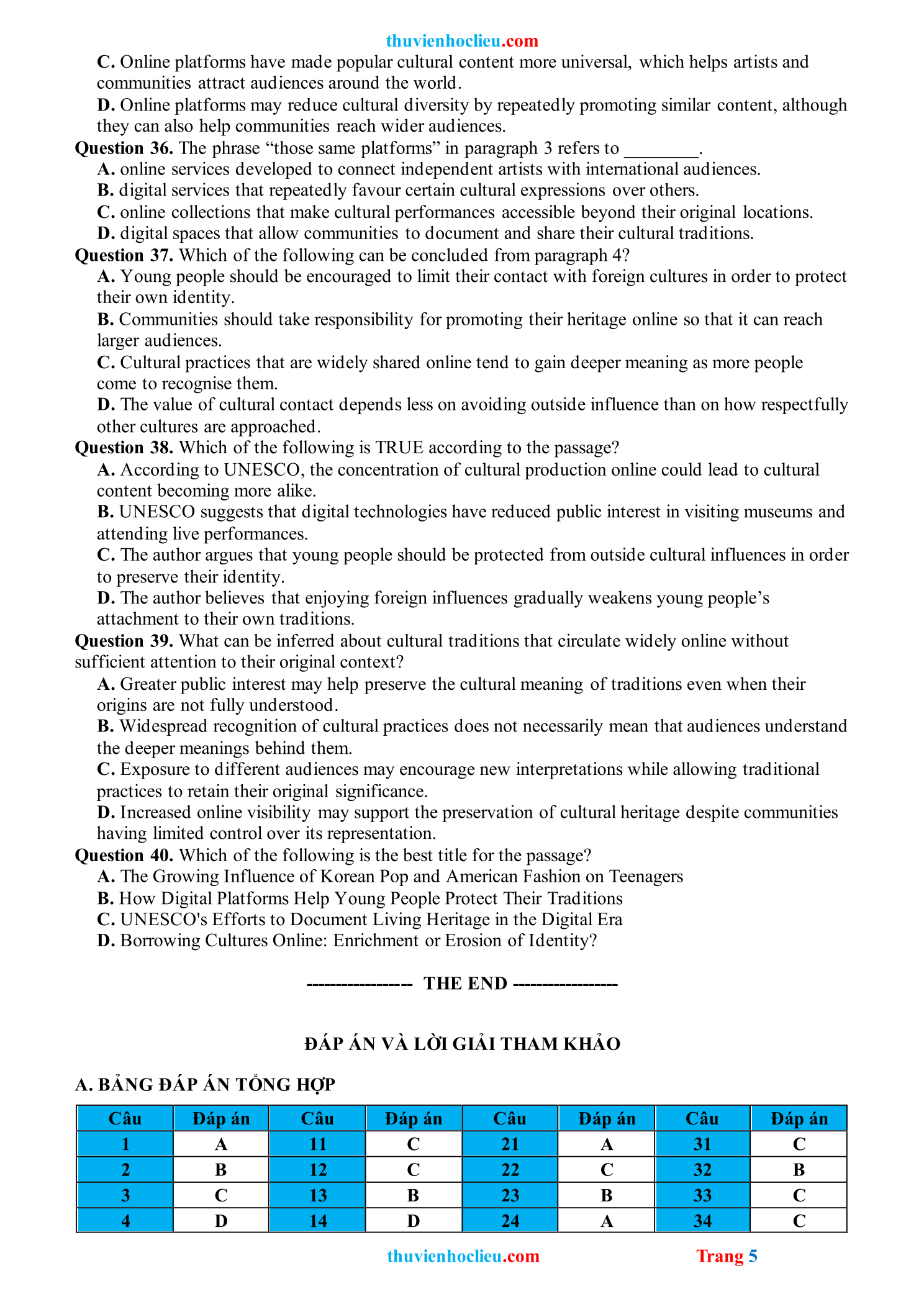
Question 36. The phrase “those same platforms” in paragraph 3 refers to ______.
A. online services developed to connect independent artists with international audiences.
B. digital services that repeatedly favour certain cultural expressions over others.
C. online collections that make cultural performances accessible beyond their original locations.
D. digital spaces that allow communities to document and share their cultural traditions.
Đáp án: B
Question 37. Which of the following can be concluded from paragraph 4?
A. Young people should be encouraged to limit their contact with foreign cultures in order to protect their own identity.
B. Communities should take responsibility for promoting their heritage online so that it can reach larger audiences.
C. Cultural practices that are widely shared online tend to gain deeper meaning as more people come to recognise them.
D. The value of cultural contact depends less on avoiding outside influence than on how respectfully other cultures are approached.
Đáp án: D
Question 38. Which of the following is TRUE according to the passage?
A. According to UNESCO, the concentration of cultural production online could lead to cultural content becoming more alike.
B. UNESCO suggests that digital technologies have reduced public interest in visiting museums and attending live performances.
C. The author argues that young people should be protected from outside cultural influences in order to preserve their identity.
D. The author believes that enjoying foreign influences gradually weakens young people’s attachment to their own traditions.
Đáp án: A
Question 39. What can be inferred about cultural traditions that circulate widely online without sufficient attention to their original context?
A. Greater public interest may help preserve the cultural meaning of traditions even when their origins are not fully understood.
B. Widespread recognition of cultural practices does not necessarily mean that audiences understand the deeper meanings behind them.
C. Exposure to different audiences may encourage new interpretations while allowing traditional practices to retain their original significance.
D. Increased online visibility may support the preservation of cultural heritage despite communities having limited control over its representation.
Đáp án: B
Question 40. Which of the following is the best title for the passage?
A. The Growing Influence of Korean Pop and American Fashion on Teenagers
B. How Digital Platforms Help Young People Protect Their Traditions
C. UNESCO’s Efforts to Document Living Heritage in the Digital Era
D. Borrowing Cultures Online: Enrichment or Erosion of Identity?
Đáp án: D