
Đề KSCL giữa kì 1 Tiếng anh 12 năm 2026 2027 Sở GDĐT Hưng Yên là tài liệu học thuật chuyên sâu và có tính quy chuẩn cao dành cho học sinh khối 12, được xây dựng bài bản nhằm mục đích khảo sát chất lượng toàn diện định kỳ và tạo tiền đề vững chắc cho kỳ thi cuối kì 1 2026 2027. Được ban hành bởi Sở GD&ĐT Hưng Yên cho năm học 2026 – 2027 nhằm đánh giá đồng bộ mặt bằng giáo dục trên vùng đất Phố Hiến giàu truyền thống hiếu học, đề thi giữa kì 1 tiếng anh 12 này gây ấn tượng bởi tính chuẩn mực, bám sát cấu trúc đề thi đổi mới với các chủ đề trọng tâm như tiểu sử danh nhân (Life stories), thế giới đa văn hóa (A multicultural world) cùng các chuyên đề ngữ pháp cốt lõi về sự phối hợp thì quá khứ, cách dùng mạo từ và liên từ nâng cao. Rèn luyện trực tiếp với bộ đề trắc nghiệm tiếng anh 12 cấp Sở này sẽ giúp các em hoàn thiện kỹ năng đọc hiểu văn bản tin tức và bảng biểu chỉ dẫn, làm chủ kỹ thuật loại trừ để chọn nhanh trắc nghiệm, nhận diện bẫy ngữ âm – trọng âm và phản xạ linh hoạt trước các tình huống giao tiếp liên hệ thực tế giàu tính ứng dụng toàn cầu.
Nhằm hỗ trợ học sinh cả nước tiếp cận các đề thi khảo sát chất lượng cấp Sở, nền tảng dethitracnghiem liên tục chọn lọc và cập nhật những đề kiểm tra mới nhất năm học 2026 – 2027 từ các Sở GD&ĐT trọng điểm, mang đến hệ sinh thái học tập với đa dạng đề thi và môn học. Website sở hữu giao diện online trực quan, cho phép học sinh làm bài nhiều lần dưới áp lực thời gian chuẩn, đồng thời hiển thị kết quả, đáp án chi tiết và lời giải thích ngữ pháp cặn kẽ ngay sau khi nộp bài để chủ động lấp đầy các lỗ hổng kiến thức kịp thời. Nhờ hệ thống câu hỏi có tính phân hóa rõ ràng từ nhận biết đến vận dụng cao, nền tảng giúp người học tiết kiệm thời gian ôn thi một cách tối đa. Việc chủ động rèn luyện chuỗi đề thi lớp 12 chất lượng tại đây chính là giải pháp tối ưu giúp các em xây dựng tâm lý tự tin, sẵn sàng bứt phá điểm số trong kỳ thi Tốt nghiệp THPT.
ĐỀ THI
LINK PDF ĐỀ THI [gồm ĐỀ THI, ĐÁP ÁN, LỜI GIẢI]:
Nội dung đề thi
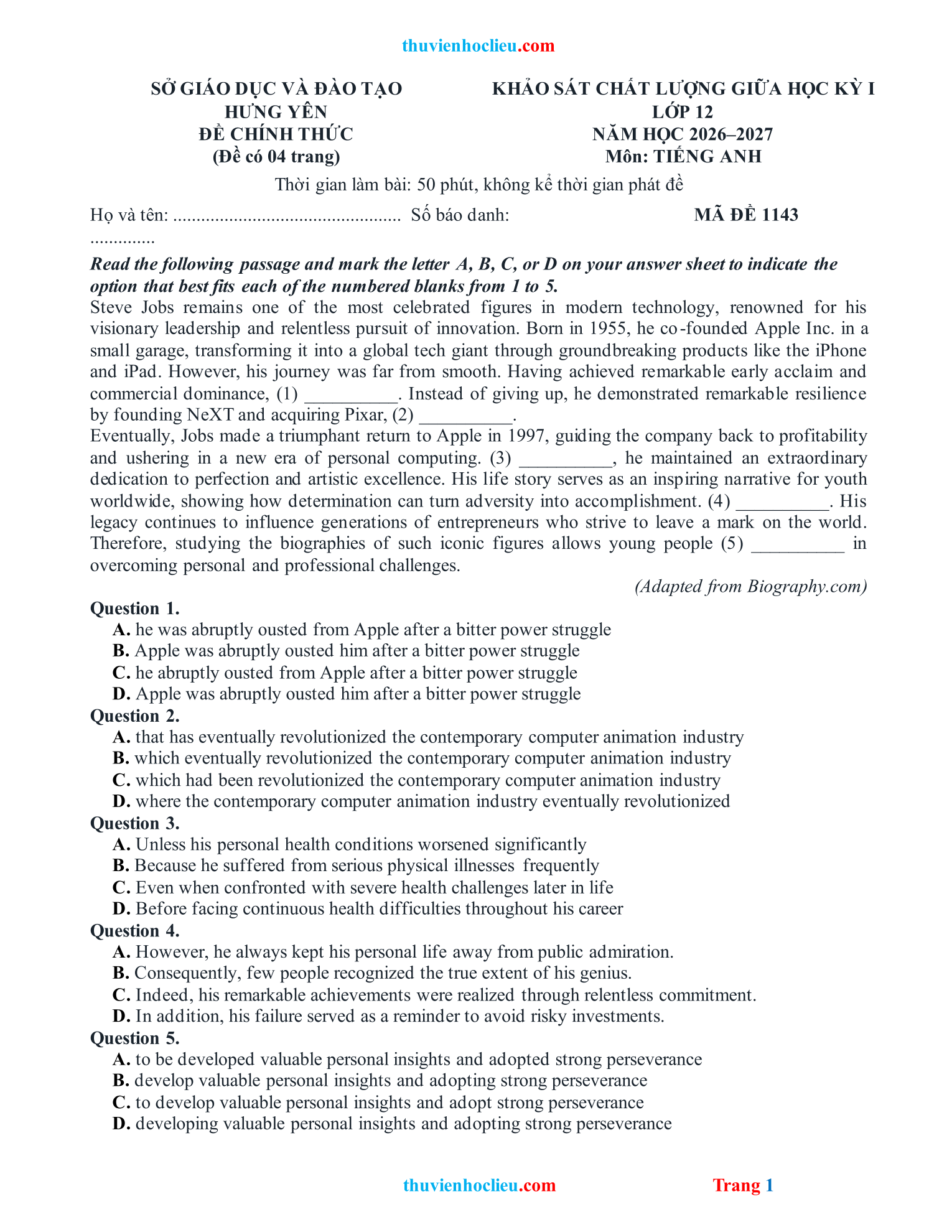
Steve Jobs remains one of the most celebrated figures in modern technology, renowned for his visionary leadership and relentless pursuit of innovation. Born in 1955, he co-founded Apple Inc. in a small garage, transforming it into a global tech giant through groundbreaking products like the iPhone and iPad. However, his journey was far from smooth. Having achieved remarkable early acclaim and commercial dominance, (1) ______. Instead of giving up, he demonstrated remarkable resilience by founding NeXT and acquiring Pixar, (2) ______.Eventually, Jobs made a triumphant return to Apple in 1997, guiding the company back to profitability and ushering in a new era of personal computing. (3) ______, he maintained an extraordinary dedication to perfection and artistic excellence. His life story serves as an inspiring narrative for youth worldwide, showing how determination can turn adversity into accomplishment. (4) ______. His legacy continues to influence generations of entrepreneurs who strive to leave a mark on the world. Therefore, studying the biographies of such iconic figures allows young people (5) ______ in overcoming personal and professional challenges.
(Adapted from Biography.com)
Question 1.
A. he was abruptly ousted from Apple after a bitter power struggle
B. Apple was abruptly ousted him after a bitter power struggle
C. he abruptly ousted from Apple after a bitter power struggle
D. Apple was abruptly ousted him after a bitter power struggle
Đáp án: A
Question 2.
A. that has eventually revolutionized the contemporary computer animation industry
B. which eventually revolutionized the contemporary computer animation industry
C. which had been revolutionized the contemporary computer animation industry
D. where the contemporary computer animation industry eventually revolutionized
Đáp án: B
Question 3.
A. Unless his personal health conditions worsened significantly
B. Because he suffered from serious physical illnesses frequently
C. Even when confronted with severe health challenges later in life
D. Before facing continuous health difficulties throughout his career
Đáp án: C
Question 4.
A. However, he always kept his personal life away from public admiration.
B. Consequently, few people recognized the true extent of his genius.
C. Indeed, his remarkable achievements were realized through relentless commitment.
D. In addition, his failure served as a reminder to avoid risky investments.
Đáp án: C
Question 5.
A. to be developed valuable personal insights and adopted strong perseverance
B. develop valuable personal insights and adopting strong perseverance
C. to develop valuable personal insights and adopt strong perseverance
D. developing valuable personal insights and adopting strong perseverance
Đáp án: C
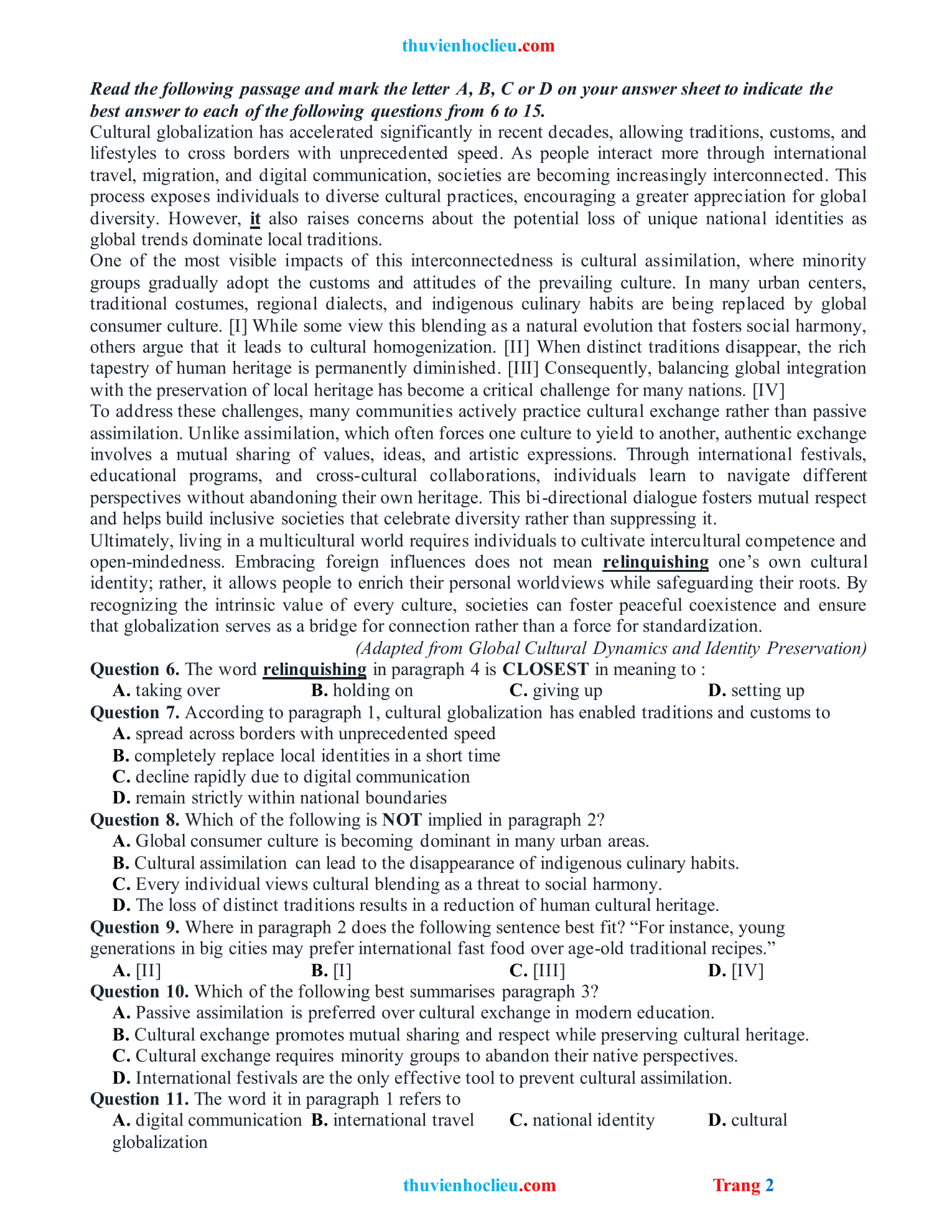
Read the following passage and mark the letter A, B, C or D on your answer sheet to indicate the best answer to each of the following questions from 6 to 15.
Cultural globalization has accelerated significantly in recent decades, allowing traditions, customs, and lifestyles to cross borders with unprecedented speed. As people interact more through international travel, migration, and digital communication, societies are becoming increasingly interconnected. This process exposes individuals to diverse cultural practices, encouraging a greater appreciation for global diversity. However, it also raises concerns about the potential loss of unique national identities as global trends dominate local traditions.
One of the most visible impacts of this interconnectedness is cultural assimilation, where minority groups gradually adopt the customs and attitudes of the prevailing culture. In many urban centers, traditional costumes, regional dialects, and indigenous culinary habits are being replaced by global consumer culture. [I] While some view this blending as a natural evolution that fosters social harmony, others argue that it leads to cultural homogenization. [II] When distinct traditions disappear, the rich tapestry of human heritage is permanently diminished. [III] Consequently, balancing global integration with the preservation of local heritage has become a critical challenge for many nations. [IV]
To address these challenges, many communities actively practice cultural exchange rather than passive assimilation. Unlike assimilation, which often forces one culture to yield to another, authentic exchange involves a mutual sharing of values, ideas, and artistic expressions. Through international festivals, educational programs, and cross-cultural collaborations, individuals learn to navigate different perspectives without abandoning their own heritage. This bi-directional dialogue fosters mutual respect and helps build inclusive societies that celebrate diversity rather than suppressing it.
Ultimately, living in a multicultural world requires individuals to cultivate intercultural competence and open-mindedness. Embracing foreign influences does not mean relinquishing one’s own cultural identity; rather, it allows people to enrich their personal worldviews while safeguarding their roots. By recognizing the intrinsic value of every culture, societies can foster peaceful coexistence and ensure that globalization serves as a bridge for connection rather than a force for standardization.
(Adapted from Global Cultural Dynamics and Identity Preservation)
Question 6. The word relinquishing in paragraph 4 is CLOSEST in meaning to :
A. taking over
B. holding on
C. giving up
D. setting up
Đáp án: C
Question 7. According to paragraph 1, cultural globalization has enabled traditions and customs to
A. spread across borders with unprecedented speed
B. completely replace local identities in a short time
C. decline rapidly due to digital communication
D. remain strictly within national boundaries
Đáp án: A
Question 8. Which of the following is NOT implied in paragraph 2?
A. Global consumer culture is becoming dominant in many urban areas.
B. Cultural assimilation can lead to the disappearance of indigenous culinary habits.
C. Every individual views cultural blending as a threat to social harmony.
D. The loss of distinct traditions results in a reduction of human cultural heritage.
Đáp án: C
Question 9. Where in paragraph 2 does the following sentence best fit? “For instance, young generations in big cities may prefer international fast food over age-old traditional recipes.”
A. [II]
B. [I]
C. [III]
D. [IV]
Đáp án: B
Question 10. Which of the following best summarises paragraph 3?
A. Passive assimilation is preferred over cultural exchange in modern education.
B. Cultural exchange promotes mutual sharing and respect while preserving cultural heritage.
C. Cultural exchange requires minority groups to abandon their native perspectives.
D. International festivals are the only effective tool to prevent cultural assimilation.
Đáp án: B
Question 11. The word it in paragraph 1 refers to
A. digital communication
B. international travel
C. national identity
D. cultural globalization
Đáp án: D
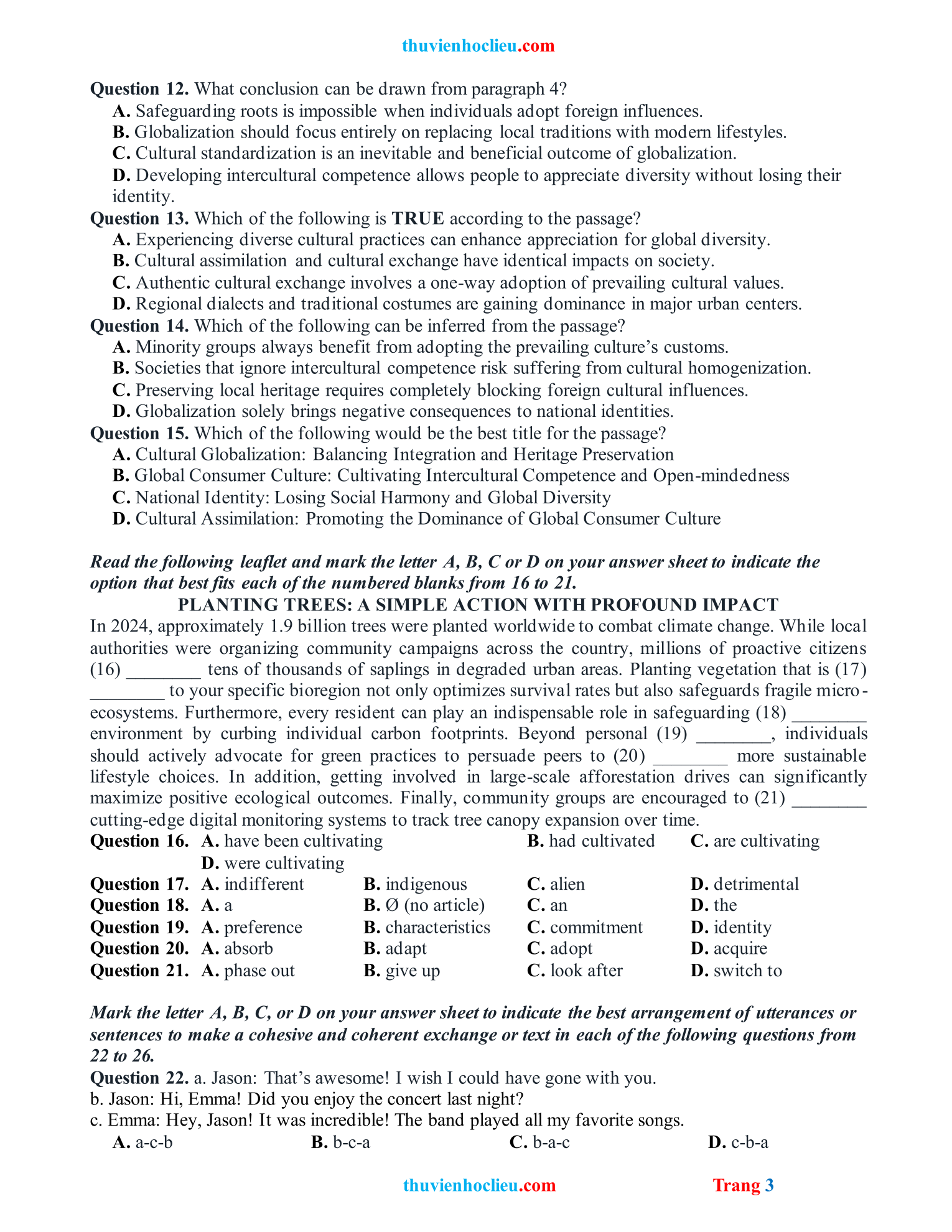
Question 12. What conclusion can be drawn from paragraph 4?
A. Safeguarding roots is impossible when individuals adopt foreign influences.
B. Globalization should focus entirely on replacing local traditions with modern lifestyles.
C. Cultural standardization is an inevitable and beneficial outcome of globalization.
D. Developing intercultural competence allows people to appreciate diversity without losing their identity.
Đáp án: D
Question 13. Which of the following is TRUE according to the passage?
A. Experiencing diverse cultural practices can enhance appreciation for global diversity.
B. Cultural assimilation and cultural exchange have identical impacts on society.
C. Authentic cultural exchange involves a one-way adoption of prevailing cultural values.
D. Regional dialects and traditional costumes are gaining dominance in major urban centers.
Đáp án: A
Question 14. Which of the following can be inferred from the passage?
A. Minority groups always benefit from adopting the prevailing culture’s customs.
B. Societies that ignore intercultural competence risk suffering from cultural homogenization.
C. Preserving local heritage requires completely blocking foreign cultural influences.
D. Globalization solely brings negative consequences to national identities.
Đáp án: B
Question 15. Which of the following would be the best title for the passage?
A. Cultural Globalization: Balancing Integration and Heritage Preservation
B. Global Consumer Culture: Cultivating Intercultural Competence and Open-mindedness
C. National Identity: Losing Social Harmony and Global Diversity
D. Cultural Assimilation: Promoting the Dominance of Global Consumer Culture
Đáp án: A
Read the following leaflet and mark the letter A, B, C or D on your answer sheet to indicate the option that best fits each of the numbered blanks from 16 to 21.
PLANTING TREES: A SIMPLE ACTION WITH PROFOUND IMPACT
In 2024, approximately 1.9 billion trees were planted worldwide to combat climate change. While local authorities were organizing community campaigns across the country, millions of proactive citizens (16) ______ tens of thousands of saplings in degraded urban areas. Planting vegetation that is (17) ______ to your specific bioregion not only optimizes survival rates but also safeguards fragile micro-ecosystems. Furthermore, every resident can play an indispensable role in safeguarding (18) ______ environment by curbing individual carbon footprints. Beyond personal (19) ______, individuals should actively advocate for green practices to persuade peers to (20) ______ more sustainable lifestyle choices. In addition, getting involved in large-scale afforestation drives can significantly maximize positive ecological outcomes. Finally, community groups are encouraged to (21) ______ cutting-edge digital monitoring systems to track tree canopy expansion over time.
Question 16.
A. have been cultivating
B. had cultivated
C. are cultivating
D. were cultivating
Đáp án: D
Question 17.
A. indifferent
B. indigenous
C. alien
D. detrimental
Đáp án: B
Question 18.
A. a
B. Ø (no article)
C. an
D. the
Đáp án: D
Question 19.
A. preference
B. characteristics
C. commitment
D. identity
Đáp án: C
Question 20.
A. absorb
B. adapt
C. adopt
D. acquire
Đáp án: C
Question 21.
A. phase out
B. give up
C. look after
D. switch to
Đáp án: D
Mark the letter A, B, C, or D on your answer sheet to indicate the best arrangement of utterances or sentences to make a cohesive and coherent exchange or text in each of the following questions from 22 to 26.
Question 22.
a. Jason: That’s awesome! I wish I could have gone with you.
b. Jason: Hi, Emma! Did you enjoy the concert last night?
c. Emma: Hey, Jason! It was incredible! The band played all my favorite songs.
A. a-c-b
B. b-c-a
C. b-a-c
D. c-b-a
Đáp án: B
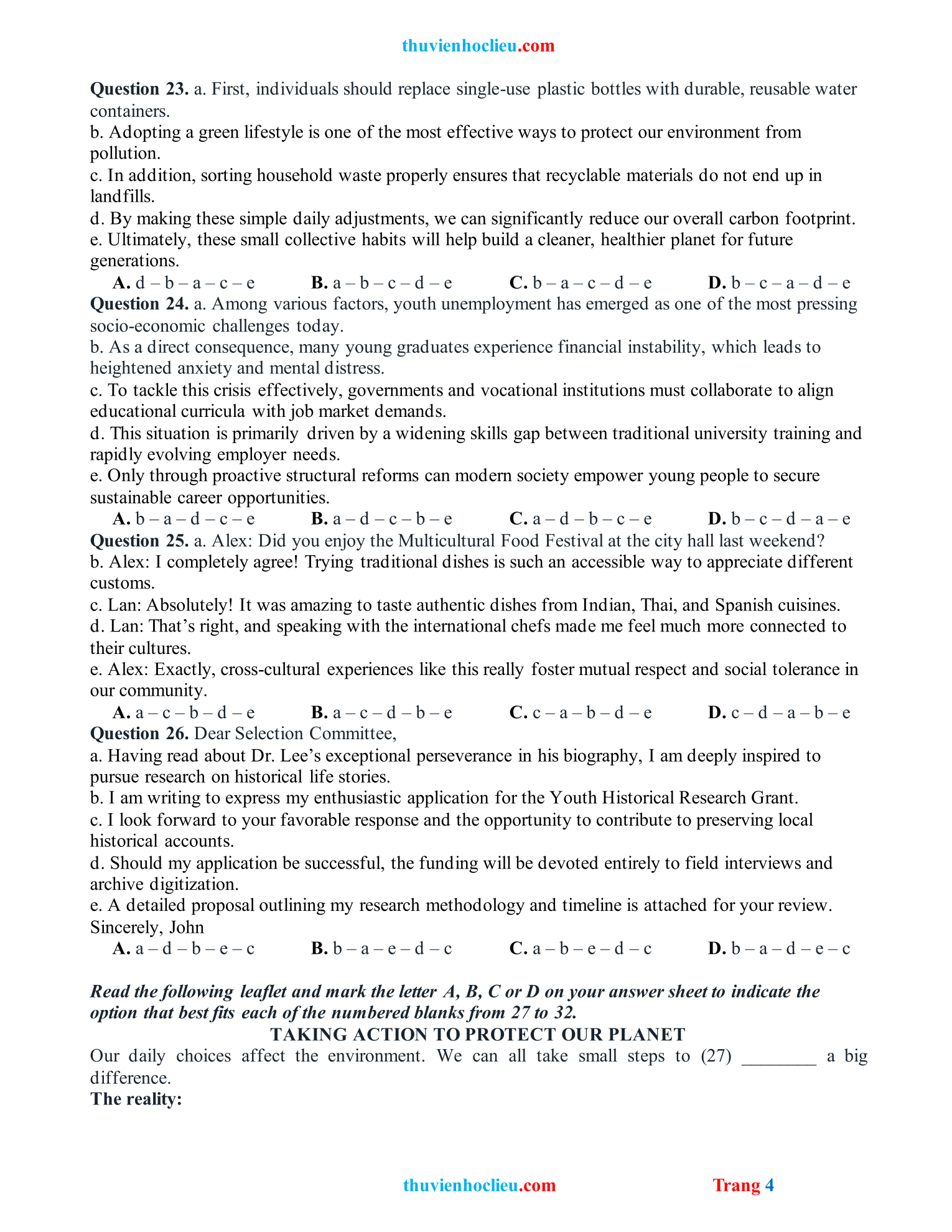
Question 23.
a. First, individuals should replace single-use plastic bottles with durable, reusable water containers.
b. Adopting a green lifestyle is one of the most effective ways to protect our environment from pollution.
c. In addition, sorting household waste properly ensures that recyclable materials do not end up in landfills.
d. By making these simple daily adjustments, we can significantly reduce our overall carbon footprint.
e. Ultimately, these small collective habits will help build a cleaner, healthier planet for future generations.
A. d – b – a – c – e
B. a – b – c – d – e
C. b – a – c – d – e
D. b – c – a – d – e
Đáp án: C
Question 24.
a. Among various factors, youth unemployment has emerged as one of the most pressing socio-economic challenges today.
b. As a direct consequence, many young graduates experience financial instability, which leads to heightened anxiety and mental distress.
c. To tackle this crisis effectively, governments and vocational institutions must collaborate to align educational curricula with job market demands.
d. This situation is primarily driven by a widening skills gap between traditional university training and rapidly evolving employer needs.
e. Only through proactive structural reforms can modern society empower young people to secure sustainable career opportunities.
A. b – a – d – c – e
B. a – d – c – b – e
C. a – d – b – c – e
D. b – c – d – a – e
Đáp án: C
Question 25.
a. Alex: Did you enjoy the Multicultural Food Festival at the city hall last weekend?
b. Alex: I completely agree! Trying traditional dishes is such an accessible way to appreciate different customs.
c. Lan: Absolutely! It was amazing to taste authentic dishes from Indian, Thai, and Spanish cuisines.
d. Lan: That’s right, and speaking with the international chefs made me feel much more connected to their cultures.
e. Alex: Exactly, cross-cultural experiences like this really foster mutual respect and social tolerance in our community.
A. a – c – b – d – e
B. a – c – d – b – e
C. c – a – b – d – e
D. c – d – a – b – e
Đáp án: A
Question 26.
Dear Selection Committee,
a. Having read about Dr. Lee’s exceptional perseverance in his biography, I am deeply inspired to pursue research on historical life stories.
b. I am writing to express my enthusiastic application for the Youth Historical Research Grant.
c. I look forward to your favorable response and the opportunity to contribute to preserving local historical accounts.
d. Should my application be successful, the funding will be devoted entirely to field interviews and archive digitization.
e. A detailed proposal outlining my research methodology and timeline is attached for your review.
Sincerely, John
A. a – d – b – e – c
B. b – a – e – d – c
C. a – b – e – d – c
D. b – a – d – e – c
Đáp án: D
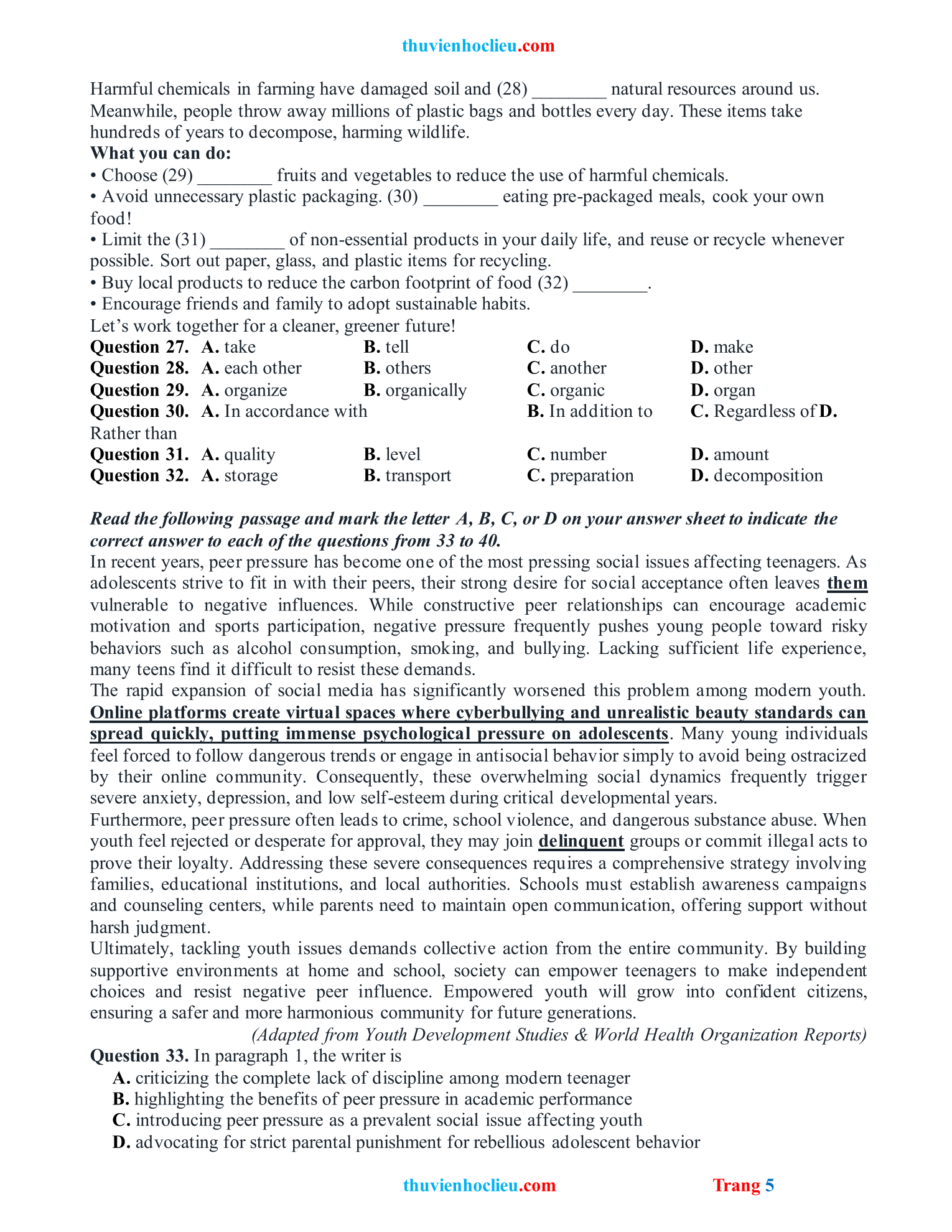
Read the following leaflet and mark the letter A, B, C or D on your answer sheet to indicate the option that best fits each of the numbered blanks from 27 to 32.
TAKING ACTION TO PROTECT OUR PLANET
Our daily choices affect the environment. We can all take small steps to (27) ______ a big difference.
The reality:
Harmful chemicals in farming have damaged soil and (28) ______ natural resources around us. Meanwhile, people throw away millions of plastic bags and bottles every day. These items take hundreds of years to decompose, harming wildlife.
What you can do:
• Choose (29) ______ fruits and vegetables to reduce the use of harmful chemicals.
• Avoid unnecessary plastic packaging. (30) ______ eating pre-packaged meals, cook your own food!
• Limit the (31) ______ of non-essential products in your daily life, and reuse or recycle whenever possible. Sort out paper, glass, and plastic items for recycling.
• Buy local products to reduce the carbon footprint of food (32) ______.
• Encourage friends and family to adopt sustainable habits.
Let’s work together for a cleaner, greener future!
Question 27.
A. take
B. tell
C. do
D. make
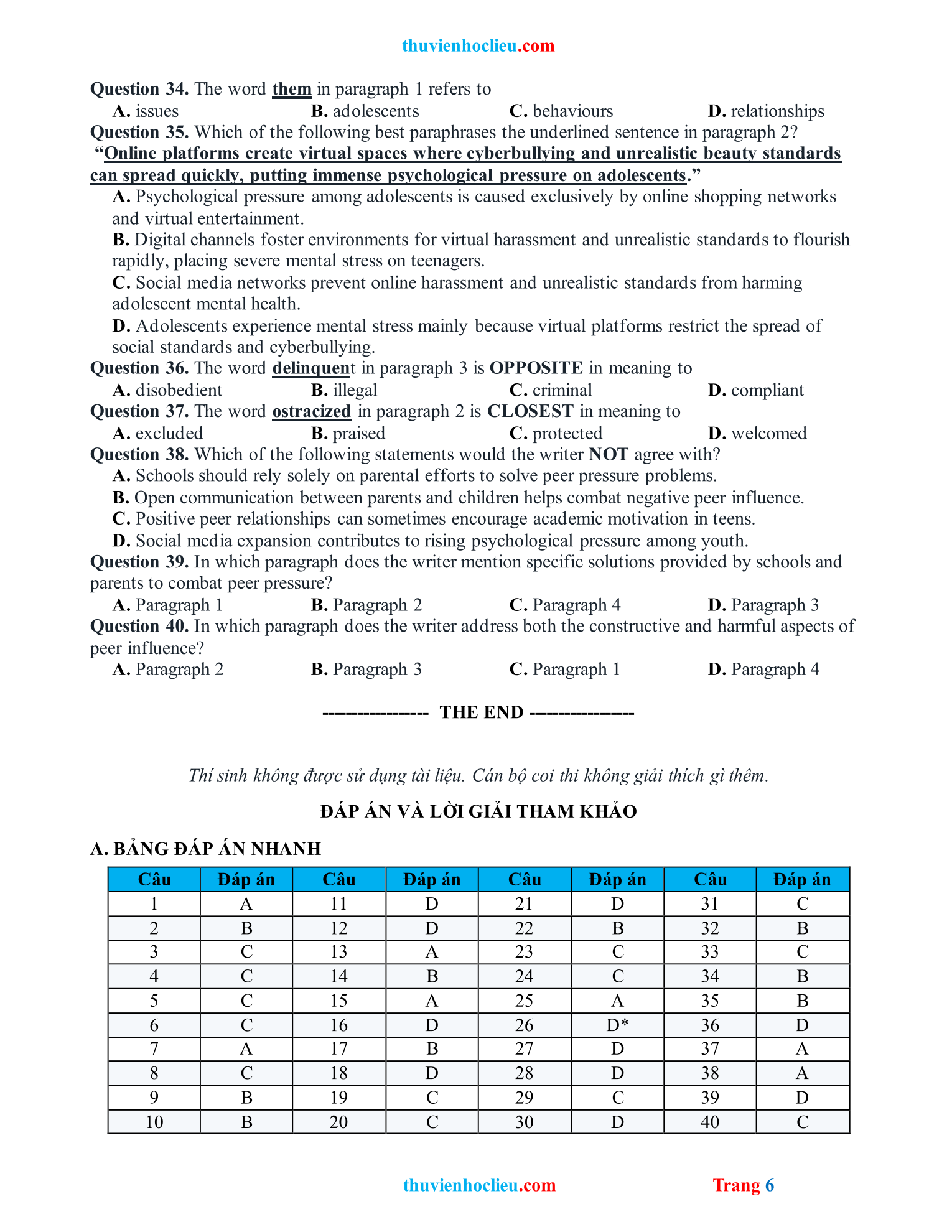
Đáp án: D
Question 28.
A. each other
B. others
C. another
D. other
Đáp án: D
Question 29.
A. organize
B. organically
C. organic
D. organ
Đáp án: C
Question 30.
A. In accordance with
B. In addition to
C. Regardless of
D. Rather than
Đáp án: D
Question 31.
A. quality
B. level
C. number
D. amount
Đáp án: C
Question 32.
A. storage
B. transport
C. preparation
D. decomposition
Đáp án: B
Read the following passage and mark the letter A, B, C, or D on your answer sheet to indicate the correct answer to each of the questions from 33 to 40.
In recent years, peer pressure has become one of the most pressing social issues affecting teenagers. As adolescents strive to fit in with their peers, their strong desire for social acceptance often leaves them vulnerable to negative influences. While constructive peer relationships can encourage academic motivation and sports participation, negative pressure frequently pushes young people toward risky behaviors such as alcohol consumption, smoking, and bullying. Lacking sufficient life experience, many teens find it difficult to resist these demands.
The rapid expansion of social media has significantly worsened this problem among modern youth. Online platforms create virtual spaces where cyberbullying and unrealistic beauty standards can spread quickly, putting immense psychological pressure on adolescents. Many young individuals feel forced to follow dangerous trends or engage in antisocial behavior simply to avoid being ostracized by their online community. Consequently, these overwhelming social dynamics frequently trigger severe anxiety, depression, and low self-esteem during critical developmental years.
Furthermore, peer pressure often leads to crime, school violence, and dangerous substance abuse. When youth feel rejected or desperate for approval, they may join delinquent groups or commit illegal acts to prove their loyalty. Addressing these severe consequences requires a comprehensive strategy involving families, educational institutions, and local authorities. Schools must establish awareness campaigns and counseling centers, while parents need to maintain open communication, offering support without harsh judgment.
Ultimately, tackling youth issues demands collective action from the entire community. By building supportive environments at home and school, society can empower teenagers to make independent choices and resist negative peer influence. Empowered youth will grow into confident citizens, ensuring a safer and more harmonious community for future generations.
(Adapted from Youth Development Studies & World Health Organization Reports)
Question 33. In paragraph 1, the writer is
A. criticizing the complete lack of discipline among modern teenager
B. highlighting the benefits of peer pressure in academic performance
C. introducing peer pressure as a prevalent social issue affecting youth
D. advocating for strict parental punishment for rebellious adolescent behavior
Đáp án: C
Question 34. The word them in paragraph 1 refers to
A. issues
B. adolescents
C. behaviours
D. relationships
Đáp án: B
Question 35. Which of the following best paraphrases the underlined sentence in paragraph 2? “Online platforms create virtual spaces where cyberbullying and unrealistic beauty standards can spread quickly, putting immense psychological pressure on adolescents.”
A. Psychological pressure among adolescents is caused exclusively by online shopping networks and virtual entertainment.
B. Digital channels foster environments for virtual harassment and unrealistic standards to flourish rapidly, placing severe mental stress on teenagers.
C. Social media networks prevent online harassment and unrealistic standards from harming adolescent mental health.
D. Adolescents experience mental stress mainly because virtual platforms restrict the spread of social standards and cyberbullying.
Đáp án: B
Question 36. The word delinquent in paragraph 3 is OPPOSITE in meaning to
A. disobedient
B. illegal
C. criminal
D. compliant
Đáp án: D
Question 37. The word ostracized in paragraph 2 is CLOSEST in meaning to
A. excluded
B. praised
C. protected
D. welcomed
Đáp án: A
Question 38. Which of the following statements would the writer NOT agree with?
A. Schools should rely solely on parental efforts to solve peer pressure problems.
B. Open communication between parents and children helps combat negative peer influence.
C. Positive peer relationships can sometimes encourage academic motivation in teens.
D. Social media expansion contributes to rising psychological pressure among youth.
Đáp án: A
Question 39. In which paragraph does the writer mention specific solutions provided by schools and parents to combat peer pressure?
A. Paragraph 1
B. Paragraph 2
C. Paragraph 4
D. Paragraph 3
Đáp án: D
Question 40. In which paragraph does the writer address both the constructive and harmful aspects of peer influence?
A. Paragraph 2
B. Paragraph 3
C. Paragraph 1
D. Paragraph 4
Đáp án: C