Đề thi giữa kì 2 Tiếng Anh 11 2025 2026 THPT Xuyên Mộc – TPHCM là tài liệu ôn luyện hữu ích dành cho học sinh lớp 11, được THPT Xuyên Mộc – TPHCM biên soạn cho năm học 2025 – 2026 nhằm phục vụ công tác khảo sát chất lượng giữa học kỳ và giúp học sinh tự đánh giá năng lực theo chương trình giáo dục phổ thông mới. Nội dung đề thi tập trung vào các chuyên đề trọng tâm của học kỳ II như từ vựng và ngữ pháp theo từng đơn vị bài học, kỹ năng nghe hiểu, đọc hiểu, giao tiếp, viết đoạn văn và các dạng bài vận dụng ngôn ngữ trong thực tế. Cấu trúc đề được xây dựng theo nhiều cấp độ từ nhận biết đến vận dụng, giúp học sinh rèn luyện kỹ năng đọc hiểu dữ kiện, lựa chọn đáp án chính xác và nâng cao hiệu quả làm bài với các dạng đề giữa kì 2 môn Tiếng Anh lớp 11. Đồng thời, đây cũng là nguồn tài liệu tham khảo giá trị với nhiều dạng đề Tiếng Anh 11 giúp học sinh củng cố kiến thức, phát triển toàn diện các kỹ năng ngôn ngữ và chuẩn bị tốt cho các kỳ kiểm tra cũng như định hướng kỳ thi tốt nghiệp THPT trong tương lai.
Tại dethitracnghiem.vn, học sinh có thể luyện đề trực tuyến trên nền tảng có giao diện thân thiện, dễ sử dụng và hỗ trợ làm bài nhiều lần không giới hạn. Sau khi hoàn thành bài thi, hệ thống sẽ hiển thị đáp án chi tiết, thống kê kết quả và giúp người học theo dõi sự tiến bộ qua từng lần luyện tập. Kho câu hỏi được phân chia từ kiến thức cơ bản đến các bài tập vận dụng thực tiễn, phù hợp với học sinh lớp 11 trong giai đoạn tăng tốc ôn tập năm học 2025 – 2026. Việc thường xuyên thực hành với các dạng đề ôn tập lớp 11 sẽ giúp học sinh làm quen với cấu trúc đề thi mới, nâng cao khả năng sử dụng tiếng Anh, tăng phản xạ ngôn ngữ và tối ưu hiệu quả ôn luyện.
ĐỀ THI
LINK PDF ĐỀ THI [gồm ĐỀ THI, ĐÁP ÁN, LỜI GIẢI]:
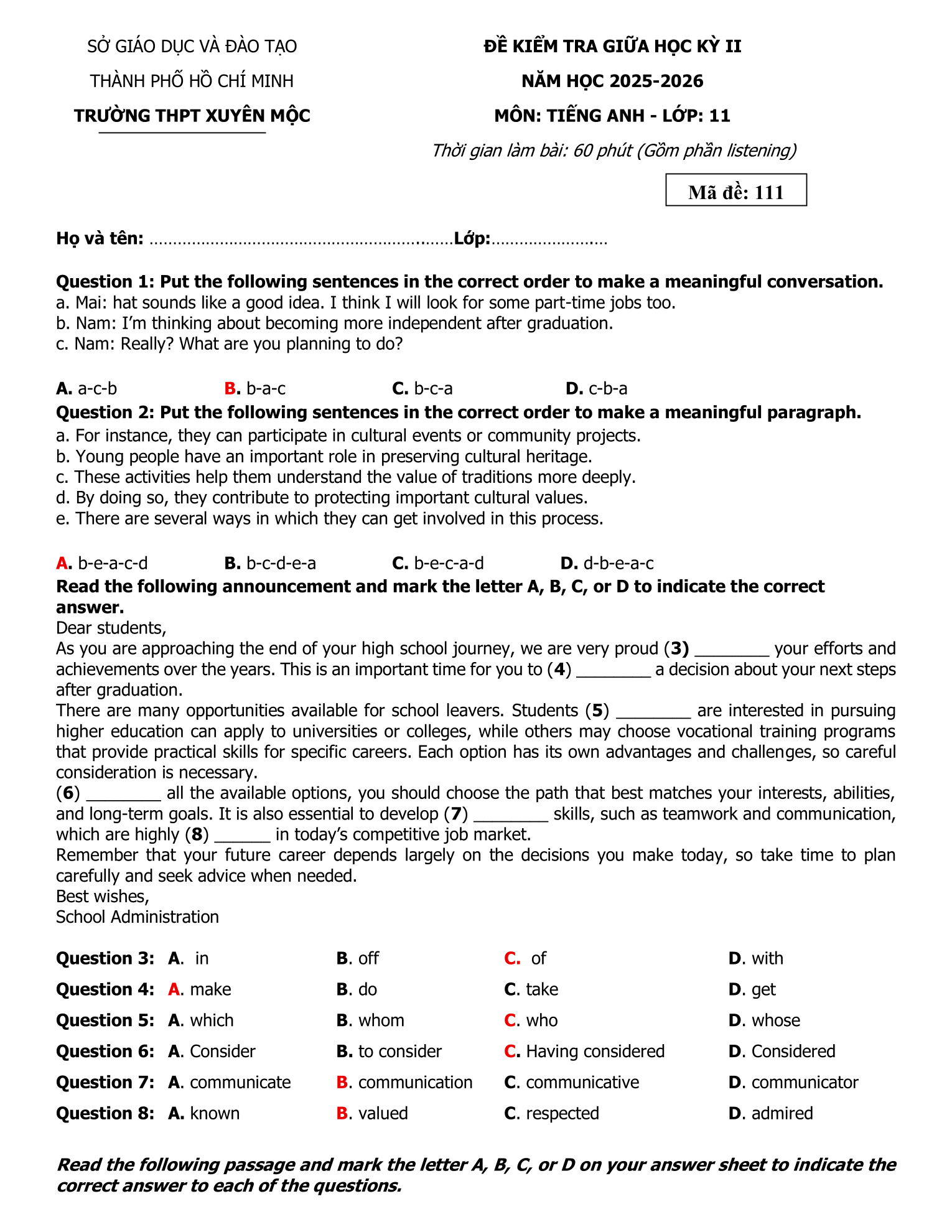
a. Mai: hat sounds like a good idea. I think I will look for some part-time jobs too.
b. Nam: I’m thinking about becoming more independent after graduation.
c. Nam: Really? What are you planning to do?
A. a-c-b
B. b-a-c
C. b-c-a
D. c-b-a
Đáp án: B
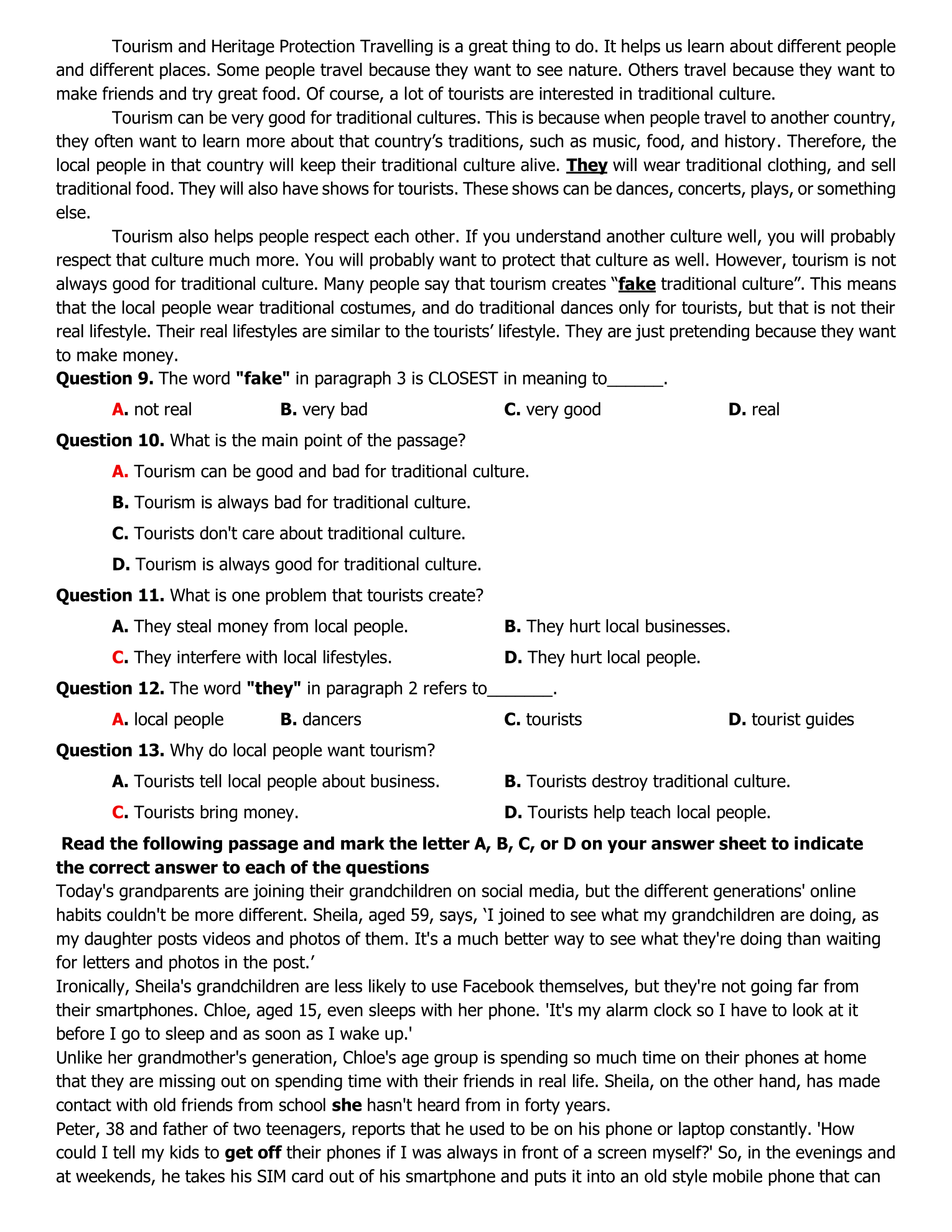
Question 2: Put the following sentences in the correct order to make a meaningful paragraph.
a. For instance, they can participate in cultural events or community projects.
b. Young people have an important role in preserving cultural heritage.
c. These activities help them understand the value of traditions more deeply.
d. By doing so, they contribute to protecting important cultural values.
e. There are several ways in which they can get involved in this process.
A. b-e-a-c-d
B. b-c-d-e-a
C. b-e-c-a-d
D. d-b-e-a-c
Đáp án: A
Read the following announcement and mark the letter A, B, C, or D to indicate the correct answer.
Dear students,
As you are approaching the end of your high school journey, we are very proud (3) _______ your efforts and achievements over the years. This is an important time for you to (4) _______ a decision about your next steps after graduation.
There are many opportunities available for school leavers. Students (5) _______ are interested in pursuing higher education can apply to universities or colleges, while others may choose vocational training programs that provide practical skills for specific careers. Each option has its own advantages and challenges, so careful consideration is necessary.
(6) _______ all the available options, you should choose the path that best matches your interests, abilities, and long-term goals. It is also essential to develop (7) _______ skills, such as teamwork and communication, which are highly (8) _______ in today’s competitive job market.
Remember that your future career depends largely on the decisions you make today, so take time to plan carefully and seek advice when needed.
Best wishes,
School Administration
Question 3:
A. in
B. off
C. of
D. with
Đáp án: C
Question 4:
A. make
B. do
C. take
D. get
Đáp án: A
Question 5:
A. which
B. whom
C. who
D. whose
Đáp án: C
Question 6:
A. Consider
B. to consider
C. Having considered
D. Considered
Đáp án: C
Question 7:
A. communicate
B. communication
C. communicative
D. communicator
Đáp án: B
Question 8:
A. known
B. valued
C. respected
D. admired
Đáp án: B
Read the following passage and mark the letter A, B, C, or D on your answer sheet to indicate the correct answer to each of the questions.
Tourism and Heritage Protection Travelling is a great thing to do. It helps us learn about different people and different places. Some people travel because they want to see nature. Others travel because they want to make friends and try great food. Of course, a lot of tourists are interested in traditional culture.
Tourism can be very good for traditional cultures. This is because when people travel to another country, they often want to learn more about that country’s traditions, such as music, food, and history. Therefore, the local people in that country will keep their traditional culture alive. They will wear traditional clothing, and sell traditional food. They will also have shows for tourists. These shows can be dances, concerts, plays, or something else.
Tourism also helps people respect each other. If you understand another culture well, you will probably respect that culture much more. You will probably want to protect that culture as well. However, tourism is not always good for traditional culture. Many people say that tourism creates “fake traditional culture”. This means that the local people wear traditional costumes, and do traditional dances only for tourists, but that is not their real lifestyle. Their real lifestyles are similar to the tourists’ lifestyle. They are just pretending because they want to make money.
Question 9: The word “fake” in paragraph 3 is CLOSEST in meaning to_____.
A. not real
B. very bad
C. very good
D. real
Đáp án: A
Question 10: What is the main point of the passage?
A. Tourism can be good and bad for traditional culture.
B. Tourism is always bad for traditional culture.
C. Tourists don’t care about traditional culture.
D. Tourism is always good for traditional culture.
Đáp án: A
Question 11: What is one problem that tourists create?
A. They steal money from local people.
B. They hurt local businesses.
C. They interfere with local lifestyles.
D. They hurt local people.
Đáp án: C
Question 12: The word “they” in paragraph 2 refers to_____.
A. local people
B. dancers
C. tourists
D. tourist guides
Đáp án: A
Question 13: Why do local people want tourism?
A. Tourists tell local people about business.
B. Tourists destroy traditional culture.
C. Tourists bring money.
D. Tourists help teach local people.
Đáp án: C
Read the following passage and mark the letter A, B, C, or D on your answer sheet to indicate the correct answer to each of the questions
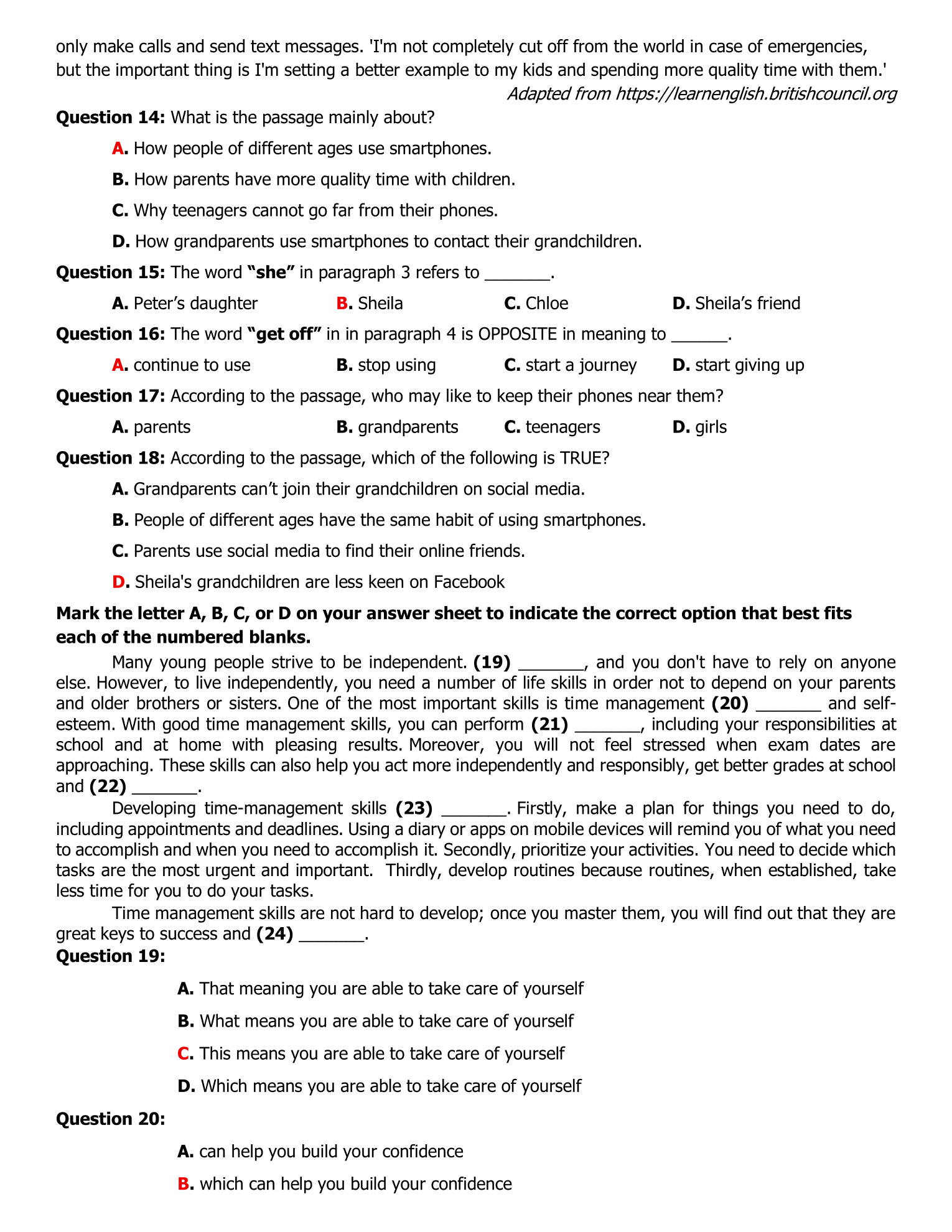
Today’s grandparents are joining their grandchildren on social media, but the different generations’ online habits couldn’t be more different. Sheila, aged 59, says, ‘I joined to see what my grandchildren are doing, as my daughter posts videos and photos of them. It’s a much better way to see what they’re doing than waiting for letters and photos in the post.’
Ironically, Sheila’s grandchildren are less likely to use Facebook themselves, but they’re not going far from their smartphones. Chloe, aged 15, even sleeps with her phone. ‘It’s my alarm clock so I have to look at it before I go to sleep and as soon as I wake up.’
Unlike her grandmother’s generation, Chloe’s age group is spending so much time on their phones at home that they are missing out on spending time with their friends in real life. Sheila, on the other hand, has made contact with old friends from school she hasn’t heard from in forty years.
Peter, 38 and father of two teenagers, reports that he used to be on his phone or laptop constantly. ‘How could I tell my kids to get off their phones if I was always in front of a screen myself?’ So, in the evenings and at weekends, he takes his SIM card out of his smartphone and puts it into an old style mobile phone that can only make calls and send text messages. ‘I’m not completely cut off from the world in case of emergencies, but the important thing is I’m setting a better example to my kids and spending more quality time with them.’
Adapted from https://learnenglish.britishcouncil.org
Question 14: What is the passage mainly about?
A. How people of different ages use smartphones.
B. How parents have more quality time with children.
C. Why teenagers cannot go far from their phones.
D. How grandparents use smartphones to contact their grandchildren.
Đáp án: A
Question 15: The word “she” in paragraph 3 refers to ______.
A. Peter’s daughter
B. Sheila
C. Chloe
D. Sheila’s friend
Đáp án: B
Question 16: The word “get off” in paragraph 4 is OPPOSITE in meaning to ______.
A. continue to use
B. stop using
C. start a journey
D. start giving up
Đáp án: A
Question 17: According to the passage, who may like to keep their phones near them?
A. parents
B. grandparents
C. teenagers
D. girls
Đáp án: C
Question 18: According to the passage, which of the following is TRUE?
A. Grandparents can’t join their grandchildren on social media.
B. People of different ages have the same habit of using smartphones.
C. Parents use social media to find their online friends.
D. Sheila’s grandchildren are less keen on Facebook
Đáp án: D
Mark the letter A, B, C, or D on your answer sheet to indicate the correct option that best fits each of the numbered blanks.
Many young people strive to be independent. (19) _______, and you don’t have to rely on anyone else. However, to live independently, you need a number of life skills in order not to depend on your parents and older brothers or sisters. One of the most important skills is time management (20) _______ and self-esteem. With good time management skills, you can perform (21) _______, including your responsibilities at school and at home with pleasing results. Moreover, you will not feel stressed when exam dates are approaching. These skills can also help you act more independently and responsibly, get better grades at school and (22) _______.
Developing time-management skills (23) _______. Firstly, make a plan for things you need to do, including appointments and deadlines. Using a diary or apps on mobile devices will remind you of what you need to accomplish and when you need to accomplish it. Secondly, prioritize your activities. You need to decide which tasks are the most urgent and important. Thirdly, develop routines because routines, when established, take less time for you to do your tasks.
Time management skills are not hard to develop; once you master them, you will find out that they are great keys to success and (24) _______.
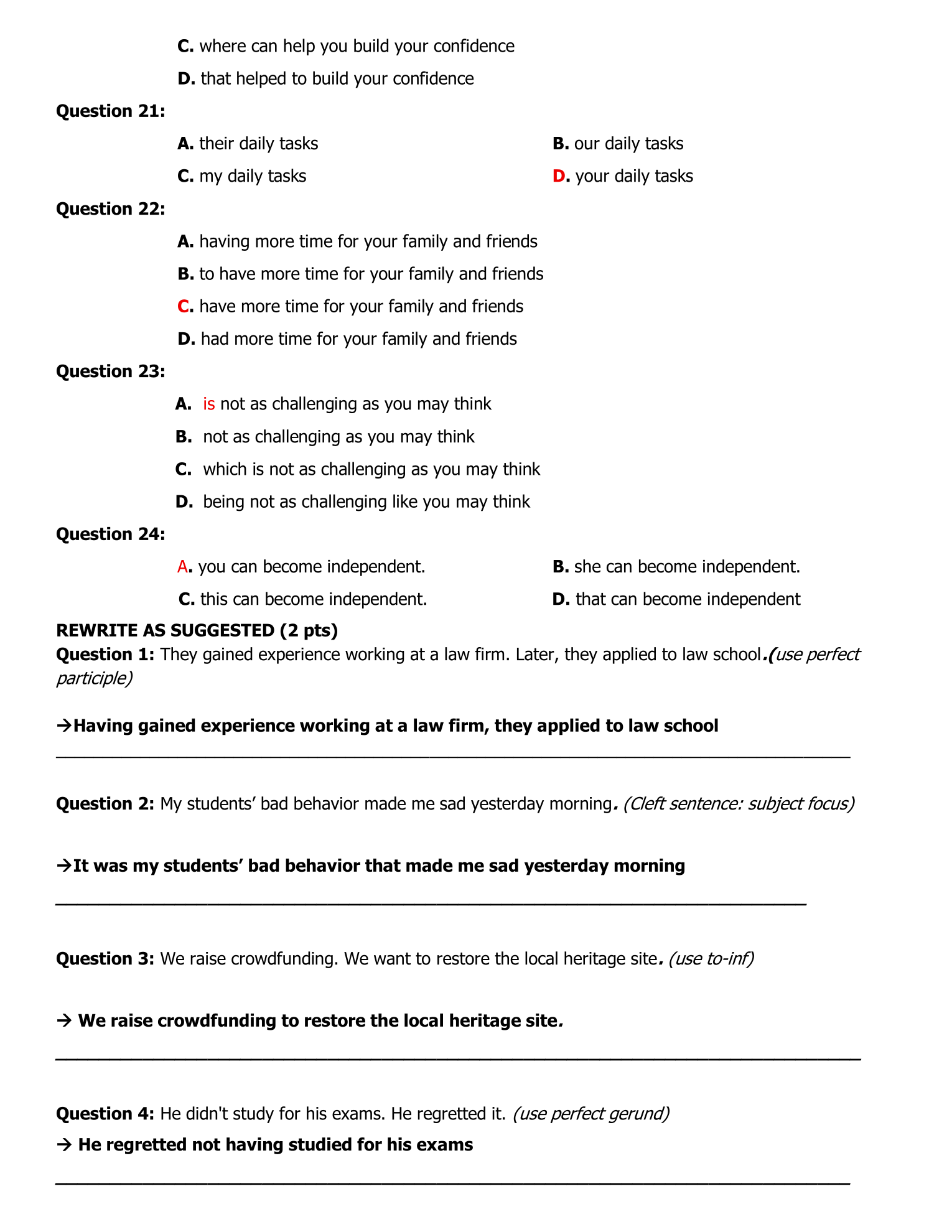
Question 19:
A. That meaning you are able to take care of yourself
B. What means you are able to take care of yourself
C. This means you are able to take care of yourself
D. Which means you are able to take care of yourself
Đáp án: C
Question 20:
A. can help you build your confidence
B. which can help you build your confidence
C. where can help you build your confidence
D. that helped to build your confidence
Đáp án: B
Question 21:
A. their daily tasks
B. our daily tasks
C. my daily tasks
D. your daily tasks
Đáp án: D
Question 22:
A. having more time for your family and friends
B. to have more time for your family and friends
C. have more time for your family and friends
D. had more time for your family and friends
Đáp án: C
Question 23:
A. is not as challenging as you may think
B. not as challenging as you may think
C. which is not as challenging as you may think
D. being not as challenging like you may think
Đáp án: A
Question 24:
A. you can become independent.
B. she can become independent.
C. this can become independent.
D. that can become independent
Đáp án: A
REWRITE AS SUGGESTED (2 pts)
Question 1: They gained experience working at a law firm. Later, they applied to law school. (use perfect participle)
Đáp án: Having gained experience working at a law firm, they applied to law school
Question 2: My students’ bad behavior made me sad yesterday morning. (Cleft sentence: subject focus)
Đáp án: It was my students’ bad behavior that made me sad yesterday morning
Question 3: We raise crowdfunding. We want to restore the local heritage site. (use to-inf)
Đáp án: We raise crowdfunding to restore the local heritage site.
Question 4: He didn’t study for his exams. He regretted it. (use perfect gerund)
Đáp án: He regretted not having studied for his exams