
Đề ôn tập Giữa kì 1 Tiếng anh 10 2026 2027 – Đề 3 là bộ tài liệu học thuật chuyên sâu dành cho học sinh lớp 10, được thuvienhoclieu.com biên soạn kỹ lưỡng cho năm học 2026 – 2027. Đây là mẫu đề ghk1 môn Tiếng Anh lớp 10 chất lượng nhằm mục đích khảo sát năng lực định kỳ và hỗ trợ học sinh xây dựng lộ trình ôn luyện vững chắc. Nội dung đề tập trung khai thác các chuyên đề trọng điểm như Bảo vệ môi trường, Sốc văn hóa, Biến đổi khí hậu và Hoạt động tình nguyện, giúp người học rèn luyện kỹ năng phân tích dữ kiện và kỹ thuật chọn đáp án nhanh. Thông qua cấu trúc bám sát chương trình mới, dạng đề trắc nghiệm tiếng anh 10 này khuyến khích học sinh vận dụng kiến thức vào các tình huống thực tiễn, tạo tiền đề tốt nhất cho các kỳ thi quan trọng sau này.
Việc thực hành trực tiếp trên hệ thống đề ôn thi lớp 10 tại dethitracnghiem.vn mang đến cho học sinh lớp 10 trải nghiệm học tập tối ưu trong giai đoạn tăng tốc ôn thi năm 2026. Website sở hữu giao diện thân thiện, cho phép người dùng làm bài nhiều lần, xem đáp án chi tiết ngay sau khi nộp và theo dõi biểu đồ tiến bộ cá nhân một cách minh bạch. Với môn Tiếng Anh, các câu hỏi được phân hóa từ lý thuyết cơ bản đến các bài tập tình huống thực tế, giúp học sinh làm quen với cách ra đề thực tế và nâng cao khả năng phản xạ ngôn ngữ. Phương pháp luyện tập này không chỉ giúp tiết kiệm thời gian ôn tập mà còn đảm bảo học sinh nắm vững kỹ năng vận dụng, từ đó tự tin đạt điểm cao trong các bài kiểm tra chính thức.
ĐỀ THI
LINK PDF ĐỀ THI [gồm ĐỀ THI, ĐÁP ÁN, LỜI GIẢI]:
Nội dung đề thi
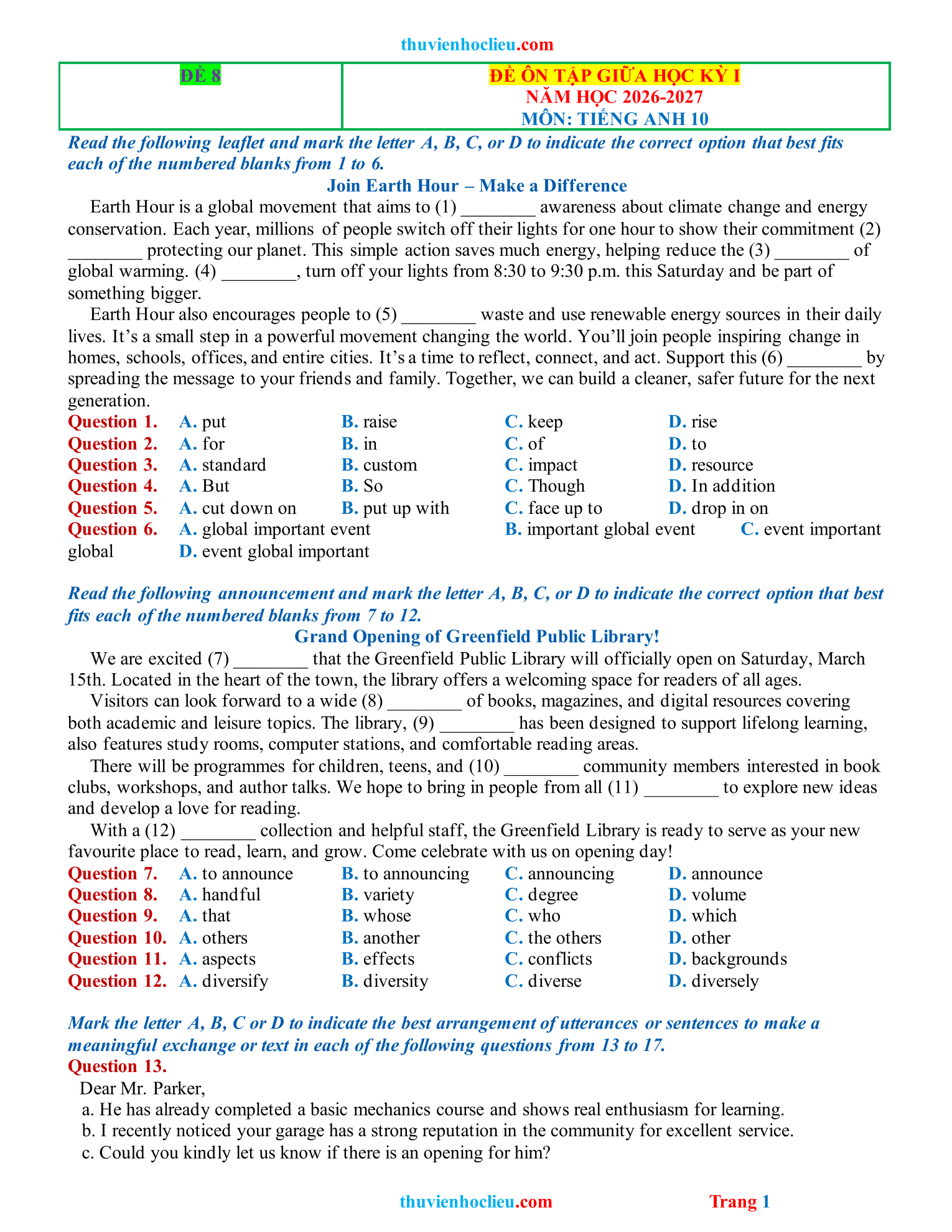
Join Earth Hour – Make a Difference
Earth Hour is a global movement that aims to (1) ________ awareness about climate change and energy conservation. Each year, millions of people switch off their lights for one hour to show their commitment (2) ________ protecting our planet. This simple action saves much energy, helping reduce the (3) ________ of global warming. (4) ________, turn off your lights from 8:30 to 9:30 p.m. this Saturday and be part of something bigger.
Earth Hour also encourages people to (5) ________ waste and use renewable energy sources in their daily lives. It’s a small step in a powerful movement changing the world. You’ll join people inspiring change in homes, schools, offices, and entire cities. It’s a time to reflect, connect, and act. Support this (6) ________ by spreading the message to your friends and family. Together, we can build a cleaner, safer future for the next generation.
Question 1.
A. put
B. raise
C. keep
D. rise
Đáp án: B
Question 2.
A. for
B. in
C. of
D. to
Đáp án: D
Question 3.
A. standard
B. custom
C. impact
D. resource
Đáp án: C
Question 4.
A. But
B. So
C. Though
D. In addition
Đáp án: B
Question 5.
A. cut down on
B. put up with
C. face up to
D. drop in on
Đáp án: A
Question 6.
A. global important event
B. important global event
C. event important global
D. event global important
Đáp án: BRead the following announcement and mark the letter A, B, C, or D to indicate the correct option that best fits each of the numbered blanks from 7 to 12.
Grand Opening of Greenfield Public Library!
We are excited (7) ________ that the Greenfield Public Library will officially open on Saturday, March 15th. Located in the heart of the town, the library offers a welcoming space for readers of all ages.
Visitors can look forward to a wide (8) ________ of books, magazines, and digital resources covering both academic and leisure topics. The library, (9) ________ has been designed to support lifelong learning, also features study rooms, computer stations, and comfortable reading areas.
There will be programmes for children, teens, and (10) ________ community members interested in book clubs, workshops, and author talks. We hope to bring in people from all (11) ________ to explore new ideas and develop a love for reading.
With a (12) ________ collection and helpful staff, the Greenfield Library is ready to serve as your new favourite place to read, learn, and grow. Come celebrate with us on opening day!
Question 7.
A. to announce
B. to announcing
C. announcing
D. announce
Đáp án: A
Question 8.
A. handful
B. variety
C. degree
D. volume
Đáp án: B
Question 9.
A. that
B. whose
C. who
D. which
Đáp án: D
Question 10.
A. others
B. another
C. the others
D. other
Đáp án: D
Question 11.
A. aspects
B. effects
C. conflicts
D. backgrounds
Đáp án: D
Question 12.
A. diversify
B. diversity
C. diverse
D. diversely
Đáp án: C
Mark the letter A, B, C or D to indicate the best arrangement of utterances or sentences to make a meaningful exchange or text in each of the following questions from 13 to 17.
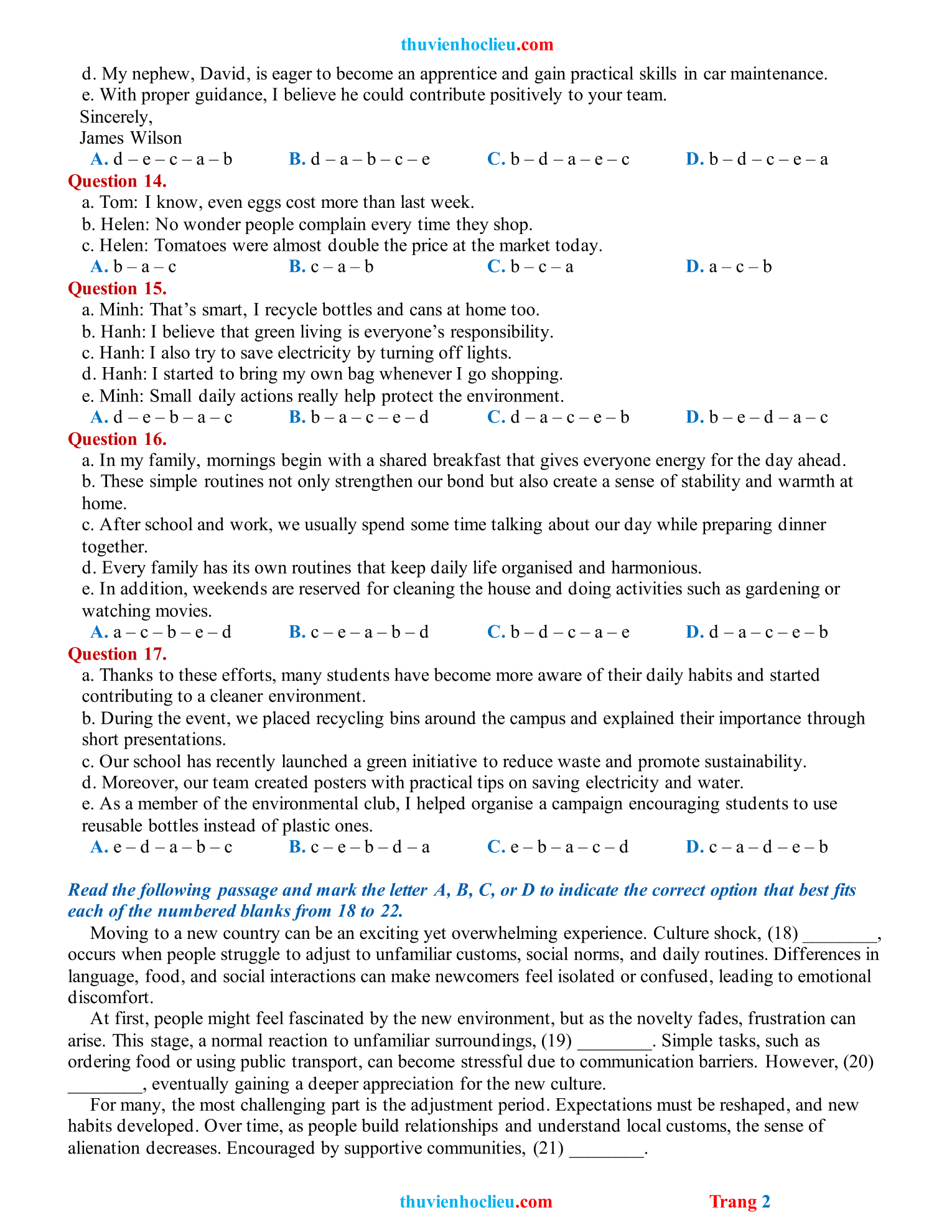
Question 13.
Dear Mr. Parker,
a. He has already completed a basic mechanics course and shows real enthusiasm for learning.
b. I recently noticed your garage has a strong reputation in the community for excellent service.
c. Could you kindly let us know if there is an opening for him?
d. My nephew, David, is eager to become an apprentice and gain practical skills in car maintenance.
e. With proper guidance, I believe he could contribute positively to your team.
Sincerely,
James Wilson
A. d – e – c – a – b
B. d – a – b – c – e
C. b – d – a – e – c
D. b – d – c – e – a
Đáp án: C
Question 14.
a. Tom: I know, even eggs cost more than last week.
b. Helen: No wonder people complain every time they shop.
c. Helen: Tomatoes were almost double the price at the market today.
A. b – a – c
B. c – a – b
C. b – c – a
D. a – c – b
Đáp án: B
Question 15.
a. Minh: That’s smart, I recycle bottles and cans at home too.
b. Hanh: I believe that green living is everyone’s responsibility.
c. Hanh: I also try to save electricity by turning off lights.
d. Hanh: I started to bring my own bag whenever I go shopping.
e. Minh: Small daily actions really help protect the environment.
A. d – e – b – a – c
B. b – a – c – e – d
C. d – a – c – e – b
D. b – e – d – a – c
Đáp án: D
Question 16.
a. In my family, mornings begin with a shared breakfast that gives everyone energy for the day ahead.
b. These simple routines not only strengthen our bond but also create a sense of stability and warmth at home.
c. After school and work, we usually spend some time talking about our day while preparing dinner together.
d. Every family has its own routines that keep daily life organised and harmonious.
e. In addition, weekends are reserved for cleaning the house and doing activities such as gardening or watching movies.
A. a – c – b – e – d
B. c – e – a – b – d
C. b – d – c – a – e
D. d – a – c – e – b
Đáp án: D
Question 17.
a. Thanks to these efforts, many students have become more aware of their daily habits and started contributing to a cleaner environment.
b. During the event, we placed recycling bins around the campus and explained their importance through short presentations.
c. Our school has recently launched a green initiative to reduce waste and promote sustainability.
d. Moreover, our team created posters with practical tips on saving electricity and water.
e. As a member of the environmental club, I helped organise a campaign encouraging students to use reusable bottles instead of plastic ones.
A. e – d – a – b – c
B. c – e – b – d – a
C. e – b – a – c – d
D. c – a – d – e – b
Đáp án: B
Read the following passage and mark the letter A, B, C, or D to indicate the correct option that best fits each of the numbered blanks from 18 to 22.
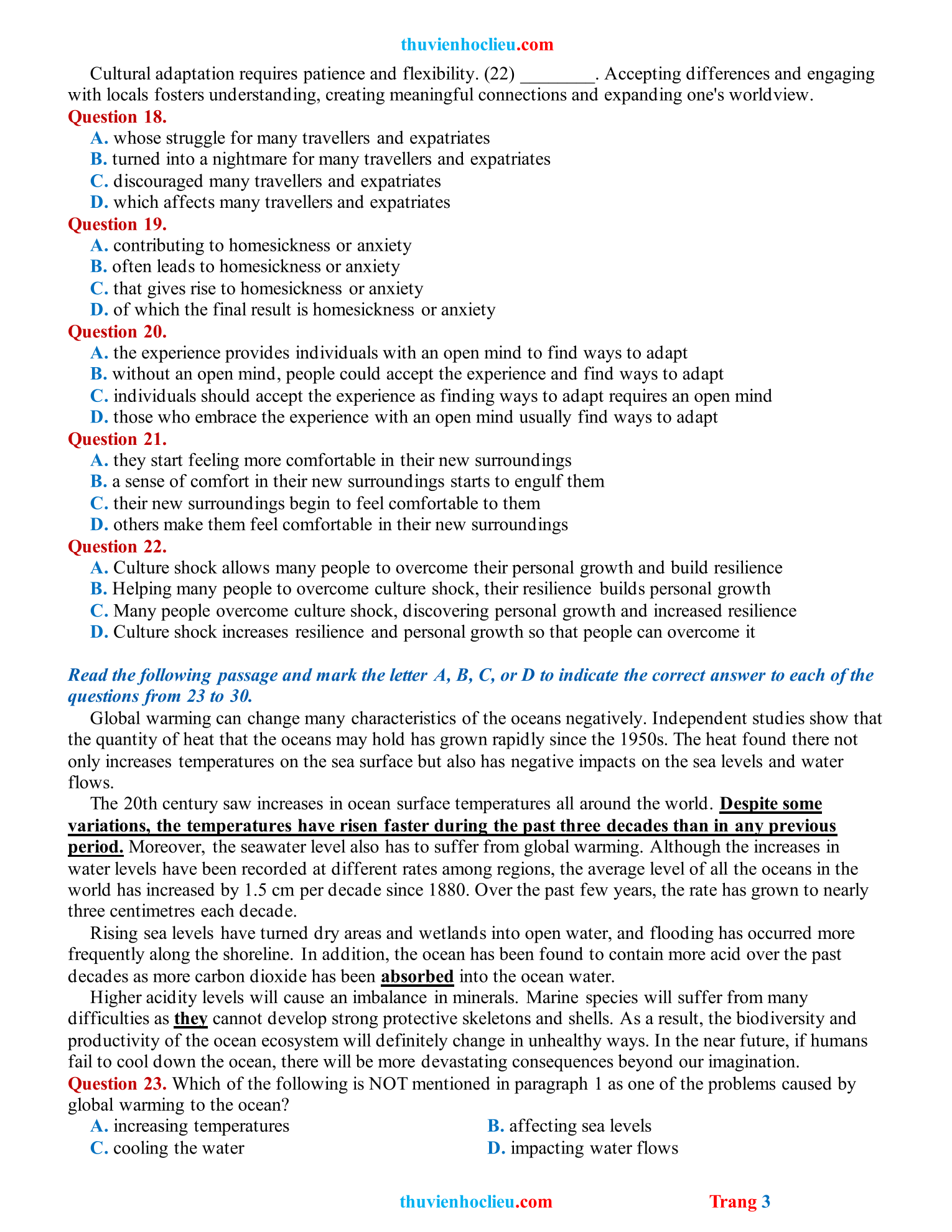
Moving to a new country can be an exciting yet overwhelming experience. Culture shock, (18) ________, occurs when people struggle to adjust to unfamiliar customs, social norms, and daily routines. Differences in language, food, and social interactions can make newcomers feel isolated or confused, leading to emotional discomfort.
At first, people might feel fascinated by the new environment, but as the novelty fades, frustration can arise. This stage, a normal reaction to unfamiliar surroundings, (19) ________. Simple tasks, such as ordering food or using public transport, can become stressful due to communication barriers. However, (20) ________, eventually gaining a deeper appreciation for the new culture.
For many, the most challenging part is the adjustment period. Expectations must be reshaped, and new habits developed. Over time, as people build relationships and understand local customs, the sense of alienation decreases. Encouraged by supportive communities, (21) ________.
Cultural adaptation requires patience and flexibility. (22) ________. Accepting differences and engaging with locals fosters understanding, creating meaningful connections and expanding one’s worldview.
Question 18.
A. whose struggle for many travellers and expatriates
B. turned into a nightmare for many travellers and expatriates
C. discouraged many travellers and expatriates
D. which affects many travellers and expatriates
Đáp án: D
Question 19.
A. contributing to homesickness or anxiety
B. often leads to homesickness or anxiety
C. that gives rise to homesickness or anxiety
D. of which the final result is homesickness or anxiety
Đáp án: B
Question 20.
A. the experience provides individuals with an open mind to find ways to adapt
B. without an open mind, people could accept the experience and find ways to adapt
C. individuals should accept the experience as finding ways to adapt requires an open mind
D. those who embrace the experience with an open mind usually find ways to adapt
Đáp án: D
Question 21.
A. they start feeling more comfortable in their new surroundings
B. a sense of comfort in their new surroundings starts to engulf them
C. their new surroundings begin to feel comfortable to them
D. others make them feel comfortable in their new surroundings
Đáp án: A
Question 22.
A. Culture shock allows many people to overcome their personal growth and build resilience
B. Helping many people to overcome culture shock, their resilience builds personal growth
C. Many people overcome culture shock, discovering personal growth and increased resilience
D. Culture shock increases resilience and personal growth so that people can overcome it
Đáp án: C
Read the following passage and mark the letter A, B, C, or D to indicate the correct answer to each of the questions from 23 to 30.
Global warming can change many characteristics of the oceans negatively. Independent studies show that the quantity of heat that the oceans may hold has grown rapidly since the 1950s. The heat found there not only increases temperatures on the sea surface but also has negative impacts on the sea levels and water flows.
The 20th century saw increases in ocean surface temperatures all around the world. Despite some variations, the temperatures have risen faster during the past three decades than in any previous period. Moreover, the seawater level also has to suffer from global warming. Although the increases in water levels have been recorded at different rates among regions, the average level of all the oceans in the world has increased by 1.5 cm per decade since 1880. Over the past few years, the rate has grown to nearly three centimetres each decade.
Rising sea levels have turned dry areas and wetlands into open water, and flooding has occurred more frequently along the shoreline. In addition, the ocean has been found to contain more acid over the past decades as more carbon dioxide has been absorbed into the ocean water.
Higher acidity levels will cause an imbalance in minerals. Marine species will suffer from many difficulties as they cannot develop strong protective skeletons and shells. As a result, the biodiversity and productivity of the ocean ecosystem will definitely change in unhealthy ways. In the near future, if humans fail to cool down the ocean, there will be more devastating consequences beyond our imagination.
Question 23. Which of the following is NOT mentioned in paragraph 1 as one of the problems caused by global warming to the ocean?
A. increasing temperatures
B. affecting sea levels
C. cooling the water
D. impacting water flows
Đáp án: C
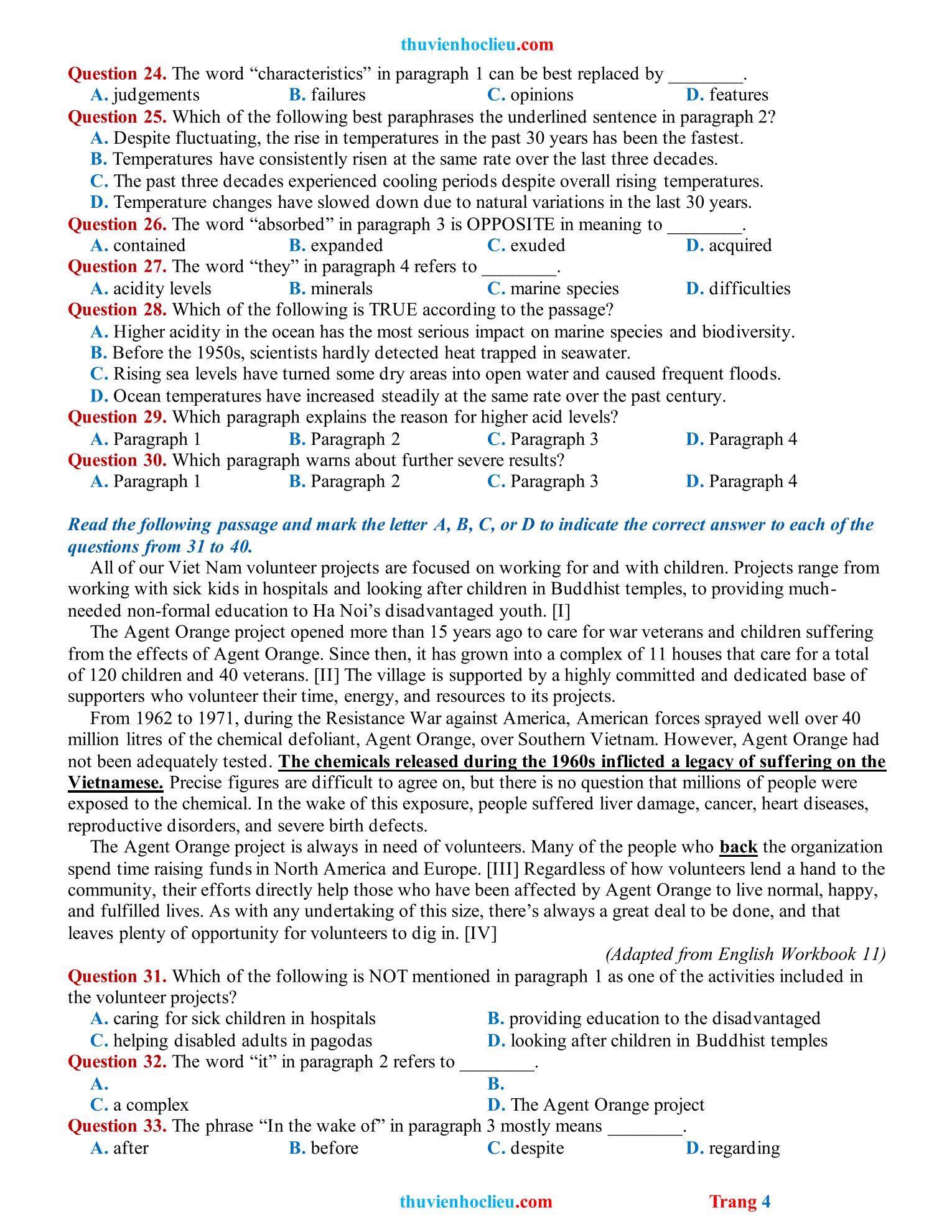
Question 24. The word “characteristics” in paragraph 1 can be best replaced by ________
A. judgements
B. failures
C. opinions
D. features
Đáp án: D
Question 25. Which of the following best paraphrases the underlined sentence in paragraph 2?
A. Despite fluctuating, the rise in temperatures in the past 30 years has been the fastest.
B. Temperatures have consistently risen at the same rate over the last three decades.
C. The past three decades experienced cooling periods despite overall rising temperatures.
D. Temperature changes have slowed down due to natural variations in the last 30 years.
Đáp án: A
Question 26. The word “absorbed” in paragraph 3 is OPPOSITE in meaning to ________
A. contained
B. expanded
C. exuded
D. acquired
Đáp án: C
Question 27. The word “they” in paragraph 4 refers to ________
A. acidity levels
B. minerals
C. marine species
D. difficulties
Đáp án: C
Question 28. Which of the following is TRUE according to the passage?
A. Higher acidity in the ocean has the most serious impact on marine species and biodiversity.
B. Before the 1950s, scientists hardly detected heat trapped in seawater.
C. Rising sea levels have turned some dry areas into open water and caused frequent floods.
D. Ocean temperatures have increased steadily at the same rate over the past century.
Đáp án: C
Question 29. Which paragraph explains the reason for higher acid levels?
A. Paragraph 1
B. Paragraph 2
C. Paragraph 3
D. Paragraph 4
Đáp án: C
Question 30. Which paragraph warns about further severe results?
A. Paragraph 1
B. Paragraph 2
C. Paragraph 3
D. Paragraph 4
Đáp án: D
Read the following passage and mark the letter A, B, C, or D to indicate the correct answer to each of the questions from 31 to 40.
All of our Viet Nam volunteer projects are focused on working for and with children. Projects range from working with sick kids in hospitals and looking after children in Buddhist temples, to providing much-needed non-formal education to Ha Noi’s disadvantaged youth. [I]
The Agent Orange project opened more than 15 years ago to care for war veterans and children suffering from the effects of Agent Orange. Since then, it has grown into a complex of 11 houses that care for a total of 120 children and 40 veterans. [II] The village is supported by a highly committed and dedicated base of supporters who volunteer their time, energy, and resources to its projects.
From 1962 to 1971, during the Resistance War against America, American forces sprayed well over 40 million litres of the chemical defoliant, Agent Orange, over Southern Vietnam. However, Agent Orange had not been adequately tested. The chemicals released during the 1960s inflicted a legacy of suffering on the Vietnamese. Precise figures are difficult to agree on, but there is no question that millions of people were exposed to the chemical. In the wake of this exposure, people suffered liver damage, cancer, heart diseases, reproductive disorders, and severe birth defects.
The Agent Orange project is always in need of volunteers. Many of the people who back the organization spend time raising funds in North America and Europe. [III] Regardless of how volunteers lend a hand to the community, their efforts directly help those who have been affected by Agent Orange to live normal, happy, and fulfilled lives. As with any undertaking of this size, there’s always a great deal to be done, and that leaves plenty of opportunity for volunteers to dig in. [IV]
(Adapted from English Workbook 11)
Question 31. Which of the following is NOT mentioned in paragraph 1 as one of the activities included in the volunteer projects?
A. caring for sick children in hospitals
B. providing education to the disadvantaged
C. helping disabled adults in pagodas
D. looking after children in Buddhist temples
Đáp án: C
Question 32. The word “it” in paragraph 2 refers to ________
A.
B.
C. a complex
D. The Agent Orange project
Đáp án: D
Question 33. The phrase “In the wake of” in paragraph 3 mostly means ________
A. after
B. before
C. despite
D. regarding
Đáp án: A
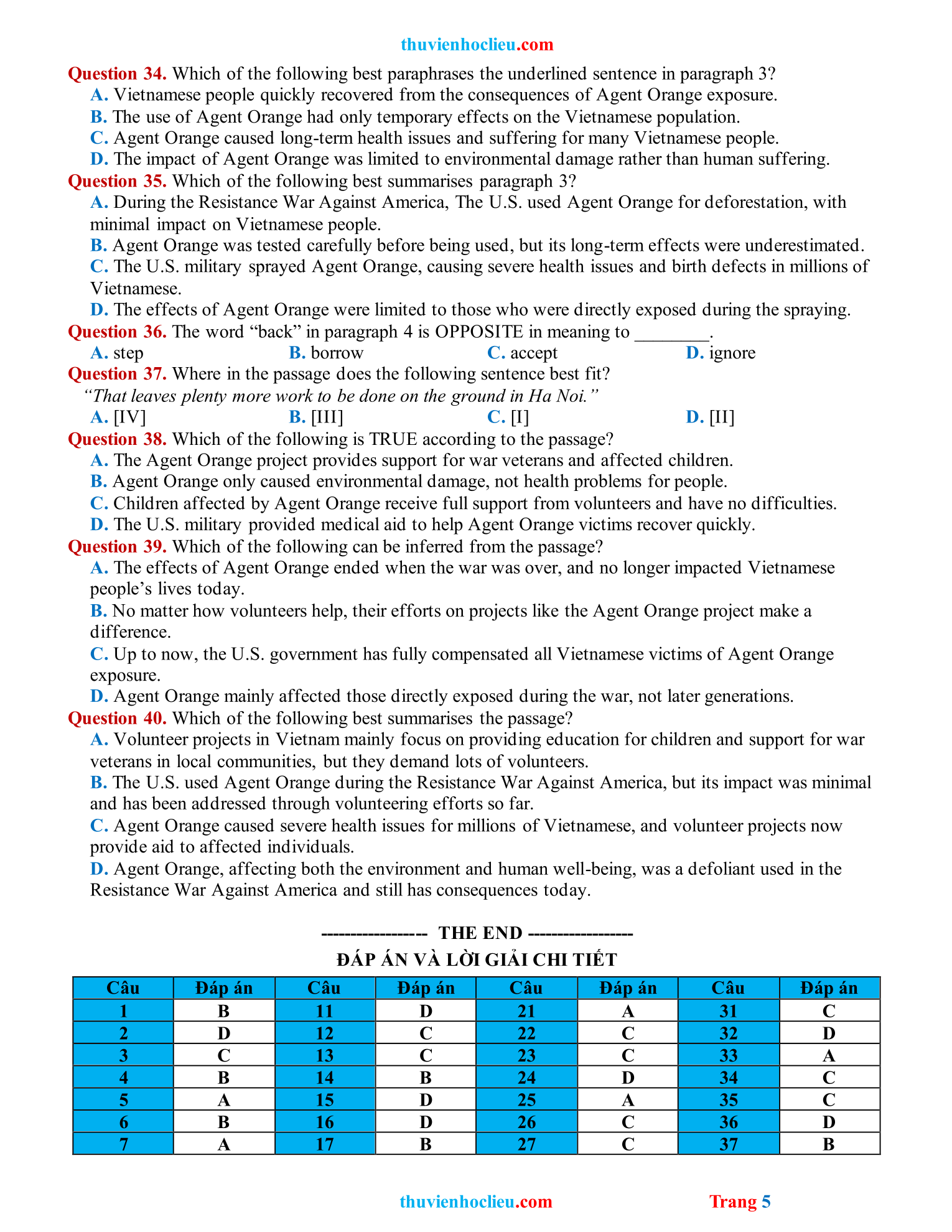
Question 34. Which of the following best paraphrases the underlined sentence in paragraph 3?
A. Vietnamese people quickly recovered from the consequences of Agent Orange exposure.
B. The use of Agent Orange had only temporary effects on the Vietnamese population.
C. Agent Orange caused long-term health issues and suffering for many Vietnamese people.
D. The impact of Agent Orange was limited to environmental damage rather than human suffering.
Đáp án: C
Question 35. Which of the following best summarises paragraph 3?
A. During the Resistance War Against America, The U.S. used Agent Orange for deforestation, with minimal impact on Vietnamese people.
B. Agent Orange was tested carefully before being used, but its long-term effects were underestimated.
C. The U.S. military sprayed Agent Orange, causing severe health issues and birth defects in millions of Vietnamese.
D. The effects of Agent Orange were limited to those who were directly exposed during the spraying.
Đáp án: C
Question 36. The word “back” in paragraph 4 is OPPOSITE in meaning to ________
A. step
B. borrow
C. accept
D. ignore
Đáp án: D
Question 37. Where in the passage does the following sentence best fit?
“That leaves plenty more work to be done on the ground in Ha Noi.”
A. [IV]
B. [III]
C. [I]
D. [II]
Đáp án: B
Question 38. Which of the following is TRUE according to the passage?
A. The Agent Orange project provides support for war veterans and affected children.
B. Agent Orange only caused environmental damage, not health problems for people.
C. Children affected by Agent Orange receive full support from volunteers and have no difficulties.
D. The U.S. military provided medical aid to help Agent Orange victims recover quickly.
Đáp án: A
Question 39. Which of the following can be inferred from the passage?
A. The effects of Agent Orange ended when the war was over, and no longer impacted Vietnamese people’s lives today.
B. No matter how volunteers help, their efforts on projects like the Agent Orange project make a difference.
C. Up to now, the U.S. government has fully compensated all Vietnamese victims of Agent Orange exposure.
D. Agent Orange mainly affected those directly exposed during the war, not later generations.
Đáp án: B
Question 40. Which of the following best summarises the passage?
A. Volunteer projects in Vietnam mainly focus on providing education for children and support for war veterans in local communities, but they demand lots of volunteers.
B. The U.S. used Agent Orange during the Resistance War Against America, but its impact was minimal and has been addressed through volunteering efforts so far.
C. Agent Orange caused severe health issues for millions of Vietnamese, and volunteer projects now provide aid to affected individuals.
D. Agent Orange, affecting both the environment and human well-being, was a defoliant used in the Resistance War Against America and still has consequences today.
Đáp án: C