Đề ôn tập Giữa kì 1 Tiếng anh 10 2026 2027 – Đề 6 là tài liệu học thuật chuyên sâu thuộc môn Tiếng Anh dành cho học sinh lớp 10, được biên soạn bởi thuvienhoclieu.com cho năm học 2026 – 2027. Đây là bộ đề ôn thi giữa học kỳ 1 môn Tiếng Anh 10 chất lượng nhằm mục đích khảo sát năng lực định kỳ và tạo nền tảng vững chắc hỗ trợ kỳ thi tốt nghiệp THPT trong tương lai. Nội dung đề tập trung vào các chuyên đề trọng tâm bao gồm từ vựng về chủ đề từ thiện và giao thông, kỹ năng đọc hiểu dữ kiện cùng bài tập sắp xếp đoạn văn logic. Thông qua dạng đề tiếng anh 10 này, học sinh được rèn luyện kỹ năng phân tích nhanh, tối ưu hóa thời gian chọn đáp án và tăng cường khả năng vận dụng kiến thức ngôn ngữ vào thực tế đời sống.
Việc luyện tập các bộ đề thi lớp 10 và tài liệu bổ trợ trên nền tảng dethitracnghiem.vn mang lại trải nghiệm học tập hiện đại với giao diện thân thiện, cho phép học sinh làm bài nhiều lần để củng cố kiến thức. Người học có thể xem đáp án chi tiết ngay sau khi nộp bài, từ đó dễ dàng theo dõi kết quả và đánh giá mức độ tiến bộ trong giai đoạn tăng tốc ôn thi năm 2026. Các câu hỏi Tiếng Anh được hệ thống phân chia khoa học từ lý thuyết cơ bản đến bài tập tình huống thực tiễn, giúp học sinh lớp 10 làm quen với cấu trúc ra đề thực tế và nâng cao trình độ ngoại ngữ một cách bài bản. Phương pháp này không chỉ giúp tiết kiệm thời gian ôn tập mà còn chuẩn bị tâm thế tự tin nhất cho các kỳ thi khảo sát quan trọng sắp tới.
ĐỀ THI
LINK PDF ĐỀ THI [gồm ĐỀ THI, ĐÁP ÁN, LỜI GIẢI]:
Nội dung đề thi
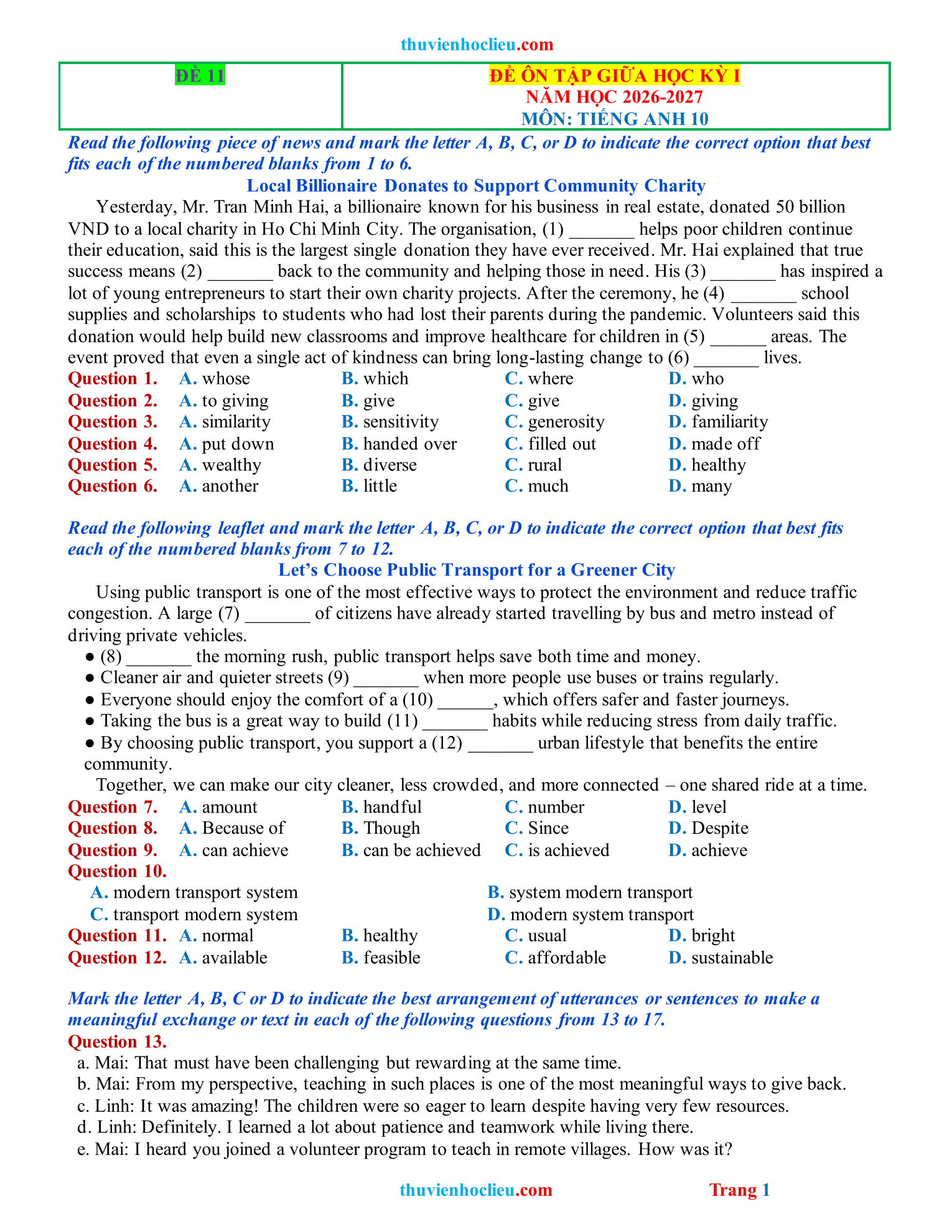
Local Billionaire Donates to Support Community Charity
Yesterday, Mr. Tran Minh Hai, a billionaire known for his business in real estate, donated 50 billion VND to a local charity in Ho Chi Minh City. The organisation, (1) ______ helps poor children continue their education, said this is the largest single donation they have ever received. Mr. Hai explained that true success means (2) ______ back to the community and helping those in need. His (3) ______ has inspired a lot of young entrepreneurs to start their own charity projects. After the ceremony, he (4) ______ school supplies and scholarships to students who had lost their parents during the pandemic. Volunteers said this donation would help build new classrooms and improve healthcare for children in (5) ______ areas. The event proved that even a single act of kindness can bring long-lasting change to (6) ______ lives.
Question 1.
A. whose
B. which
C. where
D. who
Đáp án: B
Question 2.
A. to giving
B. give
C. give
D. giving
Đáp án: D
Question 3.
A. similarity
B. sensitivity
C. generosity
D. familiarity
Đáp án: C
Question 4.
A. put down
B. handed over
C. filled out
D. made off
Đáp án: B
Question 5.
A. wealthy
B. diverse
C. rural
D. healthy
Đáp án: C
Question 6.
A. another
B. little
C. much
D. many
Đáp án: DRead the following leaflet and mark the letter A, B, C, or D to indicate the correct option that best fits each of the numbered blanks from 7 to 12.
Let’s Choose Public Transport for a Greener City
Using public transport is one of the most effective ways to protect the environment and reduce traffic congestion. A large (7) ______ of citizens have already started travelling by bus and metro instead of driving private vehicles.
● (8) ______ the morning rush, public transport helps save both time and money.
● Cleaner air and quieter streets (9) ______ when more people use buses or trains regularly.
● Everyone should enjoy the comfort of a (10) ______, which offers safer and faster journeys.
● Taking the bus is a great way to build (11) ______ habits while reducing stress from daily traffic.
● By choosing public transport, you support a (12) ______ urban lifestyle that benefits the entire community.
Together, we can make our city cleaner, less crowded, and more connected – one shared ride at a time.
Question 7.
A. amount
B. handful
C. number
D. level
Đáp án: C
Question 8.
A. Because of
B. Though
C. Since
D. Despite
Đáp án: A
Question 9.
A. can achieve
B. can be achieved
C. is achieved
D. achieve
Đáp án: B
Question 10.
A. modern transport system
B. system modern transport
C. transport modern system
D. modern system transport
Đáp án: A
Question 11.
A. normal
B. healthy
C. usual
D. bright
Đáp án: B
Question 12.
A. available
B. feasible
C. affordable
D. sustainable
Đáp án: D
Mark the letter A, B, C or D to indicate the best arrangement of utterances or sentences to make a meaningful exchange or text in each of the following questions from 13 to 17.
Question 13.
a. Mai: That must have been challenging but rewarding at the same time.
b. Mai: From my perspective, teaching in such places is one of the most meaningful ways to give back.
c. Linh: It was amazing! The children were so eager to learn despite having very few resources.
d. Linh: Definitely. I learned a lot about patience and teamwork while living there.
e. Mai: I heard you joined a volunteer program to teach in remote villages. How was it?
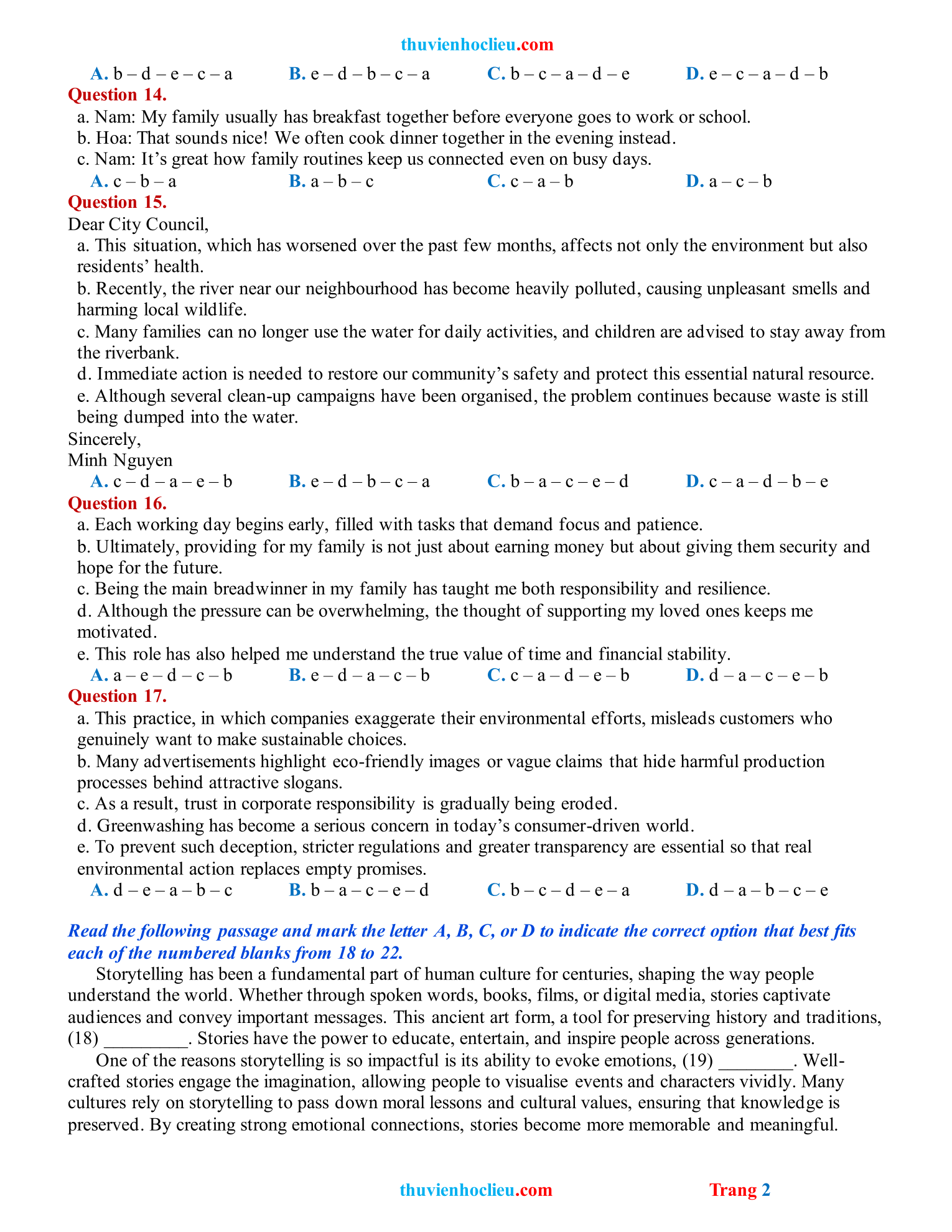
A. b – d – e – c – a
B. e – d – b – c – a
C. b – c – a – d – e
D. e – c – a – d – b
Đáp án: D
Question 14.
a. Nam: My family usually has breakfast together before everyone goes to work or school.
b. Hoa: That sounds nice! We often cook dinner together in the evening instead.
c. Nam: It’s great how family routines keep us connected even on busy days.
A. c – b – a
B. a – b – c
C. c – a – b
D. a – c – b
Đáp án: B
Question 15.
Dear City Council,
a. This situation, which has worsened over the past few months, affects not only the environment but also residents’ health.
b. Recently, the river near our neighbourhood has become heavily polluted, causing unpleasant smells and harming local wildlife.
c. Many families can no longer use the water for daily activities, and children are advised to stay away from the riverbank.
d. Immediate action is needed to restore our community’s safety and protect this essential natural resource.
e. Although several clean-up campaigns have been organised, the problem continues because waste is still being dumped into the water.
Sincerely,
Minh Nguyen
A. c – d – a – e – b
B. e – d – b – c – a
C. b – a – c – e – d
D. c – a – d – b – e
Đáp án: C
Question 16.
a. Each working day begins early, filled with tasks that demand focus and patience.
b. Ultimately, providing for my family is not just about earning money but about giving them security and hope for the future.
c. Being the main breadwinner in my family has taught me both responsibility and resilience.
d. Although the pressure can be overwhelming, the thought of supporting my loved ones keeps me motivated.
e. This role has also helped me understand the true value of time and financial stability.
A. a – e – d – c – b
B. e – d – a – c – b
C. c – a – d – e – b
D. d – a – c – e – b
Đáp án: C
Question 17.
a. This practice, in which companies exaggerate their environmental efforts, misleads customers who genuinely want to make sustainable choices.
b. Many advertisements highlight eco-friendly images or vague claims that hide harmful production processes behind attractive slogans.
c. As a result, trust in corporate responsibility is gradually being eroded.
d. Greenwashing has become a serious concern in today’s consumer-driven world.
e. To prevent such deception, stricter regulations and greater transparency are essential so that real environmental action replaces empty promises.
A. d – e – a – b – c
B. b – a – c – e – d
C. b – c – d – e – a
D. d – a – b – c – e
Đáp án: D
Read the following passage and mark the letter A, B, C, or D to indicate the correct option that best fits each of the numbered blanks from 18 to 22.
Storytelling has been a fundamental part of human culture for centuries, shaping the way people understand the world. Whether through spoken words, books, films, or digital media, stories captivate audiences and convey important messages. This ancient art form, a tool for preserving history and traditions, (18) ______. Stories have the power to educate, entertain, and inspire people across generations.
One of the reasons storytelling is so impactful is its ability to evoke emotions, (19) ______. Well-crafted stories engage the imagination, allowing people to visualise events and characters vividly. Many cultures rely on storytelling to pass down moral lessons and cultural values, ensuring that knowledge is preserved. By creating strong emotional connections, stories become more memorable and meaningful.
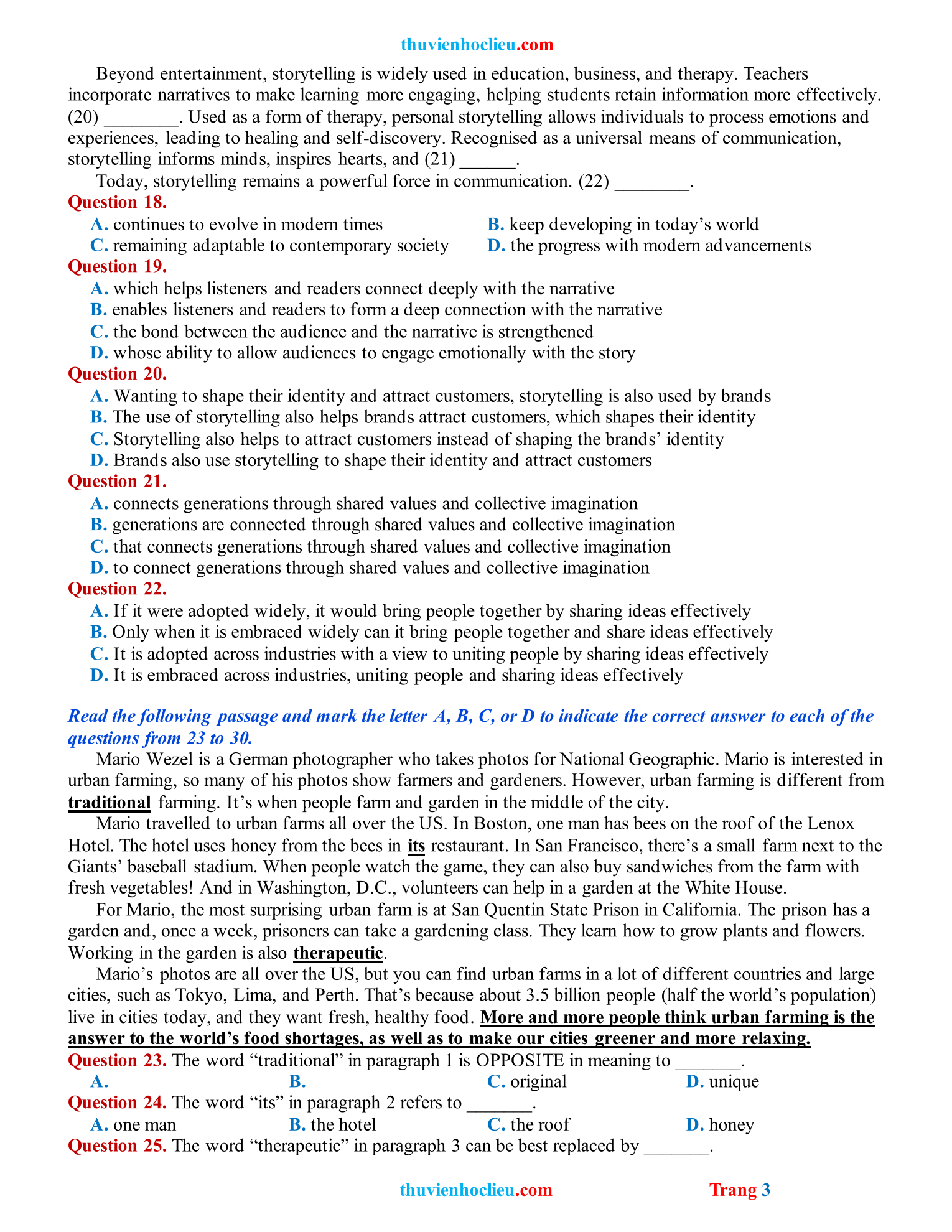
Beyond entertainment, storytelling is widely used in education, business, and therapy. Teachers incorporate narratives to make learning more engaging, helping students retain information more effectively. (20) ______. Used as a form of therapy, personal storytelling allows individuals to process emotions and experiences, leading to healing and self-discovery. Recognised as a universal means of communication, storytelling informs minds, inspires hearts, and (21) ______.
Today, storytelling remains a powerful force in communication. (22) ______.
Question 18.
A. continues to evolve in modern times
B. keep developing in today’s world
C. remaining adaptable to contemporary society
D. the progress with modern advancements
Đáp án: A
Question 19.
A. which helps listeners and readers connect deeply with the narrative
B. enables listeners and readers to form a deep connection with the narrative
C. the bond between the audience and the narrative is strengthened
D. whose ability to allow audiences to engage emotionally with the story
Đáp án: A
Question 20.
A. Wanting to shape their identity and attract customers, storytelling is also used by brands
B. The use of storytelling also helps brands attract customers, which shapes their identity
C. Storytelling also helps to attract customers instead of shaping the brands’ identity
D. Brands also use storytelling to shape their identity and attract customers
Đáp án: D
Question 21.
A. connects generations through shared values and collective imagination
B. generations are connected through shared values and collective imagination
C. that connects generations through shared values and collective imagination
D. to connect generations through shared values and collective imagination
Đáp án: A
Question 22.
A. If it were adopted widely, it would bring people together by sharing ideas effectively
B. Only when it is embraced widely can it bring people together and share ideas effectively
C. It is adopted across industries with a view to uniting people by sharing ideas effectively
D. It is embraced across industries, uniting people and sharing ideas effectively
Đáp án: D
Read the following passage and mark the letter A, B, C, or D to indicate the correct answer to each of the questions from 23 to 30.
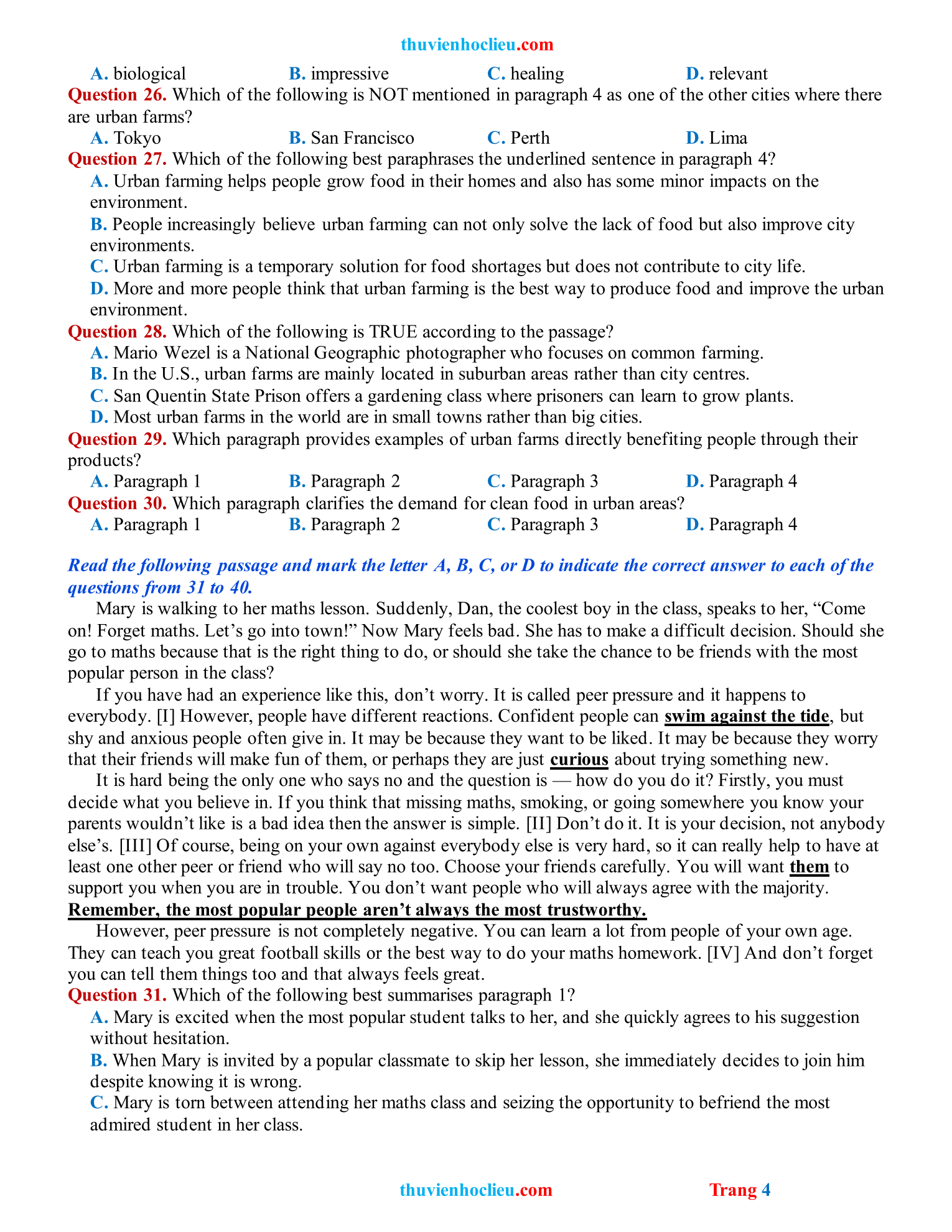
Mario Wezel is a German photographer who takes photos for National Geographic. Mario is interested in urban farming, so many of his photos show farmers and gardeners. However, urban farming is different from traditional farming. It’s when people farm and garden in the middle of the city.
Mario travelled to urban farms all over the US. In Boston, one man has bees on the roof of the Lenox Hotel. The hotel uses honey from the bees in its restaurant. In San Francisco, there’s a small farm next to the Giants’ baseball stadium. When people watch the game, they can also buy sandwiches from the farm with fresh vegetables! And in Washington, D.C., volunteers can help in a garden at the White House.
For Mario, the most surprising urban farm is at San Quentin State Prison in California. The prison has a garden and, once a week, prisoners can take a gardening class. They learn how to grow plants and flowers. Working in the garden is also therapeutic.
Mario’s photos are all over the US, but you can find urban farms in a lot of different countries and large cities, such as Tokyo, Lima, and Perth. That’s because about 3.5 billion people (half the world’s population) live in cities today, and they want fresh, healthy food. More and more people think urban farming is the answer to the world’s food shortages, as well as to make our cities greener and more relaxing.
Question 23. The word “traditional” in paragraph 1 is OPPOSITE in meaning to ______.
A.
B.
C. original
D. unique
Đáp án: A
Question 24. The word “its” in paragraph 2 refers to ______.
A. one man
B. the hotel
C. the roof
D. honey
Đáp án: B
Question 25. The word “therapeutic” in paragraph 3 can be best replaced by ______.
A. biological
B. impressive
C. healing
D. relevant
Đáp án: C
Question 26. Which of the following is NOT mentioned in paragraph 4 as one of the other cities where there are urban farms?
A. Tokyo
B. San Francisco
C. Perth
D. Lima
Đáp án: B
Question 27. Which of the following best paraphrases the underlined sentence in paragraph 4?
A. Urban farming helps people grow food in their homes and also has some minor impacts on the environment.
B. People increasingly believe urban farming can not only solve the lack of food but also improve city environments.
C. Urban farming is a temporary solution for food shortages but does not contribute to city life.
D. More and more people think that urban farming is the best way to produce food and improve the urban environment.
Đáp án: B
Question 28. Which of the following is TRUE according to the passage?
A. Mario Wezel is a National Geographic photographer who focuses on common farming.
B. In the U.S., urban farms are mainly located in suburban areas rather than city centres.
C. San Quentin State Prison offers a gardening class where prisoners can learn to grow plants.
D. Most urban farms in the world are in small towns rather than big cities.
Đáp án: C
Question 29. Which paragraph provides examples of urban farms directly benefiting people through their products?
A. Paragraph 1
B. Paragraph 2
C. Paragraph 3
D. Paragraph 4
Đáp án: B
Question 30. Which paragraph clarifies the demand for clean food in urban areas?
A. Paragraph 1
B. Paragraph 2
C. Paragraph 3
D. Paragraph 4
Đáp án: D
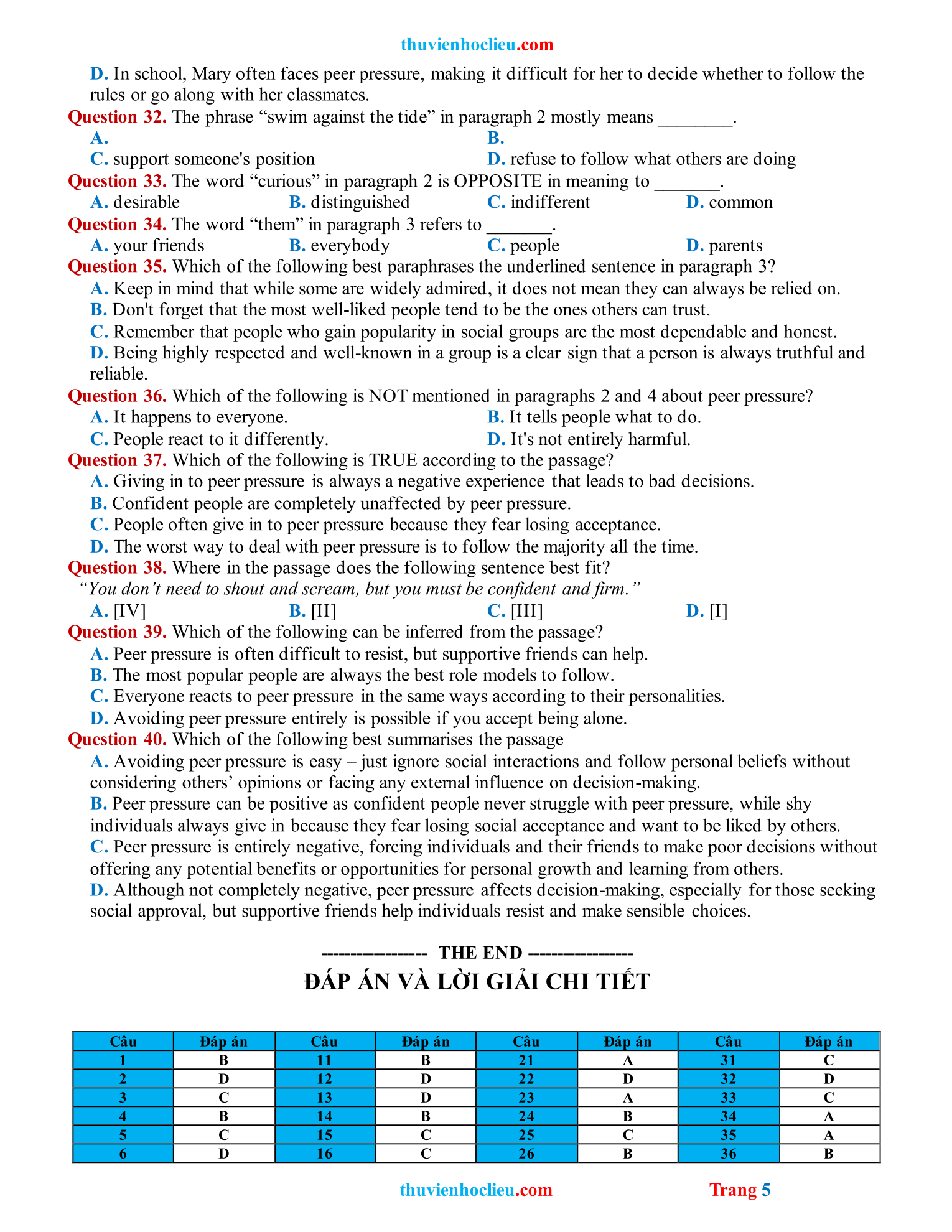
Read the following passage and mark the letter A, B, C, or D to indicate the correct answer to each of the questions from 31 to 40.
Mary is walking to her maths lesson. Suddenly, Dan, the coolest boy in the class, speaks to her, “Come on! Forget maths. Let’s go into town!” Now Mary feels bad. She has to make a difficult decision. Should she go to maths because that is the right thing to do, or should she take the chance to be friends with the most popular person in the class?
If you have had an experience like this, don’t worry. It is called peer pressure and it happens to everybody. [I] However, people have different reactions. Confident people can swim against the tide, but shy and anxious people often give in. It may be because they want to be liked. It may be because they worry that their friends will make fun of them, or perhaps they are just curious about trying something new.
It is hard being the only one who says no and the question is — how do you do it? Firstly, you must decide what you believe in. If you think that missing maths, smoking, or going somewhere you know your parents wouldn’t like is a bad idea then the answer is simple. [II] Don’t do it. It is your decision, not anybody else’s. [III] Of course, being on your own against everybody else is very hard, so it can really help to have at least one other peer or friend who will say no too. Choose your friends carefully. You will want them to support you when you are in trouble. You don’t want people who will always agree with the majority. Remember, the most popular people aren’t always the most trustworthy.
However, peer pressure is not completely negative. You can learn a lot from people of your own age. They can teach you great football skills or the best way to do your maths homework. [IV] And don’t forget you can tell them things too and that always feels great.
Question 31. Which of the following best summarises paragraph 1?
A. Mary is excited when the most popular student talks to her, and she quickly agrees to his suggestion without hesitation.
B. When Mary is invited by a popular classmate to skip her lesson, she immediately decides to join him despite knowing it is wrong.
C. Mary is torn between attending her maths class and seizing the opportunity to befriend the most admired student in her class.
D. In school, Mary often faces peer pressure, making it difficult for her to decide whether to follow the rules or go along with her classmates.
Đáp án: C
Question 32. The phrase “swim against the tide” in paragraph 2 mostly means ______.
A.
B.
C. support someone’s position
D. refuse to follow what others are doing
Đáp án: D
Question 33. The word “curious” in paragraph 2 is OPPOSITE in meaning to ______.
A. desirable
B. distinguished
C. indifferent
D. common
Đáp án: C
Question 34. The word “them” in paragraph 3 refers to ______.
A. your friends
B. everybody
C. people
D. parents
Đáp án: A
Question 35. Which of the following best paraphrases the underlined sentence in paragraph 3?
A. Keep in mind that while some are widely admired, it does not mean they can always be relied on.
B. Don’t forget that the most well-liked people tend to be the ones others can trust.
C. Remember that people who gain popularity in social groups are the most dependable and honest.
D. Being highly respected and well-known in a group is a clear sign that a person is always truthful and reliable.
Đáp án: A
Question 36. Which of the following is NOT mentioned in paragraphs 2 and 4 about peer pressure?
A. It happens to everyone.
B. It tells people what to do.
C. People react to it differently.
D. It’s not entirely harmful.
Đáp án: B
Question 37. Which of the following is TRUE according to the passage?
A. Giving in to peer pressure is always a negative experience that leads to bad decisions.
B. Confident people are completely unaffected by peer pressure.
C. People often give in to peer pressure because they fear losing acceptance.
D. The worst way to deal with peer pressure is to follow the majority all the time.
Đáp án: C
Question 38. Where in the passage does the following sentence best fit?
“You don’t need to shout and scream, but you must be confident and firm.”
A. [IV]
B. [II]
C. [III]
D. [I]
Đáp án: C
Question 39. Which of the following can be inferred from the passage?
A. Peer pressure is often difficult to resist, but supportive friends can help.
B. The most popular people are always the best role models to follow.
C. Everyone reacts to peer pressure in the same ways according to their personalities.
D. Avoiding peer pressure entirely is possible if you accept being alone.
Đáp án: A
Question 40. Which of the following best summarises the passage?
A. Avoiding peer pressure is easy – just ignore social interactions and follow personal beliefs without considering others’ opinions or facing any external influence on decision-making.
B. Peer pressure can be positive as confident people never struggle with peer pressure, while shy individuals always give in because they fear losing social acceptance and want to be liked by others.
C. Peer pressure is entirely negative, forcing individuals and their friends to make poor decisions without offering any potential benefits or opportunities for personal growth and learning from others.
D. Although not completely negative, peer pressure affects decision-making, especially for those seeking social approval, but supportive friends help individuals resist and make sensible choices.
Đáp án: D