Đề ôn tập Giữa kì 1 Tiếng anh 10 2026 2027 – Đề 1 là tài liệu học tập chuyên sâu thuộc môn Tiếng Anh dành cho học sinh lớp 10, được đội ngũ thuvienhoclieu.com biên soạn kỹ lưỡng cho năm học 2026 – 2027. Đây là bộ đề ôn thi giữa học kỳ 1 môn Tiếng Anh lớp 10 chất lượng nhằm mục đích khảo sát năng lực định kỳ và hỗ trợ học sinh xây dựng nền tảng vững chắc cho kỳ thi tốt nghiệp THPT trong tương lai. Nội dung đề tập trung vào các chuyên đề trọng tâm như Phát âm và trọng âm, Ngữ pháp và từ vựng, bài Đọc hiểu về âm nhạc và môi trường, cùng dạng bài Sắp xếp hội thoại. Cấu trúc này không chỉ giúp học sinh rèn luyện kỹ năng đọc hiểu dữ kiện và chọn đáp án nhanh mà còn hỗ trợ vận dụng kiến thức vào thực tiễn, đồng thời làm quen sớm với các dạng đề trắc nghiệm Tiếng Anh 10 phổ biến.
Trải nghiệm làm bài trực tuyến trên dethitracnghiem.vn mang lại nhiều lợi ích vượt trội cho học sinh lớp 10 trong giai đoạn tăng tốc ôn thi 2026 nhờ giao diện thân thiện, tính năng làm bài nhiều lần và xem đáp án giải thích chi tiết ngay sau khi nộp. Hệ thống còn giúp người học theo dõi kết quả và đánh giá mức độ tiến bộ qua từng lần luyện tập với các bộ đề ôn thi lớp 10 phong phú. Các câu hỏi được phân loại khoa học từ lý thuyết cơ bản đến bài tập tình huống thực tiễn, giúp học sinh nắm bắt cách ra đề thực tế và nâng cao khả năng phản xạ ngôn ngữ. Thông qua việc ôn luyện bài bản trên website, học sinh sẽ tiết kiệm tối đa thời gian chuẩn bị và tự tin hơn trước các kỳ kiểm tra quan trọng.
ĐỀ THI
LINK PDF ĐỀ THI [gồm ĐỀ THI, ĐÁP ÁN, LỜI GIẢI]:
Nội dung đề thi
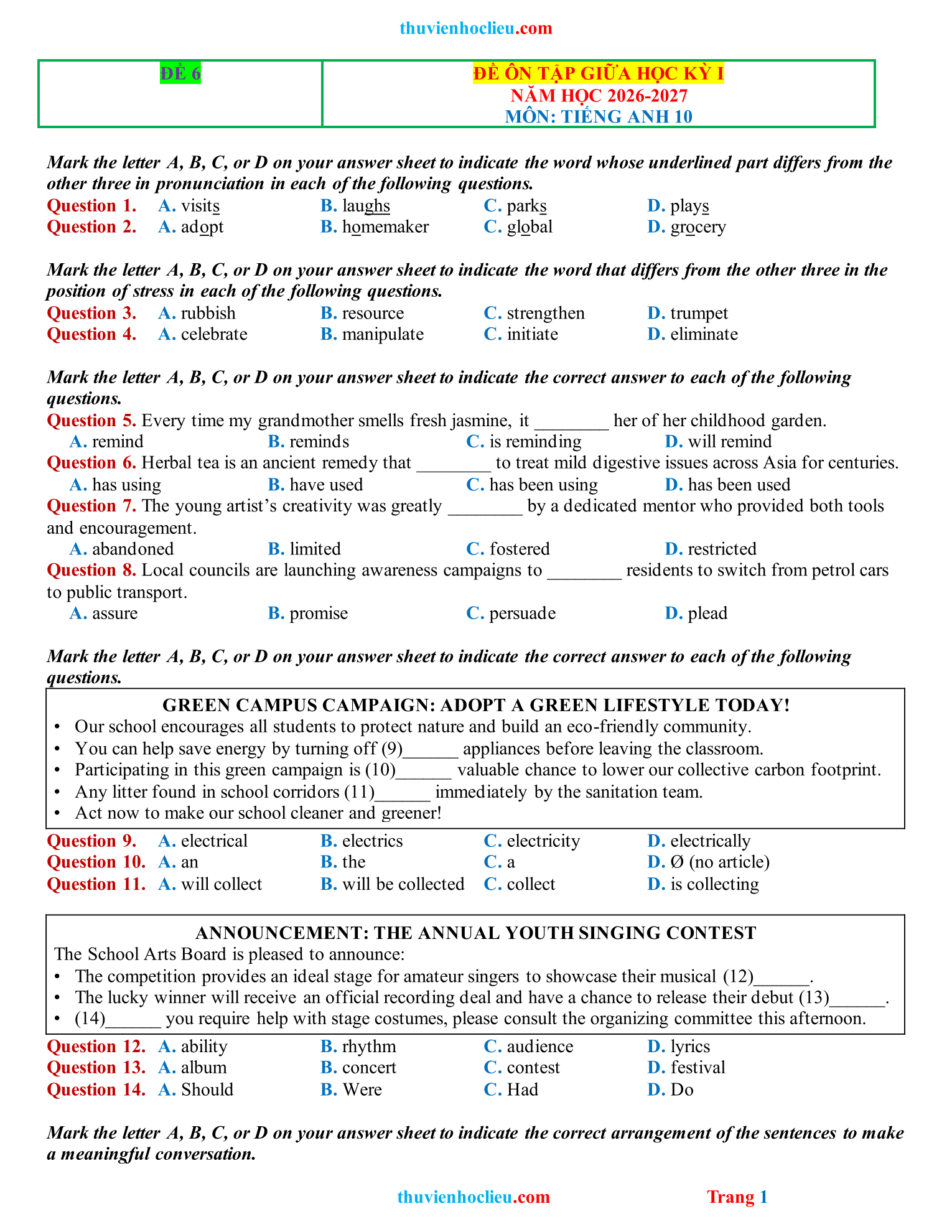
Mark the letter A, B, C, or D on your answer sheet to indicate the word whose underlined part differs from the other three in pronunciation in each of the following questions.
Question 1.
A. visits
B. laughs
C. parks
D. plays
Đáp án: D
Question 2.
A. adopt
B. homemaker
C. global
D. grocery
Đáp án: A
Mark the letter A, B, C, or D on your answer sheet to indicate the word that differs from the other three in the position of stress in each of the following questions.
Question 3.
A. rubbish
B. resource
C. strengthen
D. trumpet
Đáp án: B
Question 4.
A. celebrate
B. manipulate
C. initiate
D. eliminate
Đáp án: A
Mark the letter A, B, C, or D on your answer sheet to indicate the correct answer to each of the following questions.
Question 5. Every time my grandmother smells fresh jasmine, it ________ her of her childhood garden.
A. remind
B. reminds
C. is reminding
D. will remind
Đáp án: B
Question 6. Herbal tea is an ancient remedy that ________ to treat mild digestive issues across Asia for centuries.
A. has using
B. have used
C. has been using
D. has been used
Đáp án: D
Question 7. The young artist’s creativity was greatly ________ by a dedicated mentor who provided both tools and encouragement.
A. abandoned
B. limited
C. fostered
D. restricted
Đáp án: C
Question 8. Local councils are launching awareness campaigns to ________ residents to switch from petrol cars to public transport.
A. assure
B. promise
C. persuade
D. plead
Đáp án: C
Mark the letter A, B, C, or D on your answer sheet to indicate the correct answer to each of the following questions.
|
GREEN CAMPUS CAMPAIGN: ADOPT A GREEN LIFESTYLE TODAY!
• Our school encourages all students to protect nature and build an eco-friendly community. • You can help save energy by turning off (9)________ appliances before leaving the classroom. • Participating in this green campaign is (10)________ valuable chance to lower our collective carbon footprint. • Any litter found in school corridors (11)________ immediately by the sanitation team. • Act now to make our school cleaner and greener! |
Question 9.
A. electrical
B. electrics
C. electricity
D. electrically
Đáp án: A
Question 10.
A. an
B. the
C. a
D. Ø (no article)
Đáp án: C
Question 11.
A. will collect
B. will be collected
C. collect
D. is collecting
Đáp án: B
|
ANNOUNCEMENT: THE ANNUAL YOUTH SINGING CONTEST
The School Arts Board is pleased to announce: • The competition provides an ideal stage for amateur singers to showcase their musical (12)________. • The lucky winner will receive an official recording deal and have a chance to release their debut (13)________. • (14)________ you require help with stage costumes, please consult the organizing committee this afternoon. |
Question 12.
A. ability
B. rhythm
C. audience
D. lyrics
Đáp án: A
Question 13.
A. album
B. concert
C. contest
D. festival
Đáp án: A
Question 14.
A. Should
B. Were
C. Had
D. Do
Đáp án: A
Mark the letter A, B, C, or D on your answer sheet to indicate the correct arrangement of the sentences to make a meaningful conversation.
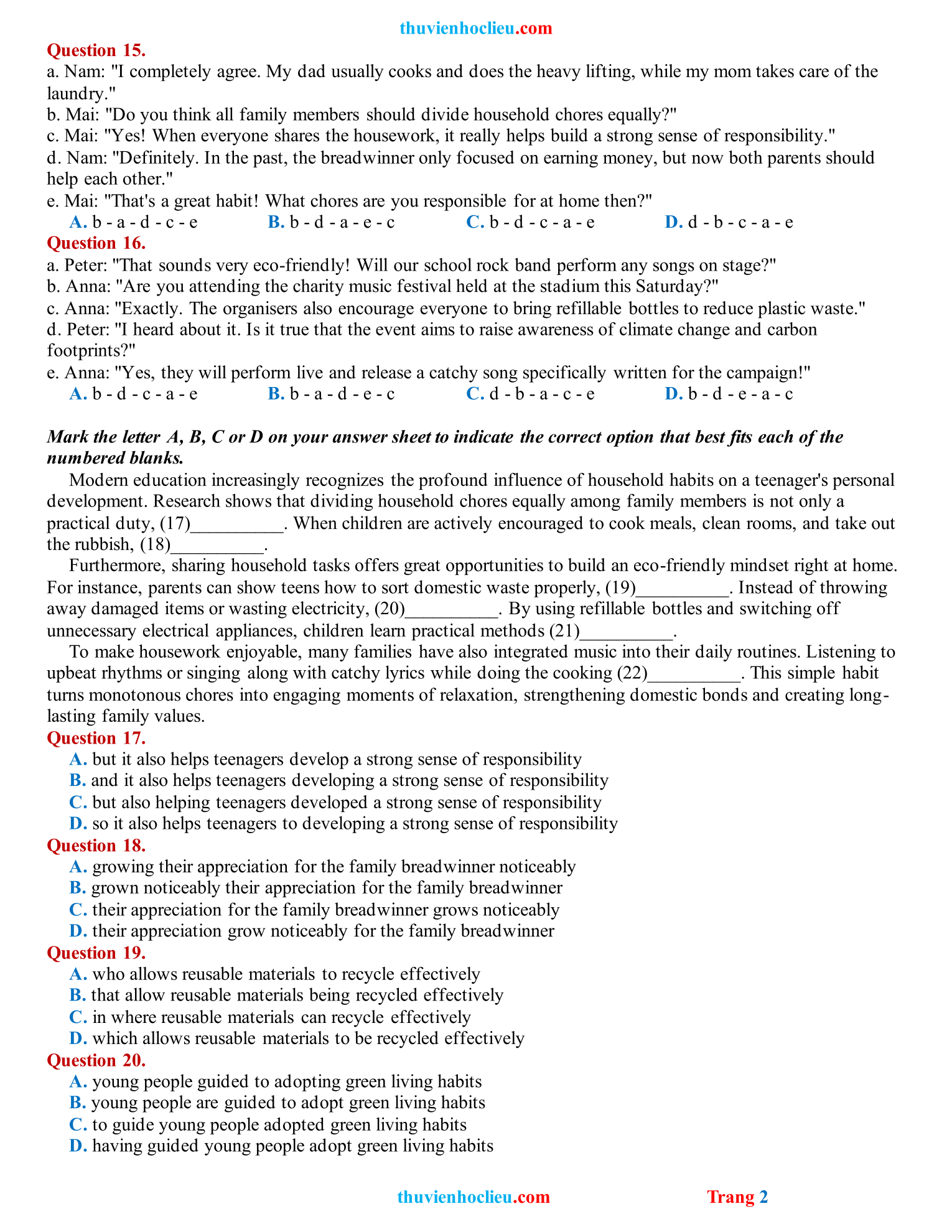
Question 15.
a. Nam: “I completely agree. My dad usually cooks and does the heavy lifting, while my mom takes care of the laundry.”
b. Mai: “Do you think all family members should divide household chores equally?”
c. Mai: “Yes! When everyone shares the housework, it really helps build a strong sense of responsibility.”
d. Nam: “Definitely. In the past, the breadwinner only focused on earning money, but now both parents should help each other.”
e. Mai: “That’s a great habit! What chores are you responsible for at home then?”
A. b – a – d – c – e
B. b – d – a – e – c
C. b – d – c – a – e
D. d – b – c – a – e
Đáp án: C
Question 16.
a. Peter: “That sounds very eco-friendly! Will our school rock band perform any songs on stage?”
b. Anna: “Are you attending the charity music festival held at the stadium this Saturday?”
c. Anna: “Exactly. The organisers also encourage everyone to bring refillable bottles to reduce plastic waste.”
d. Peter: “I heard about it. Is it true that the event aims to raise awareness of climate change and carbon footprints?”
e. Anna: “Yes, they will perform live and release a catchy song specifically written for the campaign!”
A. b – d – c – a – e
B. b – a – d – e – c
C. d – b – a – c – e
D. b – d – e – a – c
Đáp án: A
Mark the letter A, B, C or D on your answer sheet to indicate the correct option that best fits each of the numbered blanks.
Modern education increasingly recognizes the profound influence of household habits on a teenager’s personal development. Research shows that dividing household chores equally among family members is not only a practical duty, (17)________. When children are actively encouraged to cook meals, clean rooms, and take out the rubbish, (18)________.
Furthermore, sharing household tasks offers great opportunities to build an eco-friendly mindset right at home. For instance, parents can show teens how to sort domestic waste properly, (19)________. Instead of throwing away damaged items or wasting electricity, (20)________. By using refillable bottles and switching off unnecessary electrical appliances, children learn practical methods (21)________.
To make housework enjoyable, many families have also integrated music into their daily routines. Listening to upbeat rhythms or singing along with catchy lyrics while doing the cooking (22)________. This simple habit turns monotonous chores into engaging moments of relaxation, strengthening domestic bonds and creating long-lasting family values.
Question 17.
A. but it also helps teenagers develop a strong sense of responsibility
B. and it also helps teenagers developing a strong sense of responsibility
C. but also helping teenagers developed a strong sense of responsibility
D. so it also helps teenagers to developing a strong sense of responsibility
Đáp án: A
Question 18.
A. growing their appreciation for the family breadwinner noticeably
B. grown noticeably their appreciation for the family breadwinner
C. their appreciation for the family breadwinner grows noticeably
D. their appreciation grow noticeably for the family breadwinner
Đáp án: C
Question 19.
A. who allows reusable materials to recycle effectively
B. that allow reusable materials being recycled effectively
C. in where reusable materials can recycle effectively
D. which allows reusable materials to be recycled effectively
Đáp án: D
Question 20.
A. young people guided to adopting green living habits
B. young people are guided to adopt green living habits
C. to guide young people adopted green living habits
D. having guided young people adopt green living habits
Đáp án: B
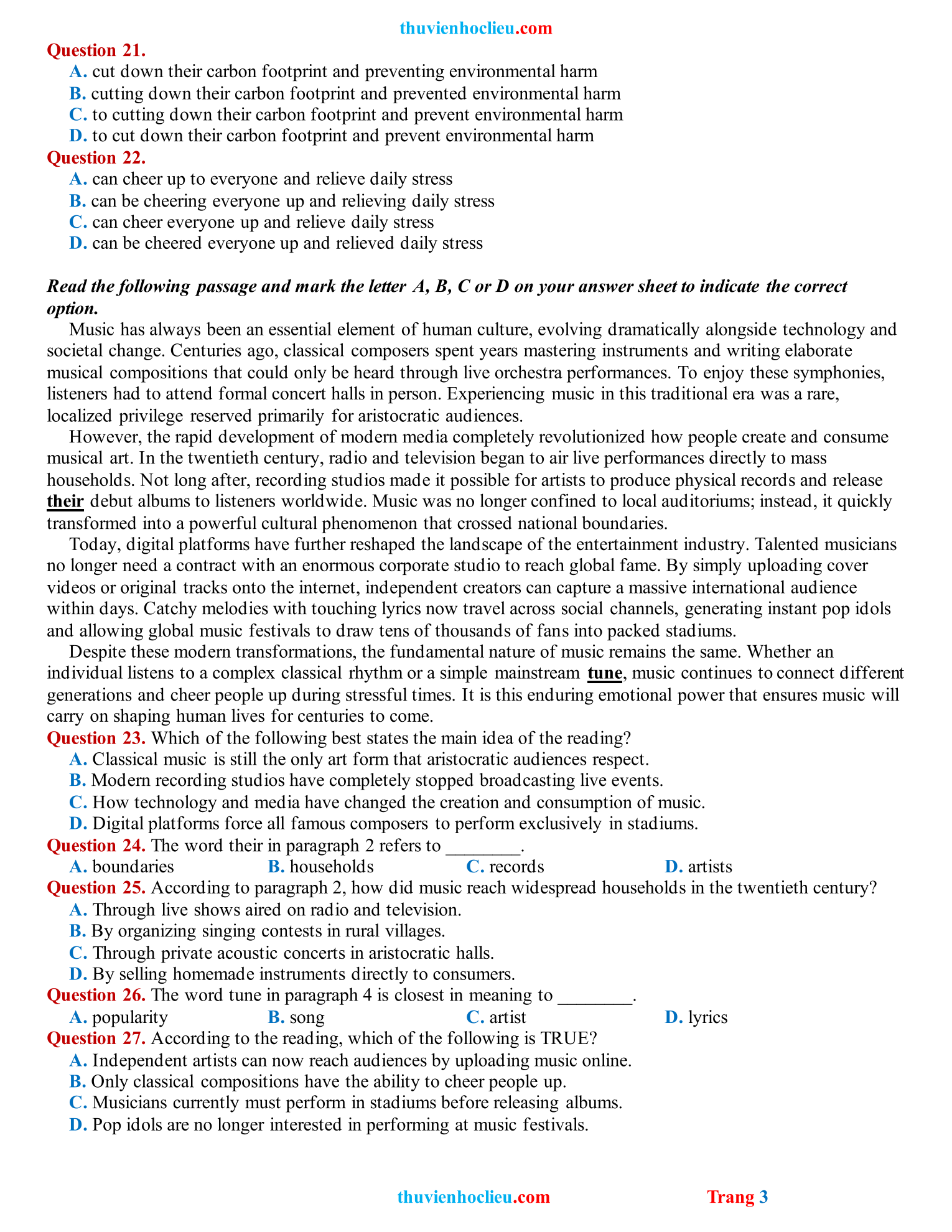
Question 21.
A. cut down their carbon footprint and preventing environmental harm
B. cutting down their carbon footprint and prevented environmental harm
C. to cutting down their carbon footprint and prevent environmental harm
D. to cut down their carbon footprint and prevent environmental harm
Đáp án: D
Question 22.
A. can cheer up to everyone and relieve daily stress
B. can be cheering everyone up and relieving daily stress
C. can cheer everyone up and relieve daily stress
D. can be cheered everyone up and relieved daily stress
Đáp án: C
Read the following passage and mark the letter A, B, C or D on your answer sheet to indicate the correct option.
Music has always been an essential element of human culture, evolving dramatically alongside technology and societal change. Centuries ago, classical composers spent years mastering instruments and writing elaborate musical compositions that could only be heard through live orchestra performances. To enjoy these symphonies, listeners had to attend formal concert halls in person. Experiencing music in this traditional era was a rare, localized privilege reserved primarily for aristocratic audiences.
However, the rapid development of modern media completely revolutionized how people create and consume musical art. In the twentieth century, radio and television began to broadcast live performances directly to mass households. Not long after, recording studios made it possible for artists to produce physical records and release their debut albums to listeners worldwide. Music was no longer confined to local auditoriums; instead, it quickly transformed into a powerful cultural phenomenon that crossed national boundaries.
Today, digital platforms have further reshaped the landscape of the entertainment industry. Talented musicians no longer need a contract with an enormous corporate studio to reach global fame. By simply uploading cover videos or original tracks onto the internet, independent creators can capture a massive international audience within days. Catchy melodies with touching lyrics now travel across social channels, generating instant pop idols and allowing global music festivals to draw tens of thousands of fans into packed stadiums.
Despite these modern transformations, the fundamental nature of music remains the same. Whether an individual listens to a complex classical rhythm or a simple mainstream tune, music continues to connect different generations and cheer people up during stressful times. It is this enduring emotional power that ensures music will carry on shaping human lives for centuries to come.
Question 23. Which of the following best states the main idea of the reading?
A. Classical music is still the only art form that aristocratic audiences respect.
B. Modern recording studios have completely stopped broadcasting live events.
C. How technology and media have changed the creation and consumption of music.
D. Digital platforms force all famous composers to perform exclusively in stadiums.
Đáp án: C
Question 24. The word their in paragraph 2 refers to ________.
A. boundaries
B. households
C. records
D. artists
Đáp án: D
Question 25. According to paragraph 2, how did music reach widespread households in the twentieth century?
A. Through live shows aired on radio and television.
B. By organizing singing contests in rural villages.
C. Through private acoustic concerts in aristocratic halls.
D. By selling homemade instruments directly to consumers.
Đáp án: A
Question 26. The word tune in paragraph 4 is closest in meaning to ________.
A. popularity
B. song
C. artist
D. lyrics
Đáp án: B
Question 27. According to the reading, which of the following is TRUE?
A. Independent artists can now reach audiences by uploading music online.
B. Only classical compositions have the ability to cheer people up.
C. Musicians currently must perform in stadiums before releasing albums.
D. Pop idols are no longer interested in performing at music festivals.
Đáp án: A
Read the following passage and mark the letter A, B, C or D on your answer sheet to indicate the correct option.
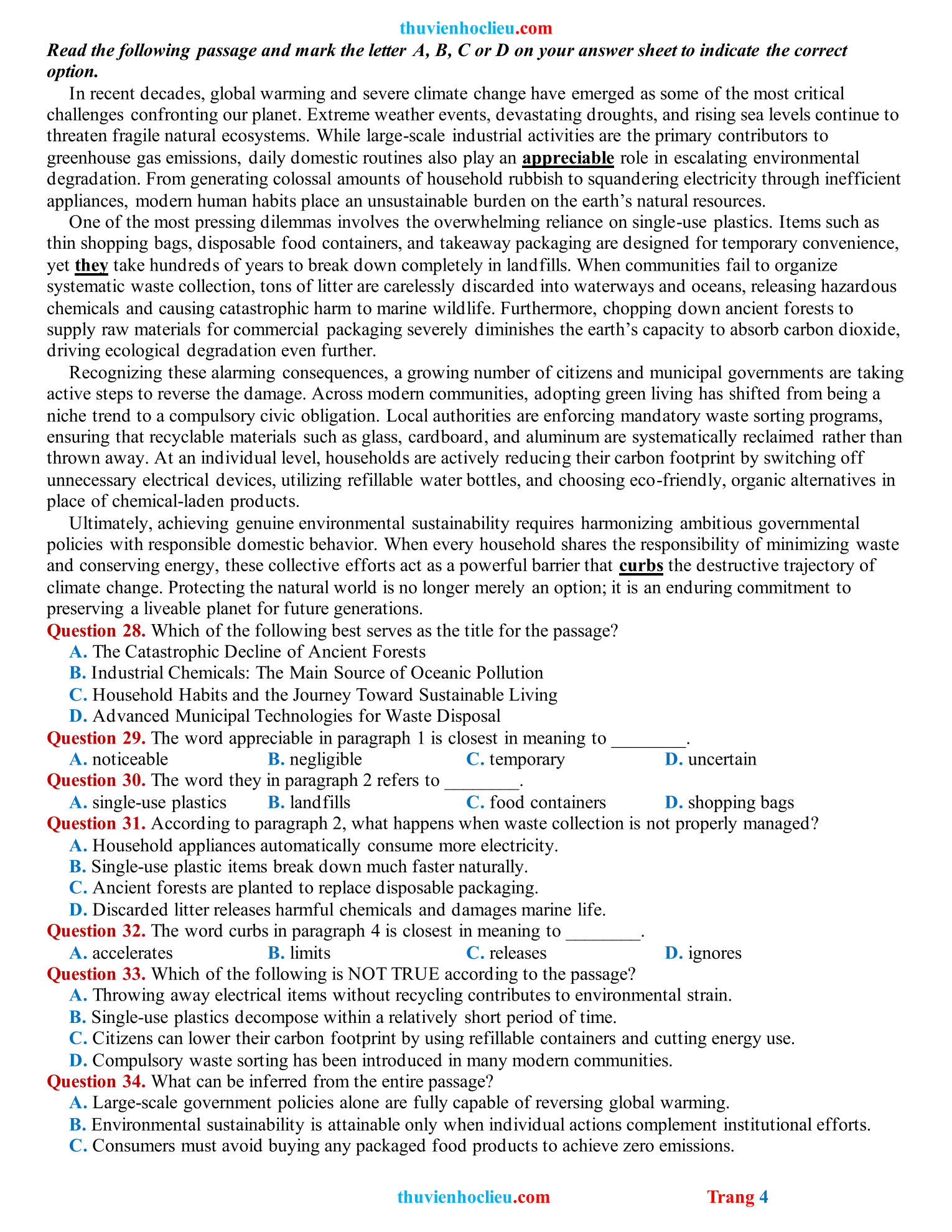
In recent decades, global warming and severe climate change have emerged as some of the most critical challenges confronting our planet. Extreme weather events, devastating droughts, and rising sea levels continue to threaten fragile natural ecosystems. While large-scale industrial activities are the primary contributors to greenhouse gas emissions, daily domestic routines also play an appreciable role in escalating environmental degradation. From generating colossal amounts of household rubbish to squandering electricity through inefficient appliances, modern human habits place an unsustainable burden on the earth’s natural resources.
One of the most pressing dilemmas involves the overwhelming reliance on single-use plastics. Items such as thin shopping bags, disposable food containers, and takeaway packaging are designed for temporary convenience, yet they take hundreds of years to break down completely in landfills. When communities fail to organize systematic waste collection, tons of litter are carelessly discarded into waterways and oceans, releasing hazardous chemicals and causing catastrophic harm to marine wildlife. Furthermore, chopping down ancient forests to supply raw materials for commercial packaging severely diminishes the earth’s capacity to absorb carbon dioxide, driving ecological degradation even further.
Recognizing these alarming consequences, a growing number of citizens and municipal governments are taking active steps to reverse the damage. Across modern communities, adopting green living has shifted from being a niche trend to a compulsory civic obligation. Local authorities are enforcing mandatory waste sorting programs, ensuring that recyclable materials such as glass, cardboard, and aluminum are systematically reclaimed rather than thrown away. At an individual level, households are actively reducing their carbon footprint by switching off unnecessary electrical devices, utilizing refillable water bottles, and choosing eco-friendly, organic alternatives in place of chemical-laden products.
Ultimately, achieving genuine environmental sustainability requires harmonizing ambitious governmental policies with responsible domestic behavior. When every household shares the responsibility of minimizing waste and conserving energy, these collective efforts act as a powerful barrier that curbs the destructive trajectory of climate change. Protecting the natural world is no longer merely an option; it is an enduring commitment to preserving a liveable planet for future generations.
Question 28. Which of the following best serves as the title for the passage?
A. The Catastrophic Decline of Ancient Forests
B. Industrial Chemicals: The Main Source of Oceanic Pollution
C. Household Habits and the Journey Toward Sustainable Living
D. Advanced Municipal Technologies for Waste Disposal
Đáp án: C
Question 29. The word appreciable in paragraph 1 is closest in meaning to ________.
A. noticeable
B. negligible
C. temporary
D. uncertain
Đáp án: A
Question 30. The word they in paragraph 2 refers to ________.
A. single-use plastics
B. landfills
C. food containers
D. shopping bags
Đáp án: A
Question 31. According to paragraph 2, what happens when waste collection is not properly managed?
A. Household appliances automatically consume more electricity.
B. Single-use plastic items break down much faster naturally.
C. Ancient forests are planted to replace disposable packaging.
D. Discarded litter releases harmful chemicals and damages marine life.
Đáp án: D
Question 32. The word curbs in paragraph 4 is closest in meaning to ________.
A. accelerates
B. limits
C. releases
D. ignores
Đáp án: B
Question 33. Which of the following is NOT TRUE according to the passage?
A. Throwing away electrical items without recycling contributes to environmental strain.
B. Single-use plastics decompose within a relatively short period of time.
C. Citizens can lower their carbon footprint by using refillable containers and cutting energy use.
D. Compulsory waste sorting has been introduced in many modern communities.
Đáp án: B
Question 34. What can be inferred from the entire passage?
A. Large-scale government policies alone are fully capable of reversing global warming.
B. Environmental sustainability is attainable only when individual actions complement institutional efforts.
C. Consumers must avoid buying any packaged food products to achieve zero emissions.
D. Traditional domestic lifestyles produce no significant harm to nature.
Đáp án: B
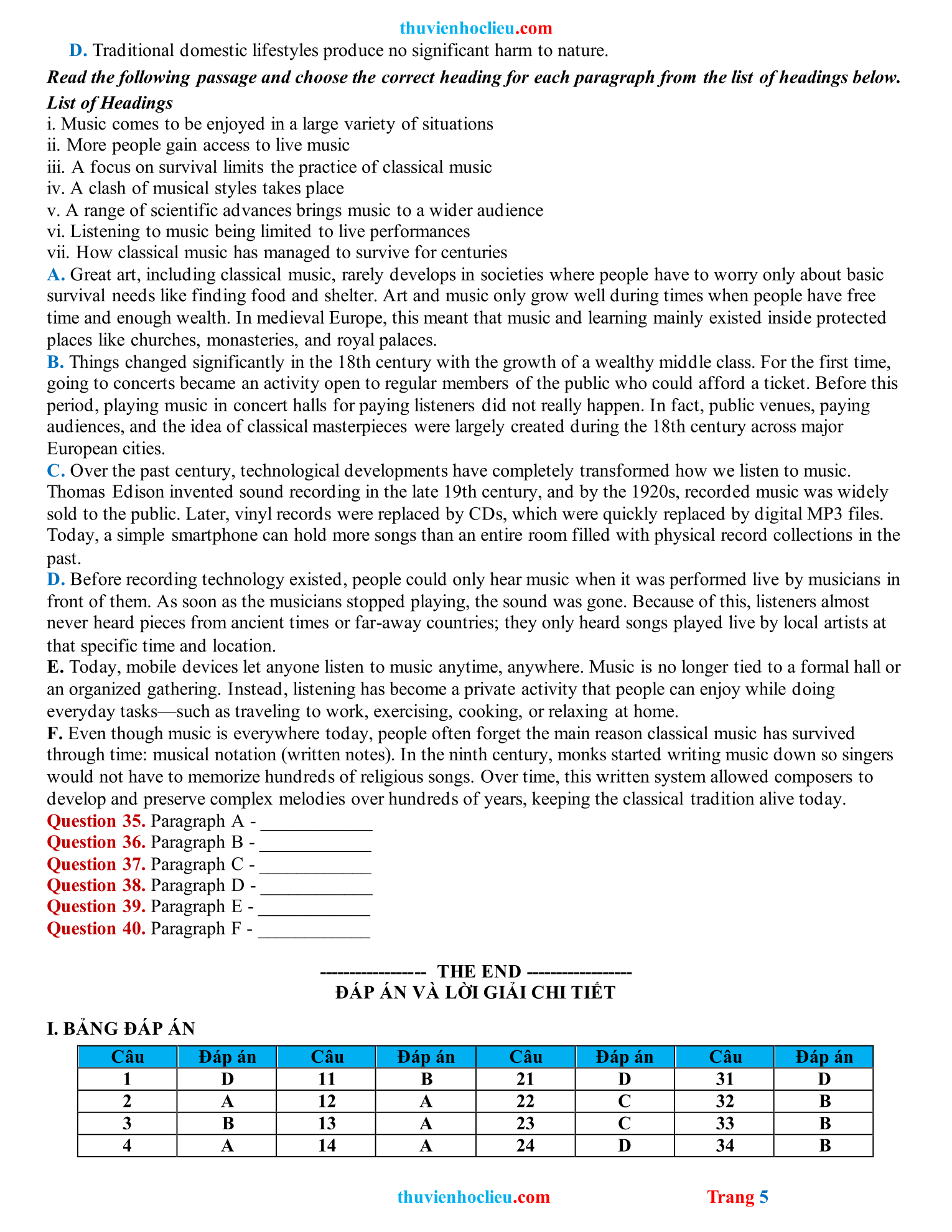
Read the following passage and choose the correct heading for each paragraph from the list of headings below.
List of Headings
i. Music comes to be enjoyed in a large variety of situations
ii. More people gain access to live music
iii. A focus on survival limits the practice of classical music
iv. A clash of musical styles takes place
v. A range of scientific advances brings music to a wider audience
vi. Listening to music being limited to live performances
vii. How classical music has managed to survive for centuries
A. Great art, including classical music, rarely develops in societies where people have to worry only about basic survival needs like finding food and shelter. Art and music only grow well during times when people have free time and enough wealth. In medieval Europe, this meant that music and learning mainly existed inside protected places like churches, monasteries, and royal palaces.
B. Things changed significantly in the 18th century with the growth of a wealthy middle class. For the first time, going to concerts became an activity open to regular members of the public who could afford a ticket. Before this period, playing music in concert halls for paying listeners did not really happen. In fact, public venues, paying audiences, and the idea of classical masterpieces were largely created during the 18th century across major European cities.
C. Over the past century, technological developments have completely transformed how we listen to music. Thomas Edison invented sound recording in the late 19th century, and by the 1920s, recorded music was widely sold to the public. Later, vinyl records were replaced by CDs, which were quickly replaced by digital MP3 files. Today, a simple smartphone can hold more songs than an entire room filled with physical record collections in the past.
D. Before recording technology existed, people could only hear music when it was performed live by musicians in front of them. As soon as the musicians stopped playing, the sound was gone. Because of this, listeners almost never heard pieces from ancient times or far-away countries; they only heard songs played live by local artists at that specific time and location.
E. Today, mobile devices let anyone listen to music anytime, anywhere. Music is no longer tied to a formal hall or an organized gathering. Instead, listening has become a private activity that people can enjoy while doing everyday tasks—such as traveling to work, exercising, cooking, or relaxing at home.
F. Even though music is everywhere today, people often forget the main reason classical music has survived through time: musical notation (written notes). In the ninth century, monks started writing music down so singers would not have to memorize hundreds of religious songs. Over time, this written system allowed composers to develop and preserve complex melodies over hundreds of years, keeping the classical tradition alive today.
Question 35. Paragraph A – ________
Đáp án: iii
Question 36. Paragraph B – ________
Đáp án: ii
Question 37. Paragraph C – ________
Đáp án: v
Question 38. Paragraph D – ________
Đáp án: vi
Question 39. Paragraph E – ________
Đáp án: i
Question 40. Paragraph F – ________
Đáp án: vii