
Đề thi cuối kì 1 Tiếng Anh 12 năm 2026 THPT Nguyễn Trãi – Đà Nẵng là tài liệu học tập quan trọng dành cho học sinh lớp 12, được biên soạn bởi THPT Nguyễn Trãi cho năm học 2025 – 2026. Đây là mẫu đề lớp 12 cuối kì 1 môn Tiếng Anh có cấu trúc chuẩn mực, giúp khảo sát chất lượng kiến thức định kỳ và tạo tiền đề vững chắc cho kỳ thi quốc gia. Nội dung đề tập trung khai thác các chuyên đề mang tính thời đại như Đô thị hóa (Urbanization), Bảo vệ môi trường và dấu chân carbon (Environmental Protection and Carbon Footprints), cùng các kỹ năng trọng tâm như đọc hiểu dữ kiện và viết lại câu. Việc tiếp cận sớm với dạng đề Tiếng anh 12 này giúp học sinh rèn luyện kỹ năng phân tích, chọn đáp án nhanh và biết cách vận dụng kiến thức ngôn ngữ vào các tình huống thực tiễn một cách hiệu quả.
Trải nghiệm luyện tập đề ôn tập 12 trên dethitracnghiem.vn mang lại lợi thế vượt trội cho học sinh lớp 12 trong giai đoạn tăng tốc năm 2025. Với giao diện trực quan và dễ sử dụng, nền tảng cho phép người học làm bài nhiều lần, xem giải thích đáp án ngay sau khi nộp bài và theo dõi biểu đồ kết quả để đánh giá mức độ tiến bộ cá nhân. Hệ thống câu hỏi môn Tiếng Anh được phân chia khoa học từ lý thuyết cơ bản đến bài tập tình huống thực tế, giúp học sinh làm quen với cách ra đề mới nhất. Điều này không chỉ nâng cao khả năng vận dụng từ vựng, ngữ pháp mà còn giúp các em tối ưu hóa thời gian ôn tập, giảm bớt áp lực trước các kỳ thi quan trọng.
ĐỀ THI
LINK PDF ĐỀ THI [gồm ĐỀ THI, ĐÁP ÁN, LỜI GIẢI]:
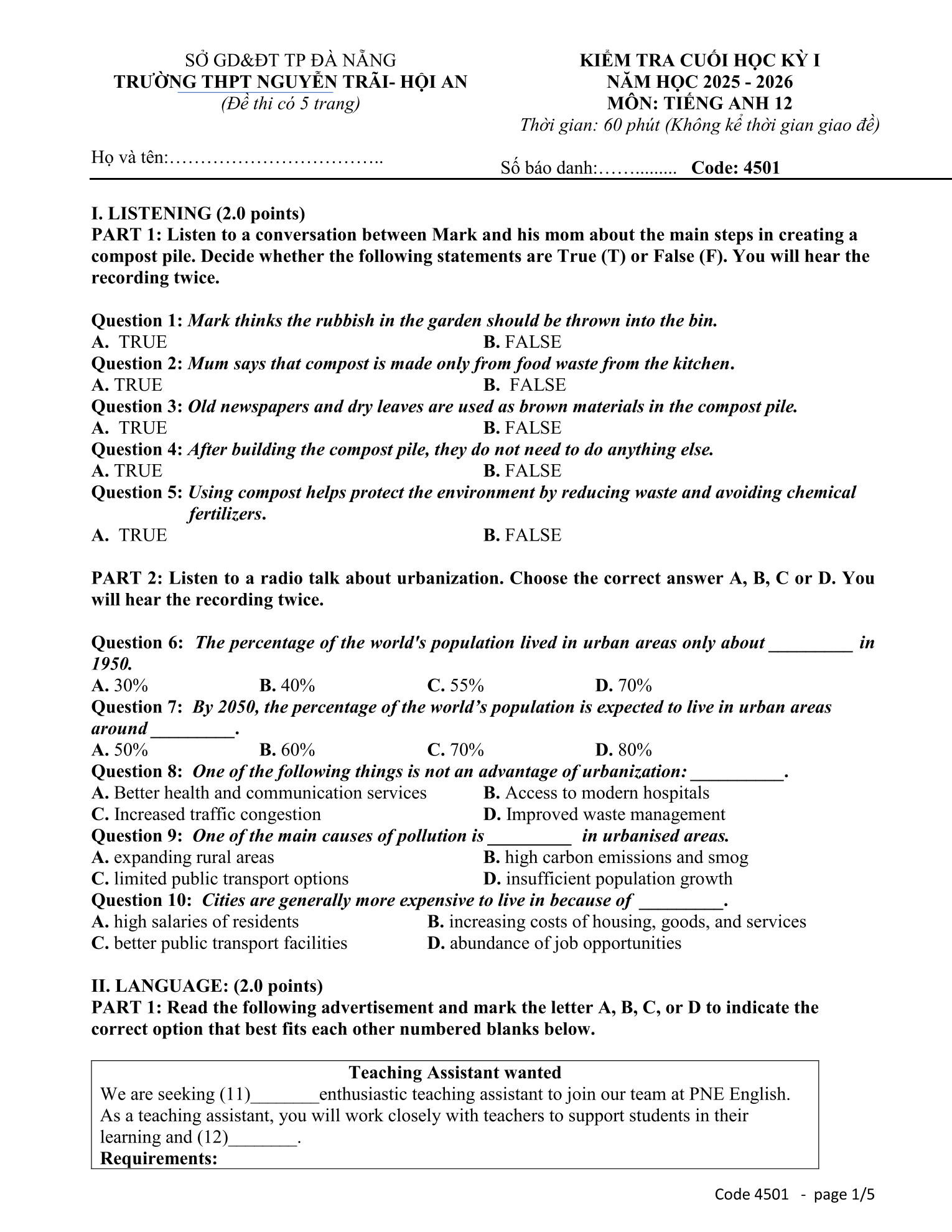
I. LISTENING (2.0 points)
PART 1: Listen to a conversation between Mark and his mom about the main steps in creating a compost pile. Decide whether the following statements are True (T) or False (F). You will hear the recording twice.
Question 1: Mark thinks the rubbish in the garden should be thrown into the bin.
A. TRUE
B. FALSE
Đáp án: B
Question 2: Mum says that compost is made only from food waste from the kitchen.
A. TRUE
B. FALSE
Đáp án: B
Question 3: Old newspapers and dry leaves are used as brown materials in the compost pile.
A. TRUE
B. FALSE
Đáp án: A
Question 4: After building the compost pile, they do not need to do anything else.
A. TRUE
B. FALSE
Đáp án: B
Question 5: Using compost helps protect the environment by reducing waste and avoiding chemical fertilizers.
A. TRUE
B. FALSE
Đáp án: A
PART 2: Listen to a radio talk about urbanization. Choose the correct answer A, B, C or D. You will hear the recording twice.
Question 6: The percentage of the world’s population lived in urban areas only about ________ in 1950.
A. 30%
B. 40%
C. 55%
D. 70%
Đáp án: A
Question 7: By 2050, the percentage of the world’s population is expected to live in urban areas around ________.
A. 50%
B. 60%
C. 70%
D. 80%
Đáp án: C
Question 8: One of the following things is not an advantage of urbanization: ________.
A. Better health and communication services
B. Access to modern hospitals
C. Increased traffic congestion
D. Improved waste management
Đáp án: C
Question 9: One of the main causes of pollution is ________ in urbanised areas.
A. expanding rural areas
B. high carbon emissions and smog
C. limited public transport options
D. insufficient population growth
Đáp án: B
Question 10: Cities are generally more expensive to live in because of ________.
A. high salaries of residents
B. increasing costs of housing, goods, and services
C. better public transport facilities
D. abundance of job opportunities
Đáp án: B
II. LANGUAGE: (2.0 points)
PART 1: Read the following advertisement and mark the letter A, B, C, or D to indicate the correct option that best fits each other numbered blanks below.
|
Teaching Assistant wanted
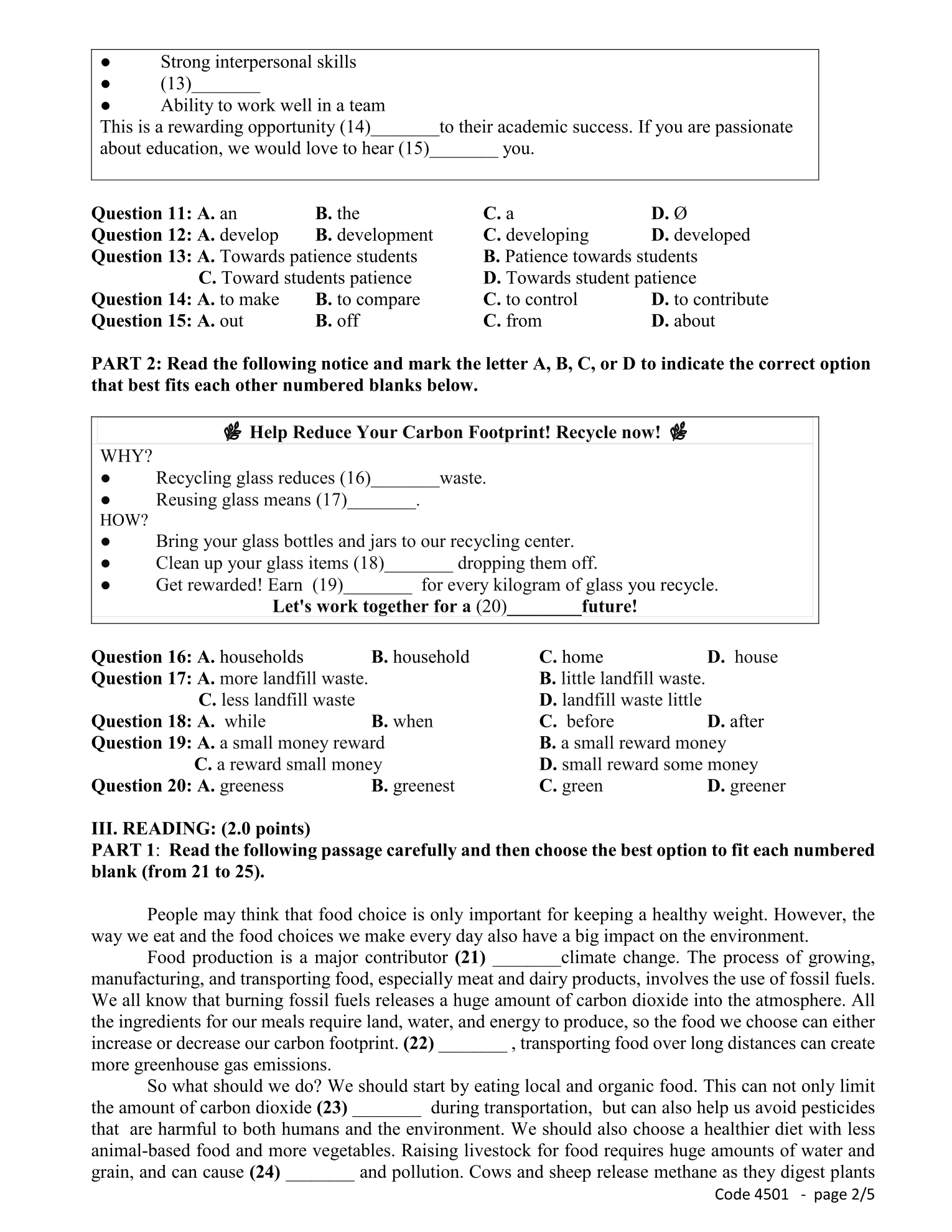
We are seeking (11)________ enthusiastic teaching assistant to join our team at PNE English. As a teaching assistant, you will work closely with teachers to support students in their learning and (12)________. Requirements: ● Strong interpersonal skills ● (13)________ ● Ability to work well in a team This is a rewarding opportunity (14)________ to their academic success. If you are passionate about education, we would love to hear (15)________ you. |
Question 11:
A. an
B. the
C. a
D. Ø
Đáp án: A
Question 12:
A. develop
B. development
C. developing
D. developed
Đáp án: B
Question 13:
A. Towards patience students
B. Patience towards students
C. Toward students patience
D. Towards student patience
Đáp án: B
Question 14:
A. to make
B. to compare
C. to control
D. to contribute
Đáp án: D
Question 15:
A. out
B. off
C. from
D. about
Đáp án: C
PART 2: Read the following notice and mark the letter A, B, C, or D to indicate the correct option that best fits each other numbered blanks below.
|
Help Reduce Your Carbon Footprint! Recycle now!
WHY? ● Recycling glass reduces (16)________ waste. ● Reusing glass means (17)________. HOW? ● Bring your glass bottles and jars to our recycling center. ● Clean up your glass items (18)________ dropping them off. ● Get rewarded! Earn (19)________ for every kilogram of glass you recycle. Let’s work together for a (20)________ future! |
Question 16:
A. households
B. household
C. home
D. house
Đáp án: B
Question 17:
A. more landfill waste.
B. little landfill waste.
C. less landfill waste
D. landfill waste little
Đáp án: C
Question 18:
A. while
B. when
C. before
D. after
Đáp án: C
Question 19:
A. a small money reward
B. a small reward money
C. a reward small money
D. small reward some money
Đáp án: A
Question 20:
A. greenness
B. greenest
C. green
D. greener
Đáp án: D
III. READING: (2.0 points)
PART 1: Read the following passage carefully and then choose the best option to fit each numbered blank (from 21 to 25).
People may think that food choice is only important for keeping a healthy weight. However, the way we eat and the food choices we make every day also have a big impact on the environment.
Food production is a major contributor (21)________ climate change. The process of growing, manufacturing, and transporting food, especially meat and dairy products, involves the use of fossil fuels. We all know that burning fossil fuels releases a huge amount of carbon dioxide into the atmosphere. All the ingredients for our meals require land, water, and energy to produce, so the food we choose can either increase or decrease our carbon footprint. (22)________, transporting food over long distances can create more greenhouse gas emissions.
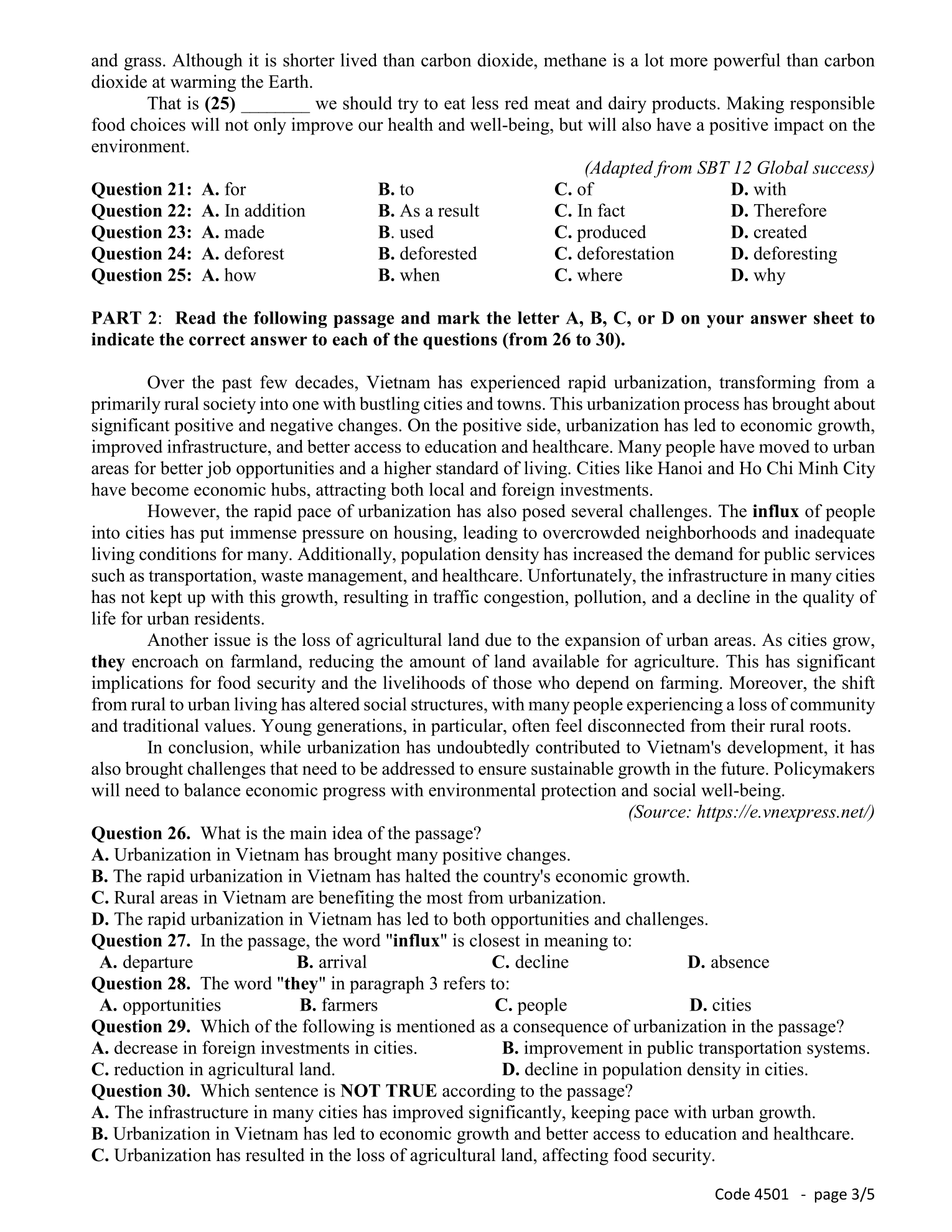
So what should we do? We should start by eating local and organic food. This can not only limit the amount of carbon dioxide (23)________ during transportation, but can also help us avoid pesticides that are harmful to both humans and the environment. We should also choose a healthier diet with less animal-based food and more vegetables. Raising livestock for food requires huge amounts of water and grain, and can cause (24)________ and pollution. Cows and sheep release methane as they digest plants and grass. Although it is shorter lived than carbon dioxide, methane is a lot more powerful than carbon dioxide at warming the Earth.
That is (25)________ we should try to eat less red meat and dairy products. Making responsible food choices will not only improve our health and well-being, but will also have a positive impact on the environment.
(Adapted from SBT 12 Global success)
Question 21:
A. for
B. to
C. of
D. with
Đáp án: B
Question 22:
A. In addition
B. As a result
C. In fact
D. Therefore
Đáp án: A
Question 23:
A. made
B. used
C. produced
D. created
Đáp án: C
Question 24:
A. deforest
B. deforested
C. deforestation
D. deforesting
Đáp án: C
Question 25:
A. how
B. when
C. where
D. why
Đáp án: D
PART 2: Read the following passage and mark the letter A, B, C, or D on your answer sheet to indicate the correct answer to each of the questions (from 26 to 30).
Over the past few decades, Vietnam has experienced rapid urbanization, transforming from a primarily rural society into one with bustling cities and towns. This urbanization process has brought about significant positive and negative changes. On the positive side, urbanization has led to economic growth, improved infrastructure, and better access to education and healthcare. Many people have moved to urban areas for better job opportunities and a higher standard of living. Cities like Hanoi and Ho Chi Minh City have become economic hubs, attracting both local and foreign investments.
However, the rapid pace of urbanization has also posed several challenges. The influx of people into cities has put immense pressure on housing, leading to overcrowded neighborhoods and inadequate living conditions for many. Additionally, population density has increased the demand for public services such as transportation, waste management, and healthcare. Unfortunately, the infrastructure in many cities has not kept up with this growth, resulting in traffic congestion, pollution, and a decline in the quality of life for urban residents.
Another issue is the loss of agricultural land due to the expansion of urban areas. As cities grow, they encroach on farmland, reducing the amount of land available for agriculture. This has significant implications for food security and the livelihoods of those who depend on farming. Moreover, the shift from rural to urban living has altered social structures, with many people experiencing a loss of community and traditional values. Young generations, in particular, often feel disconnected from their rural roots.
In conclusion, while urbanization has undoubtedly contributed to Vietnam’s development, it has also brought challenges that need to be addressed to ensure sustainable growth in the future. Policymakers will need to balance economic progress with environmental protection and social well-being.
(Source: https://e.vnexpress.net/)
Question 26. What is the main idea of the passage?
A. Urbanization in Vietnam has brought many positive changes.
B. The rapid urbanization in Vietnam has halted the country’s economic growth.
C. Rural areas in Vietnam are benefiting the most from urbanization.
D. The rapid urbanization in Vietnam has led to both opportunities and challenges.
Đáp án: D
Question 27. In the passage, the word “influx” is closest in meaning to:
A. departure
B. arrival
C. decline
D. absence
Đáp án: B
Question 28. The word “they” in paragraph 3 refers to:
A. opportunities
B. farmers
C. people
D. cities
Đáp án: D
Question 29. Which of the following is mentioned as a consequence of urbanization in the passage?
A. decrease in foreign investments in cities.
B. improvement in public transportation systems.
C. reduction in agricultural land.
D. decline in population density in cities.
Đáp án: C
Question 30. Which sentence is NOT TRUE according to the passage?
A. The infrastructure in many cities has improved significantly, keeping pace with urban growth.
B. Urbanization in Vietnam has led to economic growth and better access to education and healthcare.
C. Urbanization has resulted in the loss of agricultural land, affecting food security.
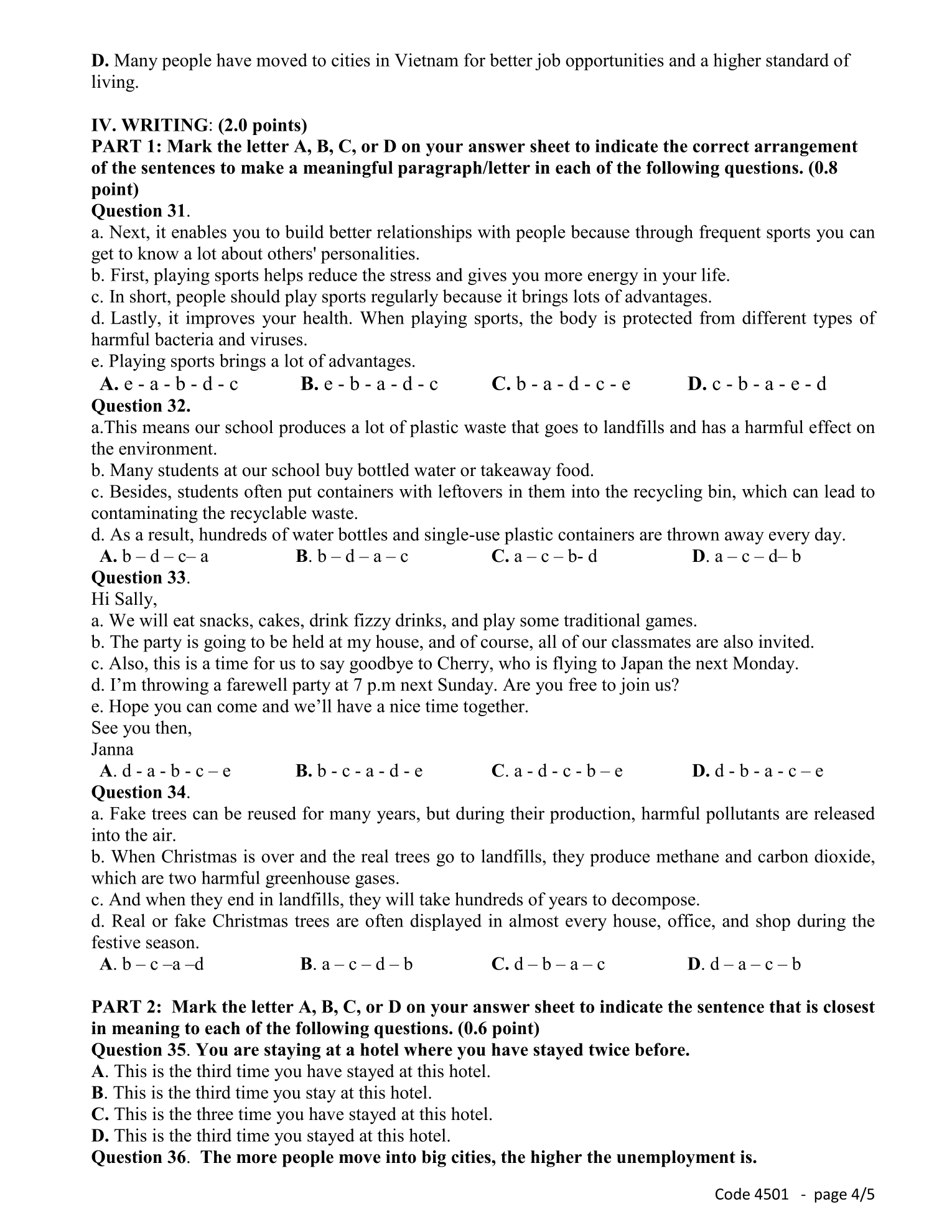
D. Many people have moved to cities in Vietnam for better job opportunities and a higher standard of living.
Đáp án: A
IV. WRITING: (2.0 points)
PART 1: Mark the letter A, B, C, or D on your answer sheet to indicate the correct arrangement of the sentences to make a meaningful paragraph/letter in each of the following questions. (0.8 point)
Question 31.
a. Next, it enables you to build better relationships with people because through frequent sports you can get to know a lot about others’ personalities.
b. First, playing sports helps reduce the stress and gives you more energy in your life.
c. In short, people should play sports regularly because it brings lots of advantages.
d. Lastly, it improves your health. When playing sports, the body is protected from different types of harmful bacteria and viruses.
e. Playing sports brings a lot of advantages.
A. e – a – b – d – c
B. e – b – a – d – c
C. b – a – d – c – e
D. c – b – a – e – d
Đáp án: B
Question 32.
a. This means our school produces a lot of plastic waste that goes to landfills and has a harmful effect on the environment.
b. Many students at our school buy bottled water or takeaway food.
c. Besides, students often put containers with leftovers in them into the recycling bin, which can lead to contaminating the recyclable waste.
d. As a result, hundreds of water bottles and single-use plastic containers are thrown away every day.
A. b – d – c – a
B. b – d – a – c
C. a – c – b – d
D. a – c – d – b
Đáp án: A
Question 33.
Hi Sally,
a. We will eat snacks, cakes, drink fizzy drinks, and play some traditional games.
b. The party is going to be held at my house, and of course, all of our classmates are also invited.
c. Also, this is a time for us to say goodbye to Cherry, who is flying to Japan the next Monday.
d. I’m throwing a farewell party at 7 p.m next Sunday. Are you free to join us?
e. Hope you can come and we’ll have a nice time together.
See you then,
Janna
A. d – a – b – c – e
B. b – c – a – d – e
C. a – d – c – b – e
D. d – b – a – c – e
Đáp án: D
Question 34.
a. Fake trees can be reused for many years, but during their production, harmful pollutants are released into the air.
b. When Christmas is over and the real trees go to landfills, they produce methane and carbon dioxide, which are two harmful greenhouse gases.
c. And when they end in landfills, they will take hundreds of years to decompose.
d. Real or fake Christmas trees are often displayed in almost every house, office, and shop during the festive season.
A. b – c – a – d
B. a – c – d – b
C. d – b – a – c
D. d – a – c – b
Đáp án: C
PART 2: Mark the letter A, B, C, or D on your answer sheet to indicate the sentence that is closest in meaning to each of the following questions. (0.6 point)
Question 35. You are staying at a hotel where you have stayed twice before.
A. This is the third time you have stayed at this hotel.
B. This is the third time you stay at this hotel.
C. This is the three time you have stayed at this hotel.
D. This is the third time you stayed at this hotel.
Đáp án: A
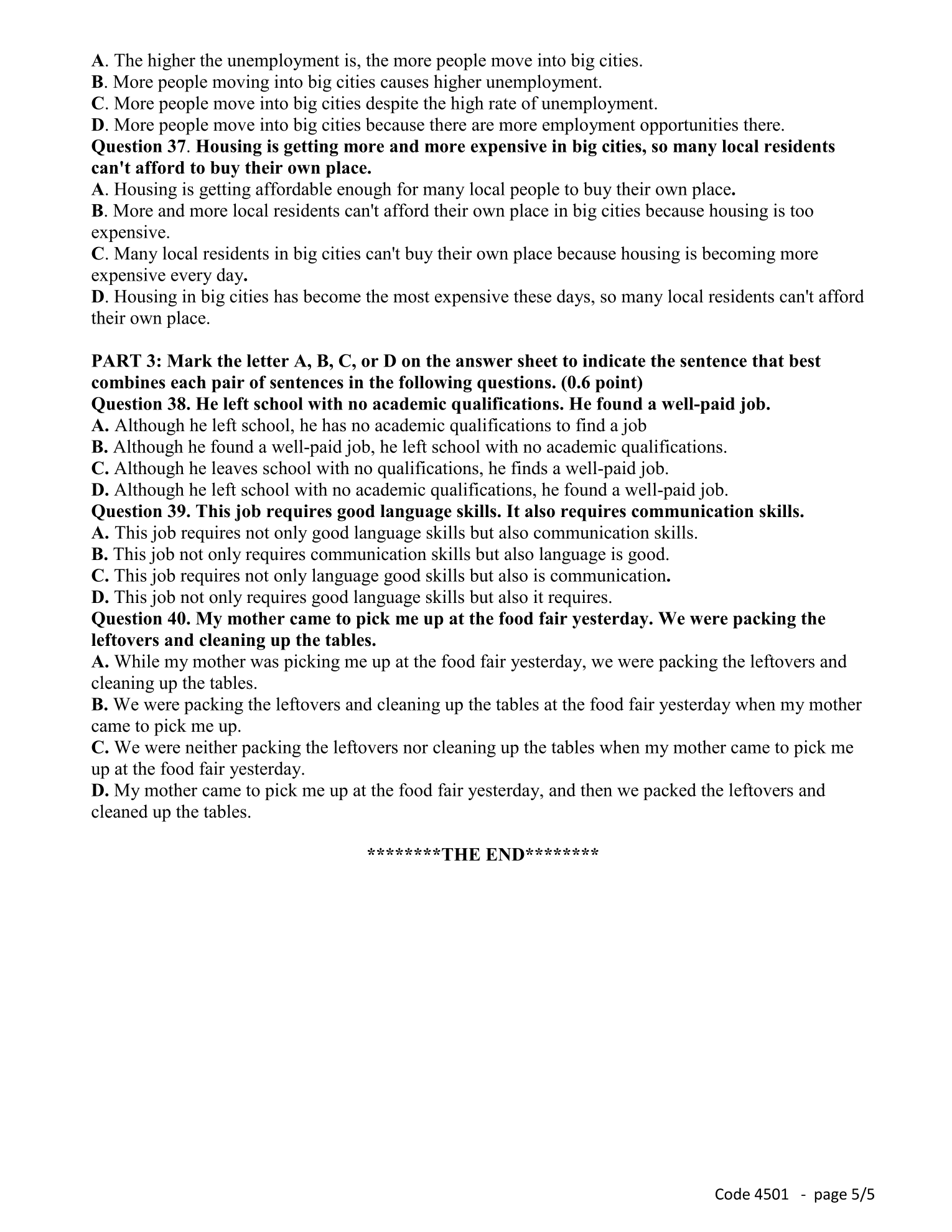
Question 36. The more people move into big cities, the higher the unemployment is.
A. The higher the unemployment is, the more people move into big cities.
B. More people moving into big cities causes higher unemployment.
C. More people move into big cities despite the high rate of unemployment.
D. More people move into big cities because there are more employment opportunities there.
Đáp án: B
Question 37. Housing is getting more and more expensive in big cities, so many local residents can’t afford to buy their own place.
A. Housing is getting affordable enough for many local people to buy their own place.
B. More and more local residents can’t afford their own place in big cities because housing is too expensive.
C. Many local residents in big cities can’t buy their own place because housing is becoming more expensive every day.
D. Housing in big cities has become the most expensive these days, so many local residents can’t afford their own place.
Đáp án: C
PART 3: Mark the letter A, B, C, or D on the answer sheet to indicate the sentence that best combines each pair of sentences in the following questions. (0.6 point)
Question 38. He left school with no academic qualifications. He found a well-paid job.
A. Although he left school, he has no academic qualifications to find a job
B. Although he found a well-paid job, he left school with no academic qualifications.
C. Although he leaves school with no qualifications, he finds a well-paid job.
D. Although he left school with no academic qualifications, he found a well-paid job.
Đáp án: D
Question 39. This job requires good language skills. It also requires communication skills.
A. This job requires not only good language skills but also communication skills.
B. This job not only requires communication skills but also language is good.
C. This job requires not only language good skills but also is communication.
D. This job not only requires good language skills but also it requires.
Đáp án: A
Question 40. My mother came to pick me up at the food fair yesterday. We were packing the leftovers and cleaning up the tables.
A. While my mother was picking me up at the food fair yesterday, we were packing the leftovers and cleaning up the tables.
B. We were packing the leftovers and cleaning up the tables at the food fair yesterday when my mother came to pick me up.
C. We were neither packing the leftovers nor cleaning up the tables when my mother came to pick me up at the food fair yesterday.
D. My mother came to pick me up at the food fair yesterday, and then we packed the leftovers and cleaned up the tables.
Đáp án: B