
Đề thi thử THPT 2026 môn Tiếng anh – Sở GDĐT Đồng Tháp là dạng tài liệu rất phù hợp với học sinh lớp 12 đang cần một bài luyện đủ rộng để tự đo năng lực trước kỳ thi tốt nghiệp THPT năm học 2025–2026. Điểm đáng giá của đề không chỉ nằm ở việc kiểm tra kiến thức đã học, mà còn ở khả năng “lộ rõ” những điểm yếu mà học sinh thường khó nhận ra khi ôn riêng lẻ từng phần, chẳng hạn phát âm, trọng âm, ngữ pháp, dùng từ trong ngữ cảnh, chức năng giao tiếp và đọc hiểu. Với những em đang cần đề rà soát tốt nghiệp THPT môn Tiếng Anh, đây là nguồn tham khảo hữu ích để kiểm tra độ chắc tay ở từng nhóm câu hỏi và điều chỉnh cách ôn theo đúng phần còn thiếu. Ở mức độ luyện tập cao hơn, đề cũng có thể xem như đề trắc nghiệm đại học vì nhiều câu đòi hỏi người học phải suy luận ngôn ngữ nhanh, đọc kỹ ngữ cảnh và giữ được độ chính xác khi chọn đáp án trong quỹ thời gian hạn chế.
Khi luyện bài trên dethitracnghiem.vn, học sinh có thể dùng đề ôn thi chuyển cấp như một công cụ học trực tuyến giúp việc ôn tập trở nên rõ hướng hơn thay vì chỉ làm đề theo cảm tính. Sau mỗi lượt làm bài, hệ thống cho phép xem đáp án ngay, đối chiếu kết quả và tiếp tục luyện lại để nhận ra mình đang mất điểm nhiều nhất ở đâu, ví dụ nhóm câu hỏi từ vựng, cấu trúc câu, hội thoại hay bài đọc. Với môn Tiếng Anh, lợi ích này đặc biệt quan trọng vì điểm số thường không giảm do thiếu kiến thức toàn bộ, mà do sai lặp lại ở một vài kỹ năng nhỏ nhưng kéo dài. Nhờ theo dõi được tiến bộ qua từng lần luyện, học sinh lớp 12 sẽ dễ ôn đúng trọng tâm hơn, giảm học lan man và xây dựng được nhịp luyện đề ổn định hơn cho giai đoạn tăng tốc năm 2026.
ĐỀ THI
LINK PDF ĐỀ THI [gồm ĐỀ THI, ĐÁP ÁN, LỜI GIẢI]:
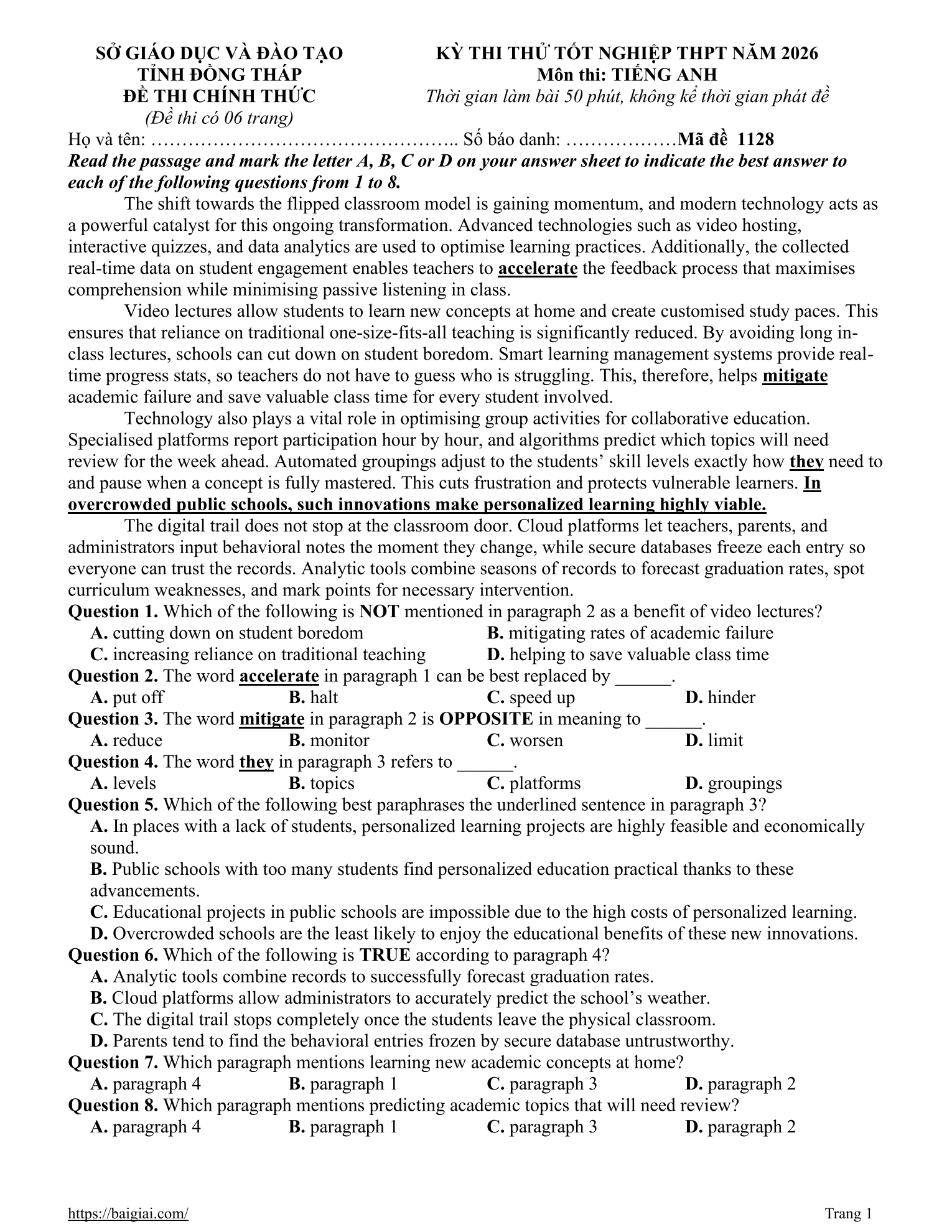
The shift towards the flipped classroom model is gaining momentum, and modern technology acts as a powerful catalyst for this ongoing transformation. Advanced technologies such as video hosting, interactive quizzes, and data analytics are used to optimise learning practices. Additionally, the collected real-time data on student engagement enables teachers to accelerate the feedback process that maximises comprehension while minimising passive listening in class.
Video lectures allow students to learn new concepts at home and create customised study paces. This ensures that reliance on traditional one-size-fits-all teaching is significantly reduced. By avoiding long in-class lectures, schools can cut down on student boredom. Smart learning management systems provide real-time progress stats, so teachers do not have to guess who is struggling. This, therefore, helps mitigate academic failure and save valuable class time for every student involved.
Technology also plays a vital role in optimising group activities for collaborative education. Specialised platforms report participation hour by hour, and algorithms predict which topics will need review for the week ahead. Automated groupings adjust to the students’ skill levels exactly how they need to and pause when a concept is fully mastered. This cuts frustration and protects vulnerable learners. In overcrowded public schools, such innovations make personalized learning highly viable.
The digital trail does not stop at the classroom door. Cloud platforms let teachers, parents, and administrators input behavioral notes the moment they change, while secure databases freeze each entry so everyone can trust the records. Analytic tools combine seasons of records to forecast graduation rates, spot curriculum weaknesses, and mark points for necessary intervention.
Question 1. Which of the following is NOT mentioned in paragraph 2 as a benefit of video lectures?
A. cutting down on student boredom
B. mitigating rates of academic failure
C. increasing reliance on traditional teaching
D. helping to save valuable class time
Đáp án: C
Question 2. The word accelerate in paragraph 1 can be best replaced by ______.
A. put off
B. halt
C. speed up
D. hinder
Đáp án: C
Question 3. The word mitigate in paragraph 2 is OPPOSITE in meaning to ______.
A. reduce
B. monitor
C. worsen
D. limit
Đáp án: C
Question 4. The word they in paragraph 3 refers to ______.
A. levels
B. topics
C. platforms
D. groupings
Đáp án: D
Question 5. Which of the following best paraphrases the underlined sentence in paragraph 3?
A. In places with a lack of students, personalized learning projects are highly feasible and economically sound.
B. Public schools with too many students find personalized education practical thanks to these advancements.
C. Educational projects in public schools are impossible due to the high costs of personalized learning.
D. Overcrowded schools are the least likely to enjoy the educational benefits of these new innovations.
Đáp án: B
Question 6. Which of the following is TRUE according to paragraph 4?
A. Analytic tools combine records to successfully forecast graduation rates.
B. Cloud platforms allow administrators to accurately predict the school’s weather.
C. The digital trail stops completely once the students leave the physical classroom.
D. Parents tend to find the behavioral entries frozen by secure database untrustworthy.
Đáp án: A
Question 7. Which paragraph mentions learning new academic concepts at home?
A. paragraph 4
B. paragraph 1
C. paragraph 3
D. paragraph 2
Đáp án: D
Question 8. Which paragraph mentions predicting academic topics that will need review?
A. paragraph 4
B. paragraph 1
C. paragraph 3
D. paragraph 2
Đáp án: C
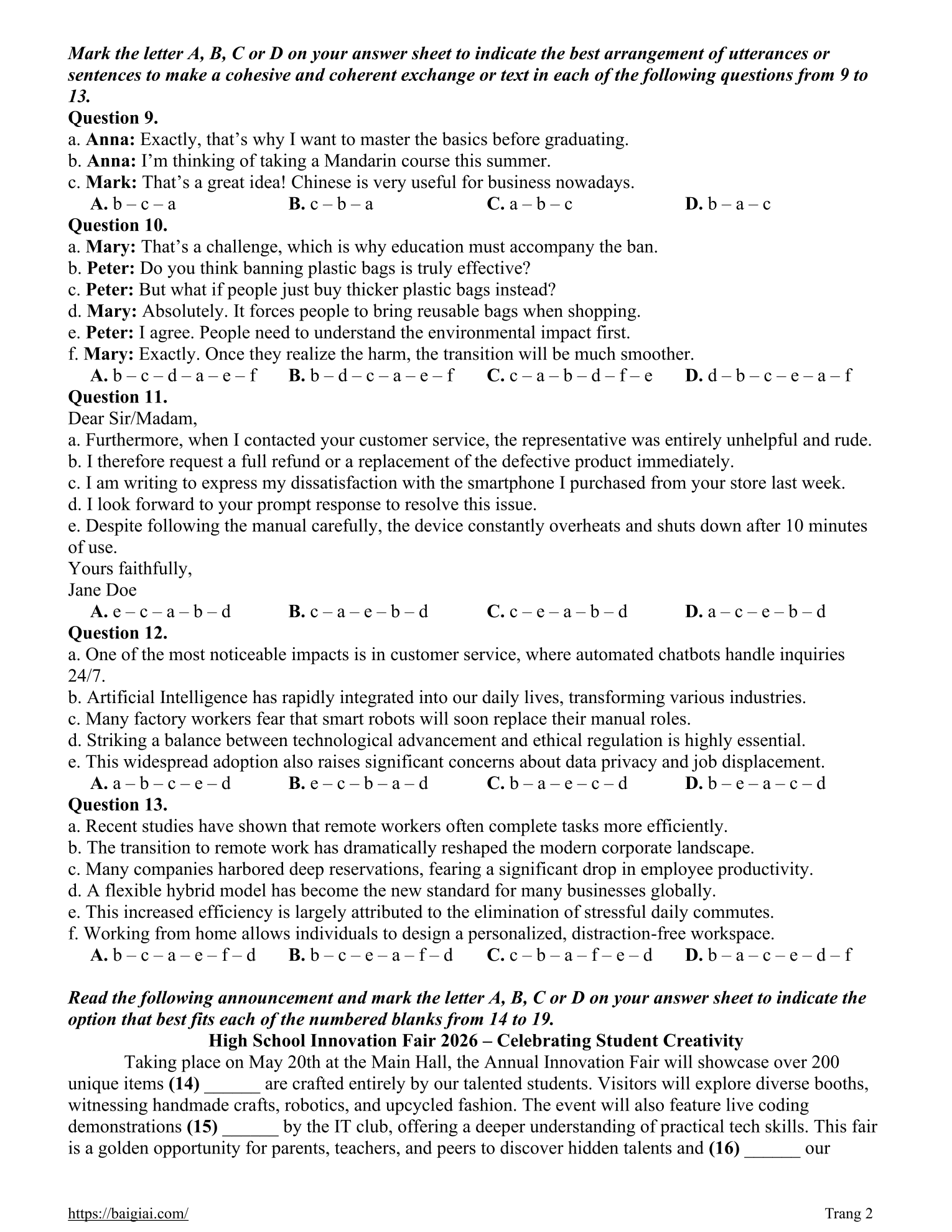
Mark the letter A, B, C or D on your answer sheet to indicate the best arrangement of utterances or sentences to make a cohesive and coherent exchange or text in each of the following questions from 9 to 13.
Question 9.
a. Anna: Exactly, that’s why I want to master the basics before graduating.
b. Anna: I’m thinking of taking a Mandarin course this summer.
c. Mark: That’s a great idea! Chinese is very useful for business nowadays.
A. b – c – a
B. c – b – a
C. a – b – c
D. b – a – c
Đáp án: A
Question 10.
a. Mary: That’s a challenge, which is why education must accompany the ban.
b. Peter: Do you think banning plastic bags is truly effective?
c. Peter: But what if people just buy thicker plastic bags instead?
d. Mary: Absolutely. It forces people to bring reusable bags when shopping.
e. Peter: I agree. People need to understand the environmental impact first.
f. Mary: Exactly. Once they realize the harm, the transition will be much smoother.
A. b – c – d – a – e – f
B. b – d – c – a – e – f
C. c – a – b – d – f – e
D. d – b – c – e – a – f
Đáp án: B
Question 11.
Dear Sir/Madam,
a. Furthermore, when I contacted your customer service, the representative was entirely unhelpful and rude.
b. I therefore request a full refund or a replacement of the defective product immediately.
c. I am writing to express my dissatisfaction with the smartphone I purchased from your store last week.
d. I look forward to your prompt response to resolve this issue.
e. Despite following the manual carefully, the device constantly overheats and shuts down after 10 minutes of use.
Yours faithfully,
Jane Doe
A. e – c – a – b – d
B. c – a – e – b – d
C. c – e – a – b – d
D. a – c – e – b – d
Đáp án: C
Question 12.
a. One of the most noticeable impacts is in customer service, where automated chatbots handle inquiries 24/7.
b. Artificial Intelligence has rapidly integrated into our daily lives, transforming various industries.
c. Many factory workers fear that smart robots will soon replace their manual roles.
d. Striking a balance between technological advancement and ethical regulation is highly essential.
e. This widespread adoption also raises significant concerns about data privacy and job displacement.
A. a – b – c – e – d
B. e – c – b – a – d
C. b – a – e – c – d
D. b – e – a – c – d
Đáp án: C
Question 13.
a. Recent studies have shown that remote workers often complete tasks more efficiently.
b. The transition to remote work has dramatically reshaped the modern corporate landscape.
c. Many companies harbored deep reservations, fearing a significant drop in employee productivity.
d. A flexible hybrid model has become the new standard for many businesses globally.
e. This increased efficiency is largely attributed to the elimination of stressful daily commutes.
f. Working from home allows individuals to design a personalized, distraction-free workspace.
A. b – c – a – e – f – d
B. b – c – e – a – f – d
C. c – b – a – f – e – d
D. b – a – c – e – d – f
Đáp án: A
Read the following announcement and mark the letter A, B, C or D on your answer sheet to indicate the option that best fits each of the numbered blanks from 14 to 19.
High School Innovation Fair 2026 – Celebrating Student Creativity
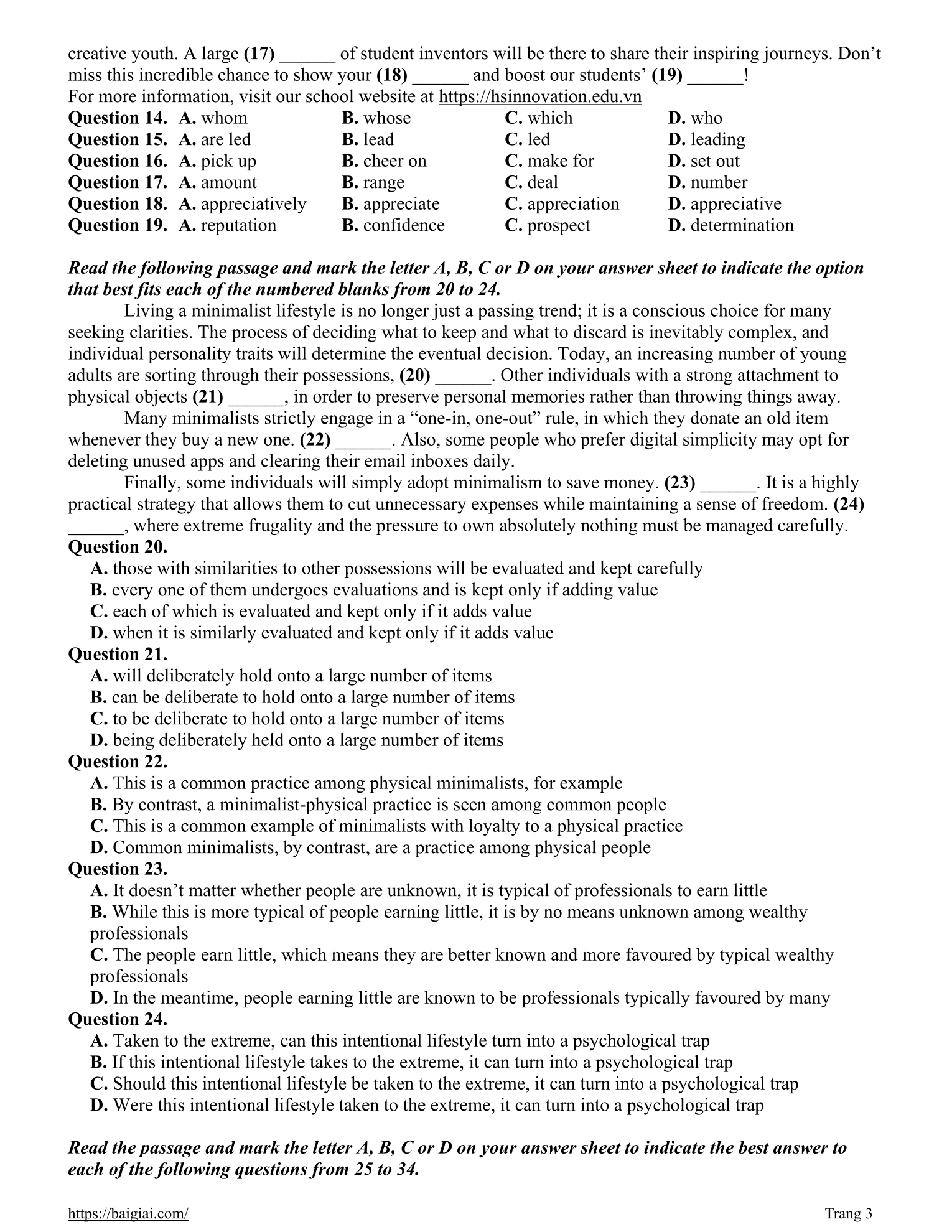
Taking place on May 20th at the Main Hall, the Annual Innovation Fair will showcase over 200 unique items (14) ______ are crafted entirely by our talented students. Visitors will explore diverse booths, witnessing handmade crafts, robotics, and upcycled fashion. The event will also feature live coding demonstrations (15) ______ by the IT club, offering a deeper understanding of practical tech skills. This fair is a golden opportunity for parents, teachers, and peers to discover hidden talents and (16) ______ our creative youth. A large (17) ______ of student inventors will be there to share their inspiring journeys. Don’t miss this incredible chance to show your (18) ______ and boost our students’ (19) ______!
For more information, visit our school website at https://hsinnovation.edu.vn
Question 14.
A. whom
B. whose
C. which
D. who
Đáp án: C
Question 15.
A. are led
B. lead
C. led
D. leading
Đáp án: C
Question 16.
A. pick up
B. cheer on
C. make for
D. set out
Đáp án: B
Question 17.
A. amount
B. range
C. deal
D. number
Đáp án: D
Question 18.
A. appreciatively
B. appreciate
C. appreciation
D. appreciative
Đáp án: C
Question 19.
A. reputation
B. confidence
C. prospect
D. determination
Đáp án: B
Read the following passage and mark the letter A, B, C or D on your answer sheet to indicate the option that best fits each of the numbered blanks from 20 to 24.
Living a minimalist lifestyle is no longer just a passing trend; it is a conscious choice for many seeking clarities. The process of deciding what to keep and what to discard is inevitably complex, and individual personality traits will determine the eventual decision. Today, an increasing number of young adults are sorting through their possessions, (20) ______. Other individuals with a strong attachment to physical objects (21) ______, in order to preserve personal memories rather than throwing things away.
Many minimalists strictly engage in a “one-in, one-out” rule, in which they donate an old item whenever they buy a new one. (22) ______. Also, some people who prefer digital simplicity may opt for deleting unused apps and clearing their email inboxes daily.
Finally, some individuals will simply adopt minimalism to save money. (23) ______. It is a highly practical strategy that allows them to cut unnecessary expenses while maintaining a sense of freedom. (24) ______, where extreme frugality and the pressure to own absolutely nothing must be managed carefully.
Question 20.
A. those with similarities to other possessions will be evaluated and kept carefully
B. every one of them undergoes evaluations and is kept only if adding value
C. each of which is evaluated and kept only if it adds value
D. when it is similarly evaluated and kept only if it adds value
Đáp án: C
Question 21.
A. will deliberately hold onto a large number of items
B. can be deliberate to hold onto a large number of items
C. to be deliberate to hold onto a large number of items
D. being deliberately held onto a large number of items
Đáp án: A
Question 22.
A. This is a common practice among physical minimalists, for example
B. By contrast, a minimalist-physical practice is seen among common people
C. This is a common example of minimalists with loyalty to a physical practice
D. Common minimalists, by contrast, are a practice among physical people
Đáp án: A
Question 23.
A. It doesn’t matter whether people are unknown, it is typical of professionals to earn little
B. While this is more typical of people earning little, it is by no means unknown among wealthy professionals
C. The people earn little, which means they are better known and more favoured by typical wealthy professionals
D. In the meantime, people earning little are known to be professionals typically favoured by many
Đáp án: B
Question 24.
A. Taken to the extreme, can this intentional lifestyle turn into a psychological trap
B. If this intentional lifestyle takes to the extreme, it can turn into a psychological trap
C. Should this intentional lifestyle be taken to the extreme, it can turn into a psychological trap
D. Were this intentional lifestyle taken to the extreme, it can turn into a psychological trap
Đáp án: C
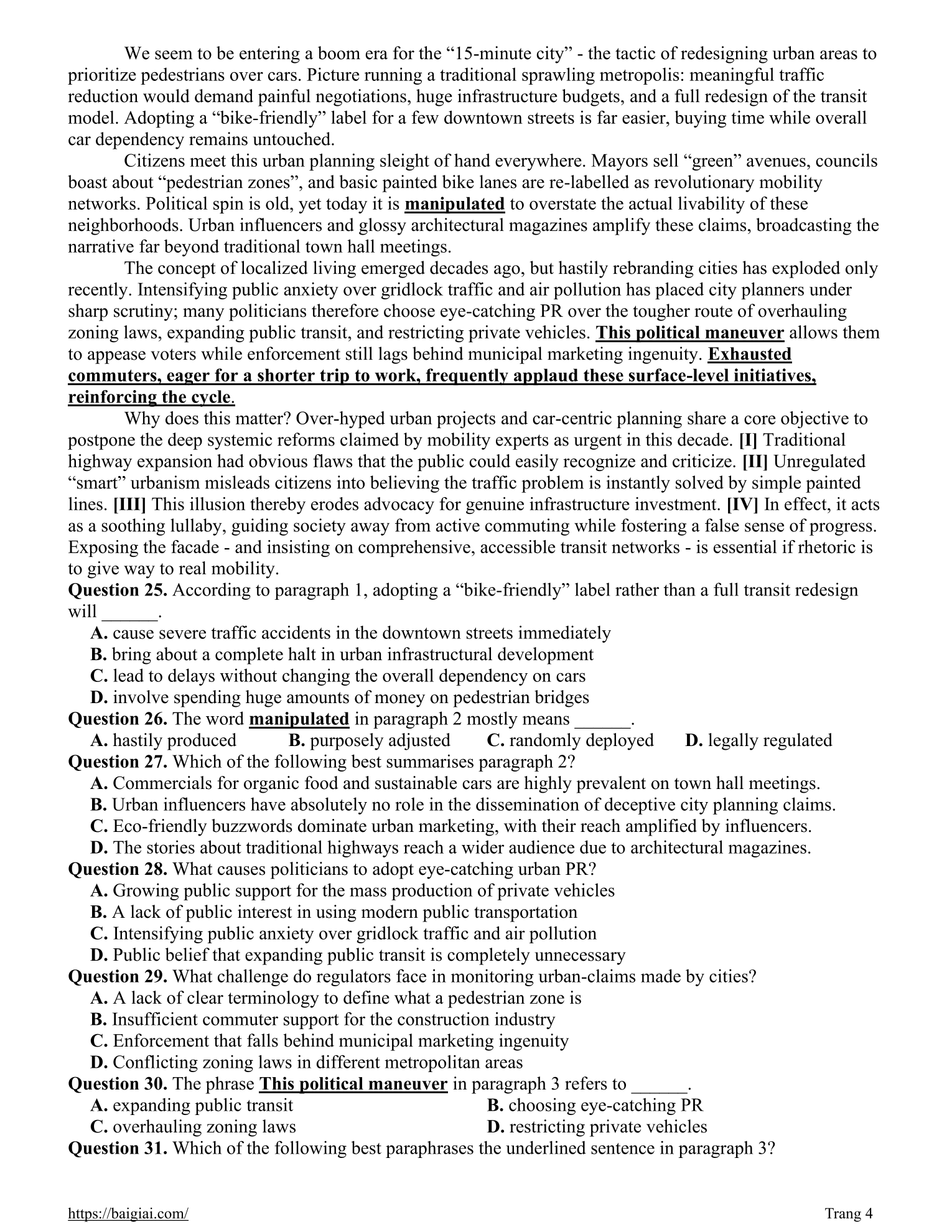
Read the passage and mark the letter A, B, C or D on your answer sheet to indicate the best answer to each of the following questions from 25 to 34.
We seem to be entering a boom era for the “15-minute city” – the tactic of redesigning urban areas to prioritize pedestrians over cars. Picture running a traditional sprawling metropolis: meaningful traffic reduction would demand painful negotiations, huge infrastructure budgets, and a full redesign of the transit model. Adopting a “bike-friendly” label for a few downtown streets is far easier, buying time while overall car dependency remains untouched.
Citizens meet this urban planning sleight of hand everywhere. Mayors sell “green” avenues, councils boast about “pedestrian zones”, and basic painted bike lanes are re-labelled as revolutionary mobility networks. Political spin is old, yet today it is manipulated to overstate the actual livability of these neighborhoods. Urban influencers and glossy architectural magazines amplify these claims, broadcasting the narrative far beyond traditional town hall meetings.
The concept of localized living emerged decades ago, but hastily rebranding cities has exploded only recently. Intensifying public anxiety over gridlock traffic and air pollution has placed city planners under sharp scrutiny; many politicians therefore choose eye-catching PR over the tougher route of overhauling zoning laws, expanding public transit, and restricting private vehicles. This political maneuver allows them to appease voters while enforcement still lags behind municipal marketing ingenuity. Exhausted commuters, eager for a shorter trip to work, frequently applaud these surface-level initiatives, reinforcing the cycle.
Why does this matter? Over-hyped urban projects and car-centric planning share a core objective to postpone the deep systemic reforms claimed by mobility experts as urgent in this decade. [I] Traditional highway expansion had obvious flaws that the public could easily recognize and criticize. [II] Unregulated “smart” urbanism misleads citizens into believing the traffic problem is instantly solved by simple painted lines. [III] This illusion thereby erodes advocacy for genuine infrastructure investment. [IV] In effect, it acts as a soothing lullaby, guiding society away from active commuting while fostering a false sense of progress. Exposing the facade – and insisting on comprehensive, accessible transit networks – is essential if rhetoric is to give way to real mobility.
Question 25. According to paragraph 1, adopting a “bike-friendly” label rather than a full transit redesign will ______.
A. cause severe traffic accidents in the downtown streets immediately
B. bring about a complete halt in urban infrastructural development
C. lead to delays without changing the overall dependency on cars
D. involve spending huge amounts of money on pedestrian bridges
Đáp án: C
Question 26. The word manipulated in paragraph 2 mostly means ______.
A. hastily produced
B. purposely adjusted
C. randomly deployed
D. legally regulated
Đáp án: B
Question 27. Which of the following best summarises paragraph 2?
A. Commercials for organic food and sustainable cars are highly prevalent on town hall meetings.
B. Urban influencers have absolutely no role in the dissemination of deceptive city planning claims.
C. Eco-friendly buzzwords dominate urban marketing, with their reach amplified by influencers.
D. The stories about traditional highways reach a wider audience due to architectural magazines.
Đáp án: C
Question 28. What causes politicians to adopt eye-catching urban PR?
A. Growing public support for the mass production of private vehicles
B. A lack of public interest in using modern public transportation
C. Intensifying public anxiety over gridlock traffic and air pollution
D. Public belief that expanding public transit is completely unnecessary
Đáp án: C
Question 29. What challenge do regulators face in monitoring urban-claims made by cities?
A. A lack of clear terminology to define what a pedestrian zone is
B. Insufficient commuter support for the construction industry
C. Enforcement that falls behind municipal marketing ingenuity
D. Conflicting zoning laws in different metropolitan areas
Đáp án: C
Question 30. The phrase This political maneuver in paragraph 3 refers to ______.
A. expanding public transit
B. choosing eye-catching PR
C. overhauling zoning laws
D. restricting private vehicles
Đáp án: B
Question 31. Which of the following best paraphrases the underlined sentence in paragraph 3?
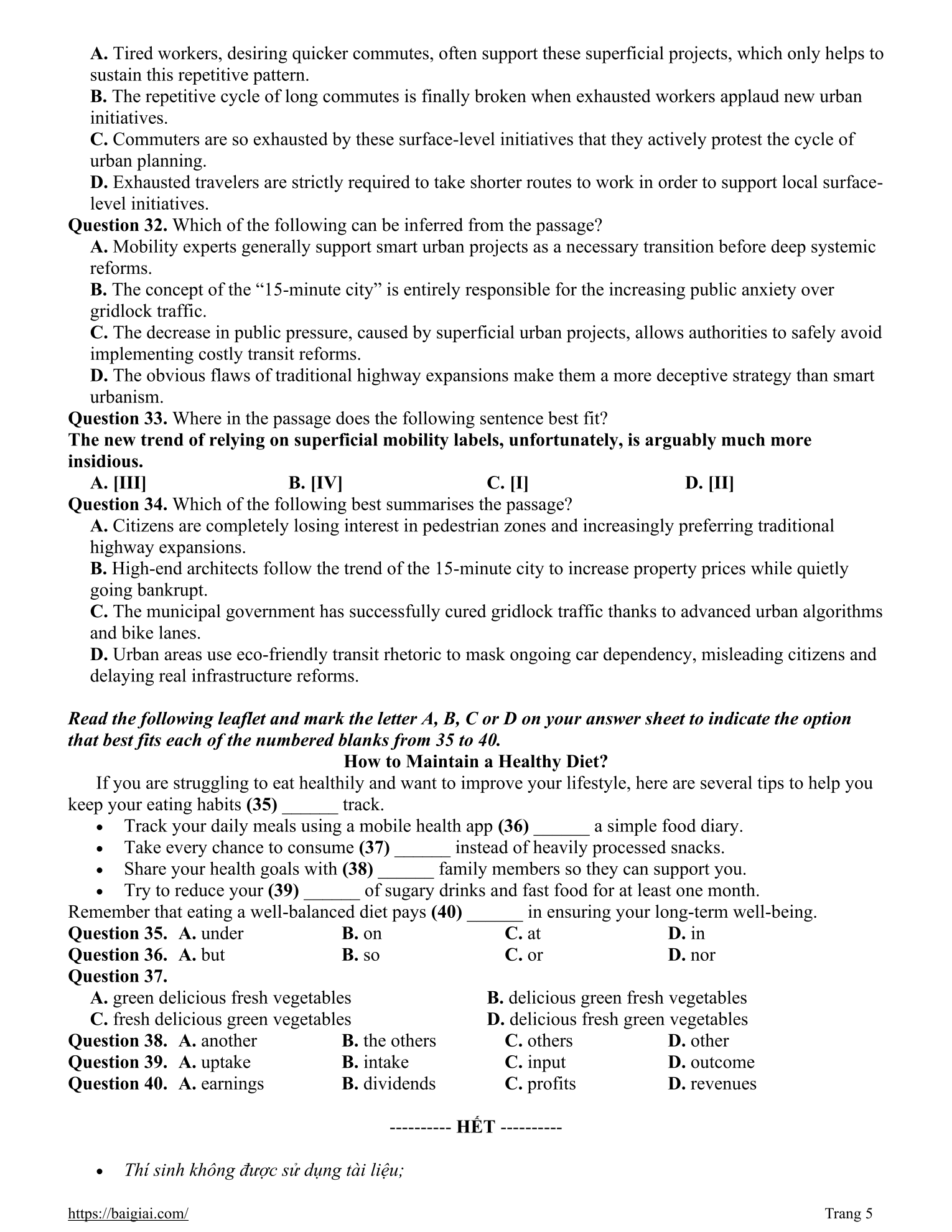
A. Tired workers, desiring quicker commutes, often support these superficial projects, which only helps to sustain this repetitive pattern.
B. The repetitive cycle of long commutes is finally broken when exhausted workers applaud new urban initiatives.
C. Commuters are so exhausted by these surface-level initiatives that they actively protest the cycle of urban planning.
D. Exhausted travelers are strictly required to take shorter routes to work in order to support local surface-level initiatives.
Đáp án: A
Question 32. Which of the following can be inferred from the passage?
A. Mobility experts generally support smart urban projects as a necessary transition before deep systemic reforms.
B. The concept of the “15-minute city” is entirely responsible for the increasing public anxiety over gridlock traffic.
C. The decrease in public pressure, caused by superficial urban projects, allows authorities to safely avoid implementing costly transit reforms.
D. The obvious flaws of traditional highway expansions make them a more deceptive strategy than smart urbanism.
Đáp án: C
Question 33. Where in the passage does the following sentence best fit?
The new trend of relying on superficial mobility labels, unfortunately, is arguably much more insidious.
A. [III]
B. [IV]
C. [I]
D. [II]
Đáp án: D
Question 34. Which of the following best summarises the passage?
A. Citizens are completely losing interest in pedestrian zones and increasingly preferring traditional highway expansions.
B. High-end architects follow the trend of the 15-minute city to increase property prices while quietly going bankrupt.
C. The municipal government has successfully cured gridlock traffic thanks to advanced urban algorithms and bike lanes.
D. Urban areas use eco-friendly transit rhetoric to mask ongoing car dependency, misleading citizens and delaying real infrastructure reforms.
Đáp án: D
Read the following leaflet and mark the letter A, B, C or D on your answer sheet to indicate the option that best fits each of the numbered blanks from 35 to 40.
How to Maintain a Healthy Diet?
If you are struggling to eat healthily and want to improve your lifestyle, here are several tips to help you keep your eating habits (35) ______ track.
• Track your daily meals using a mobile health app (36) ______ a simple food diary.
• Take every chance to consume (37) ______ instead of heavily processed snacks.
• Share your health goals with (38) ______ family members so they can support you.
• Try to reduce your (39) ______ of sugary drinks and fast food for at least one month.
Remember that eating a well-balanced diet pays (40) ______ in ensuring your long-term well-being.
Question 35.
A. under
B. on
C. at
D. in
Đáp án: B
Question 36.
A. but
B. so
C. or
D. nor
Đáp án: C
Question 37.
A. green delicious fresh vegetables
B. delicious green fresh vegetables
C. fresh delicious green vegetables
D. delicious fresh green vegetables
Đáp án: D
Question 38.
A. another
B. the others
C. others
D. other
Đáp án: D
Question 39.
A. uptake
B. intake
C. input
D. outcome
Đáp án: B
Question 40.
A. earnings
B. dividends
C. profits
D. revenues
Đáp án: B