Đề thi thử THPT 2026 môn Tiếng anh – Sở GDĐT Cần Thơ là bài luyện có ích cho học sinh lớp 12 muốn tự “test” lại phong độ trước giai đoạn ôn thi cao điểm của năm học 2025–2026. Giá trị của đề không nằm ở việc nhắc lại kiến thức một cách rời rạc, mà ở chỗ nó buộc người học phải vận hành đồng thời nhiều kỹ năng trong cùng một bài làm: nhận diện phát âm, xử lý trọng âm, dùng từ đúng ngữ cảnh, nắm cấu trúc ngữ pháp, hiểu hội thoại và đọc nhanh văn bản để chọn đáp án chính xác. Với những em đang cần đề thi thử tốt nghiệp THPT môn Tiếng Anh, đây là nguồn tham khảo phù hợp để nhìn rõ phần nào đã chắc, phần nào còn chệch nhịp và cần ôn lại kỹ hơn. Nếu muốn nâng mức luyện tập lên cao hơn, học sinh cũng có thể xem đây như đề trắc nghiệm đại học môn Anh để rèn phản xạ ngôn ngữ, cải thiện tốc độ xử lý và giữ độ ổn định ở các câu hỏi phân hóa.
Trên dethitracnghiem.vn, học sinh có thể tiếp cận đề ôn thi chuyển cấp theo hình thức trực tuyến, nhờ đó việc luyện đề không còn bị bó hẹp trong cách học làm một lần rồi thôi. Sau mỗi lượt làm bài, hệ thống cho phép xem đáp án, đối chiếu kết quả và tiếp tục luyện lại để nhận ra mình đang mất điểm nhiều ở nhóm câu hỏi nào, như từ vựng, ngữ pháp, giao tiếp hay đọc hiểu. Với môn Tiếng Anh, kiểu học này đặc biệt hữu ích vì sai sót thường phân tán ở nhiều kỹ năng chứ không dồn vào một phần duy nhất. Nhờ theo dõi được tiến bộ qua từng lần luyện, học sinh lớp 12 sẽ dễ ôn đúng trọng tâm hơn, giảm học lan man và duy trì được nhịp chuẩn bị hiệu quả cho kỳ thi năm 2026.
ĐỀ THI
LINK PDF ĐỀ THI [gồm ĐỀ THI, ĐÁP ÁN, LỜI GIẢI]:
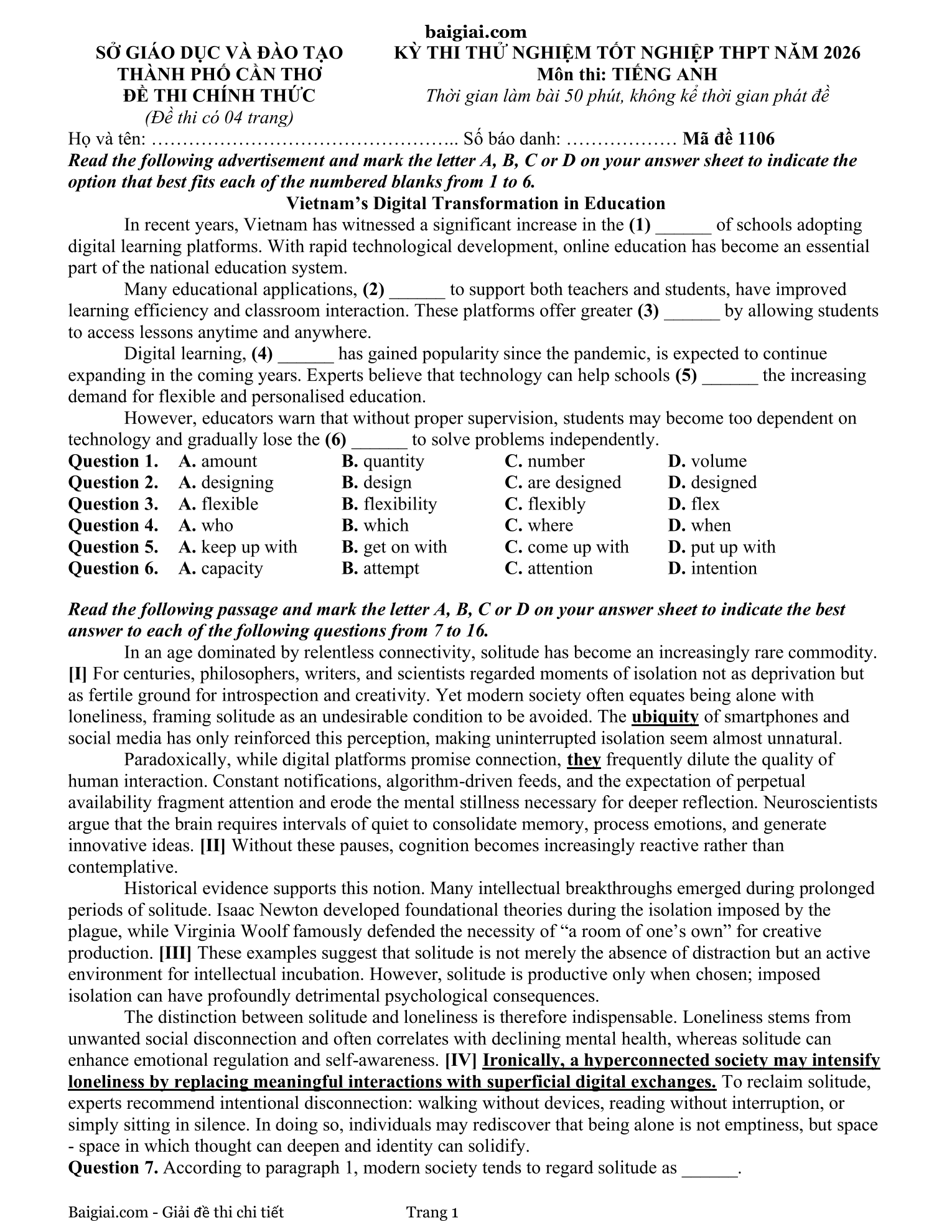
Vietnam’s Digital Transformation in Education
In recent years, Vietnam has witnessed a significant increase in the (1) _______ of schools adopting digital learning platforms. With rapid technological development, online education has become an essential part of the national education system.
Many educational applications, (2) _______ to support both teachers and students, have improved learning efficiency and classroom interaction. These platforms offer greater (3) _______ by allowing students to access lessons anytime and anywhere.
Digital learning, (4) _______ has gained popularity since the pandemic, is expected to continue expanding in the coming years. Experts believe that technology can help schools (5) _______ the increasing demand for flexible and personalised education.
However, educators warn that without proper supervision, students may become too dependent on technology and gradually lose the (6) _______ to solve problems independently.
Question 1.
A. amount
B. quantity
C. number
D. volume
Đáp án: C
Question 2.
A. designing
B. design
C. are designed
D. designed
Đáp án: D
Question 3.
A. flexible
B. flexibility
C. flexibly
D. flex
Đáp án: B
Question 4.
A. who
B. which
C. where
D. when
Đáp án: B
Question 5.
A. keep up with
B. get on with
C. come up with
D. put up with
Đáp án: A
Question 6.
A. capacity
B. attempt
C. attention
D. intention
Đáp án: A
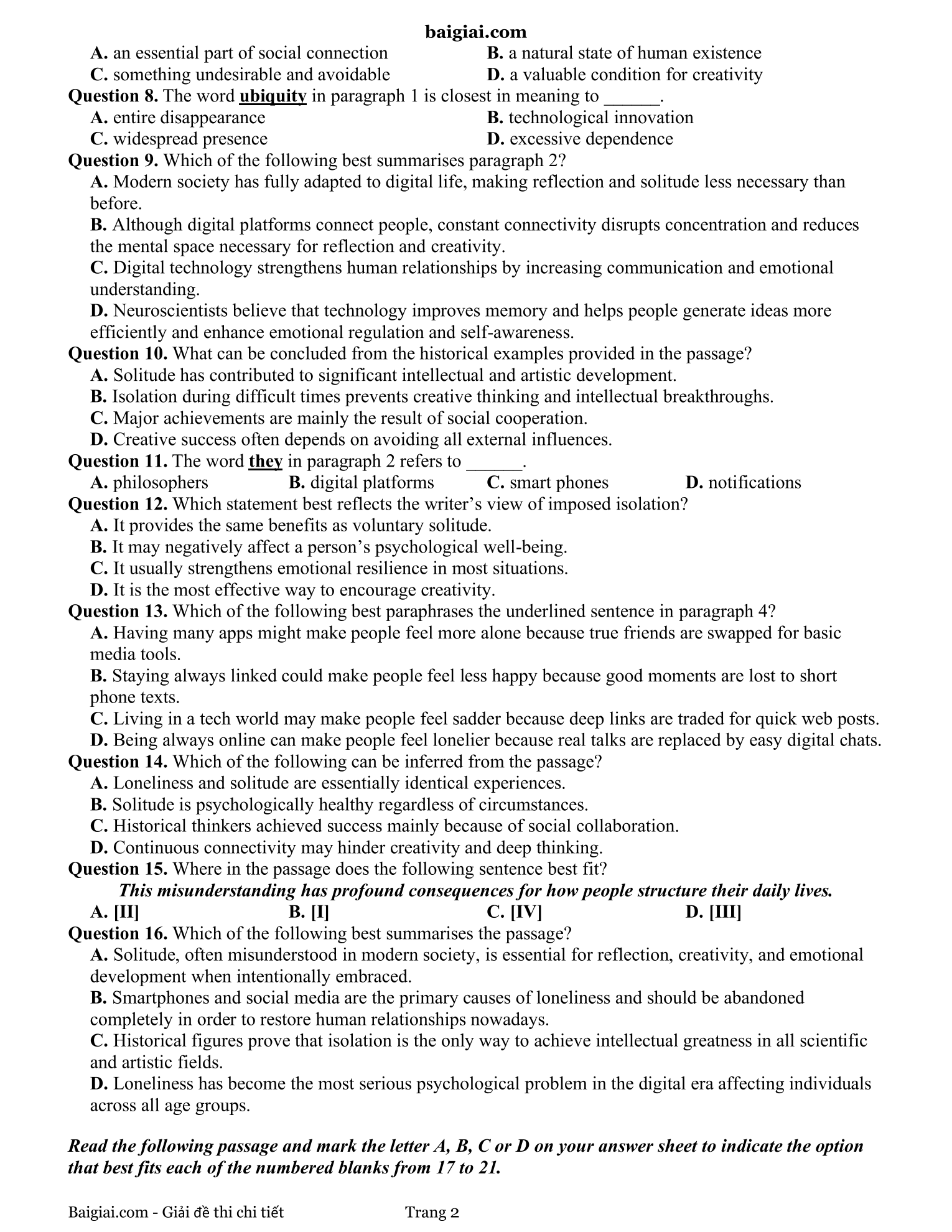
Read the following passage and mark the letter A, B, C or D on your answer sheet to indicate the best answer to each of the following questions from 7 to 16.
In an age dominated by relentless connectivity, solitude has become an increasingly rare commodity. [I] For centuries, philosophers, writers, and scientists regarded moments of isolation not as deprivation but as fertile ground for introspection and creativity. Yet modern society often equates being alone with loneliness, framing solitude as an undesirable condition to be avoided. The ubiquity of smartphones and social media has only reinforced this perception, making uninterrupted isolation seem almost unnatural.
Paradoxically, while digital platforms promise connection, they frequently dilute the quality of human interaction. Constant notifications, algorithm-driven feeds, and the expectation of perpetual availability fragment attention and erode the mental stillness necessary for deeper reflection. Neuroscientists argue that the brain requires intervals of quiet to consolidate memory, process emotions, and generate innovative ideas. [II] Without these pauses, cognition becomes increasingly reactive rather than contemplative.
Historical evidence supports this notion. Many intellectual breakthroughs emerged during prolonged periods of solitude. Isaac Newton developed foundational theories during the isolation imposed by the plague, while Virginia Woolf famously defended the necessity of “a room of one’s own” for creative production. [III] These examples suggest that solitude is not merely the absence of distraction but an active environment for intellectual incubation. However, solitude is productive only when chosen; imposed isolation can have profoundly detrimental psychological consequences.
The distinction between solitude and loneliness is therefore indispensable. Loneliness stems from unwanted social disconnection and often correlates with declining mental health, whereas solitude can enhance emotional regulation and self-awareness. [IV] Ironically, a hyperconnected society may intensify loneliness by replacing meaningful interactions with superficial digital exchanges. To reclaim solitude, experts recommend intentional disconnection: walking without devices, reading without interruption, or simply sitting in silence. In doing so, individuals may rediscover that being alone is not emptiness, but space – space in which thought can deepen and identity can solidify.
Question 7. According to paragraph 1, modern society tends to regard solitude as _______.
A. an essential part of social connection
B. a natural state of human existence
C. something undesirable and avoidable
D. a valuable condition for creativity
Đáp án: C
Question 8. The word ubiquity in paragraph 1 is closest in meaning to _______.
A. entire disappearance
B. technological innovation
C. widespread presence
D. excessive dependence
Đáp án: C
Question 9. Which of the following best summarises paragraph 2?
A. Modern society has fully adapted to digital life, making reflection and solitude less necessary than before.
B. Although digital platforms connect people, constant connectivity disrupts concentration and reduces the mental space necessary for reflection and creativity.
C. Digital technology strengthens human relationships by increasing communication and emotional understanding.
D. Neuroscientists believe that technology improves memory and helps people generate ideas more efficiently and enhance emotional regulation and self-awareness.
Đáp án: B
Question 10. What can be concluded from the historical examples provided in the passage?
A. Solitude has contributed to significant intellectual and artistic development.
B. Isolation during difficult times prevents creative thinking and intellectual breakthroughs.
C. Major achievements are mainly the result of social cooperation.
D. Creative success often depends on avoiding all external influences.
Đáp án: A
Question 11. The word they in paragraph 2 refers to _______.
A. philosophers
B. digital platforms
C. smart phones
D. notifications
Đáp án: B
Question 12. Which statement best reflects the writer’s view of imposed isolation?
A. It provides the same benefits as voluntary solitude.
B. It may negatively affect a person’s psychological well-being.
C. It usually strengthens emotional resilience in most situations.
D. It is the most effective way to encourage creativity.
Đáp án: B
Question 13. Which of the following best paraphrases the underlined sentence in paragraph 4?
A. Having many apps might make people feel more alone because true friends are swapped for basic media tools.
B. Staying always linked could make people feel less happy because good moments are lost to short phone texts.
C. Living in a tech world may make people feel sadder because deep links are traded for quick web posts.
D. Being always online can make people feel lonelier because real talks are replaced by easy digital chats.
Đáp án: D
Question 14. Which of the following can be inferred from the passage?
A. Loneliness and solitude are essentially identical experiences.
B. Solitude is psychologically healthy regardless of circumstances.
C. Historical thinkers achieved success mainly because of social collaboration.
D. Continuous connectivity may hinder creativity and deep thinking.
Đáp án: D
Question 15. Where in the passage does the following sentence best fit?
This misunderstanding has profound consequences for how people structure their daily lives.
A. [II]
B. [I]
C. [IV]
D. [III]
Đáp án: B
Question 16. Which of the following best summarises the passage?
A. Solitude, often misunderstood in modern society, is essential for reflection, creativity, and emotional development when intentionally embraced.
B. Smartphones and social media are the primary causes of loneliness and should be abandoned completely in order to restore human relationships nowadays.
C. Historical figures prove that isolation is the only way to achieve intellectual greatness in all scientific and artistic fields.
D. Loneliness has become the most serious psychological problem in the digital era affecting individuals across all age groups.
Đáp án: A
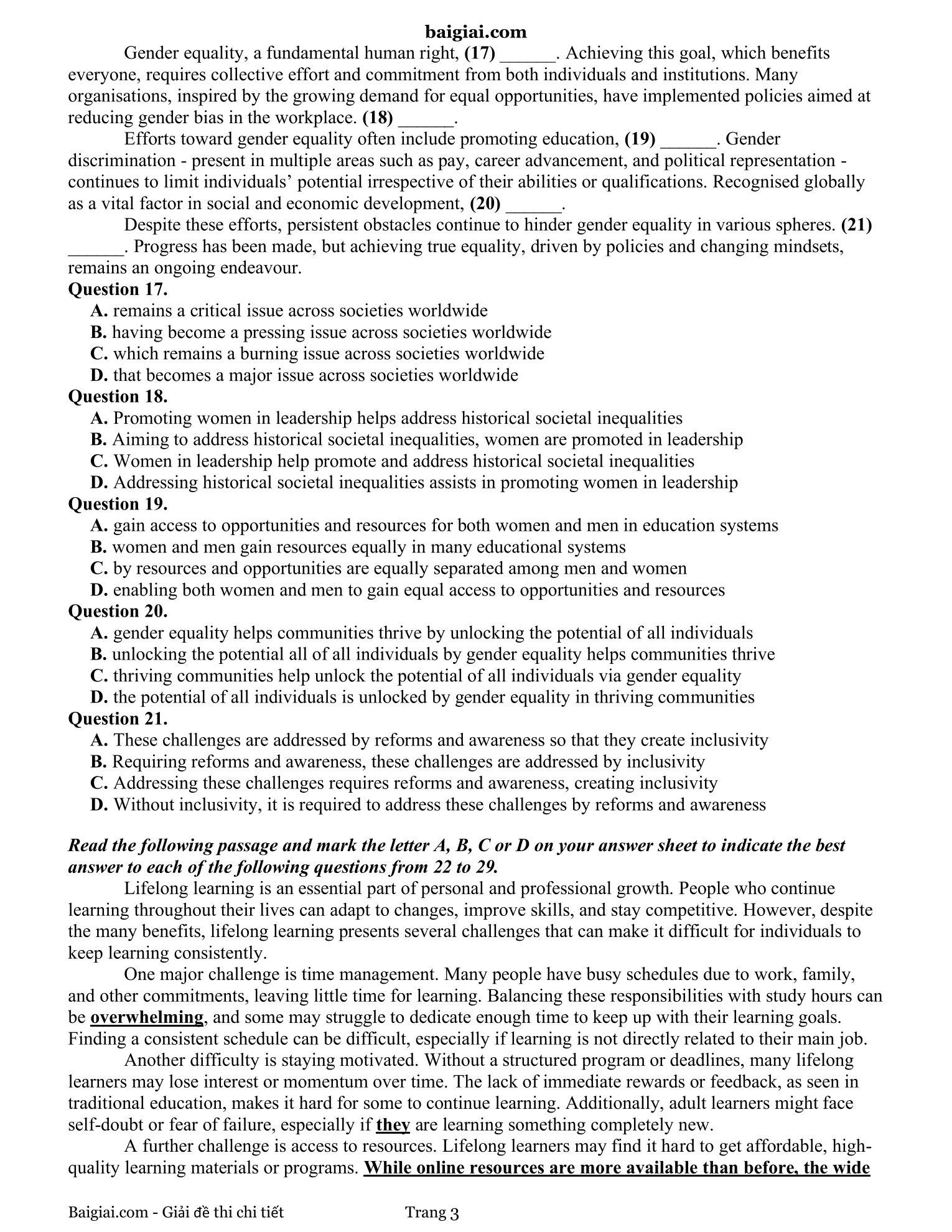
Read the following passage and mark the letter A, B, C or D on your answer sheet to indicate the option that best fits each of the numbered blanks from 17 to 21.
Gender equality, a fundamental human right, (17) _______. Achieving this goal, which benefits everyone, requires collective effort and commitment from both individuals and institutions. Many organisations, inspired by the growing demand for equal opportunities, have implemented policies aimed at reducing gender bias in the workplace. (18) _______.
Efforts toward gender equality often include promoting education, (19) _______. Gender discrimination – present in multiple areas such as pay, career advancement, and political representation – continues to limit individuals’ potential irrespective of their abilities or qualifications. Recognised globally as a vital factor in social and economic development, (20) _______.
Despite these efforts, persistent obstacles continue to hinder gender equality in various spheres. (21) _______. Progress has been made, but achieving true equality, driven by policies and changing mindsets, remains an ongoing endeavour.
Question 17.
A. remains a critical issue across societies worldwide
B. having become a pressing issue across societies worldwide
C. which remains a burning issue across societies worldwide
D. that becomes a major issue across societies worldwide
Đáp án: A
Question 18.
A. Promoting women in leadership helps address historical societal inequalities
B. Aiming to address historical societal inequalities, women are promoted in leadership
C. Women in leadership help promote and address historical societal inequalities
D. Addressing historical societal inequalities assists in promoting women in leadership
Đáp án: A
Question 19.
A. gain access to opportunities and resources for both women and men in education systems
B. women and men gain resources equally in many educational systems
C. by resources and opportunities are equally separated among men and women
D. enabling both women and men to gain equal access to opportunities and resources
Đáp án: D
Question 20.
A. gender equality helps communities thrive by unlocking the potential of all individuals
B. unlocking the potential all of all individuals by gender equality helps communities thrive
C. thriving communities help unlock the potential of all individuals via gender equality
D. the potential of all individuals is unlocked by gender equality in thriving communities
Đáp án: A
Question 21.
A. These challenges are addressed by reforms and awareness so that they create inclusivity
B. Requiring reforms and awareness, these challenges are addressed by inclusivity
C. Addressing these challenges requires reforms and awareness, creating inclusivity
D. Without inclusivity, it is required to address these challenges by reforms and awareness
Đáp án: C
Read the following passage and mark the letter A, B, C or D on your answer sheet to indicate the best answer to each of the following questions from 22 to 29.
Lifelong learning is an essential part of personal and professional growth. People who continue learning throughout their lives can adapt to changes, improve skills, and stay competitive. However, despite the many benefits, lifelong learning presents several challenges that can make it difficult for individuals to keep learning consistently.
One major challenge is time management. Many people have busy schedules due to work, family, and other commitments, leaving little time for learning. Balancing these responsibilities with study hours can be overwhelming, and some may struggle to dedicate enough time to keep up with their learning goals. Finding a consistent schedule can be difficult, especially if learning is not directly related to their main job.
Another difficulty is staying motivated. Without a structured program or deadlines, many lifelong learners may lose interest or momentum over time. The lack of immediate rewards or feedback, as seen in traditional education, makes it hard for some to continue learning. Additionally, adult learners might face self-doubt or fear of failure, especially if they are learning something completely new.
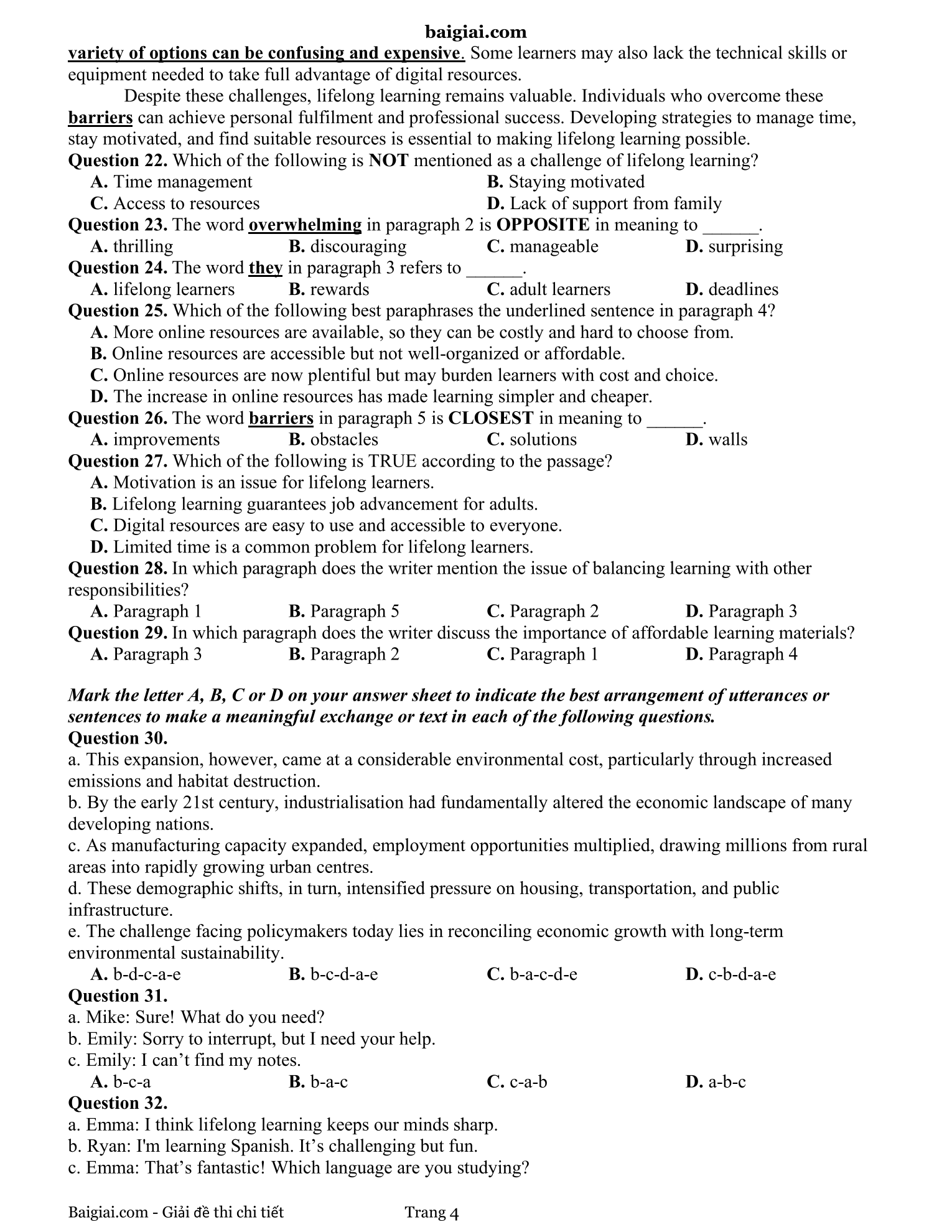
A further challenge is access to resources. Lifelong learners may find it hard to get affordable, high-quality learning materials or programs. While online resources are more available than before, the wide variety of options can be confusing and expensive. Some learners may also lack the technical skills or equipment needed to take full advantage of digital resources.
Despite these challenges, lifelong learning remains valuable. Individuals who overcome these barriers can achieve personal fulfilment and professional success. Developing strategies to manage time, stay motivated, and find suitable resources is essential to making lifelong learning possible.
Question 22. Which of the following is NOT mentioned as a challenge of lifelong learning?
A. Time management
B. Staying motivated
C. Access to resources
D. Lack of support from family
Đáp án: D
Question 23. The word overwhelming in paragraph 2 is OPPOSITE in meaning to _______.
A. thrilling
B. discouraging
C. manageable
D. surprising
Đáp án: C
Question 24. The word they in paragraph 3 refers to _______.
A. lifelong learners
B. rewards
C. adult learners
D. deadlines
Đáp án: C
Question 25. Which of the following best paraphrases the underlined sentence in paragraph 4?
A. More online resources are available, so they can be costly and hard to choose from.
B. Online resources are accessible but not well-organized or affordable.
C. Online resources are now plentiful but may burden learners with cost and choice.
D. The increase in online resources has made learning simpler and cheaper.
Đáp án: C
Question 26. The word barriers in paragraph 5 is CLOSEST in meaning to _______.
A. improvements
B. obstacles
C. solutions
D. walls
Đáp án: B
Question 27. Which of the following is TRUE according to the passage?
A. Motivation is an issue for lifelong learners.
B. Lifelong learning guarantees job advancement for adults.
C. Digital resources are easy to use and accessible to everyone.
D. Limited time is a common problem for lifelong learners.
Đáp án: D
Question 28. In which paragraph does the writer mention the issue of balancing learning with other responsibilities?
A. Paragraph 1
B. Paragraph 5
C. Paragraph 2
D. Paragraph 3
Đáp án: C
Question 29. In which paragraph does the writer discuss the importance of affordable learning materials?
A. Paragraph 3
B. Paragraph 2
C. Paragraph 1
D. Paragraph 4
Đáp án: D
Mark the letter A, B, C or D on your answer sheet to indicate the best arrangement of utterances or sentences to make a meaningful exchange or text in each of the following questions.
Question 30.
a. This expansion, however, came at a considerable environmental cost, particularly through increased emissions and habitat destruction.
b. By the early 21st century, industrialisation had fundamentally altered the economic landscape of many developing nations.
c. As manufacturing capacity expanded, employment opportunities multiplied, drawing millions from rural areas into rapidly growing urban centres.
d. These demographic shifts, in turn, intensified pressure on housing, transportation, and public infrastructure.
e. The challenge facing policymakers today lies in reconciling economic growth with long-term environmental sustainability.
A. b-d-c-a-e
B. b-c-d-a-e
C. b-a-c-d-e
D. c-b-d-a-e
Đáp án: B
Question 31.
a. Mike: Sure! What do you need?
b. Emily: Sorry to interrupt, but I need your help.
c. Emily: I can’t find my notes.
A. b-c-a
B. b-a-c
C. c-a-b
D. a-b-c
Đáp án: B
Question 32.
a. Emma: I think lifelong learning keeps our minds sharp.
b. Ryan: I’m learning Spanish. It’s challenging but fun.
c. Emma: That’s fantastic! Which language are you studying?
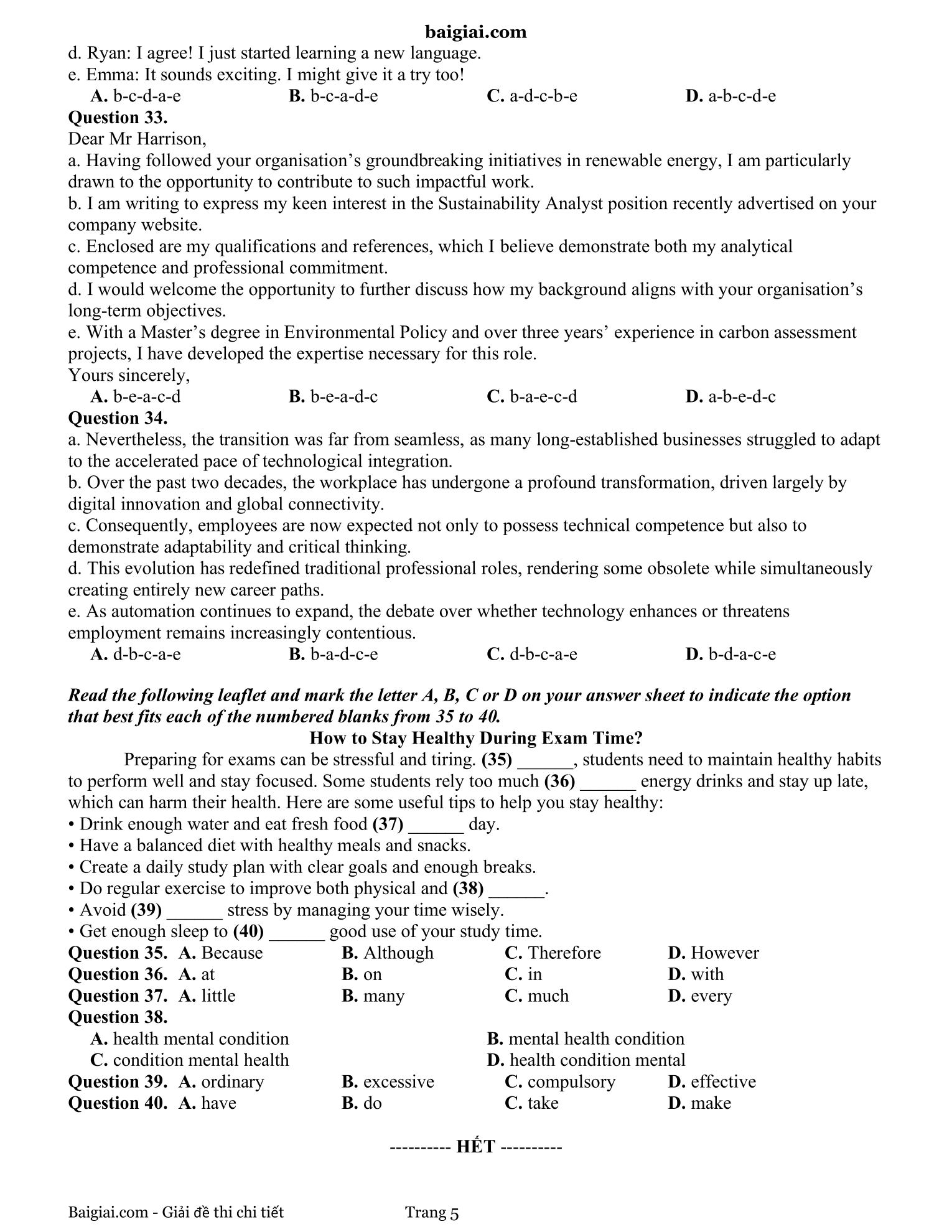
d. Ryan: I agree! I just started learning a new language.
e. Emma: It sounds exciting. I might give it a try too!
A. b-c-d-a-e
B. b-c-a-d-e
C. a-d-c-b-e
D. a-b-c-d-e
Đáp án: C
Question 33.
Dear Mr Harrison,
a. Having followed your organisation’s groundbreaking initiatives in renewable energy, I am particularly drawn to the opportunity to contribute to such impactful work.
b. I am writing to express my keen interest in the Sustainability Analyst position recently advertised on your company website.
c. Enclosed are my qualifications and references, which I believe demonstrate both my analytical competence and professional commitment.
d. I would welcome the opportunity to further discuss how my background aligns with your organisation’s long-term objectives.
e. With a Master’s degree in Environmental Policy and over three years’ experience in carbon assessment projects, I have developed the expertise necessary for this role.
Yours sincerely,
A. b-e-a-c-d
B. b-e-a-d-c
C. b-a-e-c-d
D. a-b-e-d-c
Đáp án: C
Question 34.
a. Nevertheless, the transition was far from seamless, as many long-established businesses struggled to adapt to the accelerated pace of technological integration.
b. Over the past two decades, the workplace has undergone a profound transformation, driven largely by digital innovation and global connectivity.
c. Consequently, employees are now expected not only to possess technical competence but also to demonstrate adaptability and critical thinking.
d. This evolution has redefined traditional professional roles, rendering some obsolete while simultaneously creating entirely new career paths.
e. As automation continues to expand, the debate over whether technology enhances or threatens employment remains increasingly contentious.
A. d-b-c-a-e
B. b-a-d-c-e
C. d-b-c-a-e
D. b-d-a-c-e
Đáp án: D
Read the following leaflet and mark the letter A, B, C or D on your answer sheet to indicate the option that best fits each of the numbered blanks from 35 to 40.
How to Stay Healthy During Exam Time?
Preparing for exams can be stressful and tiring. (35) _______, students need to maintain healthy habits to perform well and stay focused. Some students rely too much (36) _______ energy drinks and stay up late, which can harm their health. Here are some useful tips to help you stay healthy:
• Drink enough water and eat fresh food (37) _______ day.
• Have a balanced diet with healthy meals and snacks.
• Create a daily study plan with clear goals and enough breaks.
• Do regular exercise to improve both physical and (38) _______.
• Avoid (39) _______ stress by managing your time wisely.
• Get enough sleep to (40) _______ good use of your study time.
Question 35.
A. Because
B. Although
C. Therefore
D. However
Đáp án: C
Question 36.
A. at
B. on
C. in
D. with
Đáp án: B
Question 37.
A. little
B. many
C. much
D. every
Đáp án: D
Question 38.
A. health mental condition
B. mental health condition
C. condition mental health
D. health condition mental
Đáp án: B
Question 39.
A. ordinary
B. excessive
C. compulsory
D. effective
Đáp án: B
Question 40.
A. have
B. do
C. take
D. make
Đáp án: D