
Đề thi thử THPT 2026 môn Tiếng anh – Sở GDĐT Ninh Bình (Lần 3) là dạng tài liệu rất thích hợp cho học sinh lớp 12 đang cần một “bài kiểm tra thử thật sự” trước kỳ thi tốt nghiệp THPT năm học 2025–2026. Giá trị của đề không chỉ nằm ở việc giúp ôn lại kiến thức, mà còn ở chỗ buộc người học phải làm việc với toàn bộ cấu trúc đề trong một mạch liên tục, từ phát âm, trọng âm, từ vựng, ngữ pháp đến giao tiếp và đọc hiểu. Với những em đang cần đề thi thử tốt nghiệp THPT môn Tiếng Anh, đây là nguồn luyện tập hữu ích để kiểm tra xem mình đang mất điểm ở đâu, phần nào còn thiếu chắc và dạng câu hỏi nào cần ưu tiên ôn lại. Đồng thời, đề cũng có thể được xem như đề luyện thi đại học đối với học sinh muốn nâng mức luyện tập lên cao hơn, nhất là khi cần rèn khả năng đọc nhanh, hiểu ngữ cảnh chính xác và xử lý câu hỏi phân hóa một cách ổn định.
Trên dethitracnghiem.vn, học sinh có thể làm bài theo hình thức trực tuyến với đề ôn thi chuyển cấp, nhờ đó việc luyện đề không còn chỉ là làm xong rồi dò đáp án thủ công. Hệ thống cho phép xem kết quả ngay sau khi nộp, làm lại nhiều lần và theo dõi sự thay đổi qua từng lượt thực hành để biết mình đang tiến bộ thật hay chỉ làm theo cảm giác. Với môn Tiếng Anh, cách học này đặc biệt có ích vì học sinh thường sai lặp lại ở một vài nhóm kỹ năng như từ vựng ngữ cảnh, cấu trúc câu hoặc bài đọc dài mà không tự nhận ra. Khi nhìn thấy đúng “điểm rơi lỗi sai” của mình, học sinh lớp 12 sẽ dễ ôn tập có trọng tâm hơn, tiết kiệm công sức hơn và giữ được nhịp tăng tốc tốt hơn cho kỳ thi năm 2026.
ĐỀ THI
LINK PDF ĐỀ THI [gồm ĐỀ THI, ĐÁP ÁN, LỜI GIẢI]:
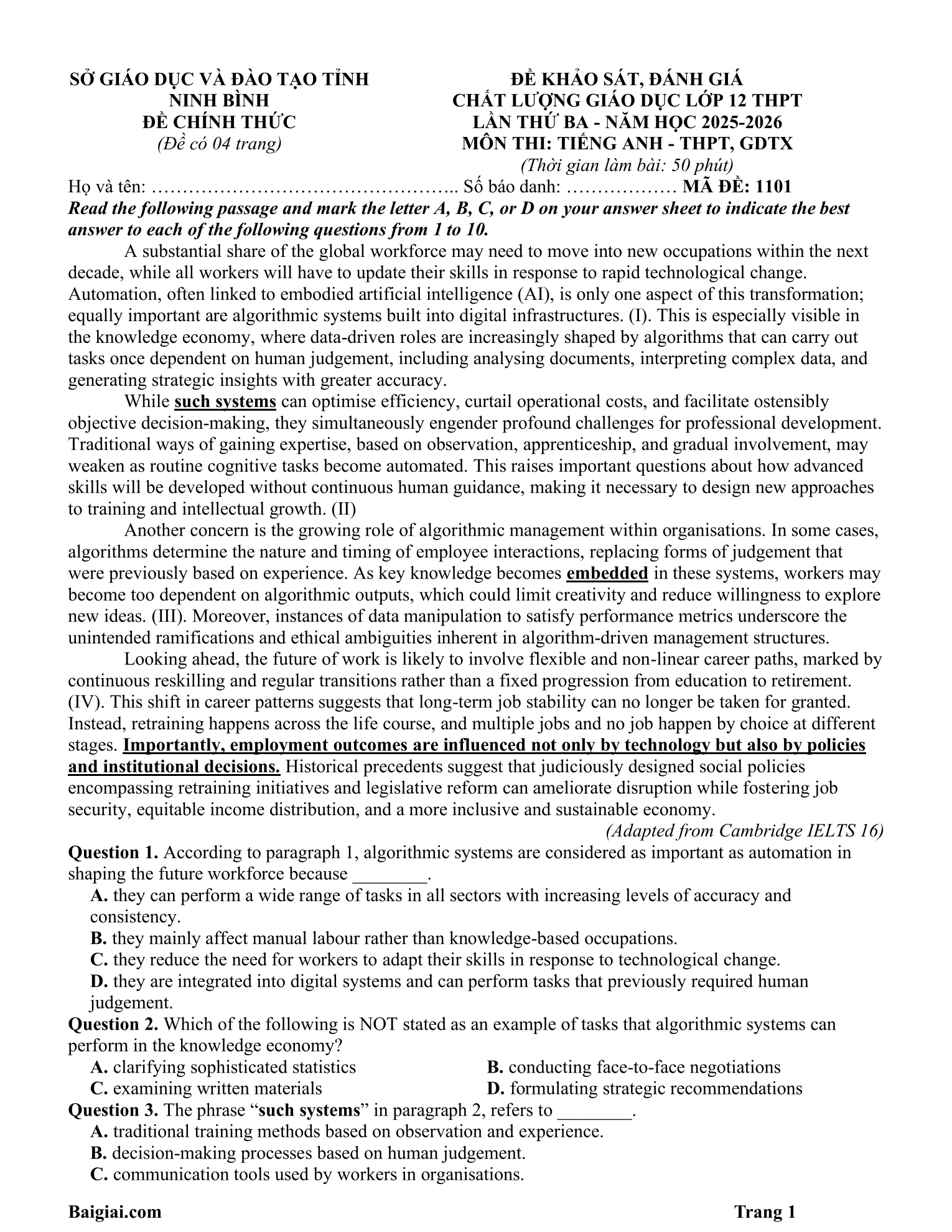
Read the following passage and mark the letter A, B, C, or D on your answer sheet to indicate the best answer to each of the following questions from 1 to 10.
A substantial share of the global workforce may need to move into new occupations within the next decade, while all workers will have to update their skills in response to rapid technological change. Automation, often linked to embodied artificial intelligence (AI), is only one aspect of this transformation; equally important are algorithmic systems built into digital infrastructures. (I). This is especially visible in the knowledge economy, where data-driven roles are increasingly shaped by algorithms that can carry out tasks once dependent on human judgement, including analysing documents, interpreting complex data, and generating strategic insights with greater accuracy.
While such systems can optimise efficiency, curtail operational costs, and facilitate ostensibly objective decision-making, they simultaneously engender profound challenges for professional development. Traditional ways of gaining expertise, based on observation, apprenticeship, and gradual involvement, may weaken as routine cognitive tasks become automated. This raises important questions about how advanced skills will be developed without continuous human guidance, making it necessary to design new approaches to training and intellectual growth. (II)
Another concern is the growing role of algorithmic management within organisations. In some cases, algorithms determine the nature and timing of employee interactions, replacing forms of judgement that were previously based on experience. As key knowledge becomes embedded in these systems, workers may become too dependent on algorithmic outputs, which could limit creativity and reduce willingness to explore new ideas. (III). Moreover, instances of data manipulation to satisfy performance metrics underscore the unintended ramifications and ethical ambiguities inherent in algorithm-driven management structures.
Looking ahead, the future of work is likely to involve flexible and non-linear career paths, marked by continuous reskilling and regular transitions rather than a fixed progression from education to retirement. (IV). This shift in career patterns suggests that long-term job stability can no longer be taken for granted. Instead, retraining happens across the life course, and multiple jobs and no job happen by choice at different stages. Importantly, employment outcomes are influenced not only by technology but also by policies and institutional decisions. Historical precedents suggest that judiciously designed social policies encompassing retraining initiatives and legislative reform can ameliorate disruption while fostering job security, equitable income distribution, and a more inclusive and sustainable economy.
(Adapted from Cambridge IELTS 16)
Question 1.
According to paragraph 1, algorithmic systems are considered as important as automation in shaping the future workforce because ________.
A. they can perform a wide range of tasks in all sectors with increasing levels of accuracy and consistency.
B. they mainly affect manual labour rather than knowledge-based occupations.
C. they reduce the need for workers to adapt their skills in response to technological change.
D. they are integrated into digital systems and can perform tasks that previously required human judgement.
Đáp án: D
Question 2.
Which of the following is NOT stated as an example of tasks that algorithmic systems can perform in the knowledge economy?
A. clarifying sophisticated statistics
B. conducting face-to-face negotiations
C. examining written materials
D. formulating strategic recommendations
Đáp án: B
Question 3.
The phrase “such systems” in paragraph 2, refers to ________.
A. traditional training methods based on observation and experience.
B. decision-making processes based on human judgement.
C. communication tools used by workers in organisations.
D. algorithmic systems used in digital environments to support work tasks.
Đáp án: D
Question 4.
What happens when performance figures are deliberately adjusted to meet evaluation standards?
A. It improves data accuracy and strengthens overall trust within algorithm-based management systems.
B. It standardises evaluation procedures and ensures consistency within algorithm-based management systems.
C. It supports managerial decisions and enhances efficiency within algorithm-based management systems.
D. It exposes hidden consequences and raises ethical concerns within algorithm-based management systems.
Đáp án: D
Question 5.
Which of the following best summarises paragraph 2?
A. While organisations adopt algorithmic systems to enhance performance, they continue to rely on traditional training methods to ensure workers gain necessary expertise.
B. Algorithmic systems mainly benefit organisations by lowering costs and improving decision-making while having only a limited impact on how workers develop their skills.
C. While algorithmic systems improve efficiency and reduce costs, they also challenge traditional skill development and require new approaches to professional training.
D. As algorithmic systems replace routine tasks, workers no longer need traditional forms of training and can rely on technology to develop advanced skills.
Đáp án: C
Question 6.
The word “embedded” in paragraph 3 is closest in meaning to:
A. artificially created
B. temporarily hidden
C. loosely connected
D. deeply integrated
Đáp án: D
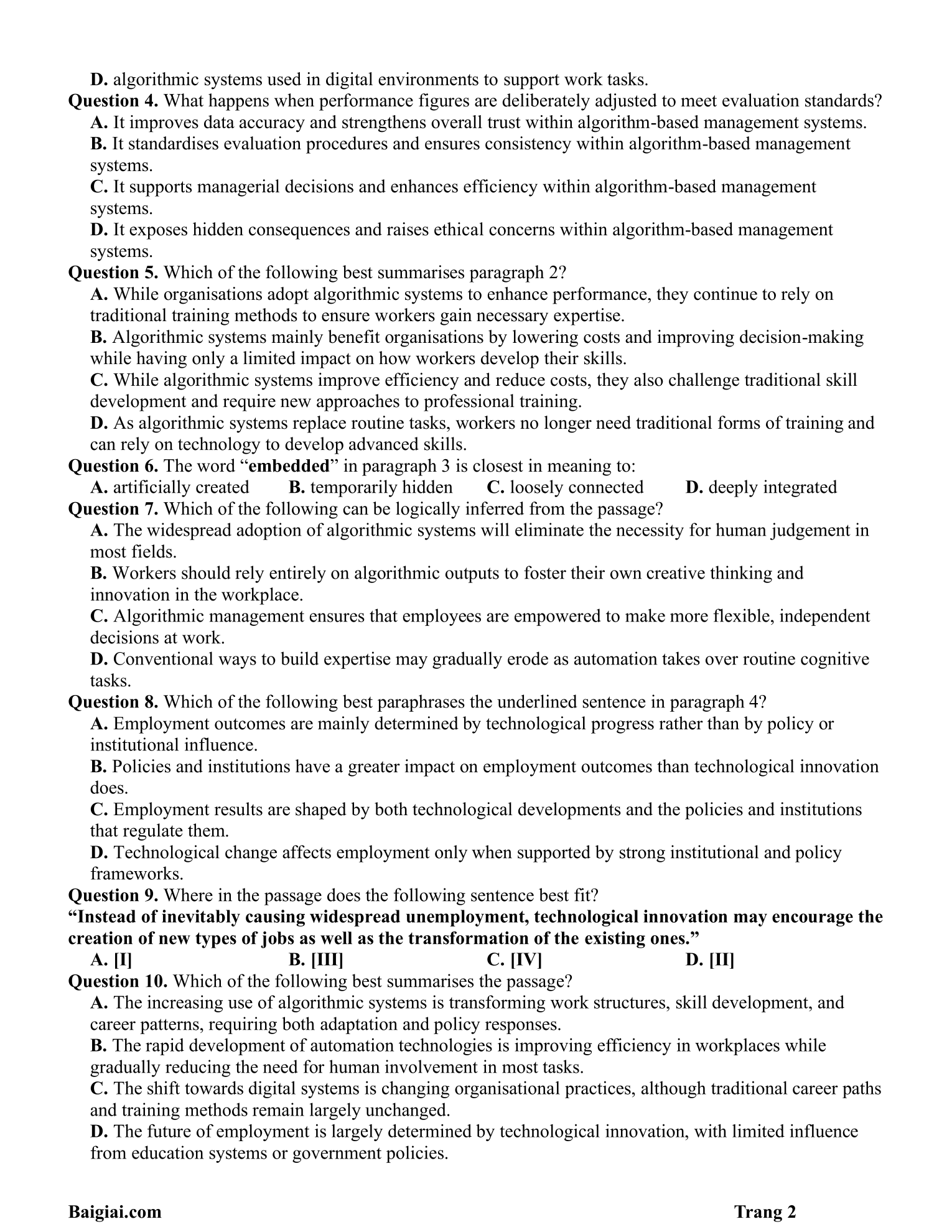
Question 7.
Which of the following can be logically inferred from the passage?
A. The widespread adoption of algorithmic systems will eliminate the necessity for human judgement in most fields.
B. Workers should rely entirely on algorithmic outputs to foster their own creative thinking and innovation in the workplace.
C. Algorithmic management ensures that employees are empowered to make more flexible, independent decisions at work.
D. Conventional ways to build expertise may gradually erode as automation takes over routine cognitive tasks.
Đáp án: D
Question 8.
Which of the following best paraphrases the underlined sentence in paragraph 4?
A. Employment outcomes are mainly determined by technological progress rather than by policy or institutional influence.
B. Policies and institutions have a greater impact on employment outcomes than technological innovation does.
C. Employment results are shaped by both technological developments and the policies and institutions that regulate them.
D. Technological change affects employment only when supported by strong institutional and policy frameworks.
Đáp án: C
Question 9.
Where in the passage does the following sentence best fit?
“Instead of inevitably causing widespread unemployment, technological innovation may encourage the creation of new types of jobs as well as the transformation of the existing ones.”
A. [I]
B. [III]
C. [IV]
D. [II]
Đáp án: A
Question 10.
Which of the following best summarises the passage?
A. The increasing use of algorithmic systems is transforming work structures, skill development, and career patterns, requiring both adaptation and policy responses.
B. The rapid development of automation technologies is improving efficiency in workplaces while gradually reducing the need for human involvement in most tasks.
C. The shift towards digital systems is changing organisational practices, although traditional career paths and training methods remain largely unchanged.
D. The future of employment is largely determined by technological innovation, with limited influence from education systems or government policies.
Đáp án: A
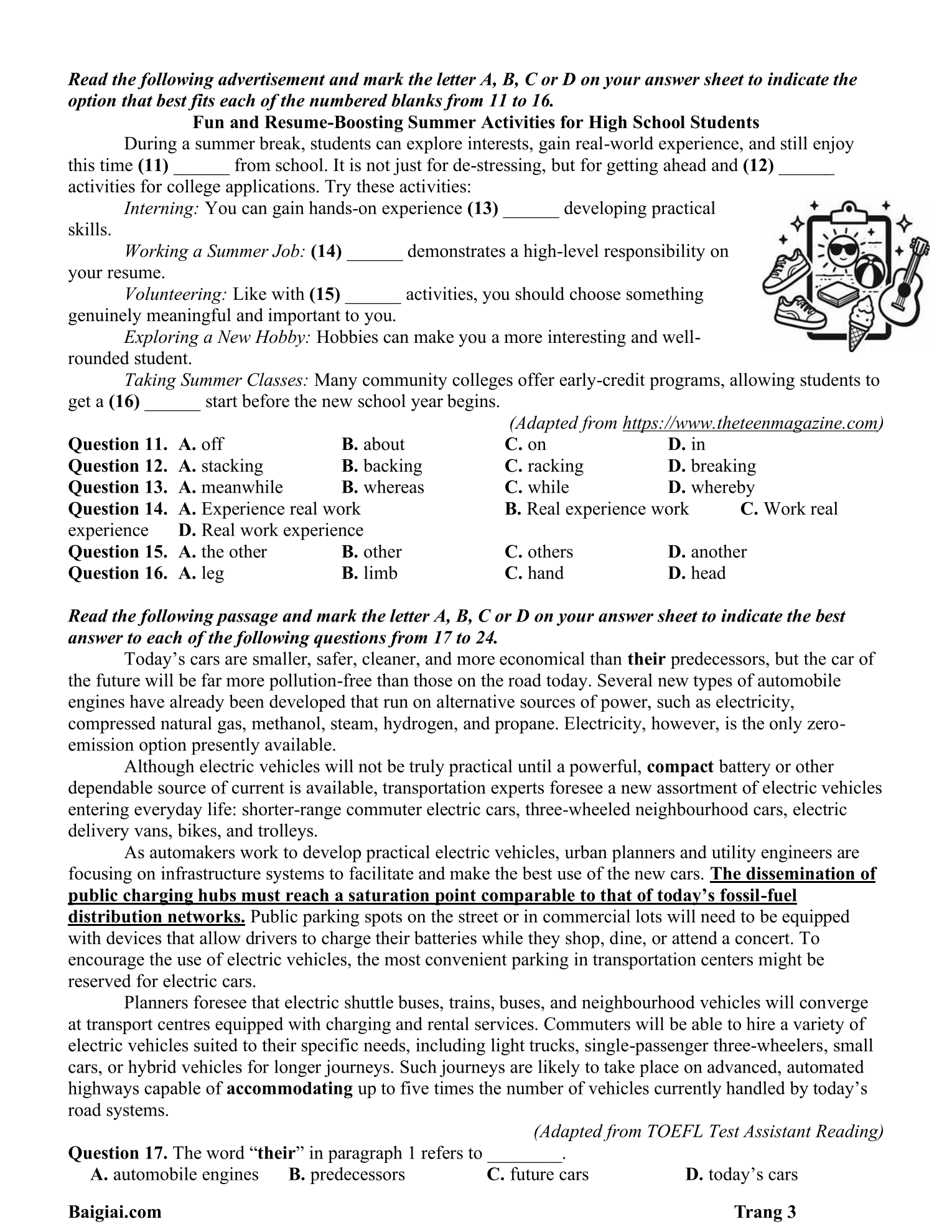
Read the following advertisement and mark the letter A, B, C or D on your answer sheet to indicate the option that best fits each of the numbered blanks from 11 to 16.
Fun and Resume-Boosting Summer Activities for High School Students
During a summer break, students can explore interests, gain real-world experience, and still enjoy this time (11) ________ from school. It is not just for de-stressing, but for getting ahead and (12) ________ activities for college applications. Try these activities:
Interning: You can gain hands-on experience (13) ________ developing practical skills.
Working a Summer Job: (14) ________ demonstrates a high-level responsibility on your resume.

Volunteering: Like with (15) ________ activities, you should choose something genuinely meaningful and important to you.
Exploring a New Hobby: Hobbies can make you a more interesting and well-rounded student.
Taking Summer Classes: Many community colleges offer early-credit programs, allowing students to get a (16) ________ start before the new school year begins.
(Adapted from https://www.theteenmagazine.com)
Question 11.
A. off
B. about
C. on
D. in
Đáp án: A
Question 12.
A. stacking
B. backing
C. racking
D. breaking
Đáp án: A
Question 13.
A. meanwhile
B. whereas
C. while
D. whereby
Đáp án: C
Question 14.
A. Experience real work
B. Real experience work
C. Work real experience
D. Real work experience
Đáp án: D
Question 15.
A. the other
B. other
C. others
D. another
Đáp án: B
Question 16.
A. leg
B. limb
C. hand
D. head
Đáp án: D
Read the following passage and mark the letter A, B, C or D on your answer sheet to indicate the best answer to each of the following questions from 17 to 24.
Today’s cars are smaller, safer, cleaner, and more economical than their predecessors, but the car of the future will be far more pollution-free than those on the road today. Several new types of automobile engines have already been developed that run on alternative sources of power, such as electricity, compressed natural gas, methanol, steam, hydrogen, and propane. Electricity, however, is the only zero-emission option presently available.
Although electric vehicles will not be truly practical until a powerful, compact battery or other dependable source of current is available, transportation experts foresee a new assortment of electric vehicles entering everyday life: shorter-range commuter electric cars, three-wheeled neighbourhood cars, electric delivery vans, bikes, and trolleys.
As automakers work to develop practical electric vehicles, urban planners and utility engineers are focusing on infrastructure systems to facilitate and make the best use of the new cars. The dissemination of public charging hubs must reach a saturation point comparable to that of today’s fossil-fuel distribution networks. Public parking spots on the street or in commercial lots will need to be equipped with devices that allow drivers to charge their batteries while they shop, dine, or attend a concert. To encourage the use of electric vehicles, the most convenient parking in transportation centers might be reserved for electric cars.
Planners foresee that electric shuttle buses, trains, buses, and neighbourhood vehicles will converge at transport centres equipped with charging and rental services. Commuters will be able to hire a variety of electric vehicles suited to their specific needs, including light trucks, single-passenger three-wheelers, small cars, or hybrid vehicles for longer journeys. Such journeys are likely to take place on advanced, automated highways capable of accommodating up to five times the number of vehicles currently handled by today’s road systems.
(Adapted from TOEFL Test Assistant Reading)
Question 17.
The word “their” in paragraph 1 refers to ________.
A. automobile engines
B. predecessors
C. future cars
D. today’s cars
Đáp án: D
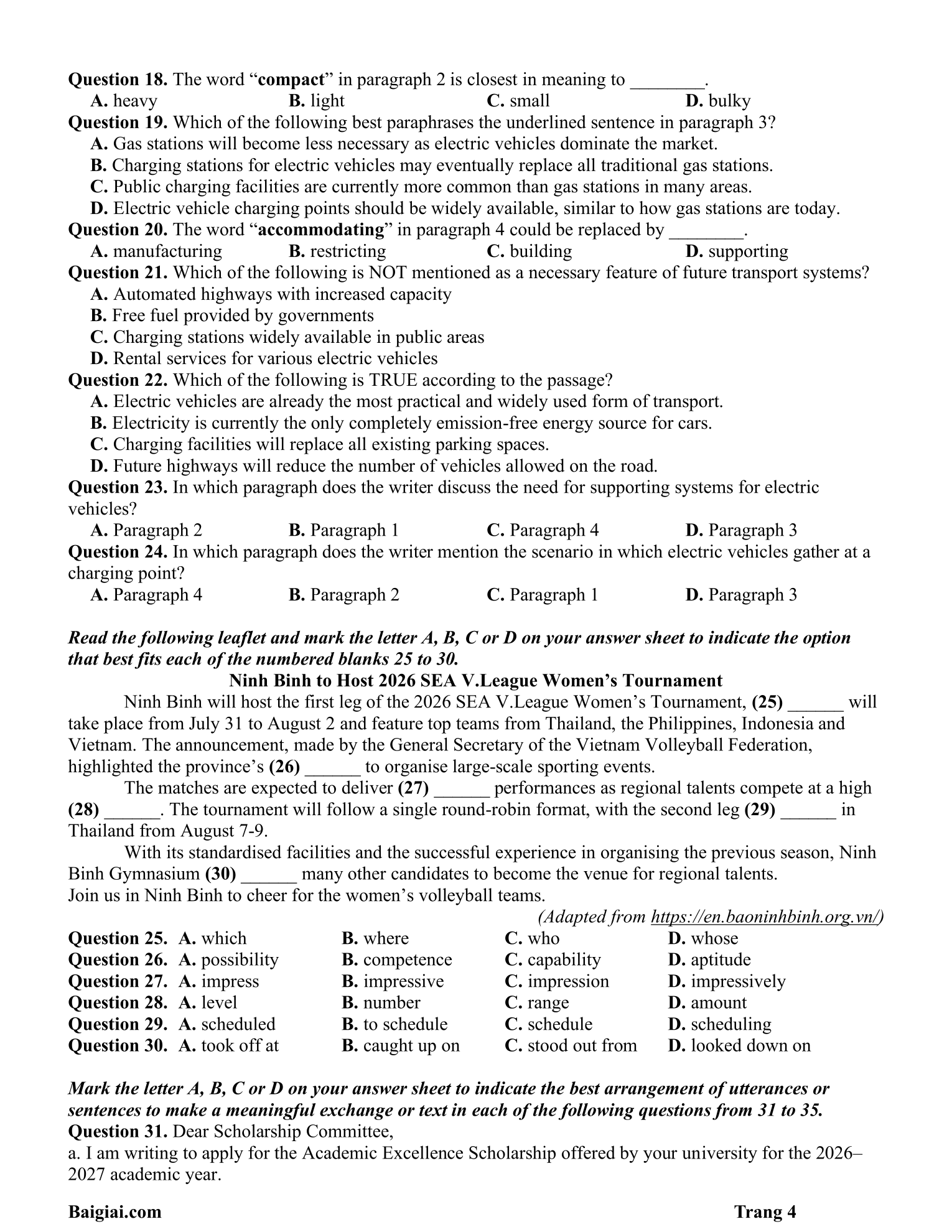
Question 18.
The word “compact” in paragraph 2 is closest in meaning to ________.
A. heavy
B. light
C. small
D. bulky
Đáp án: C
Question 19.
Which of the following best paraphrases the underlined sentence in paragraph 3?
A. Gas stations will become less necessary as electric vehicles dominate the market.
B. Charging stations for electric vehicles may eventually replace all traditional gas stations.
C. Public charging facilities are currently more common than gas stations in many areas.
D. Electric vehicle charging points should be widely available, similar to how gas stations are today.
Đáp án: D
Question 20.
The word “accommodating” in paragraph 4 could be replaced by ________.
A. manufacturing
B. restricting
C. building
D. supporting
Đáp án: D
Question 21.
Which of the following is NOT mentioned as a necessary feature of future transport systems?
A. Automated highways with increased capacity
B. Free fuel provided by governments
C. Charging stations widely available in public areas
D. Rental services for various electric vehicles
Đáp án: B
Question 22.
Which of the following is TRUE according to the passage?
A. Electric vehicles are already the most practical and widely used form of transport.
B. Electricity is currently the only completely emission-free energy source for cars.
C. Charging facilities will replace all existing parking spaces.
D. Future highways will reduce the number of vehicles allowed on the road.
Đáp án: B
Question 23.
In which paragraph does the writer discuss the need for supporting systems for electric vehicles?
A. Paragraph 2
B. Paragraph 1
C. Paragraph 4
D. Paragraph 3
Đáp án: D
Question 24.
In which paragraph does the writer mention the scenario in which electric vehicles gather at a charging point?
A. Paragraph 4
B. Paragraph 2
C. Paragraph 1
D. Paragraph 3
Đáp án: A
Read the following leaflet and mark the letter A, B, C or D on your answer sheet to indicate the option that best fits each of the numbered blanks 25 to 30.
Ninh Binh to Host 2026 SEA V.League Women’s Tournament
Ninh Binh will host the first leg of the 2026 SEA V.League Women’s Tournament, (25) ________ will take place from July 31 to August 2 and feature top teams from Thailand, the Philippines, Indonesia and Vietnam. The announcement, made by the General Secretary of the Vietnam Volleyball Federation, highlighted the province’s (26) ________ to organise large-scale sporting events.
The matches are expected to deliver (27) ________ performances as regional talents compete at a high (28) ________. The tournament will follow a single round-robin format, with the second leg (29) ________ in Thailand from August 7-9.
With its standardised facilities and the successful experience in organising the previous season, Ninh Binh Gymnasium (30) ________ many other candidates to become the venue for regional talents.
Join us in Ninh Binh to cheer for the women’s volleyball teams.
(Adapted from https://en.baoninhbinh.org.vn/)
Question 25.
A. which
B. where
C. who
D. whose
Đáp án: A
Question 26.
A. possibility
B. competence
C. capability
D. aptitude
Đáp án: C
Question 27.
A. impress
B. impressive
C. impression
D. impressively
Đáp án: B
Question 28.
A. level
B. number
C. range
D. amount
Đáp án: A
Question 29.
A. scheduled
B. to schedule
C. schedule
D. scheduling
Đáp án: A
Question 30.
A. took off at
B. caught up on
C. stood out from
D. looked down on
Đáp án: C
Mark the letter A, B, C or D on your answer sheet to indicate the best arrangement of utterances or sentences to make a meaningful exchange or text in each of the following questions from 31 to 35.
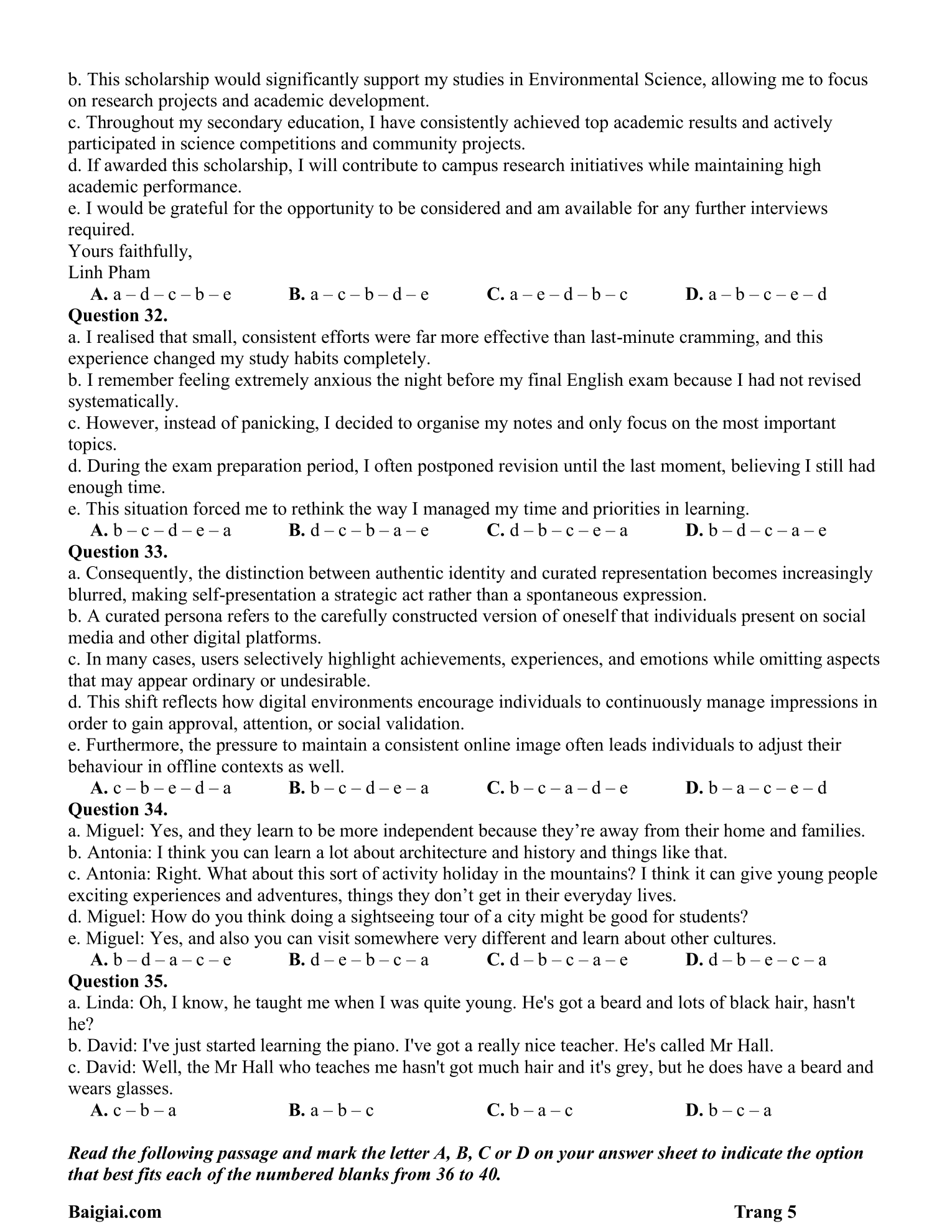
Question 31.
Dear Scholarship Committee,
a. I am writing to apply for the Academic Excellence Scholarship offered by your university for the 2026-2027 academic year.
b. This scholarship would significantly support my studies in Environmental Science, allowing me to focus on research projects and academic development.
c. Throughout my secondary education, I have consistently achieved top academic results and actively participated in science competitions and community projects.
d. If awarded this scholarship, I will contribute to campus research initiatives while maintaining high academic performance.
e. I would be grateful for the opportunity to be considered and am available for any further interviews required.
Yours faithfully,
Linh Pham
A. a – d – c – b – e
B. a – c – b – d – e
C. a – e – d – b – c
D. a – b – c – e – d
Đáp án: B
Question 32.
a. I realised that small, consistent efforts were far more effective than last-minute cramming, and this experience changed my study habits completely.
b. I remember feeling extremely anxious the night before my final English exam because I had not revised systematically.
c. However, instead of panicking, I decided to organise my notes and only focus on the most important topics.
d. During the exam preparation period, I often postponed revision until the last moment, believing I still had enough time.
e. This situation forced me to rethink the way I managed my time and priorities in learning.
A. b – c – d – e – a
B. d – c – b – a – e
C. d – b – c – e – a
D. b – d – c – a – e
Đáp án: C
Question 33.
a. Consequently, the distinction between authentic identity and curated representation becomes increasingly blurred, making self-presentation a strategic act rather than a spontaneous expression.
b. A curated persona refers to the carefully constructed version of oneself that individuals present on social media and other digital platforms.
c. In many cases, users selectively highlight achievements, experiences, and emotions while omitting aspects that may appear ordinary or undesirable.
d. This shift reflects how digital environments encourage individuals to continuously manage impressions in order to gain approval, attention, or social validation.
e. Furthermore, the pressure to maintain a consistent online image often leads individuals to adjust their behaviour in offline contexts as well.
A. c – b – e – d – a
B. b – c – d – e – a
C. b – c – a – d – e
D. b – a – c – e – d
Đáp án: B
Question 34.
a. Miguel: Yes, and they learn to be more independent because they’re away from their home and families.
b. Antonia: I think you can learn a lot about architecture and history and things like that.
c. Antonia: Right. What about this sort of activity holiday in the mountains? I think it can give young people exciting experiences and adventures, things they don’t get in their everyday lives.
d. Miguel: How do you think doing a sightseeing tour of a city might be good for students?
e. Miguel: Yes, and also you can visit somewhere very different and learn about other cultures.
A. b – d – a – c – e
B. d – e – b – c – a
C. d – b – c – a – e
D. d – b – e – c – a
Đáp án: D
Question 35.
a. Linda: Oh, I know, he taught me when I was quite young. He’s got a beard and lots of black hair, hasn’t he?
b. David: I’ve just started learning the piano. I’ve got a really nice teacher. He’s called Mr Hall.
c. David: Well, the Mr Hall who teaches me hasn’t got much hair and it’s grey, but he does have a beard and wears glasses.
A. c – b – a
B. a – b – c
C. b – a – c
D. b – c – a
Đáp án: C
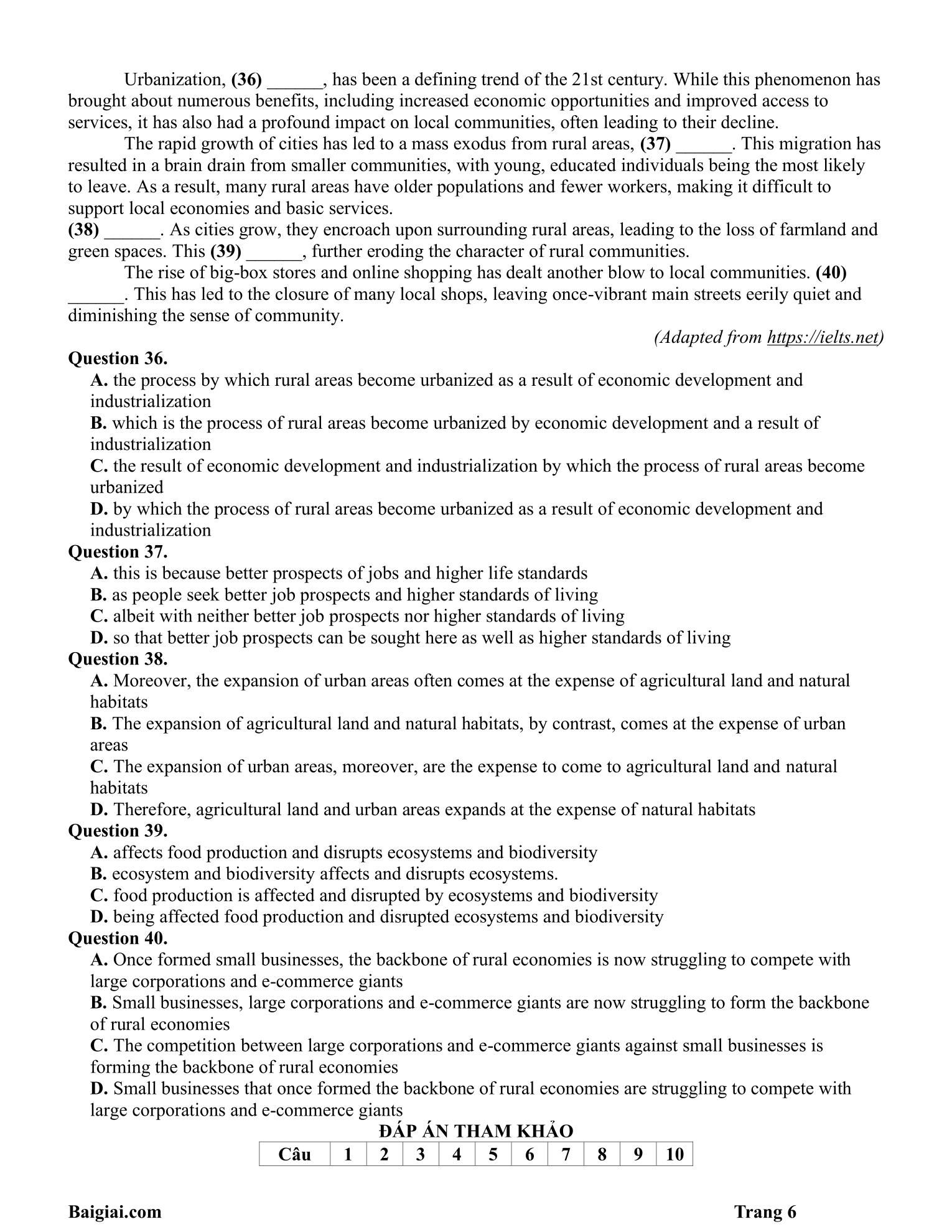
Read the following passage and mark the letter A, B, C or D on your answer sheet to indicate the option that best fits each of the numbered blanks from 36 to 40.
Urbanization, (36) ________, has been a defining trend of the 21st century. While this phenomenon has brought about numerous benefits, including increased economic opportunities and improved access to services, it has also had a profound impact on local communities, often leading to their decline.
The rapid growth of cities has led to a mass exodus from rural areas, (37) ________. This migration has resulted in a brain drain from smaller communities, with young, educated individuals being the most likely to leave. As a result, many rural areas have older populations and fewer workers, making it difficult to support local economies and basic services.
(38) ________. As cities grow, they encroach upon surrounding rural areas, leading to the loss of farmland and green spaces. This (39) ________, further eroding the character of rural communities.
The rise of big-box stores and online shopping has dealt another blow to local communities. (40) ________. This has led to the closure of many local shops, leaving once-vibrant main streets eerily quiet and diminishing the sense of community.
(Adapted from https://ielts.net)
Question 36.
A. the process by which rural areas become urbanized as a result of economic development and industrialization
B. which is the process of rural areas become urbanized by economic development and a result of industrialization
C. the result of economic development and industrialization by which the process of rural areas become urbanized
D. by which the process of rural areas become urbanized as a result of economic development and industrialization
Đáp án: A
Question 37.
A. this is because better prospects of jobs and higher life standards
B. as people seek better job prospects and higher standards of living
C. albeit with neither better job prospects nor higher standards of living
D. so that better job prospects can be sought here as well as higher standards of living
Đáp án: B
Question 38.
A. Moreover, the expansion of urban areas often comes at the expense of agricultural land and natural habitats
B. The expansion of agricultural land and natural habitats, by contrast, comes at the expense of urban areas
C. The expansion of urban areas, moreover, are the expense to come to agricultural land and natural habitats
D. Therefore, agricultural land and urban areas expands at the expense of natural habitats
Đáp án: A
Question 39.
A. affects food production and disrupts ecosystems and biodiversity
B. ecosystem and biodiversity affects and disrupts ecosystems.
C. food production is affected and disrupted by ecosystems and biodiversity
D. being affected food production and disrupted ecosystems and biodiversity
Đáp án: A
Question 40.
A. Once formed small businesses, the backbone of rural economies is now struggling to compete with large corporations and e-commerce giants
B. Small businesses, large corporations and e-commerce giants are now struggling to form the backbone of rural economies
C. The competition between large corporations and e-commerce giants against small businesses is forming the backbone of rural economies
D. Small businesses that once formed the backbone of rural economies are struggling to compete with large corporations and e-commerce giants
Đáp án: D